What model is the world?

"Big Club's Game"

1.5 Billion | Club Deal | Fundraising | FOMO
Produced by | AI Nao

In the first half of 2026, cumulative fundraising in the world model track exceeded 10 billion yuan. Roughly 100 Chinese companies claim to be building "world models."
A partner at a top-tier VC firm believes that if you apply strict "pre-training" criteria, there are at most three to five startups genuinely building world models.
"Pre-training" is one of the litmus tests separating real model builders from concept peddlers. It involves feeding massive datasets into a model so it learns to understand and predict the laws of the physical world from scratch — a step that burns through enormous GPU compute, carries extremely high technical barriers, and costs roughly 100 million yuan per training run. (For language models, you verify real work by looking at token count; for world models, it's GPU count × hours × data flywheel.)
The defining moment for the world model track came in the first half of 2026, when Fei-Fei Li's World Labs raised $1 billion and Yann LeCun's AMI Labs raised $1.03 billion. The signal was amplified, in a sense, into a "national competition." In a still-unproven technical domain, state capital, corporate investors, and financial institutions all developed FOMO — at least at the narrative level.
Companies that previously worked on embodied intelligence, video generation, autonomous driving, and 3D simulation all began pivoting toward this direction.
A batch of projects from 2023 that worked on 3D, simulation engines, and the metaverse slapped on "world model" labels and raised three to four rounds in the past six months. A dollar-fund investor called these textbook "edge cases" — "taking their existing simulation, 3D Gaussian splatting, and other non-core technical approaches, then claiming they're building world models. The core team, tech stack, and customers haven't changed. The only thing that changed is the sector name on the fundraising deck."
For example, one Suzhou company whose 2024 business was letting users upload photos to generate 3D models, in June 2026 recast itself in its angel round PR as a "spatial intelligence and world model startup."
VLA (Vision-Language-Action models) was the mainstream approach for embodied intelligence in 2024–2025, but hit a structural ceiling in 2026. A wave of companies unable to raise money faced elimination, and the emergence of world models essentially saved embodied intelligence's life.
Now virtually every embodied intelligence company touts "world model" concepts. A dollar-fund investor suggested we look at Anyverse Dynamics' fundraising narrative. When it announced its 300 million yuan angel round in November 2025, the pitch was "general-purpose brain + manipulation intelligence." By its $200 million Pre-A round PR in June 2026, it had become "latent-space world model + reinforcement learning."
Another category of companies operates more stealthily — taking others' pre-trained models, fine-tuning them, then hanging out a "world model" shingle to raise money, with the technology still at the PowerPoint stage.
World models also rescued a batch of video generation companies that had been suffocating under ByteDance's pressure. Their valuations had long been capped by the "video tool" narrative. After repackaging as "general world models" in 2026, one leading company completed three rounds in six months totaling roughly 6.2 billion yuan. Investors included two major corporate strategic investors, state capital, and a cluster of listed company strategic investments. It has now launched its Hong Kong IPO.
We recently met an AI application founder in Shanghai preparing for a Series A round. His FA advised him to蹭一蹭 (ride the coattails of) "world models," or any "model concept" element. "Like, your user data in some vertical can do some prediction — couldn't you call that a prediction model?"
Many investors confirmed this view: in 2026, nobody's looking at AI applications anymore. Only world models.
Child Prodigies
World models is a research-driven track, but power seems to reside not with technologists but with capital.
The one or two most critical people are typically personally secured by partners at major institutions. A partner at a dollar fund said, "The Tsinghua professor we recently incubated is a longtime friend of the partner. At this level, ordinary investors can't move them."
A "world model" talent-tracking system has become industry standard: major institutions dispatch intern analysts to monitor students at target universities, focusing on first authors on papers (second authors don't count); partners target professors and academicians. They schedule coffee chats, attend all their events, and "nudge them into starting companies."
An FA described his current target to us: 27 years old, undergraduate at University of Science and Technology of China, PhD from Harvard/MIT, now teaching at Tsinghua — "You have to strike first through more advanced personal connections. Wait for the BP later? Too late."
Another group is tracking researchers at major tech companies' model teams. Below the ByteDance model team's offices at Zhongguancun Dinghao in Beijing, a cafe called Mojo has a permanent investor presence.
"The project I'm working on now is someone who just left a major Shenzhen tech company. Less than a month after leaving, the second funding round has already started at a 2 billion yuan valuation," a Shanghai-based FA told us, unable to share more details. The first and second rounds are running simultaneously. "One institution was too slow on the first round, so they immediately moved some allocation from the second round into the first."
The most representative major tech figure is Junyang Lin (former technical lead of Alibaba's Tongyi Qianwen), whose world model + embodied brain direction raised $220 million (co-led by Sequoia and Gaorong Ventures).
The selected prodigies follow clear valuation logic.
The first two rounds primarily weight founder background. A list circulates among institutions: a Chinese AI academic genealogy mapping top universities, academic award winners, first authors on papers, or renowned departments and professor labs (Tsinghua's Cross-Disciplinary Information Sciences Institute, Yao Class, He Wang at Peking University, Shanghai Jiao Tong University's School of Mechanical Engineering, etc.).
"Even being a Peking University top-ten student carries halo points," one FA said. "Technical approach doesn't matter — you can't see clearly for three to five years anyway."
On who specifically to back, preferences vary. Some institutions favor professors as more mature; others find professors have high cash-out expectations and struggle to go all-in. Zhipu AI is a rare case that worked. But betting on "post-2000 child prodigies" is consensus across all institutions — young, driven, with more room to grow. If the technology is fundamentally unclear right now, why not believe in young post-2000s talent?
At MiraclePlus's 2026 spring demo day, Researcher Founders reached 45%. An industry joke circulates: child prodigies are already in short supply.
We also obtained a list of Chinese world model startups — 39 companies, ranked S/A/B (investor assessments; while the ranking criteria are unclear, the general tiers are roughly reasonable). Among them, 20 projects have Researcher founders, and all four S-tier projects are Researcher Founder-led.
One FA believes Zhipu AI's trillion-yuan valuation has stimulated many people. "Seeing classmates around you worth over 100 million, young people all adopt a 'why not me' mentality."
Spokespeople
A standard world model team needs three roles: Builder (technical core), Influencer (external storyteller), and Trader (capital operations).
All three are indispensable. The team configuration itself has been financialized.
Most industry insiders consider "Inverse Matrix Technology" the track's defining fundraising event in the first half of 2026, with Hillhouse, Peking University, and BAAI deeply involved, and Cygnus Equity serving as exclusive financial advisor. This project anchored early-stage valuation benchmarks and team aesthetics for the market; subsequent comparable projects were priced largely within this range.
Inverse Matrix was founded in February 2026 by two Peking University "brothers" — Jiaming Ji (born 1998) and Boyuan Chen (born 2004). Both studied under Yaodong Yang; Hillhouse had previously invested in Proto-Sentient Intelligence, a general embodied intelligence company where Yang served as chief scientist, at the seed stage.
Hillhouse and PKU-affiliated YanYuan Venture Capital put in millions of dollars in the first round; three months later, Inverse Matrix completed a seed++ round exceeding $100 million. Jiaming Ji is the primary Influencer, handling fundraising and storytelling. Boyuan Chen is the builder, having just graduated in June, the post-2000s prodigy pushed out for interviews. Several participating investment institutions are deeply involved.
A dollar-fund investor believes that as of June, the world model track's spokespeople have been selected by major institutions (he used the interesting term "spokespeople" rather than "founders").
Hillhouse has PKU's Jiaming Ji and Boyuan Chen; Sequoia backed LiberAI, founded by Tsinghua TSAIL PhD student and post-2000s Songming Liu; IDG has Natural Will, founded by Ning Ding, an assistant professor in Tsinghua's Department of Electronic Engineering; BlueRun Ventures and Monolith bet on Moke Robotics, founded by HKUST's Xiaowei Chi; Matrix Partners China has Aether AI, founded by Biwei Huang, an assistant professor at UC San Diego; Shunwei Capital invested in LiQing Intelligence, founded by Yiming Li, a professor at Tsinghua's Institute for AI.
Funded researchers mostly have investor potential themselves. "First, they can tell stories. Second, they click with investors. Most investors don't deeply understand the technology, so they can only identify people similar to themselves — what's called homophily."
Stories circulate in the market. One post-2000s founder at a leading world model company, not yet graduated a year ago, would constantly turn to PR for help during interviews. Now he can show up at investors' doors with Kweichow Moutai, casually discussing which big checks he's recently turned down.
Starting at 1.5 Billion
This spring after Lunar New Year was the peak for world model fundraising. Many institutions established dedicated world model teams — investors who previously covered autonomous driving or hard tech began sweeping through world models, reviewing twenty-plus papers weekly. A batch of decks previously labeled "simulation data" or "autonomous driving" were rewritten as "world models" for investment committee.
Rumor has it two top institutions are competing in secret, deploying a sector-coverage logic to invest in three to four world model companies in short order.
A dollar-fund investor said many institutions do indeed deploy blindly without understanding the technology's essence. "But this strategy isn't necessarily wrong — getting in early on the trend can still make money."
State capital entered relatively early and also chased up world model valuations. The historical analogy is semiconductors, where numerous companies saw valuations halve post-IPO, with state capital that bought at highs getting burned. Now state investors prefer to move earlier — standing alongside dollar funds to enter at lower prices.
Because model training is involved and costs are high, world model pre-seed/seed valuations start around 1.5 billion yuan.
What used to take one to two years to raise now compresses to two months. This logic itself references the embodied intelligence rhythm: Galbot's valuation exploded from $1 billion to $3 billion in the second half of 2025. "By the later stages you can't even chase it. $3 billion in capital will definitely beat $300 million."
Also pushing valuations is the club deal — multiple institutions investing jointly to spread risk and capital pressure. World model valuations show clear polarization: extremely expensive, or cheap (under $100 million), with no mid-range.
A dollar-fund investor recently looked at a Peking University professor's project. Everything was solid, but it felt too cheap, so they passed. "That shows he's not the person being clubbed together. In a sector nobody can see clearly, who you invest in sometimes matters less than who you stand with."
Below that, leaderboard rankings and demos are especially important. The former is one of the few quantifiable achievements; the latter is visible output.
Leaderboard grinding is more like an open-book exam. WorldArena, VBench, WorldModelBench — datasets and evaluation code are all on GitHub. Competing models can do basic fine-tuning on leaderboard data, then iterate repeatedly against fixed simulation environments, prompt templates, and scoring functions until the numbers look good.
In the first half of 2026, WorldArena's "global #1" changed at least six times — Astribot, Visionary, Shengshu Technology, AgiBot, Koala, Chinese Academy of Sciences' PAIWorld, CrossWe, and Xiaomi all took turns at the top. Nearly every month or two, a new company announced "breaking through a global authoritative benchmark."
On demos, one investor put it bluntly: they might be fake. "But it doesn't matter. If you make it fake enough that nobody can tell, then you're real. There's no commercial landing anyway."
At the just-concluded WAIC conference, most world model companies that raised money in the first half released demos, mostly to launch their next funding round. By the first half of 2027, the sector is expected to start digesting valuations, and a batch of companies that purely raised on narrative without finding data flywheels or application scenarios will lose their reason to exist.
Satellite Launches
Who is the highest-valued Chinese world model company?
It's hard to tell from public data. Everyone is competing to launch satellites, with huge gaps between PR'd fundraising amounts and reality.
Some FAs, when working on projects, will promote the next round's valuation as the current one. For example, one world model project — according to sources close to the deal — Ant Group's strategic investment actually came in at a 4.5 billion yuan valuation, but PR would claim 15 billion.
There's also a Hangzhou star embodied intelligence company — before shareholders even signed term sheets, the PR piece was already released by the FA. This company added "world model" concepts in the first half of the year, completing four rounds in three months totaling 5 billion yuan. But in one professional rating list, the company's assessment: "Very little investment, almost no world model capability."
A world model project that Duowei Capital recently worked on involves a team that exited as a unit from Cainiao Logistics. At one point they reported the first $100 million round nearly closed; at another, the second $250 million round was closing. The sector's conventions are typically ambiguous. The two rounds run simultaneously, aiming to create an impression that "the market has plenty of money, it's safe" — a contagion effect that pressures competitors. If they don't release higher fundraising amounts, their momentum looks weak.
We've also heard that some FAs working on world model projects charge no fees, only asking to have their names in the fundraising announcement. In the world model track, FA attribution rates are far lower than in the AI application era; more deals happen with institutions going directly to Researcher Founders, with FAs rendered invisible. (Cygnus Equity and Duowei Capital are relatively well-known FAs in the world model track.) On one hand, everyone wants to replicate Farsighted Capital's breakout from the last AI application cycle, emphasizing "deal-making" capability. On the other, by releasing inflated fundraising information, they create FOMO in the market and drive up transaction volume.
A more extreme case: one embodied project (with world model elements), on its FA's advice, pitched at a 20 billion yuan valuation. Claiming that after this round, the next stop would be IPO or state acquisition — if they raise, it's a win; if not, no matter, there won't be a next round anyway.
Most industry insiders believe world model prices have already stopped functioning. Capital shows clear self-reinforcing effects: raising big money means buying more GPUs, recruiting more talent, grinding better leaderboards, thus raising even bigger money next round.
Technical capability and commercial closure are no longer core variables.
Yiting Xiao, partner at Capital Dynamics, did the math. At current world model company valuations, assuming a hot project successfully exits at roughly 30 billion yuan; if you enter at the 10-billion-yuan level, you're looking at roughly 3x returns. With at least three years of time cost, that's roughly 30% annualized. "We early-stage institutions can't play this game. It's already big club territory."
Three years ago, Capital Dynamics invested in a company called Visionary at a seed-stage valuation of tens of millions of yuan. Visionary initially切入 from the BEV direction and was indeed among the earliest world model companies. The company was mediocre for several years in between, but three years later, with world models a hot sector, Visionary merged into Saidai. As one of the few companies with real orders, it raised roughly 3.5 billion yuan in three months in the first half of this year, reaching a valuation in the tens of billions.
"Three years ago when we invested, we genuinely thought it was incredibly cheap. But I never expected valuation would rise over 300x in three years," Xiao said. Another company Capital Dynamics seeded was Light Wheel Intelligence, a simulation data company. With the world model boom, the market re-understood simulation data's infrastructure value in physical AI. Light Wheel completed three rounds in six months, totaling roughly 2 billion yuan, also achieving roughly 300x valuation growth.
Xiao attributes both investments to early physical AI positioning rather than chasing hot concepts. "I now warn LPs: don't expect me to replicate this. Visionary and Light Wheel were both investments we made in winter, both at seed stage. These windows don't come every day."
Vision Big Enough
World models can be simply summarized as having two technical approaches.
Explicit world models were the earliest approach — model outputs become pixels, directly generating images, video, or 3D scenes. The essence is "build the space, let you see the world." But it has a theoretical ceiling: it doesn't match how the human brain works. When we see a car rushing toward us, our brains don't actually draw a picture of the car hitting us, yet we already know the consequences are severe.
The implicit approach (JEPA, also Yann LeCun's route) doesn't generate images but reasons and predicts in abstract latent space. This approach theoretically subsumes underlying visual models and is a longer-term direction.
Additionally, from founder backgrounds there are two paths — analogized as "south slope vs. north slope," like two groups climbing Everest from different directions.
One is the downward extension from large language models. Representative figures: Junyang Lin and Inverse Matrix. They excel at processing massive data, training large-parameter models, using large GPU clusters. Weakness: lack of physical world interaction capability. The other is the upward extension from embodied intelligence (intelligent driving). "Ascending" to world models is like moving from a small track into a big one. Advantage: understanding and modeling of physical environments. But the absolute prerequisite is落地 experience.
World model pre-training is far harder than language model pre-training. Language model training data is text — virtually inexhaustible on the internet. World models need physical data: 4D spatiotemporal sequences containing depth, motion, causality, object interaction. This data is either simulation-generated or physically collected — high cost, long closure. Moreover, language model training errors at worst produce nonsense; world model training errors concern human lives.
How to verify technical validity is also the capital market's structural dilemma.
Compared to language models, world models are currently at the 2018–2019 "GPT-1.5, GPT-2 stage" — business models remain unclear, still waiting for killer scenarios to emerge, at least 5–10 years from real落地.
Why is so much hot money flowing in? Capital markets are gambling on the next Zhipu AI or MiniMax. After this complete large language model cycle, there's now a concept of "how to price model companies."
Moreover, China's primary market has accumulated massive capital needing deployment (state capital, local government funds, dual-currency funds), yet genuinely investable technical directions remain scarce. World models happen to satisfy a "big enough, far enough" vision.
New Narrative
However, world models as an independent investment track has its imprecisions.
By base model taxonomy, it should be large language models vs. physical models. World models are just one technical approach to physical models.
"Suppose later an even more powerful technical approach called super world model emerges — would a new track called super world track appear?" said Capital Dynamics partner Yiting Xiao, expressing that in all her years in the industry, world models is the only investment theme she can't quite grasp. "A track should first define what it wants to achieve, not how to do it. Since when do we use technical means to define a track? This half-year has really been eye-opening."
This inversely answers why the "world model" track is so鱼龙混杂 — the concept itself is full of fuzziness and confusion.
Of 100 so-called world model companies — all must eventually return to compete on the "base model" track: who can become the Zhipu AI or MiniMax of the physical world, or who can find physical scenarios, is what matters.
One clear feeling: entering the second half of 2026, many projects no longer call themselves "world models," replacing it with "physical AI."
Most interviewees believe the world model concept has already "hit its ceiling." Many founders are deliberately avoiding "world model" in fundraising news, "afraid the track will get played out, like the metaverse a few years ago."
AI hype cycle rotation has also become unprecedentedly fast.
2025 moved in half-year cycles — first half was Agent applications, second half was software-hardware integration. 2026 shifted to quarterly theme changes — Q1 was OpenClaw, Q2 was world models; the latest capital narrative for Q3 has already emerged: NeoLab. Like world models, it's another narrative far from commercialization but capable of raising big money right now.
Rumor has it a top domestic institution's latest investment committee standard: projects that cannot be falsified. This also means these projects cannot be verified in the short term.
Everything traces back to world models and similar technologies having far higher verification barriers than past waves. When market verification capability approaches zero, price no longer reflects technical capability — only narrative consensus strength.
Yet perhaps泡沫 is a feature. Historically, speculative capital has borne the vast majority of infrastructure construction costs — fiber overbuild enabled Web 2.0; railway overbuild enabled the American industrial system.
So the question becomes: what infrastructure will the world model track's泡沫 leave behind?
—Fin—
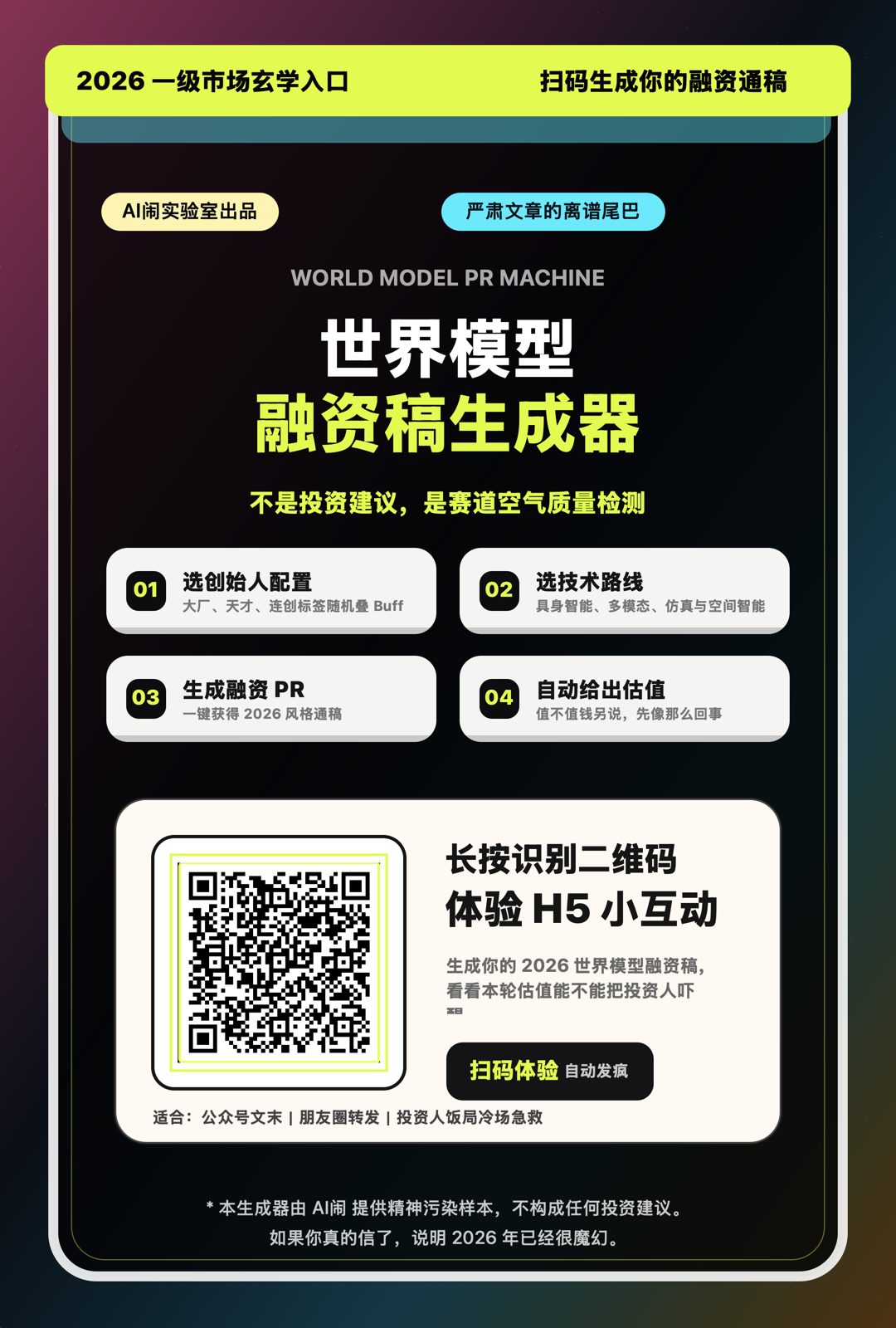
As a bonus, we made a "World Model Fundraising Announcement Generator"
Scan the QR code, enter your company name,
The system will automatically calculate this round's valuation and gift you a PR template
Purely for entertainment, not investment advice
AI Nao is looking for independent contributors
If you're curious about the people and stories in the AI wave, and skilled at writing
Please contact: shizao1123@hotmail.com
Email should include: 1. Personal introduction; 2. Relevant articles; 3. Your favorite AI Nao article
Competitive pay, professional editorial guidance
Looking forward to making noise with you