YouMind: Yu Bo's 9 Reflections on Entrepreneurship — Growing Disenchanted, Growing Contrarian

Honest reflections from an AI founder over the past year.

Consumer Products | New Organizations | Explicit Demand | Profit
Produced by | AI Nao
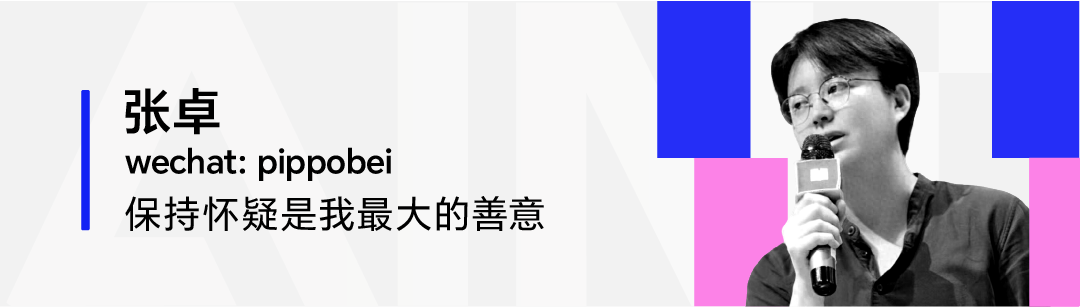
When I met Yubo last May, he had just finished meeting with his first investor who had come to Hangzhou. YouMind 0.3 had just launched, and the entire world was at a fever pitch over Manus's Agent narrative. Without a dedicated office, we sat chatting in a pavilion at an outdoor garden in Hangzhou (got bitten by mosquitoes quite a bit). He had this strained quality of someone trying hard to stay optimistic. Dialogue with YouMind Founder Yubo: The Man Challenging Douyin | 100 AI Creators
A year later, he's noticeably more grounded and at ease. He's raised the right amount of money, and even joked half-seriously that "we might have raised a bit too much."
In the 2026 AI startup circle, this is practically a provocation. At the same time, DeepSeek is negotiating its first funding round at a $45 billion valuation, and his former colleague Junyang Lin's newly founded AI lab hit a $2 billion post-money valuation — the industry's hunger for capital is like a bottomless pit. Yet Yubo's "worry" is: how to grow healthily and with restraint.
This "untimeliness" runs through YouMind's entire growth trajectory. It was born at the height of Agent mania — Yubo carried the halo of a major Alibaba veteran — yet fundraising was difficult. Most investors couldn't understand what he was talking about. After a series of external doubts, YouMind instead found its own survival space in a narrow crevice.
In 2026, YouMind's renewal rate is 86%, paying users average 1.3 hours of daily product usage, and monthly average payment is over $50. At the current trajectory, profitability is within reach — "more than enough to support the team."
Ben Thompson, the world's most influential tech strategy analyst, likes to talk about a concept: the internet is Aggregation Theory — platforms integrate supply by controlling demand, with attention as the core currency. But AI-era unit economics are inverted: every additional user means an additional token cost. The free model doesn't work from day one.
Yubo may be among the earliest Chinese entrepreneurs to fully grasp this. He defines YouMind as a "shelf" — the mental model of a very traditional consumer product. "Like Sam's Club. Users browse, select, play, and explore on their own. We don't plunder attention; we return it to users."
Recently, AI Nao sat down with Yubo again in Hangzhou. He said the past year has also been one of gradually demystifying AI and the industry for himself.
He spoke honestly about not understanding many things, not comprehending many concepts. What follows are his most genuine thoughts — though they could all be wrong.
1. Raising too much isn't necessarily good: Last year, my fundraising wasn't very smooth — I met with roughly 90+ investors. Back then, I envied my friends who had also left major companies to start their own ventures. They raised tens of millions of dollars, so much money (laughs).
This year, that feeling seems to have disappeared. My recent reflection has surprisingly become: we might have raised a bit too much (laughs). The best approach is to raise just enough — enough to reach the next valuation milestone, then start raising the next round.
Raising too much makes it easy to spend recklessly. A friend keeps reminding me: if you raise 2 million, you must spend it as if you only have 1 million. That's entrepreneurship.
Over the past year, I've seen many entrepreneurs burn through most of their funding in the first year. I was quite shocked. Later I asked, and most of it went to growth marketing. Once you start burning money, it's hard to stop, because the numbers will drop.
YouMind has never spent heavily on marketing. I set a target for the growth team: any new user who tries the product for a week should stay. We're basically achieving that now.
2. Inefficiency赛道 has great potential: I have my own classification for AI products: for work or for life.
Productivity scenarios are certainly a good赛道, but not a good赛道 for entrepreneurs. Foundation models and major companies will definitely compete here. Also, the productivity赛道 is necessarily "measurable." If Product A delivers results in 10 minutes and Product B in 3 minutes, the 10-minute one loses.
The "for life"赛道, my metaphor is like a garden — the measurement criteria are extremely diverse. Some users simply prefer writing articles with YouMind; others prefer ChatGPT. Even if humanity goes extinct, there will never be a standard or ranking that evaluates whether an article is good or bad.
Currently, YouMind users spend over an hour daily in the product. Our research shows most aren't pursuing efficiency.
The first wave was content creators wanting to write better articles. The second wave is learning enthusiasts — teachers, students, white-collar workers watching videos, studying papers. They use YouMind as a learning tool.
Many people mistakenly think we're an efficiency tool product. It doesn't matter — as long as they pay and play for a week, users discover YouMind is a product that satisfies curiosity and is somewhat fun.
3. The people who don't use AI are who you should care about most. Most people have read Crossing the Chasm, but in practice, I've found it's also a huge trap. If you want to serve mass users, you need to find them on day one — the more geeks you have, the more reluctant you are to transform, but geek user needs are fundamentally not ordinary user needs.
For example, when many YouMind users use the image generation feature, one need is: help me remove the background. For geeks, this is a need that shouldn't even exist (laughs), and Doubao already has this feature. Another example: our product only recently launched the "Shrimp" format — many users' feedback was, they'd heard about Shrimp, but this was their first time actually using it.
Many hyped concepts in the AI circle, like A2A, FDE, are actually still far from the masses. Just as many people don't know Doubao is an AI product, yet Doubao has accumulated 200 million DAU — arguably the first mass-market product of the AI era.
What the masses want are extremely basic features, so basic that many entrepreneurs disdain to build them. But for the product, these are all excellent needs.
4. Mine "can't go back" features: Return to users. Where are users' fundamental needs?
Yujun's product methodology still applies to the AI era. For example, users are a collection of needs; you need to abstract the commonalities across different users' needs.
Previously, when doing product, we easily fell into serving every need mentioned by a single user. That's wrong. Now when I do user interviews, I bring more data and assumptions — interviews without assumptions are field surveys.
Second, the new experience needs to be significantly better to attract users.
Last year, I actually underestimated YouMind's PPT feature. At the time, I thought it was too simple. But later I discovered users loved making PPTs with YouMind — it became a word-of-mouth feature.
Later I understood: this is indeed a feature with huge experiential differentiation. Once you use YouMind to make PPTs, you'll never open Keynote or PowerPoint again. So we're still crazily investing in the PPT feature because there's still massive room for improvement.
Entrepreneurship is about mining these scenarios and features with huge experiential differentiation.
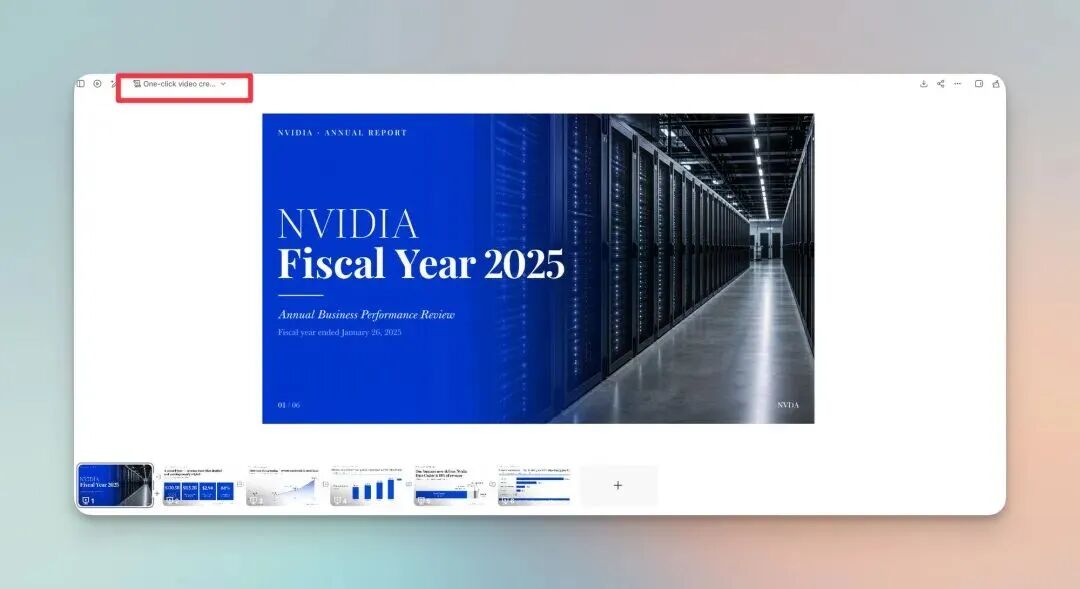
- PPT scenarios are ordinary people's刚需
5. No great ambition,方能great achievement — these eight characters come from an interview with Yongping Duan. I strongly agree. My understanding is that only when a person relaxes can they connect with real user needs.
Without relaxation, founders easily get led astray by their own imagined vanities or misled by competitors' surface-level moves. As the saying goes, be an honest person. Being well-fed and sleeping well is the best state for entrepreneurship.
6. AI products follow consumer product logic, not traffic logic: The internet era was traffic logic — the so-called attention economy is a concept from the platform perspective, because platforms lack users' attention. So through "recommendations that know you better," "infinitely scrolling feeds," "user time spent," they snatch attention from users' hands to achieve the business model where羊毛出在猪身上.
But the AI era is different. Due to token and compute costs, products cannot be free from day one. It's consumer product logic.
Consumer product logic has an advantage: it's not a zero-sum market. It's not you or me, Meituan or Ele.me. As long as a product has unique value, users can buy different brands in the same category — Nike buyers also buy Adidas.
YouMind is like a shelf, or a boutique supermarket, filled with things — skills, PPT, illustration generation. Users come browse, choose how to buy, how to play, not held hostage by feeds and algorithms.
I believe good AI products should return attention to users, transforming users from passive time consumers to active time choosers, enabling a better life.
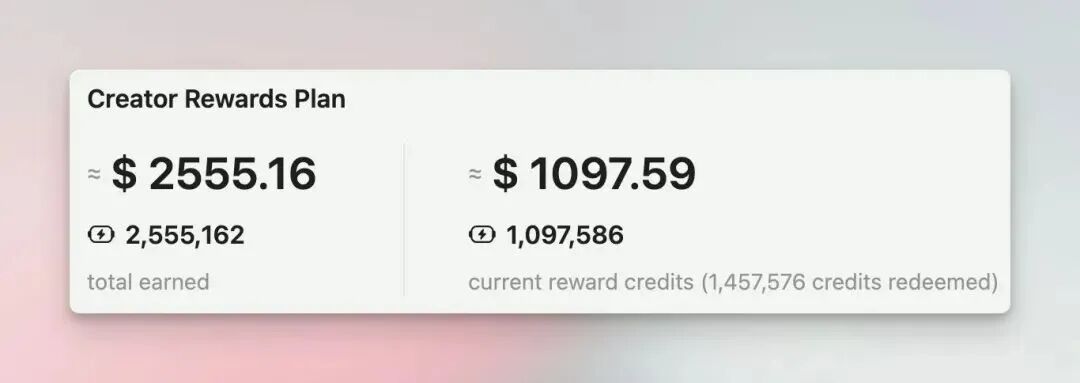
- Recently launched skill trading; creators can earn up to $2,000 a month
7. Nothing matters more than "profit": A very basic business common sense that everyone seems to have forgotten: if entrepreneurship doesn't make money, why do it?
I used to be quite anxious about this. Later I wasn't, because I did the math. YouMind's base annual fee is $200. With 10,000 users, that's over $2 million annual revenue — basically enough to support the team. In 2026, our monthly ARPU is around $50, approaching $70, with 86% user renewal rate. We're close to profitability.
If you're not too greedy, entrepreneurship in the AI era is quite interesting. Supporting the team is completely doable.
Also, I've always hoped YouMind could evolve from tool to community to platform. Later I studied successful community products like Xiaohongshu and Bilibili and discovered a characteristic: building community can't be too cash-strapped, because community is about格调, and格调 takes time.
If I can't guarantee profit, worrying about cash flow every day, I can't build a community.
8. AI will not emergently produce intelligence: The past year has also been one of gradually demystifying AI for myself. I firmly believe human value is irreplaceable.
For example, ask AI to draw something it's never seen — it can't, because AI doesn't have knowledge outside of human knowledge.
Or take our current situation: 90% of our code is AI-written. But what to write, and the quality of output — the beginning and end evaluation standards are still controlled by humans. Not human in the loop, but human on the loop.
I also don't believe AI will emergently produce intelligence surpassing humans. It just becomes faster and stronger.
In physics there's a school of thought called reductionism — break matter down to molecules, atoms, neutrons, quarks. Study these properties thoroughly, and you can reverse-derive the operating rules of the entire world.
But "emergence theory" is completely different. Study hydrogen and oxygen, water molecules as thoroughly as you like, it's still hard to predict — when your toilet flushes, will that vortex swirl left or right?
Returning to "intelligence": human intelligence still has no universally accepted definition. If AI truly emergently produced intelligence, there should be some cases by now.
AlphaGo beat everyone, but did it emergently produce anything new? Currently AI hasn't emergently produced any entirely new programming languages — it's still using human C, Java.
AGI is also a long-overestimated concept in the industry. In the past year, model versions have iterated, but once reinforcement learning kicks in, what emerges are only specialists or lopsided talents. The latest models' writing ability is far inferior to six months ago.
The so-called world model won't lead to AGI either. It uses physics modeling concepts to let AI know world operating rules, but physics is also a specialty. Understanding physics doesn't mean understanding sociology or economics.
9. People are the core moat of entrepreneurship: Recent events at DingTalk made me realize: the core moat is people. Around people, organizational forms will be rebuilt — and this will definitely be entirely new.
The OKR advocated in the past — now, KR can be completely done by AI. Programming implementation costs have dropped dramatically. Have an idea, the R&D team quickly builds it, then discuss what's problematic, what should be cut.
So O becomes especially important. What YouMind now practices is GPA.
G (Goal) — Target: This must be CEO dictatorship. Who YouMind serves this year, what the goals are — decided directly, most efficient.
P (Priority) — Priorities: Team democratic centralism. For example, in June the team proposed 20 things they wanted to do, but ultimately needed to collectively filter down to the 5 most important.
A (Alternatives) — Alternative approaches: How to specifically execute, completely delegated to the front lines.
Thus the entire organizational form becomes an inverted "inverted pyramid." The CEO is flipped to the bottom, serving and doing杂事 for frontline R&D colleagues. Frontline R&D colleagues are the apex, charging at the front lines, achieving goals.
That kind of organization with strong leadership control is completely unsuitable for the AI era.
Image Sources | Interviewee, YouMind
Join the Community