A Conversation with YouMind Founder Yu Bo: The Man Taking on Douyin | 100 AI Creators

He believes future content platforms will shift from Douyin addiction to universal creation.
Produced by | AI NOW! Intro
Yubo, founder of YouMind and a former rebellious senior executive at Alibaba, is taking on the entire industry with a product that defies human nature.
In his view, most internet products cater to human greed, anger, and delusion. YouMind, by contrast, is committed to making "everyone a productive creator."
He's targeting the崩溃 moments every creator has experienced:
Saving 100 "high-quality" articles and being unable to use a single sentence when it's time to write;
Watching a video and, when you want to cite a point, being unable to find which second it appeared;
Planning to write something, opening a blank document, your mind going blank, and simply closing it.
"This isn't a people problem. It's a product problem," Yubo says. YouMind's website describes it as an "AI Creation Studio." Simply put, Yubo wants to build the paper and pen of the AI era — when you have an idea, YouMind can take you from conception to finished draft.
YouMind launched in December 2024 and has just reached its 0.2 phase. Yubo plans to first nail the tool, "letting users uniformly save videos, podcasts, articles, and various materials," with a major release in Q2 this year to unlock more features. Yubo speaks softly and is always smiling, but he actually has plenty of "controversial takes."
For example, this technical heavyweight once hailed as Alibaba's top frontend developer, known in the industry for building knowledge management tools, has for this venture refused to build an efficiency tool, declaring that all AI-powered knowledge management is a伪需求 — "and I'm not afraid of offending friends";
Or that a founder with 15 years of big-tech background insists on starting from a "small and beautiful" product, even when challenged by many investors;
And his insistence that any tool not aimed at output is utterly worthless. An ideal usage scenario: a user has a deadline next week, their hair's on fire, they open YouMind and get to work.
When it comes to the many time-killing products of the mobile internet era, he shows disdain. He believes that entering the AI era, more people will become creators, "and those who scroll Douyin will gradually become the minority." Creation will become the best form of content consumption.
On social platforms, Yubo's self-introduction reads: an honest person.
Recently, AI NOW! sat down with Yubo in Hangzhou. Compared to half a year ago when he first started his venture and mentioned many "non-consensus" views, he's become more resolute. "Don't understand? That's the investors' cognitive limitation."
He talked about leaving the big tech firm to start a company out of fear of time — "if I don't leave now, I'll get old." His understanding of "time" also differs from most: not higher, faster, stronger, but "whether the next second is more beautiful."
This is also YouMind's original intention.
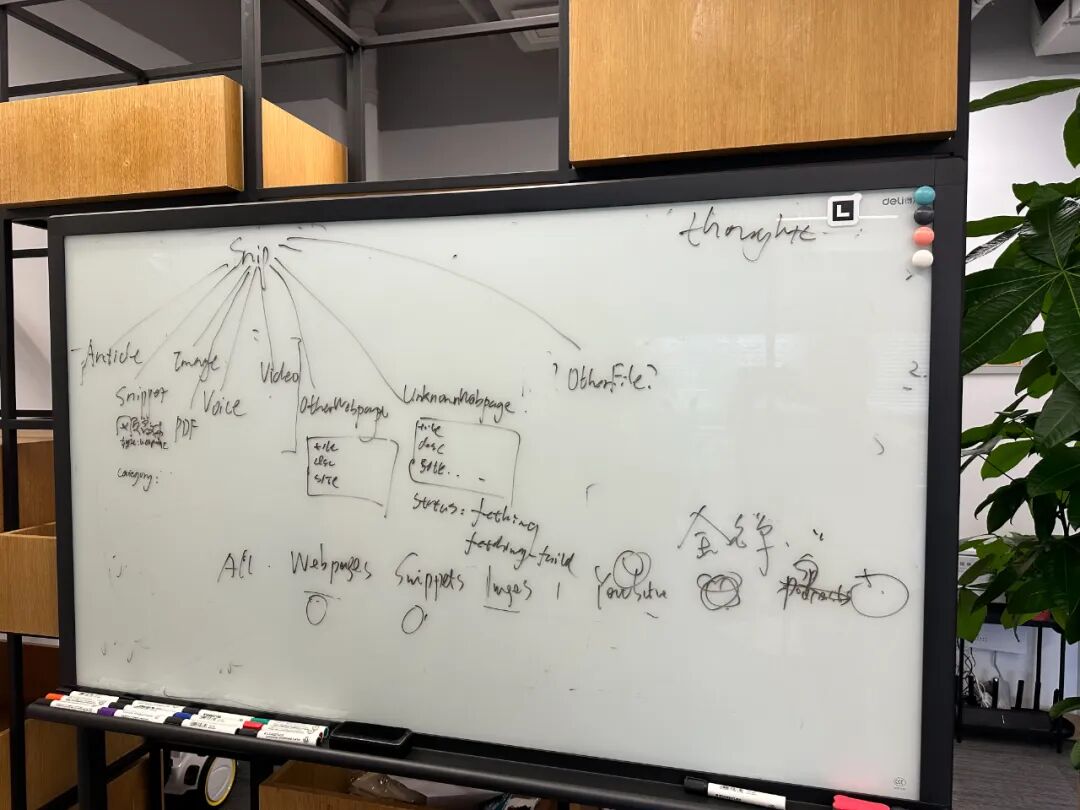
- November 2024, whiteboard meeting notes before YouMind 0.1 launch
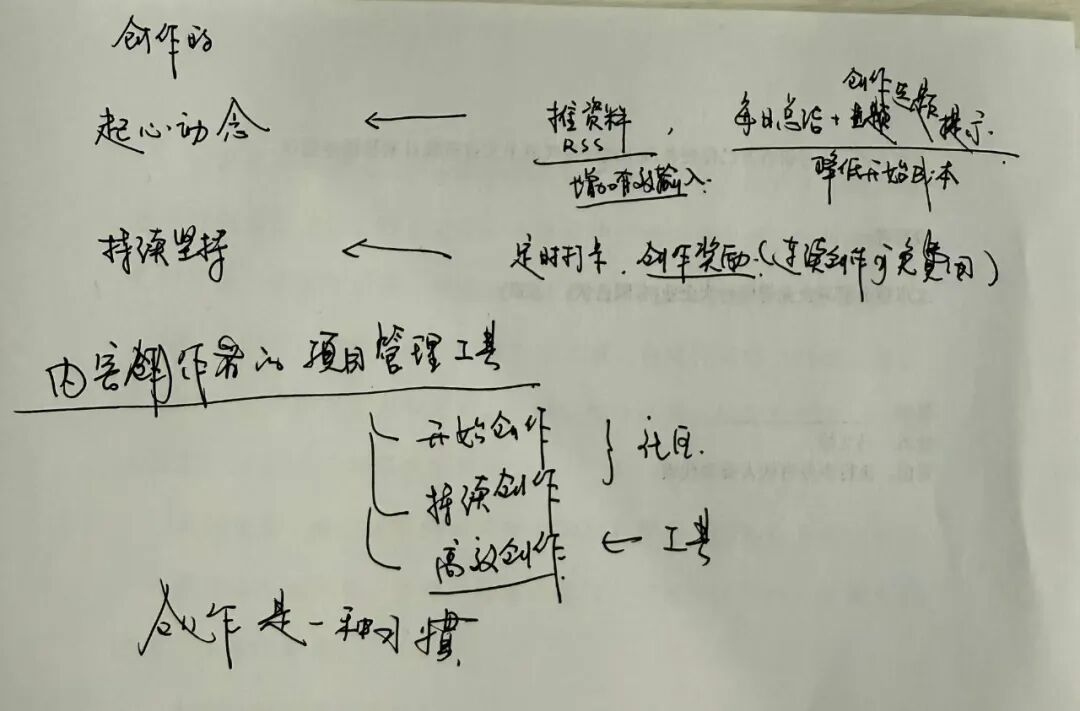
- December 2024, Yubo's handwritten notes. Content: sharing with the team about the pain points of creation.
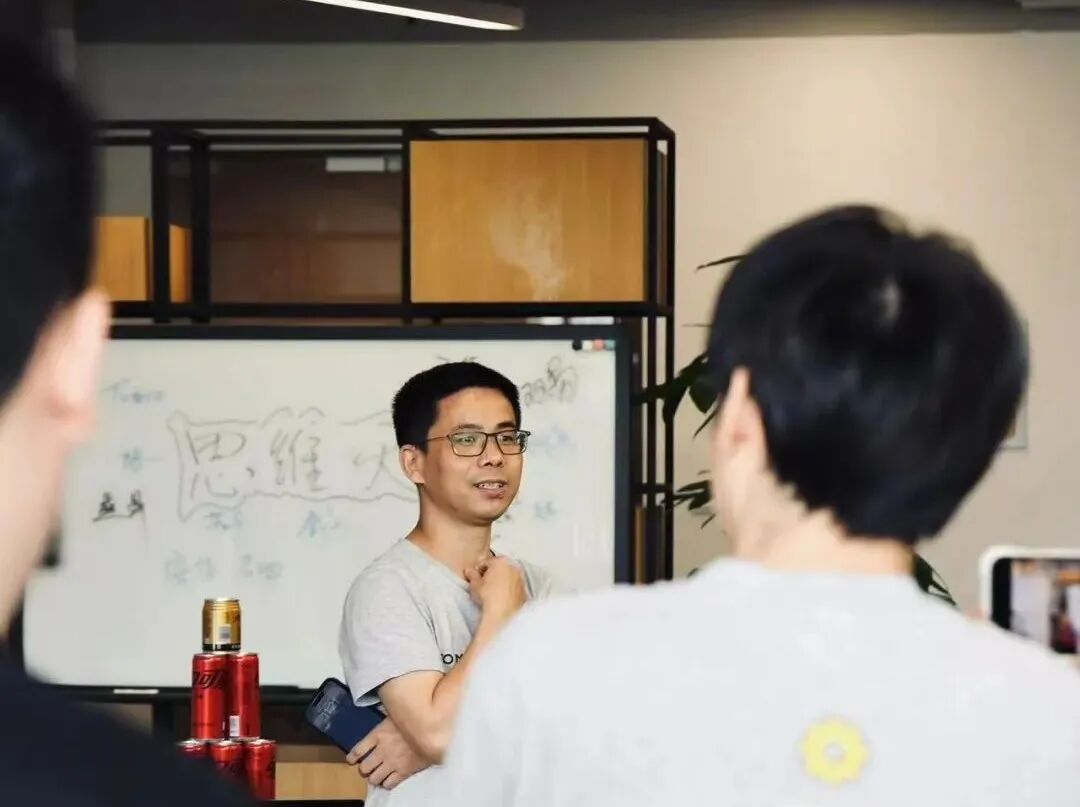
- Yubo and team's daily discussions.
Conversation with Yubo
Part 01
About the Product
Meaning Matters More
AI NOW!: In a previous interview, you said YouMind ultimately wants to be the paper and pen of the AI era. Can you elaborate? How does it help people find inspiration?
Yubo: Human content production can be divided into three eras. The first was the paper and printing era, where creation relied on traditional pen and paper. The second was the digital software era, with Office, WPS, and various tool software, plus the internet as an auxiliary tool.
The AI era is phase 3.0. "Paper" must not only allow writing but also enable creation of video and audio — it must be a multimodal carrier. "Pen" is essentially AI, assisting and stimulating your creation. You might write an outline and have AI generate a first draft. You write a draft, AI helps polish it. Beyond writing, AI can draw for you, and eventually generate music or video that sparks inspiration.
For example, I've been thinking that YouMind will later incorporate some product touches — when a user has saved hundreds of materials, we can prompt them: you've actually been very focused on a certain topic, why not move beyond reading others' articles and output your own perspective on it?
AI NOW!: Is the pain point about helping everyone improve creative efficiency?
Yubo: I don't really like the word "efficiency." More precisely, it's about improving quality. We may not shorten your creation time, but we can improve the quality of what you create.
I once had a very abstract thought: what YouMind truly cares about is time, not space — the latter is what knowledge-base and note-taking products focus on. YouMind cares more about what the creator will do in the next second, whether YouMind can help you accomplish it, and then give creators more sparks.
AI NOW!: So becoming a "creation companion"?
Yubo: Yes, I've always felt there should be a product designed more around the user's time, around "what to write next," and "how to push creation forward." The current product functionality hasn't reached this yet, but we'll gradually upgrade from creation assistant to creation companion — this companion should understand your saved materials better than you do.
After a user has an impulse, the hardest part is how to start acting. YouMind's focus is on how to make people's lives more interesting. This matters more than anything.
AI NOW!: You've always said, if you're not outputting, don't use YouMind. Isn't this an overly elite perspective? Most people don't know what they want to write.
Yubo: Many people really don't know what to write. They have no specific topic. Even if they start, find that first piece of material, then they can't continue.
This is how I've come to understand it in recent months. An OpenAI former chief scientist on Twitter proposed a concept called vibe coding — "atmospheric programming." More and more programmers are writing disposable code, like quickly making a small game, quickly making a webpage, then sharing it with friends and family.
So in the future, will there also be "atmospheric creation"?
For example, you casually write 10 pieces of content. Maybe one is shared with friends, or today you just chatted with a friend, got some inspiration, no particular theme, let AI help you write part of it, you refine it yourself — wouldn't this reduce some of the psychological burden of creation?
AI NOW!: What's the motivation for atmospheric creation? After all, platforms like Douyin and Xiaohongshu provide positive feedback through followers and traffic.
Yubo: That's a great question.
I thought about this for a long time, but then through talking with some post-95s and Gen Z, I suddenly found the answer. Some young people post their gaming experiences on Bilibili, spending two hours on it, but they don't care at all whether anyone pays attention. Many of them also play Minecraft, spending lots of time just building a house, and they're happy with that.
For post-80s and 90s, creation still habitually comes with thinking about how to make money. But post-95s and Gen Z live in a more affluent era. They pursue pleasure, recognition, and respect — more self-fulfillment needs that aren't necessarily tied to money.
AI NOW!: What's a typical YouMind user scenario?
Yubo: Currently our core users are podcast or video creators.
These people often need to write transcripts and need to save video or audio files. Previously they kept things in favorites, and when it was time to use them, they couldn't remember which sentence was in which segment — very frustrating.
Now they first save to YouMind, which automatically processes text. Users just need to remember keywords to search back — solving a core pain point of video search. I actually hadn't thought of this before YouMind launched; many users pay precisely for this point. That's one of the joys of building products.
AI NOW!: Paid from launch?
Yubo: Building a bridge to filter for seed users.
Part 02
About Entrepreneurship
Big Tech Senior Exec? I Hate That Label
AI NOW!: Back to you personally — 15 years at Alibaba, why did you decide to start a company in 2024?
Yubo: In April 2023, when I received Alibaba's 15th anniversary congratulations, I suddenly realized — if I don't leave now, I'll get old (laughs). That night, my celebratory message to myself was: get out now. This was the most primal fear-driven motivation.
But the real turning point was ChatGPT. Alibaba is典型的运营驱动. As a frontend developer, during the mobile internet era I was getting promotions and raises, but psychologically I felt like I was watching Alibaba's story from the sidelines. The AI application layer showed me an opportunity that was truly mine. To be honest though, when I first left, I found fewer opportunities than imagined. It wasn't until 2024, seeing GitHub Copilot and Perplexity as genuine AI applications, that the direction became clear.
AI NOW!: Why?
Yubo: The key difference between traditional programming (PC/mobile) and AI-era programming is that the former is a deterministic logical world — input and output are clear, debugging is traceable, development flows are linearly controllable. AI-era programming is uncertain intellectual collaboration. Humans become coaches, using data, prompts, and feedback to repeatedly train AI's creative capabilities. Code is no longer absolutely controllable, but can solve more complex problems.
I'll give an example. Douyin's recommendation algorithm can achieve personalized feeds for thousands of users, but for programmers, what video a user sees is understandable because the algorithm is a white box. In the AI era, with LLMs, everything is a black box. How the large model responds no longer necessarily has anything to do with the programmer. Compared to thousands of faces, AI can enable "one person, thousand faces."
AI NOW!: Why choose the AI application layer rather than large models or other directions?
Yubo: From brutal self-awareness. I can read AI papers, but someone like Zhilin Yang (founder of Moonshot AI) who was studying large models as an undergraduate at Tsinghua — what qualifies me to surpass him? Saying I could is just lying to myself.
Later I thought of Steve Jobs's "connecting the dots" — what I've been good at must connect together. Like knowing you're fast at running, don't force yourself to do high jump.
AI NOW!: The industry currently favors AI-native entrepreneurs more. What do you think?
Yubo: The ones most likely to be swallowed by the AI wave are so-called AI-native applications, because remove AI and they're worthless. I insist on building "boats" — businesses that rise with the tide as the sea level of large models rises.
AI NOW!: Do you think you fit the "big tech executive" label?
Yubo: It actually annoys me, because every big tech executive is different, and there are some senior executives I look down on too. I'm a non-typical big tech senior executive.
If investment institutions have prejudices against me, that's their immaturity, not mine. If after one or two conversations they still tag me as a big tech executive, their cognition is quite ordinary too — then bye-bye.
AI NOW!: Since starting your venture, what's the most frequently challenged question?
Yubo: Three soul-searching questions: 1) How high is YouMind's ceiling? 2) YouMind says it wants to transition from tool to community — how? 3) Why is our team the one to do this?
AI NOW!: How do you answer?
Yubo: It's all about valuation, really. What's the ceiling? Frankly, I don't know.
Many people look at ARR (Annual Recurring Revenue) now, but this is also a gamed metric. I often see products surge up a ranking, take one month's data and multiply by 12 to get ARR — a bit strange. I even recently saw a company that launched 9 days ago claiming ARR broke 10 million.
I believe 7-day user retention is objective data. If it reaches above 40%, the product is basically stable. But people generally don't mention this metric now, because it's not good for anyone (laughs).
AI NOW!: If data can't support your conviction, how do you persuade investors?
Yubo: What I've discovered this time around is that when someone finds problems here and there with your project, that's actually a good thing.
For example, I simply believe more content consumers will become content creators, and content creators may grow from 30-50 million globally to 10x that. There's no data supporting this; it's my belief.
If investment institutions are willing to believe me, welcome to invest. If not, no need to waste each other's emotions.
Part 03
About AI
In an Era of Universal Lying Flat, I'm Betting on "Human Nature Aspiring Upward"
AI NOW!: Why abandon the knowledge management track you've cultivated for years and pivot to AI creation tools?
Yubo: Because in the AI era, knowledge management tools may be a伪命题. This will definitely offend many people, but it's what I think.
I was once a heavy user of note-taking products. Later I conducted an experiment: I quietly stored a knowledge management tool's account password somewhere, thinking I'd go back when I really needed it. But I discovered that after uninstalling, I never opened it once.
AI NOW!: You think knowledge management is a伪命题, yet such products are exploding in the market.
Yubo: Knowledge management tools have always emphasized building a second brain. But since ChatGPT, it's already the strongest second brain. Do users still need to organize things themselves? Not much value.
Without output, storing however much knowledge is meaningless. When designing YouMind, I strongly emphasized output. I've always believed content creation is the best content consumption.
AI NOW!: Emphasizing "output-driven" — how specifically is this mechanism designed?
Yubo: Drawing from the PARA methodology in knowledge management.
P is Project — whatever you do, it's best to have a timeline, gathering materials around a project to produce output. A is Area — domains, like projects without timelines. I'm currently interested in AI but don't know when I'll figure it out; that's an area. R is Resource — various materials. The final A is Archive — this is extremely important. Don't let things pile up endlessly. If you find a project can't be completed, archive it or simply delete it.
AI NOW!: In a previous interview you said YouMind is the next generation of YouTube, because the masses will shift from passive consumption like scrolling Douyin to "active creation." Aren't you being overly optimistic? This view seems too反人性 — the vast majority still prefer lying in bed scrolling on their phones.
Yubo: I've always believed the next generation content platform won't be content consumption platforms like Douyin, but likely content creation platforms. Because I believe human society has yin and yang poles — however much human nature tends downward, it equally tends upward.
Greed, anger, and delusion represent 50% of human nature. Believe that the remaining 50% is good. This is also the Buddhist concept of yin-yang poles. Without "aspiring upward," gyms and yoga wouldn't thrive.
In the mobile internet era, many products targeted human greed, anger, and delusion. The AI era should have different products: this too is human nature.
AI NOW!: You're very certain that in the future everyone will be a creator — this is YouMind's opportunity?
Yubo: Yes, creation will become routine.
So from the start of my venture I've been saying: if YouMind makes creation so easy to generate, it will ultimately be a community, not just a tool.
AI NOW!: Tool-to-community transition is a公认的难题. What gives YouMind confidence to break this curse?
Yubo: Based on my more than ten years of open-source project experience. Back then, the largest programmer community GitHub grew from a very small tool into a tool suite, then into a large community, and finally into a company worth tens of billions.
I know this process very well, so returning to why I'm building YouMind, I think GitHub's path is worth learning from.

• Biggest AI shock for you in 2025?
Yubo: Before DeepSeek emerged, even at the end of 2024, I felt基础模型 progress was too slow.
I'm a boat-builder. If the water doesn't rise, I don't rise. Sometimes I'd even hit rocks, feeling the water level was too low.
In the 2025 Spring Festival, first DeepSeek released, then OpenAI launched o3 — I started feeling AI's active reasoning ability had greatly improved, really beginning to think like humans.
Second was Manus introducing the Agent concept, combining reasoning ability, tool calling, and various capabilities through Agent to give AI initiative. I immediately felt: the Agent era has arrived.
Actually all of this happened in just the first four months of 2025. A complete upheaval, so fast.
• Anything in AI over the past year you initially didn't favor but completely changed your mind about?
Yubo: GPT-4o's image generation. I always felt diffusion models were weird. Even when using them myself, while some details were good, it was relatively easy to tell it was AI-generated.
But with this recent 4o version, I realized it might be my own limitations, even my shortsightedness. Multimodal or fully multimodal models will be very significant.
• In this wave of AI entrepreneurship, what's undervalued and what's overvalued?
Yubo: Overvalued are application scenarios, but long-term they're undervalued.
AI is still currently an efficiency tool. For example, out of 100 tasks, maybe 60% can be replaced by AI, but the remaining portion is actually hard to replace. I've always felt designers are hard to replace by AI, but programmers are easily replaceable.
With AI's emergence, the barrier to entrepreneurship has actually been lowered by AI itself. So the hardest part of entrepreneurship is actually finding direction. People who love learning, love tinkering, and have traditional industry backgrounds are more likely to break through in vertical domains through AI.
• What are you most looking forward to in 2025?
Yubo: Whether DeepSeek, OpenAI, or Claude, truly becoming cheap and good, turning into utilities like water and electricity, further lowering everyone's entrepreneurship costs.
• Finally, recommend three of your favorite books?
Yubo: The Diamond Sutra — didn't really understand it before, copied it several times, seemed to understand a bit; Li Shuo's The Great History of Confucius, another book by the author of The Sacrifice of Shang; and Mu Xin's Literary Memoirs, very beautiful.
Image sources | Provided by interviewee, Unsplash