Inspired by "The Greatest Show on Earth," a 17-year-old high schooler put on a hackathon | WAVES
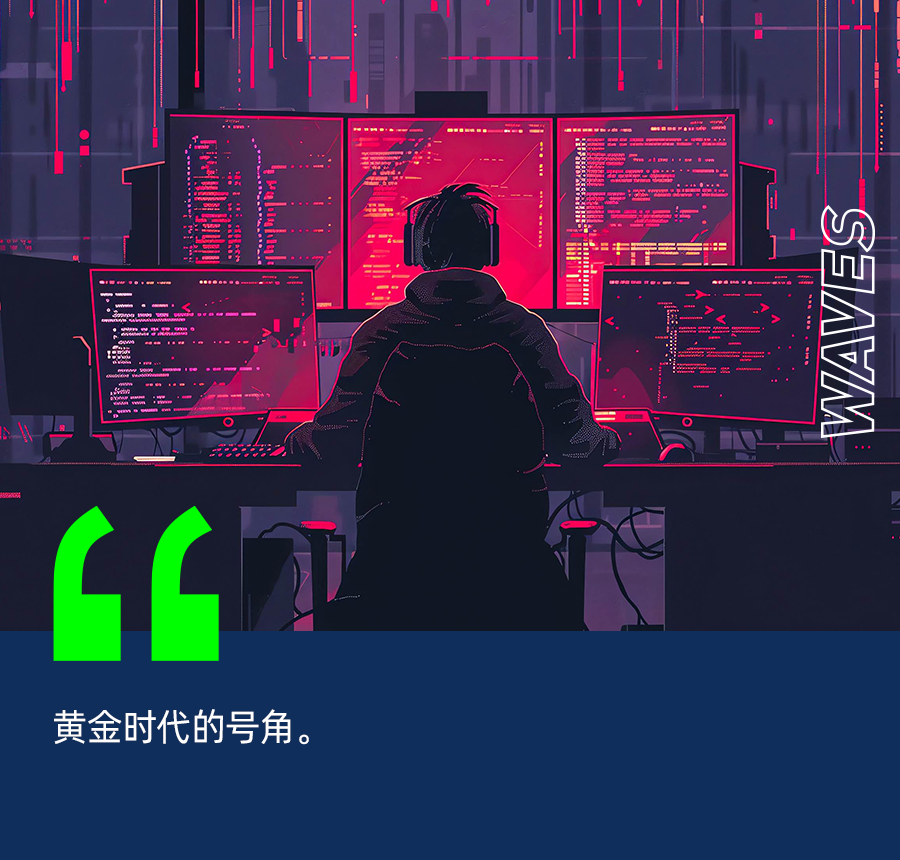
The trumpet of the golden age.
By Muxin Xu
Edited by Jing Liu

Hangzhou, Hupan Innovation and Research Center — part university campus, part music festival grounds. Hundreds of young people gathered here. Some hurried past with laptops tucked under their arms, rushing to workshops. Others sat in circles debating ideas. Tents and sleeping bags were scattered across the ground, the summer heat thick with the smell of sweat.
Nearby, a conference for restaurant owners had just ended, and they had to cut through this crowd to exit the compound. Some paused to stare at the sleeping bags. The scene crackled with a jarring sense of separation — middle-aged entrepreneurs from traditional industries and Gen Z geeks who believed the AI era was coming, briefly crossing paths in a space where the old guard and the new would likely collide in the years ahead.
This was a hackathon. The term comes from "hackathon," a competition where developers, designers, product managers, and others with different backgrounds team up to build a project within a limited timeframe, then pitch it for judging. American hackathons have spawned successful products like GroupMe and Zapier.
But this one, called "AdventureX," was different. It had five rock songs as its themes. It lasted five days. And every participant was under 26 — a "hackathon for the young."
More striking still, the person who started it was a 17-year-old high school sophomore.
"WAVES" is a column by Dark Tide (暗涌). Here, we bring you the stories and spirit of a new generation of founders and investors.

"You're Paying for the Famine!"
Ryan Zhu Haoyu had snuck into hackathons at foreign universities using his sister's ID, considering himself experienced. But after failing at the CTB (China Thinks Big) international competition, he decided to throw his own.
He set some ground rules: participants had to be under 26 — no veteran entrepreneurs, no Big Tech cogs. No entry fees; instead, he'd provide housing and prizes. The event would run five days, with guest speeches confined to a single evening.
Travel reimbursements, lodging, meals, venue costs, prizes, and awards — it all added up to roughly one million RMB.
This was April 2024. The opening date he'd set was three months away. The whole operation was held together with duct tape: besides Ryan, the team consisted of a few classmates and some internet friends, all around the same age, full of dreams and empty of cash. Ryan had asked his parents — "both traditional industry workers" — who disapproved and wouldn't contribute a cent.
So from the start, Ryan knew he had zero resources. He'd have to bootstrap, snowballing his way to a million with minimal upfront cost. And "young people" would be his leverage. He drew inspiration and confidence from a Bilibili documentary about Live Aid — after all, the "greatest concert in history," a famine relief fundraiser, had started with a has-been singer rallying his neighbors.
He made a few slick graphics with keywords: a hackathon for young people, completely free, July in Hangzhou. He spent a little over 100 RMB on Xiaohongshu promotion.
ZhenFund became the first snowflake in the avalanche.
Perhaps only an early-stage fund so focused on "investing in people" would get involved in an event that, at that point, was just a handful of students. ZhenFund reached out to Ryan. Without even verifying his "invited" guest list, partner Yuan Liu confirmed he'd attend.
Ryan immediately slapped ZhenFund's logo into his deck and WeChat posts. That endorsement boosted credibility significantly. So much so that many people mistook it for a ZhenFund co-hosted event — including Zhang Nan, then president of Feishu.
Next, Ryan volunteered at a Beijing visionOS conference and met the emcee, Race, who later introduced him to Zhao Yi. Zhao was intrigued by this teenager's hackathon and connected Ryan with Hupan Innovation and Research Center. In the office of Hupan's vice president, Ryan delivered a PowerPoint presentation. He later said the key to a good deck was: "Write something that looks cool, then explain it in human terms."
Whatever the reason, Hupan bought in. They offered venue space and catering — the former alone saved him roughly 500,000 RMB.
No one had paid yet, but the event was taking shape. All that remained were speakers and the rest of the sponsorship money.
In Bohemian Rhapsody, the film shows how the organizers snagged so many big-name musicians. They called Queen: "David Bowie's coming, aren't you? Well, if you don't, I'll tell the world you personally refused to raise money for famine relief." Of course, they told David Bowie the same thing.
Ryan borrowed this strategy. When inviting CEOs and investors, he'd mention that another impressive guest had already confirmed — even if at that moment it was only "invited." And more importantly, he kept hammering home the message: you're paying for the famine / for young people, you're the institution that most supports young people!
Ryan structured sponsorship into four tiers. Tiers one and two offered basic swag and exposure. Tier three cost 40,000 RMB and included all registrants' personal information. Tier four cost 60,000 RMB, adding early access to that data plus contact details. He told interested partners that ZhenFund would likely choose tier four, so most institutions picked tier three. State-owned enterprises and corporations almost always went straight to the top tier — some because HR wanted to build talent pipelines, others who had no idea what they were actually buying. Ryan tried tempting some companies with "everything's set, we just need your final 60,000," and some actually bit.
Three months later, Ryan had raised 300,000 RMB.

Refusing to Be a "Good Student"
Back in real life, Ryan Zhu Haoyu was a high school sophomore. At a military-style boarding middle school in Hangzhou, he'd discovered geek forums. For the next four years, he plunged headlong down the geek path: teaching himself Python, participating in nearly ten hackathons at home and abroad, independently developing three apps — one of them an AI proxy for sitting through online classes — culminating now in organizing a hackathon. The organization called AdventureX had grown to attract 38 members.
Before this, he'd been a regular at "Crazy Thursday" in Liangzhu Cultural Village, a gathering spot for indie developers with weekly offline meetups. There Ryan met Eve — later a team member; a Linear Capital investor — later a sponsor; various KOLs in the circle — later judges. He even met another Ryan, who was preparing to launch an accelerator for founders under 20.
Perhaps because he'd been immersed with indie developers both online and offline, Ryan could pick up on shifts faster. He'd tried to catch the Web3 wave, then pivoted to AI before the tide turned.
These changes also fed a time anxiety. He despised "good kids" or "test-takers." "Run the opportunity cost and you'll see it's a waste of time." He cared more about building real projects, the kind of "building" every developer gets addicted to.
This contempt for "good students" produced some side effects, like a连带 resistance to the schools and parental authority that enforced those values. When his school illegally started the semester early, Ryan rallied a hundred classmates to call the education bureau's tip line, escalating it into a city-wide emergency. The rebellion failed. Ryan got a demerit.
Shared disgust for authority drew many team members in. Eve, whom Ryan met at "Crazy Thursday," had been a model student her whole life. She told her parents she was going on vacation, then secretly came to support the event. Another co-founder, Xu Chen — Ryan believed he'd been fighting against his own affluent family background — was especially insistent on eliminating any advantage from participants' origins in the competition design.
After the first AdventureX, Ryan's vision for it was something like a university club or NGO. He and the team were building a system to optimize the entire event workflow, hoping AdventureX could eventually run without him.
Because his ambitions stretched further. With a co-founder he'd met at Penn, he was developing a social app to launch during the September back-to-school season at American universities. The plan: accumulate users, drive up valuation, then raise funding.

The Horn of a Golden Age
Ryan's hunger for time is a defining trait of young AI app entrepreneurs in an era of light-speed iteration.
A popular saying goes: among the next Zhang Yimings, Wang Xings, and Colin Huangs of the AI age, at least one is already starting up. Debatable, but powerfully seductive — for investors hunting the next Zhang Yiming, and for founders wanting to become him.
The final day of the AdventureX hackathon was Demo Day and awards. Participants pitched from their booths, most having pulled all-nighters, sleep deprivation and adrenaline warring in their bodies.
Their projects and apps mostly grew from personal needs: a toaster yearning to be objectified, an AI companion for scrolling celebrity tweets, an AI-powered 58.com for selling time, a "Magic Painter" that transforms children's drawings into 3D images, and many young men who chose to tackle long-distance relationship companionship as their theme.
Most were still in school; a few had stints at Huawei or model companies. This partly reflected Ryan's observations and preferences — in his view, people with work experience, especially those who'd tightened screws at big tech firms, had rigid mindsets. A demerit. He'd also loaded the application with behavioral test questions, like "If you met a Martian, how would you introduce humanity to them?" One answer delighted him: "Shoot the Martian."
In some ways, these future founders at the hackathon fit a profile closer to Liu Jingkang, founder of Insta360: sufficiently unconventional — he once hacked the academic affairs office email system and posted exam answers online, nearly getting expelled from Nanjing University — and simultaneously hardcore enough to crack Zhou Hongyi's phone number just by listening to dial tones.
In China's current AI app landscape, nearly 30% of founders are such "super individuals" or "technical prodigies." In this ideal kingdom Ryan constructed, where "commercialization" wasn't the judging criteria, every founder felt the joy of standing at the wind's eye. They believed the AI era would come, and in the long night before that killer app appeared, change was so rapid that no one dared sleep.
But stepping out of the building suffused with technological egalitarianism and idealism, they faced harsher realities. Typically, within a year of a technology inflection point (like ChatGPT), veteran industry experts begin entering the fray. This doesn't just signal advancement in AI tech — it means they'll build more defensible "deep applications." For individual or small-team founders, extreme speed is almost their only chip.
One example: ChatMind. After ChatGPT's debut, founder Shi Tianfang realized GPT's logical capabilities made it exceptionally suited for mind maps. He didn't waste time validating the idea. While team members were still discussing feasibility, he built a ChatMind prototype in one night. In retrospect, the technology wasn't difficult — it was just early positioning, more subscribers. ChatMind was later acquired by Xmind, a leading app.
Acquisition represents a relatively happy ending in the AI app space currently. More players must accept the fate of flaming out after viral success — like Miaoya Camera, or its predecessor Lensa. Most AI + image apps have a two-month lifecycle.
This seems like an unsolvable problem for many consumer-facing apps today. So one indie developer proposed an alternative AI app entrepreneurship framework: while hit AI apps are cyclical, if you can master a methodology for "mass production," jumping out of the flash-in-the-pan cycle, you could infinitely extend the hype curve.
But setting aside the hard problems, more young people are joining the AI entrepreneurship wave because they see opportunity, and want to make up for missing the mobile internet era. Drawing analogies between the AI age and the mobile internet era has become common sense — people try to predict AI's trajectory through this comparison.
For instance, as AI apps have shifted from "save time" productivity tools to "kill time" toys, multiple institutions lean toward viewing this as similar to the eve of the 2000 mobile internet app explosion, suggesting an industry blowout isn't far off.
Another example: the hackathon renaissance. Domestic hackathons peaked during mobile internet's rise, with almost daily events. They dwindled as the internet entered its second half, only to resurge recently with AI-themed hackathons.
In fact, around 2016-2017, there were also small mobile internet hackathons organized by high schoolers, targeting participants their own age. Most of that cohort are now in PhD programs. Eight years later, another high schooler-organized hackathon has finally emerged — like a horn heralding the next golden age.