18 Reasons We Miss Tsung-Dao Lee
A life where dreams contain only geometric shapes.
By Muxin Xu and Jiaxiang Shi

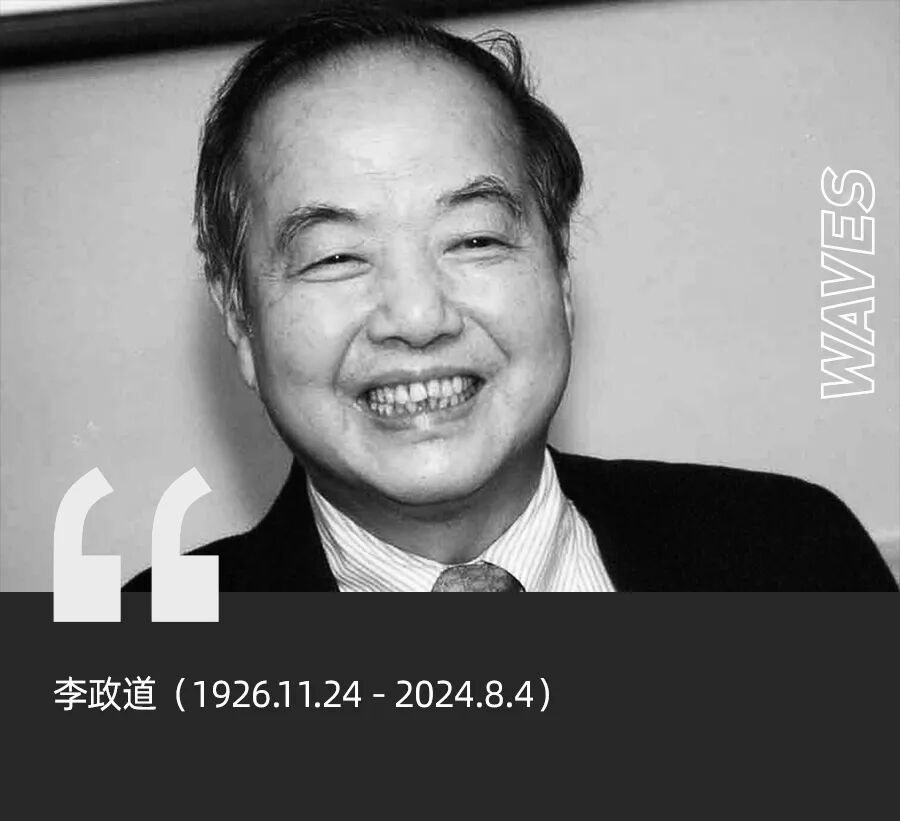
Renowned physicist and Nobel Prize in Physics laureate Tsung-Dao Lee passed away in San Francisco on August 4, local time, at the age of 98. The news was confirmed in recent days. For many, this now somewhat distant name may first call to mind the prolonged rift between him and Chen-Ning Yang. But this was merely an unexpected episode in Lee's 98-year life — he had a far richer and more legendary story worth telling: war and exile, proposing the theory of parity nonconservation and becoming the first Chinese Nobel laureate in physics, his contributions to China's high-energy physics, and his role as a bridge between Chinese and American academia. Ninety-eight years, nearly a century — the transformations one could witness and experience in that span could fill volumes. Drawing from Lee's own words across four periods of his life, Waves attempts to piece together the sweeping story of this master physicist.

War and Exile
1926–1946
This was Lee's youth.
War and exile defined his pre-fame years: born in Shanghai in 1926, he was in second grade when the Battle of Shanghai erupted, and his family fled to the British concession. After the Pacific War broke out, even the concession could no longer hold a desk for studying. At just 15, Lee began his life as a refugee. He later trekked hundreds of kilometers to take the college entrance exam in Guiyang, was admitted to Zhejiang University, and subsequently transferred to the National Southwestern Associated University.
Due to the war and other circumstances, he never obtained diplomas for elementary school, middle school, high school, or undergraduate studies. The only diploma he ever received was his PhD from the University of Chicago.
"Why doesn't God fall from the sky to the ground?" — When his grandfather, a pastor, spoke of God in heaven, young Lee replied.
"When a person's existence is extremely difficult and bitter, if you ask them what meaning life has, why live? In the chaos of war and famine, people were dying everywhere — death and life were very close. You needed some motivation to make you want to keep living. For me, what was that motivation? I read that set of university textbooks from the Commercial Press and discovered that nature actually has laws!" — In the spring of 1942, Lee briefly settled in Ganzhou, where he first read General Physics.
"Every individual has meaning in their existence. We are all life, but I am different from an ant — I can understand how this universe evolved, what laws govern all things in the world, and an ant cannot."
"I constantly had physics problems running through my mind. When I couldn't figure them out, I went to books. When doing exercises or research problems, I never asked others to teach me how to solve them, never applied others' methods — I always worked through questions and found answers myself." — At the National Southwestern Associated University, physicist Ta-You Wu gave Lee an advanced physics textbook used by American university seniors. Within two weeks, he had worked through all of it.

The Basic Concepts of Physics Have Been Overthrown!
1946–1972
This was the era of Lee's academic ascendancy.
In 1949, the atomic bombs dropped on Hiroshima and Nagasaki brought the Manhattan Project depicted in Oppenheimer into public view. At that time, three Chinese experts were sent to the United States, and physicist Ta-You Wu was among them. Lee went to America as his assistant.
Without a university degree, Lee was forced to choose the University of Chicago, which did not emphasize diplomas, and there he met his mentor Enrico Fermi.
In the autumn of 1946, Lee first met Chen-Ning Yang. Eleven years later, they would each reach their defining moment. Shortly after Lee and Yang's co-authored paper "Question of Parity Conservation in Weak Interactions" was published, Columbia University's physics department held a press conference to announce to the public that a fundamental law of physics called "parity conservation" had been overthrown. The next day's New York Times ran the headline across its front page: "Basic Concept in Physics Is Reported Upset in Tests."
In 1956, Lee received the Nobel Prize in Physics at just over 30 — the first time a Chinese person had won the award.
"If you're doing theory, you have to guess where the wind is coming from. If you're doing experiments, you follow the kite and know where the wind is going. And to know where the wind is coming from, you have to design another experiment."
"Fermi's uniqueness lay not only in his surpassing achievements in physics, but also in how remarkably kind he was in daily interactions. He suggested a thesis topic for me, and I said I didn't want to do it. I was naive and didn't know my place. Another professor might have said, 'Then don't work with me, find someone else.' But Fermi said, 'Very well, you teach me.' That required tremendous patience and kindness. I was too young then to know how fortunate I was, to have met such an extraordinary teacher."
"Without past experience, without present stimulation, the ideas and knowledge we have today would not have been produced; without future experiments, our present ideas and knowledge cannot evolve. Although these many factors constitute the whole of any advance, people often remember only the final glorious harvest and forget the hard cultivation within. At today's solemn ceremony, I feel especially that many great physicists have made great contributions to humanity's understanding of nature, yet have not been honored as we are today." — At the Nobel Prize ceremony in Stockholm, Sweden, on December 10, 1957, Lee spoke with characteristic humility.
"Yang's and my collaboration ended twenty-five years ago. Its significance is reflected in the fact that our co-authored papers have stood the test of time. Each of us has made many other contributions to physics. Our achievements are universally recognized. Is that not enough?" — At age 60, Lee reflected on his Chicago years and parity nonconservation.

Something More Important Than the Nobel Prize
1972–2011
This was the era when Lee passed the torch.
In 1972, he came to Shanghai and saw that the vast majority of students had been sent to the countryside, while the few worker-peasant-soldier students lacked even a basic understanding of science. Grateful that education had transformed his own life, he decided to return to China personally to teach.
For many years after, he traveled back and forth between Chinese and American universities, working to establish CUSPEA (China-US Physics Examination and Application). He wrote letter after letter until he filled the nearby mailboxes, even drawing protests from the post office — he and his wife had to push a cart to more distant post offices.
In an era without GRE or TOEFL, the CUSPEA program was virtually the only opportunity for Chinese physics students to study abroad, and over 900 Chinese students seized it. Among them was Charles Zhang, who would later become CEO of Sohu.
After the 1990s, almost every return trip Lee made to China was to advance the country's high-energy physics. He established the postdoctoral mobile station system to help his students secure decent positions upon returning home. He pushed for the creation of the National Natural Science Foundation, with particular emphasis on funding basic research, because he believed a great nation could not simply sit waiting for others' new technologies.
"Is science less important than ballet?" — On his first return to China, Lee saw the devastated research environment alongside the bustling Shanghai Ballet School.
"At Fudan University, the only research work I saw was measuring the power of a few large light bulbs. The vast majority of students were not studying in school but had gone to the countryside for labor, that is, to serve the people. At Fudan, there were only a few worker-peasant-soldier students. From talking with them, I found that although they were enthusiastic, they lacked understanding of even the most basic scientific common sense — they were almost entirely scientifically illiterate. They had no opportunity to learn, nor did they know what they needed to learn. In this way, how could they serve the people?"
"The actual purpose of my proposal was not really to create some special youth class, but to break the situation where cultivating basic science talent and other kinds of talent was not valued, so that the cultivation of all kinds of talent across the country could get on the right track." — Lee later recalled this period. The University of Science and Technology of China's youth class has now passed 40 years, with no shortage of controversy along the way.
"You are free to pursue the physics research of your choice." — Upon learning his student was preparing to return to China, Lee gave him a $4,000 stipend, with this note attached.
"The National Natural Science Commission must have a strong academic consciousness, must have independence — authority must be placed in the hands of scientists. There cannot be an administrative body above it managing things, or it will be very difficult to make fair evaluations."
"In certain respects, [the CUSPEA program] is more meaningful than the discovery of the law of parity nonconservation."

A Life and Dreams of Nothing But Geometric Shapes
2011–2024
This was Lee's later life.
In 2011, Lee retired and donated his lifetime of manuscripts to Shanghai Jiao Tong University, establishing the Tsung-Dao Lee Library. A scene still remains there today: letters Lee sent to CUSPEA students, flying out from a mailbox and spreading densely all the way to the ceiling.
Three years later, Lee left New York, where he had lived for 61 years, and moved to San Francisco to be closer to his children and grandchildren.
In his later years, he reread his own youthful papers for amusement. Eventually, he gradually found his old work difficult to understand, and switched to reading university physics textbooks, still deriving pleasure from solving exercises.
Throughout Lee's long life, his history with Chen-Ning Yang was frequently brought up — a story approaching that of "twin heroes of an era." But today, the old struggle has dissipated like smoke.
"In discussing and exchanging ideas with others, the most important thing is to figure out what the other person doesn't understand, not to learn what they've already done — only this way can you get ahead of them." — The hands-on teaching Lee received from his mentors, he passed on to his own students in turn.
"One dark and foggy day, two children were playing on the beach. One said: 'Hey, do you see that flickering light in the distance?' The other replied: 'Yes, let's go closer.' The two children ran shoulder to shoulder toward the light. Sometimes one was ahead, sometimes the other. They ran with all their might, faster and faster. The first to reach the temple opened the door and said, 'Ah! Here it is.' The other rushed in after, dazzled by the extraordinary beauty inside, and exclaimed: 'How wonderful! How brilliant!'
"Years passed, and they grew old, becoming quarrelsome. Their memories blurred, their lives monotonous. One decided to have his epitaph engraved in gold: 'Here lies the one who first discovered the treasure.' The other then said: 'But I was the one who opened the door.'"
— In his 1986 essay Broken Parity, Lee thus described his relationship with Chen-Ning Yang.
"A person's success depends on many factors, among which 'opportunity' is perhaps the most important and the hardest to control. I hope more similar opportunities will visit the young." — On his 60th birthday, Lee wrote these words, recalling his early efforts on behalf of young physics talent, especially the energy he devoted to the CUSPEA program.
"I have never in my life had a dream with a plot — I only see geometric shapes of different forms in my dreams." — Lee's eldest son, James Lee, later recalled that one day, his father suddenly offered this summary of his lifelong dreams.
References:
[1] Lifeweek: "Tsung-Dao Lee, 'Hoping Opportunities Visit More Young People'"; "Tsung-Dao Lee, Opening a Door for More Chinese Prodigies"; "The Growth Path of a Genius Physicist"
[2] The Intellectual: "Tsung-Dao Lee: Wholeheartedly Cultivating Talent for the Motherland"
[3] Tsung-Dao Lee: Broken Parity
Image source: IC Photo
Layout: Nan Yao