Two Roads Diverge, But You Can't Travel Both | 2024 · Under 36
Make your choice.

Research | Zhuxi Huang, Yunxiao Guo, Yi Zhang
Editor | Jing Liu

"One word to describe today's venture capital industry?" When Anyong Waves posed this question to ChatGPT, Tongyi Qianwen, Kimi, Hailuo AI, Doubao, and Baixiaoying, the answers were: turbulent, divergent, vibrant, diverse, volatile, and recovering. After much deliberation, the Anyong editorial team landed on an answer closer to Tongyi Qianwen's: going separate ways.
Perhaps our corpus still isn't comprehensive enough, but this is indeed the distillation we arrived at after surveying over 435 nominees for the 2024 Under 36 cohort. The sky they once shared has scattered its clouds. Today's venture capital industry reminds us of Robert Frost's lines in The Road Not Taken: "Two roads diverged in a yellow wood, / And sorry I could not travel both." So before presenting this year's Under 36 list, we want to spend some time documenting this path of divergence.
< Some All-In on Domestic
Some Rush to Global >
In or out? This is the first choice entrepreneurs and investors must make today. At a recent press conference, Ba Wang Cha Ji founder Zhang Junjie teared up, issuing a call to China's tea beverage industry: "Together, we set out again — globalization is the modern Eastern tea." Rumor has it that Ba Wang Cha Ji plans to go public in the U.S. around mid-year, and part of their strategic second-curve story involves taking the brand to North America.
BAI Capital partner Penglan Zhao began tracking the Mexican market in 2019, investing in local digital bank Stori and later fintech company Trubit. Today Mexico has become a key focus for Zhao and BAI. Linear Capital partner Songyan Huang started researching the European market three years ago, inspired by his multi-round investment in Agile Robots. Huang is now based full-time in Munich, building out a European team.
In fact, our survey found that over half of Under 36 investors (concentrated in AI investing) now spend "half the year abroad." AI startups have had their sights set on global markets practically from day one.
Of course, there's also a contingent firmly anchored in domestic markets. Fangdong Zhuang, co-founder and CEO of Boya Juli, is a quintessential post-90s scientist-entrepreneur: bachelor's, master's, and PhD from Peking University's College of Chemistry and Molecular Engineering, then straight from the lab to founding a company commercializing flexible materials technology, focused on import substitution. Cheng Liu, general manager of Inovance Industrial Investment, has built his career entirely in Shenzhen, the "city of money": switching from public markets to private equity, eventually landing at Inovance Technology's CVC arm with its "eight-route army" industrial culture. In his words: "Started from scratch at Inovance, toughed it out all the way to CVC 2.0."
Behind the choice of domestic versus global lies both ambition and resignation.
< Some Hold High Their Ideals
Some Respect Reality >
The tension between idealists and realists has been especially pronounced in AI lately. The emblematic figures of this divide: Zhilin Yang, a founder in this year's Under 36 who believes in technology's future, and Allen Zhu, who "believes in applications, believes in commercialization now."
Though this divergence may eventually converge. But for young entrepreneurs, they must first read the terrain and find their own sequencing.
On this year's Under 36 list, numerous post-90s entrepreneurs riding the AI application wave — Jian Liang of RightBrain Tech, Tiange Ling of Gezi Interactive, Lifan Wang of FlowGPT, Huaizhe Xu of Morph AI, Yating Hu of Aiuni AI, among others — began with explicit consideration of product and monetization from day one.
< Some in the Lab
Some on the Battlefield >
In our research, we observed that with the AI wave, scientists who in previous years hesitated at the fork between research and commerce are now more decisively taking the entrepreneurial leap: from lab to commercialization.
Zhilin Yang, founder of Moonshot AI, previously served as an assistant professor at Tsinghua University's Institute for Interdisciplinary Information Sciences. When technology becomes a driving force for entrepreneurship, researchers are arguably among the best-suited to build companies. "I wanted a more radical, more thorough path to break down the barriers between academia and industry," Yang once replied when asked why he started a company.
Among this year's Under 36 honorees, we can list many similar names: Junbin Zhang of Narwal (age 34), Yuanming Hu of Taichi Graphics (29), Shaoxia Fang of Ori-Chip (36), general manager Fangdong Zhuang of Boya Juli (32), Yu Ji of Xingyun (30), and Wanqiu Zhao of Youibot (30). They were all young research scientists once.
< Some Bet Big on Youth
Some Rely on Old Hands >
Early-stage funds are once again hunting for young talent. Among this year's honorees, entrepreneurs under 30 almost all come from AI: Tiange Ling, Yating Hu, Jian Liang, and Yachen Song are among the youngest. Liang and his two co-founders were both college roommates and fellow interns at Microsoft Research Asia — this rarely seen "roommate startup" story perhaps epitomizes this generation of young AI entrepreneurs: young and passionate, AI-native, barging into the veterans' battlefield with reckless abandon.
Wang Huai, a former Under 36 honoree and founder and CEO of Linear Capital, told us in an interview: the greatest opportunities in AI applications will belong to those unburdened young people who can react quickly.
Among this year's 128 honorees, the youngest is 24 — Gen Z has now appeared on this stage for two consecutive years. If opportunities in energy, manufacturing, and similar sectors belong solely to old hands, the AI explosion has made generational matchups less one-sided. For the older generation, the courage to enter new battlefields deserves respect. A month ago, when Kai-Fu Lee was asked how he felt about being China's oldest large-model entrepreneur, he replied: "I hope the value I bring is accumulated experience that comes with age, not a loss of technical command."
The text-to-video field, where this year's Under 36 cohort clusters, is gradually descending into chaos. Industry veterans or the well-funded can train foundation models themselves, but young people also have opportunities to build differentiation on top of giants' APIs, grounded in user insight. Everyone ends up in the same evaluation framework: which works better?
More old-versus-new clashes are playing out.
< Some Dare to Speak Out
Some Grow Ever More Silent >
Even on the question of whether to have a voice, stark differences have emerged. In today's era of personal IP-building, the Under 36 creators we've selected are prime examples. But more people seem to have chosen — greater silence.
The Anyong WAVES editorial team nominated and directly invited over a dozen entrepreneurs we admire. After several rounds of communication, nearly ten chose not to participate in any form of exposure. Their reasons: "Still far from 36, being on the list makes me seem old," "Used to keeping my head down building product," "Hope to do better before 36, then I'll apply myself!", "Want to stay relatively low-key, keep the business externally quiet," and so on.
This is somewhat regrettable.
Key Takeaways on Honorees:
113 and 128 This year's U36 totals 128 honorees across scientists (36), entrepreneurs (36), investors (36), and creators (20). Those in the 30-36 age bracket reached 113.
Average age 32.8 The overall average age is 32.8. U36 investors average the oldest at 34, followed by U36 scientists (33), then U36 entrepreneurs (31). There are 11 post-95s total; the youngest are Yating Hu of Aiuni AI (born 2000) and Tiange Ling of Gezi Interactive (born 2000).
1/3 AI-related Among all U36 entrepreneurs and scientists' focus areas: over one-third concentrate in broad AI (including large models, AI applications, algorithms, etc.), followed by embodied intelligence, consumer electronics, consumer retail, healthcare, new energy, and new materials. In this pragmatic era, over one-third of listed companies are also profitable.
Ivy League and grassroots All U36 scientists hold PhDs or above; 19 have dual top-tier domestic and international educational backgrounds. But advanced degrees aren't prerequisites for entrepreneurship. Zhao Ding of Zhao Yiming Snacks lists his education as: "Grassroots entrepreneur, did not attend university." Nie Yunchen of Hey Tea and Quchao Qiu of RoboSense share the same alma mater: Guangzhou Vocational and Technical University of Science and Technology.
Investors average 10 years in industry Among U36 investors, 20 hold partner titles, mostly concentrated at ages 34-35 (19 of 36), with roughly 10 years average industry experience — meaning they've just completed a full "raise, invest, manage, exit" cycle, achieving their first career self-validation.
One honoree investor shared with Anyong Waves: "It's hard to say whether an investor captures alpha because of 'good luck' hitting an industry tailwind, or by riding a super-platform's momentum. So what truly tests ability is whether you can consistently capture beta — that's the fundamentals."
Indeed this is an industry increasingly about "fundamentals." Beyond 13 with business backgrounds, professional expertise is increasingly distributed across pharmacy, chemistry, physics, mathematics and statistics, biology, computer science, AI, electronic engineering and automation, East Asian studies, journalism, and more. Four hold PhDs or above, 19 master's degrees, 13 bachelor's.
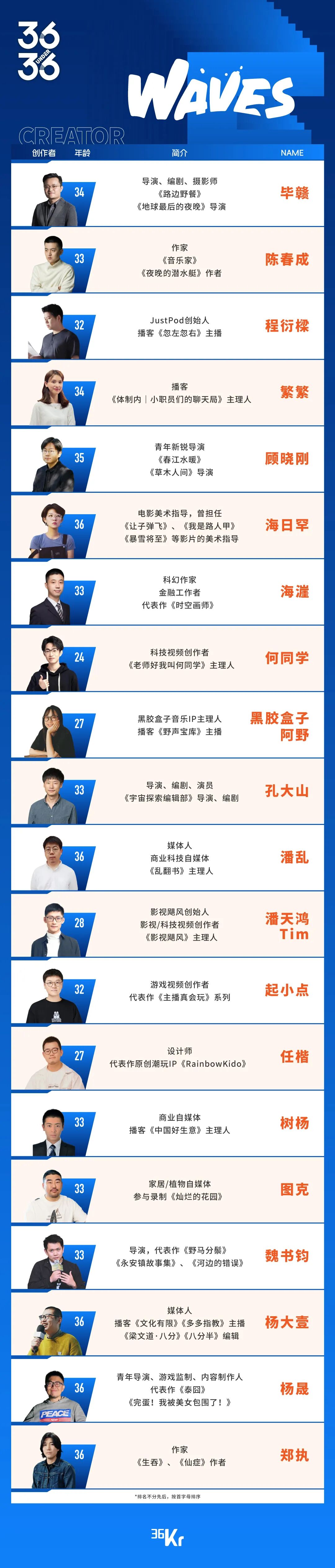
2024 Under 36 Full List
Ordered by entrepreneurs, scientists, investors, creators.



On Selection Rules and Peer Voting:
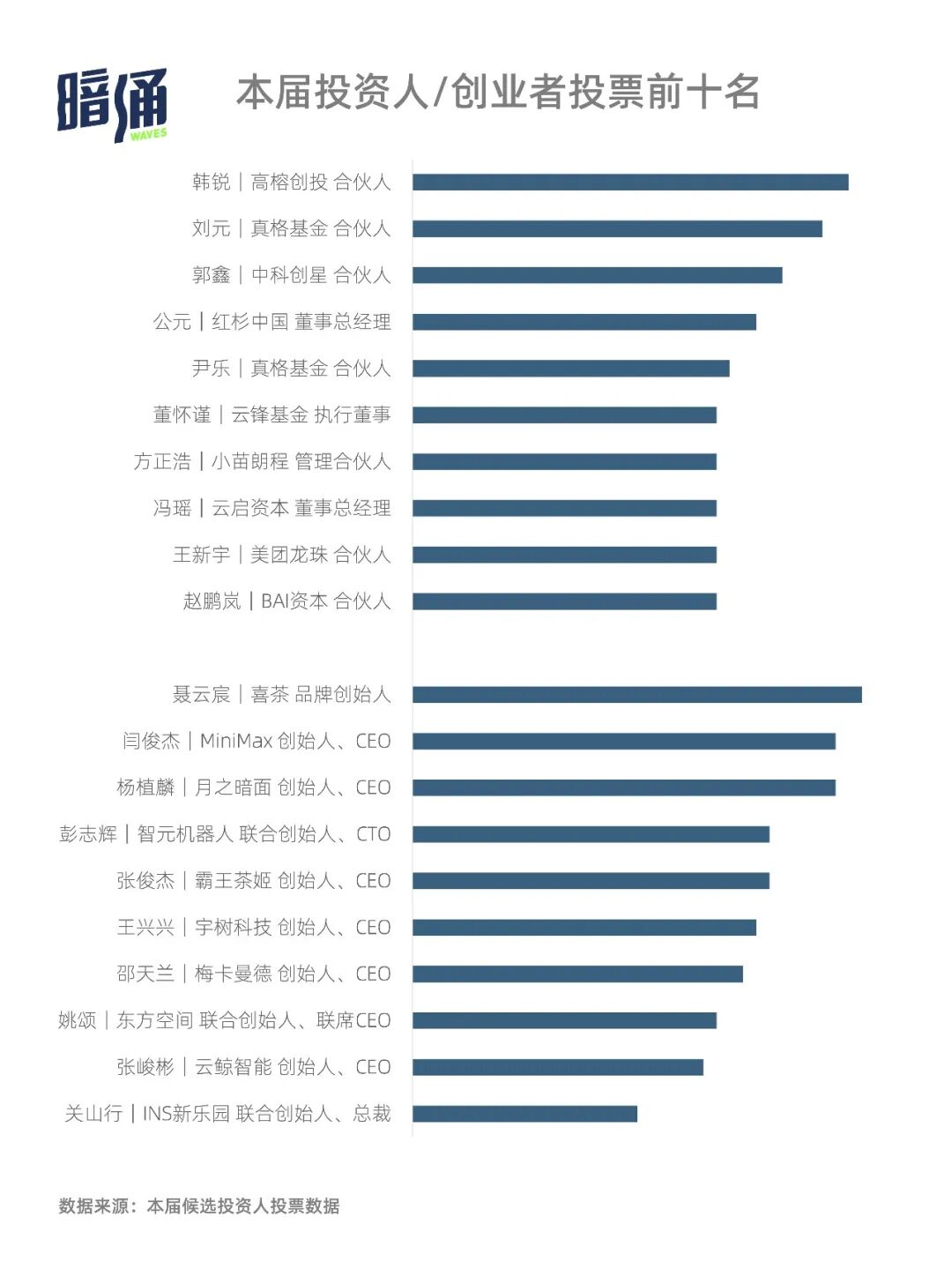
In the selection process, we adopted tailored approaches for different candidate types: Under 36 investors were evaluated on performance (70%) + peer voting (30%); Under 36 entrepreneurs and scientists were selected through Anyong Waves editorial pre-screening + investor voting.
In the Under 36 peer voting round, we invited candidate investors to vote on fellow investors, entrepreneurs, and scientists. This year's highest vote-getter among founders was Nie Yunchen; among investors, Han Rui. Other top vote-getters included new faces among U36 investors: Xin Guo, Yuan Gong, and Xinyu Wang. Among U36 entrepreneurs/scientists, two large-model companies, two tea beverage companies, and four robotics companies ranked highly.
Unlike previous Under 36 editions focused solely on innovation and venture capital, this year we expanded our search to include creators. During the technological leaps of a century ago, Einstein said: "Our technology has exceeded our humanity." This was our starting point for seeking creators, because we've become more acutely aware than ever of their importance in this era — just as AI surges forward with claims of fully replacing humans, those who can precisely and completely construct ideas, who can write a beautiful prompt, remain scarce.
They don't merely represent a voice or a group; they may also bear the identity of humanity's first architects of an ideal world. So we solicited and nominated them.
Under 36 creators were primarily selected through editorial "review committee" voting. The criteria: honorees should encompass diverse content creation forms, possess relatively broad public influence and certain commercial value, and demonstrate top-tier content aesthetics, creative ability, and technical craft in their respective verticals.
It's hard to imagine what the world would become if one day there were no people devoted to "imagination."
About the WAVES Conference:
We invite all 2024 Under 36 honorees to participate in the 2024 New Waves Conference, June 14-15 at Beijing Langyuan Station. Friends from all circles are welcome to scan the QR code in the poster below and join us at WAVES! See you there!
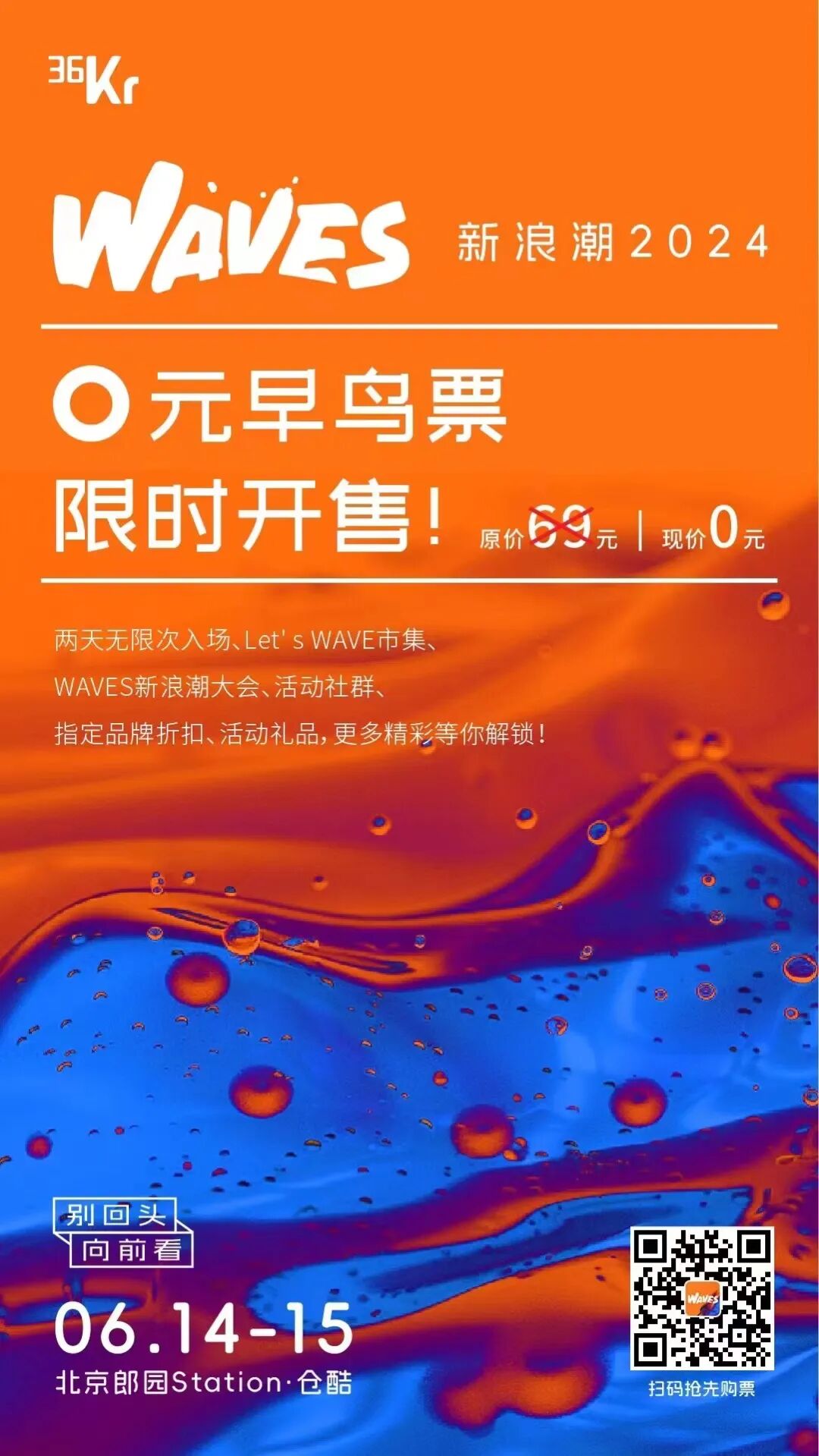
Image source | DALL·E