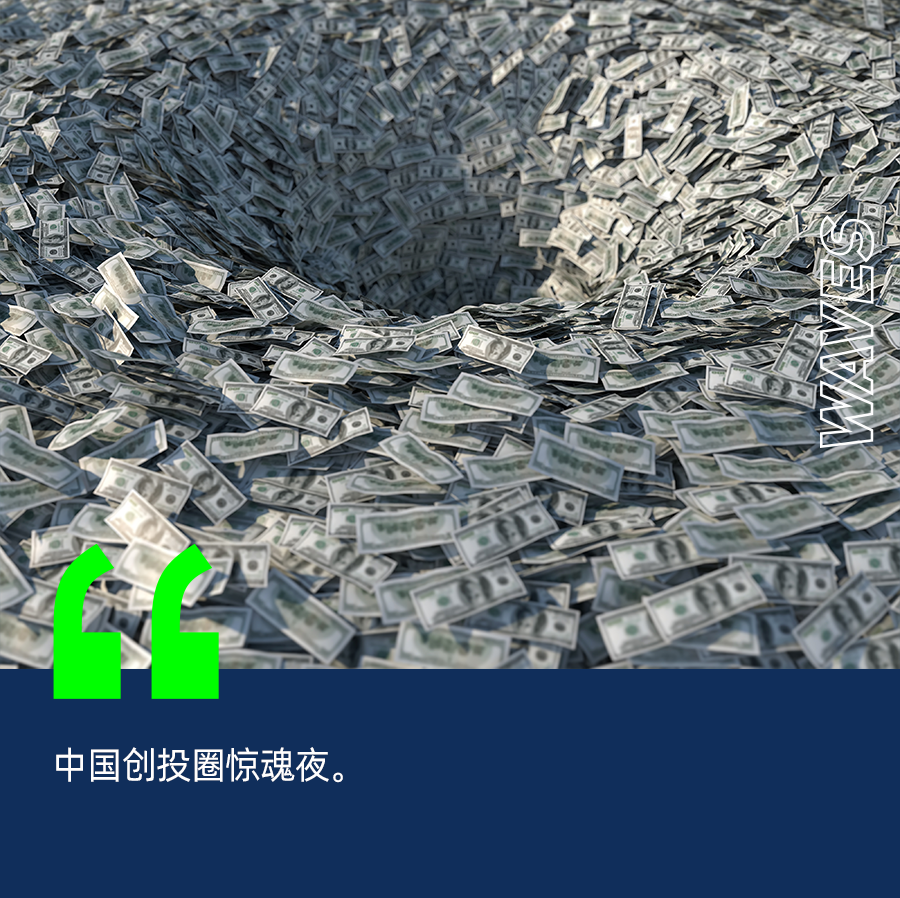
Silicon Valley Bank, a fixture in venture capital for four decades, couldn't survive 40 hours of market panic.
China's venture capital world had a night of shock and panic.
By Qian Ren
Edited by Zhiyan Chen, Jing Liu


March 10, 11:25 AM
The Final Window
After repeatedly clicking "Submit" and "Confirm" on Silicon Valley Bank's (SVB) website to initiate a withdrawal, Yan Zhao finally lifted his sweating hands from the keyboard and mouse — but his eyes remained fixed on the screen. Whether he could successfully retrieve nearly $2 million from SVB was critically important to both him and SEIMEI, the anti-aging biotech company he had founded.
"The $4 million from our Pre-A round at the end of last year — after partially injecting some into our domestic entity, we still had nearly $2 million sitting in SVB."
Two hours earlier, Zhao had been going through a routine medical checkup at the hospital. Around the same time, multiple investors sent him urgent messages with remarkably consistent keywords: SVB was facing a bank run, and if he had accounts or funds there, he should move them immediately.
At this point, just 28 hours had passed since the starting point of an epic collapse in the venture capital world.
At 5:00 AM Beijing time on March 9, SVB announced it would sell all of its $21 billion in available-for-sale securities, resulting in an $1.8 billion loss, and would need to raise $2.25 billion through common and preferred stock offerings. The combination of losses and fundraising was interpreted by Wall Street as a panic-driven asset fire sale and severe equity dilution. Overnight, SVB's stock plummeted over 60%, wiping out more than $9.4 billion in market value.
By the early hours of March 10, several top-tier US VC firms including Coatue and Founders Fund had advised their portfolio companies to strongly consider withdrawing funds from SVB as concerns about its stability mounted.
The bank run quickly materialized and escalated. By the time China's venture capital community woke from sleep, numerous Chinese CEOs who held their companies' primary funds in SVB had already missed the final window for rapid withdrawal.
After speaking with multiple sources, Waves found that on March 10, many founders couldn't even access the website. Even those who successfully submitted applications were met with a glaring "pending" status.
For all dollar-denominated VC firms and VIE-structured startups, SVB was an ever-present partner.
"Most traditional banks are unfriendly to startups, especially those with offshore equity structures. SVB was arguably the best — or only — option for many startups, which is why a large number of Chinese tech companies with VIE structures used it," one industry insider explained.
To address this, SVB hired numerous Chinese employees specifically to serve China's tech market. It even partnered with Shanghai Pudong Development Bank in 2012 to establish SPD Silicon Valley Bank.
On July 7, 2011, Meituan completed its $50 million Series B round. At a media briefing, CEO Wang Xing opened his laptop to reveal Meituan's SVB account, stunning the room with its $61.92 million balance. Among the nearly ten startups interviewed by Waves, virtually every company that had received dollar fund investment before Series B had chosen to open an account at SVB.
Former VC investor Zhuang Minghao told Waves that within traditional banking systems, loan approval focused primarily on factors like fixed assets and cash flow — metrics that were often "abysmal" for early-stage internet startups. SVB, however, had a sophisticated risk assessment system for high-tech startups refined over decades — its proprietary "secret sauce."
SVB was also bold in extending credit to companies. Zhuang summarized the difference with traditional banks this way: "If you've secured $4 million in funding from Hongshan and ask a bank for $1 million loan, a traditional bank will ask: Who is Hongshan? But SVB will say: The money's already hit your account."
As the byword for the "startup bank," SVB focused exclusively on B2B services for startups and venture capital firms, serving Silicon Valley and the global tech and VC industries through loans and fund-of-funds for decades. When it suddenly collapsed, innovative enterprises and investment institutions connected to the dollar ecosystem worldwide became direct victims. China — a major hub of innovation and venture capital for over two decades — naturally found itself in the high-risk zone.
A WeChat group named "SVB Post-Event Experience Sharing" gathered over 200 people within half an hour of its creation, expanding to 500 within three hours. With too many people wanting to join, a second group was opened. Members shared foreign media updates in real time, emailed and called the FDIC, researched fund transfer channels, and contacted lawyers. "This is pretty much all we can do right now," one entrepreneur in the group said helplessly.
SVB held the primary dollar account for Functor, a "no-code development platform" company. Early on March 10, after receiving "risk alerts" from two investors, founder Lu Jiheng quickly had his finance team log into SVB's website to initiate a transfer. "A substantial portion of the company's assets were in that account." In the crisis, this was virtually the only action he could take — but to this day, his withdrawal request remains pending.
Compared to platform companies with frequent capital transactions, capital-efficient tech companies like Functor were among the more severely affected in the SVB bank run. Because their funding sits in accounts for extended periods before being deployed to R&D, prolonged freezes or direct losses could cause severe liquidity problems, even bankruptcy.
"For Chinese startups, this was a collective free-fall," a partner at one investment institution told Waves.

March 10, 8:30 AM
Risk Beyond Comprehension
"Do not transfer any more money into the account these next two days!" Before even starting work that Friday, Liu Na's (pseudonym) phone was burning hot. As a GP at a dollar fund, she had just advised three companies nearing the close of their next funding rounds to "pause fundraising and withdraw money immediately." Now she was on the phone with an LP.
Just ten days earlier, she had contacted this LP to request a new capital call, with the "destination" being her fund's primary account at SVB. Now, for possibly the first time in her career, she was hoping the LP wouldn't transfer the money too quickly.
On the morning of March 10, finance teams at virtually every dollar fund and dual-currency fund in the market were likely instructed to do the same thing — attempt to transfer funds from SVB accounts to other, safer major banks. With no other choice, dollar fund GPs joined their portfolio companies in the bank run against SVB.
A partner at an asset management firm witnessed a GP requesting a withdrawal mid-meeting: "We were in a meeting when his secretary suddenly brought in a laptop for the boss to operate. I took one look — sure enough, it was a withdrawal from SVB." Two other investors were chatting over coffee when they simultaneously stood up to rush off — both needed to get back to their firms to approve withdrawals.
Similar to Chinese startups that had raised dollar funding, SVB was virtually every China-based dollar fund's preferred bank. On March 11 around noon, a list of investment institutions with deposits at SVB circulated in China's venture capital community. Among them were Hongshan, IDG Capital, Gaorong Capital, Xianghe Capital, and other top-tier firms, with multiple funds they had managed over the years all listed.
"Beyond becoming an LP to major GPs through fund-of-funds, SVB could also provide bridge loans and fill funding gaps for GPs — something most banks simply won't do," one fund manager noted. A key reason SVB was popular among dollar fund GPs: it could partially address fundraising concerns at relatively low cost.
Although domestic dollar GPs were also affected by the SVB collapse, with funds frozen in accounts, many institutions claimed the impact on them was considerably smaller than on startups that held their operating capital entirely at SVB.
Two dollar fund GPs independently told us that to adapt to changing external conditions, they had made adjustments to fund management last year, including but not limited to transferring funds to Singaporean banks.
Even for those who hadn't moved funds out of the US, established dollar fund GPs typically maintained accounts at multiple American banks, meaning SVB likely held only a portion of total liquid assets. Meanwhile, interbank transfers within the US were more convenient, allowing GPs to withdraw faster than startups.
Additionally, most dollar funds used a "capital call by project" approach, obtaining committed capital from LPs in multiple tranches aligned with investment pacing. Multiple dollar fund partners told Waves that after receiving a capital call, they would immediately transfer funds to portfolio companies, so the money wouldn't sit in the institution's account for long. "Right now, the account probably only holds some management fees, so the financial impact on investment institutions in this incident is relatively small."
But for funds that successfully raised capital in 2022 and hadn't deployed enough projects yet, or for mega funds with enormous fundraising amounts, the situation may be less optimistic — after all, management fees alone represent a substantial sum.
"Most GPs have surplus funds in their accounts after completing project capital calls," one dollar fund partner told us. Even with multiple accounts, SVB was typically an unavoidable primary choice.
This investor gave Waves an example: if a dollar fund needed to transfer $50 million in investment funds to a portfolio company soon, the GP might set the capital call amount at $70 million to leave room for the investment. Adding partial management fees and other investment balances, "it's quite normal for a top-tier dollar fund to have tens of millions or even $100 million on its books."
Multiple LPs told Waves that as the situation unfolded, just as investment institutions were monitoring their portfolio companies, LPs were closely tracking their GPs' fund status. But when asked "who bears the cost if institutional funds remain inaccessible for an extended period," neither GPs nor LPs could provide a definitive answer.
Clearly, SVB's collapse exceeded the venture capital ecosystem's conventional understanding of "risk."
"The SVB collapse may be the biggest crisis Chinese dollar funds have faced in 20 years — a comprehensive blow to the entire LP/GP/startup chain," Liu Na said.

March 11, 12:48 AM
The Lehman Moment for Venture Capital
"Silicon Valley Bank has failed and is now under the control of the Federal Deposit Insurance Corporation (FDIC)." This news alert appeared on the phones of all participants in China's primary market.
Local media reported that SVB was the second-largest bank failure in US history and the largest American bank to collapse since the 2008 financial crisis. At this point, less than two days had passed since SVB announced its securities sale.
The ending came this abruptly. When the news reached the other side of the Pacific, Chinese investors and entrepreneurs were still staying up through the night, frantically logging into the system during SVB staff working hours in the US to attempt transfers. SVB China's customer service lines were overwhelmed with calls.
In one early-stage VC's portfolio company group chat, at least five or six companies had over $1 million trapped. Another dozen or so companies had hundreds of thousands of dollars still in their accounts, with withdrawal webpages stuck at the login stage, ultimately failing to complete the process.
What would happen to the funds in these accounts?
According to Waves' understanding, the FDIC provides up to $250,000 in insurance per depositor, per bank. This means amounts up to $250,000 should be accessible starting March 13, but how amounts exceeding this would be handled remained unknown.
The FDIC later announced that SVB's headquarters and all branches would reopen on March 13. Foreign media reported that transactions pre-authorized before 11:15 PM Eastern Time on March 9 (12:15 PM Beijing Time on March 10) would be completed normally.
Yan Zhao felt some relief — he had initiated his transfer before the cutoff time, giving him a chance of successful completion. "If the transaction can't be completed, the FDIC might issue a portion of the amount exceeding $250,000 next week, but I don't know what percentage." Lu Jiheng was relatively optimistic: "SVB's main assets still exceed its deposits."
One LP analyzed for Waves that the likelihood of companies and institutions suffering complete losses due to the SVB incident was low; once bankruptcy liquidation concluded, funds should regain liquidity. "But this process could be very lengthy, and whether companies can survive the waiting period is unknown."
"This is the Lehman moment for venture capital." At 1:00 AM, upon learning of SVB's bankruptcy, one tech company founder posted this sentiment on social media.
In June 2008, Lehman Brothers, then the fourth-largest US investment bank, revealed massive losses. By September 10, Lehman announced it would sell assets and spin off $30 billion of troubled real estate assets. Five days later, after the US government refused to guarantee an acquisition, potential buyers withdrew from negotiations, and Lehman was forced to file for Chapter 11 bankruptcy protection.
There were indeed similarities. But even the "financial nightmare" of 15 years ago hadn't collapsed so quickly. The reason: the pervasive pessimism permeating Silicon Valley's venture capital community directly triggered the bank run that traditional banking fears most — becoming "the straw that broke the camel's back."
Before this episode escalated, multiple prominent US venture capital firms had already advised portfolio companies to withdraw funds from SVB. Months earlier, Greenoaks Capital, a VC firm managing $15 billion in assets, had warned its portfolio companies of risks; over a dozen portfolio companies subsequently withdrew approximately $1 billion from SVB.
"Actually, SVB only lost $1.8 billion on its bond investments due to rate hikes. But VC clients withdrew immediately upon hearing about its refinancing, leading to ultimate closure," one domestic investor observed. This illustrates at least two points: the market couldn't adapt to the Fed's rapid, aggressive rate hikes; and the venture industry, drained after the 2020-2021 liquidity flood, panicked at any negative news.
The precursor to collapse is often mania. According to analysis by financial blogger GMF in an article titled A Simple But Serious Retrospective of the Entire SVB Incident, in the second half of 2020, as the Federal Reserve's quantitative easing continued, global tech companies entered a fundraising boom. Massive amounts of cash and deposits flowed into SVB. Between June 2020 and December 2021 — just 18 months — SVB's deposits grew from $76 billion to over $190 billion, nearly tripling. By 2022, the Fed's rapid rate hikes made fundraising difficult for global tech companies and drove down stock prices. "But R&D had to continue, so they could only keep drawing down their SVB deposits." Over the year, SVB's total deposits fell by $16 billion, roughly 10% of total deposits, with non-interest-bearing demand deposits plunging from $126 billion to $81 billion.
In this context, whether venture capitalists or startup founders, many had become jittery birds, unable to withstand even a hint of bank instability. Though firms like Accel, B Capital, and Lightspeed vocally supported SVB, panic had already left reason far behind.
Would SVB become the first domino in a new financial crisis?
One veteran investor told us that SVB's failure wouldn't impact the global financial system as significantly as Lehman Brothers' bankruptcy. "First, SVB's asset scale and influence are far smaller than Lehman's; second, SVB's main business was in tech and venture capital, without extensive spillover into other higher-risk areas."
But for the tech and venture capital industry specifically, optimism was harder to maintain. Garry Tan, CEO of renowned startup accelerator Y Combinator, stated on social media that the SVB collapse affected 1,000 startups, one-third of which would be unable to make payroll within 30 days.
"This catastrophic disaster will set innovation and entrepreneurship back ten years or more," Tan said.

June 2004: Another Metaphor
Rewind to early 2004: 25 partners from world-class venture capital firms including Sequoia Capital, KPCB, Accel Partners, NEA, Redpoint Ventures, and DCM squeezed into business class on a plane, embarking on a six-day China exploration trip.
Though most of their time was spent sightseeing in Beijing and Shanghai, this trip directly catalyzed multiple major dollar funds' entry into China, opening the curtain on internet equity investment, and is considered by later generations as an extremely important historical moment for China's venture capital industry.
SVB, founded in 1983, was one of the most important architects of this moment. It was SVB that took the lead in sending out that historically significant first invitation to Silicon Valley and Wall Street for the China exploration trip.
At the time, the US was eager to recover from the 2000 dot-com bubble, and China appeared to them as "a new continent." Shortly after that trip, SVB established its first representative office in Shanghai in 2005, followed by a second in Beijing in 2010. Together with the successive establishment of China branches by dollar funds, this built the earliest venture capital ecosystem.
In fact, as early as 1999, SVB had conducted its first China exploration trip and immediately decided to replicate the Silicon Valley model in China. But without a banking license, SVB could only provide offshore dollar services for offshore-registered Chinese tech companies and consulting services for American clients operating in China. SVB never abandoned its pursuit of a Chinese banking license; the successful establishment of SPD Silicon Valley Bank in 2012 was viewed internally at SVB as the most important day since its China entry.
SVB's bankruptcy also triggered some domestic attention toward SPD Silicon Valley Bank. On March 11 at 9:20 AM, the bank issued an announcement stating it had standardized corporate governance and an independently operated balance sheet, and that it "has always operated in compliance with Chinese laws and regulations in a prudent manner."
If we step back from the most recent 24 hours, it becomes clear that SVB's fall can also be seen as another manifestation of the faltering dollar fund narrative of recent years. One investor defined the incident for Waves as "the disintegration of Silicon Valley's investment-lending synergy model," while others viewed it as another metaphor for the sunset of venture capital's golden age.
Sand Hill Road, west of Stanford University, is known as "the Silicon Valley of Silicon Valley." Along it stand Morgan Stanley, Draper Fisher Jurvetson, KPCB, Sequoia Capital, and Silver Lake — and at 2770 on this road, SVB's doors have temporarily closed.
Poignantly, SVB accompanied tech startups and its investment partners on Sand Hill Road for 40 years, yet those it once supported didn't even give it 40 hours.
(Waves analyst Guo Yunxiao and intern Yang Yitao also contributed to this article.)
Image source: Visual China
Layout: Guo Yunxiao




Recent WeChat Official Account Updates
🌟 Star Waves
Get information first