HETAN Intelligence Closes 50 Million Yuan Funding Round, as Robots Make Real Inroads into Labs
Veteran founders with backgrounds at Alibaba, Tencent, and WuXi AppTec.
"Veteran founders who cut their teeth at Alibaba, Tencent, and WuXi AppTec." By Zhiyan Chen

After an embodiment intelligence-saturated Lunar New Year, new funding rounds and product announcements in this space are once again surfacing at a breakneck pace. While videos of humanoid robots folding laundry, tightening screws, hauling packages, and doing backflips flood social feeds, a different kind of experiment has been quietly running for 50 days in the labs of BeiGene's Guangzhou Bio Island Innovation Center.
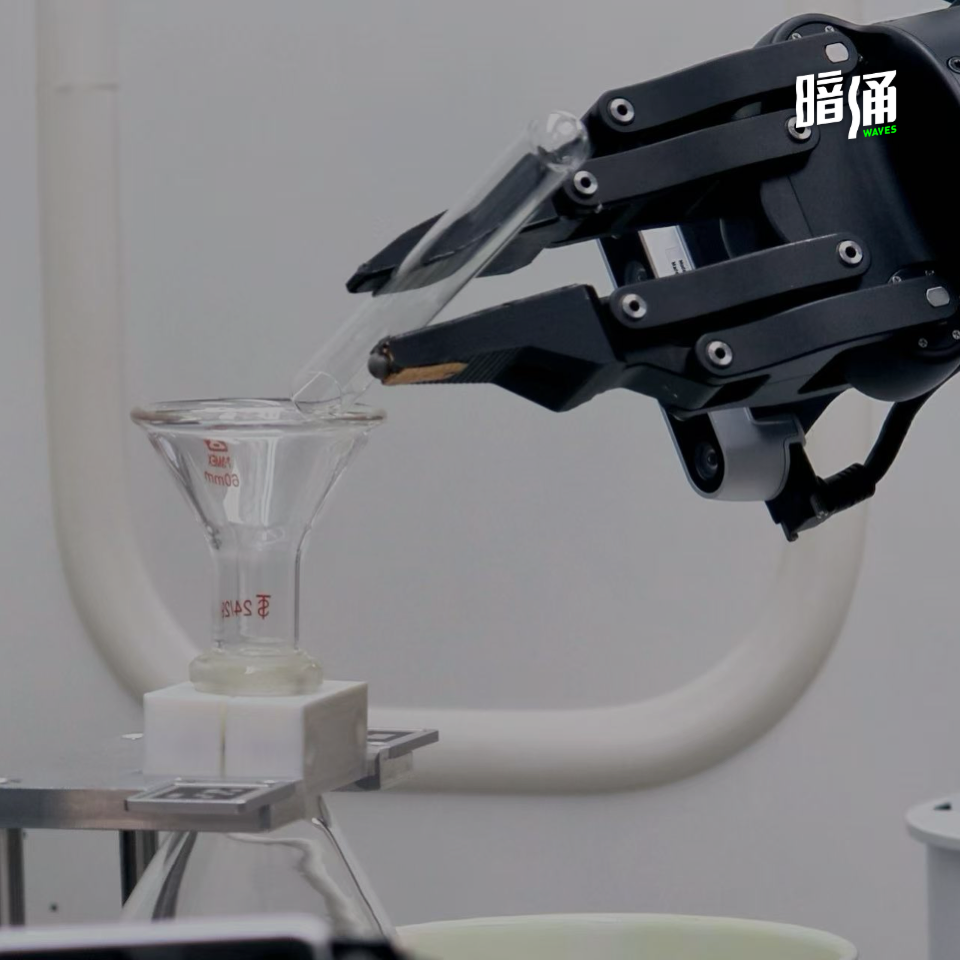
A mobile robot dubbed Talos — a "physical AI scientist" — is performing molecular purification, a tedious and time-consuming step in drug discovery that previously consumed over 50% of human medicinal chemists' working hours and demanded exceptional experience and manual dexterity. Over its 50-day pilot run, Talos has demonstrated performance approaching that of senior medicinal chemists, a first for the industry. In 15 completed molecular purification experiments, each involving more than 200 sequential operations — totaling over 3,000 physical manipulations — Talos maintained zero execution errors.
Dark Waves (「暗涌Waves」) has learned exclusively that its developer, C12.ai (合碳智能), just closed a new RMB 50 million funding round led by Yonghua Capital, with participation from VeriSilicon Ventures and individual investors. C12.ai's first round closed in August 2022, led by Yunqi Partners, with participation from Jingya Capital, BioMap, and individual investors.
The robot's form factor is hardly the most notable thing about Talos — the hardware itself is a standard dual-arm mobile robot available for lease on the open market. What matters is the brain C12.ai has implanted in it: through self-developed sensors, the company has trained the general-purpose robot in specialized laboratory operations and drug discovery prediction capabilities.
According to the company, Talos can not only autonomously execute end-to-end, cross-instrument experimental workflows like a skilled technician, but also perform real-time reasoning, planning, and error recovery during experiments through its proprietary vision-language-action (VLA) architecture. Its professional capabilities in specific scenarios have reached the level of human experts with 10 years of experience, enabling it to shoulder large volumes of repetitive bench work and free scientists to focus on more creative research decisions.
Yet for C12.ai founder and CEO Zhigang Chen, completing drug molecular purification is merely the first application for this robot.
In his vision, as Talos masters more complex ADME (absorption, distribution, metabolism, and excretion) experimental skills and process scale-up capabilities, there will be room for robotic participation in any scenario where "physical execution is the bottleneck to scaling" — including quality control in stem cell therapy, flexible small-batch, multi-batch production of designed biochemicals, and beyond.
Chen is a veteran of internet healthcare and pharma, having served as chief architect and head of algorithms and models at Alibaba Health, founder of Tencent Medical Big Data Lab, and the first chief digital officer (CDO) at WuXi AppTec. His entrepreneurial logic stems from deep reflection on the limitations of traditional "automation."
During his tenure as CDO at WuXi AppTec, he led a team that used algorithms to boost production equipment utilization from 40% to 60%. Yet he discovered that traditional automation equipment — those dedicated, single-purpose workstations — had fatal weaknesses: rigidity, high cost, and inability to be repurposed across scenarios.
"Traditional automation solved the standardization problem, but flexibility has always been its Achilles' heel," Chen told Dark Waves. "What we're building is a general-purpose, software-defined robot scientist."
This logic represents, in some ways, an evolution beyond the traditional CRO (contract research organization) model. The capabilities of traditional pharmaceutical companies and CROs have long been built on dense concentrations of specialized talent, process systems, and large-scale collaboration efficiency. Chen believes that when AI and robotics are deeply integrated, they may open an entirely new growth path for the industry — not replacing existing CRO giants, but complementing them to create a new collaborative paradigm.
To date, Talos's capabilities are already being explored beyond pharmaceuticals.
C12.ai is in discussions with international cosmetics brands to enable "flexible production of personalized skincare." A user simply takes a photo; AI recognizes their skin condition and formulates a custom blend, and the robot completes small-batch production overnight, delivering the product to the consumer through logistics. This leap from molecular-level mixing to flexible production lines aims to establish an extremely tight feedback loop between R&D and the consumer end.
Before the Lunar New Year, Dark Waves met with Chen. We spoke about Talos and its most critical brain, the possibilities of laboratory robots expanding into different scenarios, and the long-term future of human-robot symbiosis.
The following conversation has been edited for clarity —
Dark Waves: How has Talos's pilot run been going at BeiGene's Guangzhou Bio Island Innovation Center?
Zhigang Chen: So far we've run 15 real drug molecule intermediate purifications, with 14 successes — a 93% success rate. Purification demands enormous experience and manual feel; having a robot autonomously achieve this precision is a first for the industry. The goal is for robots to handle 80% of molecules in the future, freeing human scientists to do more valuable work.
Dark Waves: Why did you choose "drug molecular purification" as your entry point?
Chen: The demand here is unambiguous. About 50% of drug discovery time is spent on purification. In the past, after a scientist ran a reaction, they might not receive the product until day three. With our robot, it's done that same evening, and they can proceed to the next step the next day — cutting the R&D cycle in half.
Dark Waves: Beyond the robot form factor, how is Talos different from existing automation equipment?
Chen: Traditional automation is "custom-built for specific purposes" — dedicated machines for dedicated tasks. Change one workflow and you have to tear everything down and start over, with extremely high marginal costs. Our logic is: standardized hardware, software-defined capabilities. The robot is a leased standard product, but we've infused it with "skill libraries" and "muscle memory."
You can think of it this way: traditional automation is fixed units that require lab renovation, create data silos, and generate very limited logs. Talos is a mobile, general-purpose robot that operates existing instruments in current labs as-is. It doesn't need labs redesigned; it moves between workstations like a human scientist. More importantly, it's goal-driven, with real-time adaptation and error recovery capabilities, whereas traditional solutions can only execute predefined fixed workflows.
Dark Waves: Specifically, how do you imbue the robot with these capabilities?
Chen: Two levels. First, operational skills — using vision and force sensing to control the robotic arm for precise movements. Second, professional judgment — such as predicting molecular polarity, which requires specialized models. Only the combination of both forms a self-iterating closed loop.
We define precise actions like swapping pipette tips, liquid handling, and capping bottles as underlying "muscle memory." Laboratory workflows that appear complex are essentially decomposable into modular, Lego-like standardized skill blocks. To give the robot this sense of touch, we equipped standard robotic arms with self-developed sensors worn like "a watch on a human wrist." Through the combination of vision and force sensing, we've achieved precise control of the robotic arm at Talos's neural level, enabling it to perform difficult, delicate operations.
Dark Waves: The brain is the harder part, right?
Chen: Exactly. What we've implanted is a VLA architecture. This means the robot is no longer merely executing a preset fixed program, but possesses real-time reasoning and planning capabilities. When you give it an experimental intent, it first recognizes the intent, performs access management, then autonomously generates a detailed experimental plan. At the execution level, it perceives the environment in real time and adapts; if deviations occur during the experiment, it has self-error-recovery capabilities.
Dark Waves: Compared to home scenarios, is the tolerance for error higher or lower in laboratory settings? How is Talos's success rate?
Chen: That depends on which level you're discussing tolerance. At the safety level, laboratory tolerance is extremely low — even more stringent than home scenarios. A home robot might just bump into a sofa, but in a lab filled with chemical reagents and precision instruments, any physical collision could cause immeasurable damage. So Talos already has extremely high environmental awareness; when human scientists approach, it automatically stops to ensure absolute human-robot collaborative safety.
Dark Waves: What about at the execution level? That's the foundation for making your B2B business work.
Chen: At the business execution level, we need to view "success rate" rationally.
Currently, in real pharmaceutical laboratories rather than simulated environments, Talos has completed 15 molecular purification experiments, each involving over 200 sequential operations — totaling more than 3,000 physical manipulations — with zero execution errors by the robot. At the experimental results level, 14 of 15 molecules succeeded. The single failure was due to the molecule's solubility exceeding the current method's scope, not a robot operational issue.
This execution performance already benchmarks against human medicinal chemists with over 10 years of industry experience. In long-duration, highly repetitive tasks, robots have natural advantages in data consistency and standardized execution, because they can stably reproduce the same movements and parameters.
We're currently focused on handling 80% of routine molecular purifications. For the 20% of extremely complex cases requiring human expert intervention, the system identifies these in real time and flags them rather than forcefully trial-and-erroring.
Dark Waves: Beyond molecular purification, what other scenarios can Talos be used for?
Chen: Purification is just our "needle point" for entering the lab. Any scenario involving atoms and molecules in the physical world is theoretically Talos's stage. Within pharmaceutical R&D itself, our next move is very clear: ADME. This requires large volumes of precise liquid handling, with extremely high demands on pipetting range span and precision — which Talos can handle through autonomous tip changing and visual closed loops.
Zooming out further, in stem cell therapy, human entry into labs introduces contamination risk, whereas robots can maintain extremely high consistency and operate in fully enclosed or sterile environments. We're experimenting with using robots for process monitoring. Previously, process changes required lengthy regulatory approval cycles; if robots can generate complete data trails in real time, release timelines could potentially be compressed. Then robot R&D isn't just about efficiency gains — it's racing against time for lives.
Dark Waves: What about beyond pharmaceutical scenarios?
Chen: Take cosmetics. Currently, massive costs are piled into marketing, while the R&D end struggles to quickly respond to individual nuances. But Talos's flexible production line can actually enable this.
A consumer takes a photo; AI recognizes their skin condition (whether sensitive, dry or oily degree) and generates a bespoke formula. The robot receives the task and can immediately begin time-limited production, working overnight to dose, control temperature, and mix according to the formula, completing this kind of "small-batch, multi-batch" continuous manufacturing, then shipping directly to the consumer. If a system can meet drug discovery's demands for precision and process control, it can also migrate to scenarios like cosmetics that need flexible manufacturing.
Any physical scenario with "small-batch multi-batch," "continuous manufacturing," and "environmental adaptability requirements" is our target.
Dark Waves: So C12.ai doesn't want to be just a laboratory robotics company?
Chen: Of course not. I believe future manufacturing shouldn't be immutable assembly lines, but software-defined intelligent agents that can perceive the physical world and adjust in real time.
Dark Waves: How did you form this perspective and understanding?
Chen: I come from a computer science background, worked in Silicon Valley, and after returning to China spent many years in internet healthcare at Alibaba and Tencent. But the real turning point was my years as CDO at WuXi AppTec.
At WuXi I was responsible for the entire group's AI and digital transformation, and over those years developed deep intuition about the industry's growth model. CRO growth models depend heavily on specialized talent density, experimental resources, and process coordination. Business growth typically means teams, lab space, and supporting capabilities must expand in parallel, which creates organizational efficiency and cost constraints during scaling. Meanwhile, from an investment perspective, I also reviewed numerous automation projects and found that traditional automation solutions have fundamental flexibility limitations. Want to change an experimental workflow? Not only are hardware costs exorbitant, you might even need to renovate the lab.
I realized that to solve the "physical execution" scaling bottleneck, the only path is deep integration of AI and robotics, using software to absorb hardware differences.
Dark Waves: As an engineer, how do you understand scientists' pain points?
Chen: To cross this professional threshold, I spent a year self-studying chemistry and pharmaceutical knowledge, and repeatedly went into labs and factory floors to witness scientists' repeated trial-and-error, time pressure, and efficiency bottlenecks in real R&D scenarios. Only then could I truly understand their pain in the lab. So C12.ai's cognitive closed loop wasn't imagined out of thin air, but forged under top-tier business pressure through persistent reflection on "efficiency limits" and cross-disciplinary integration.
Dark Waves: Currently Talos has only taken its first step in the lab. To achieve what you describe — using software to solve physical execution scaling bottlenecks across different fields — does C12.ai have a timeline?
Chen: Our current roadmap follows the drug development lifecycle downstream. We've already launched in early-stage R&D — inverse synthesis AI plus small-molecule purification, which is the BeiGene experiment. Next is preclinical: ADME and process exploration with small-scale trials, where extreme precision liquid handling demands play to Talos's strengths. Further downstream is clinical-phase GxP-compliant production and analytical method automation — at this stage, the robot's value isn't just efficiency, but data integrity and compliance, which are hard requirements for pharma companies.
The ultimate vision is commercial production-phase HMLV (high-mix, low-volume) flexible lines, plus online QC and continued process verification. Simply put, we're not building a single-point tool, but having robots penetrate step by step along a drug's entire lifecycle. At root, we want good medicines to reach patients faster and more affordably.
Dark Waves: What do you think is the hardest part of this process? Convincing the "old world"?
Chen: Convincing the "old world" is certainly part of it, but harder is that when we first started, the outside world generally lacked sufficient confidence. Because this was inherently a classic contrarian bet.
This contrarianism has two dimensions. First, it's not a proposition that any single discipline can fully judge. You can't just understand drug discovery, or just understand AI, or just understand robotics — you have to see the real bottlenecks in R&D workflows, the current boundaries of AI capabilities, and the engineering constraints of robots in the physical world, all together. Precisely because of this, many people's first reaction to hearing about this direction is that it's attractive, but they'll also quite naturally ask: can this actually be delivered?
Second, the path the industry has been more familiar with is fixed automation workstations. That system has its value — high precision, strong stability — but suits relatively fixed workflows better. What we want to do is something else: have dual-arm mobile robots autonomously perform cross-instrument, cross-workstation delicate operations in existing labs. This is more difficult, so it's natural that outsiders initially had doubts about precision, environmental complexity, and system stability.
But conversely, precisely because it's difficult, once this path is validated, the moat established won't be just any single-point technology, but an entire cross-disciplinary, cross-system capability set.
Dark Waves: Finally, a small curiosity: why "carbon" (碳) in the name? You're clearly working with silicon-based things.
Chen: He (合) is synthesis; carbon is the fundamental principle of organic life. Though we use silicon-based algorithms and hardware, the entities we ultimately serve and the essence we connect with remain the laws of the carbon-based living world. That's our founding intention.
Operation demo | Video source: Company provided
Layout | Nan Yao | Image source | Company provided

Recommended Reading
The flow of money, the rise and fall of people