After a Six-Hour Conversation with Liu Jingkang, Here Are 35 Selected Quotes
Behind the Billion-Dollar Market Cap and Financial Reports.

"Behind the $100 billion market cap and the earnings report." By Qian Ren
Edited by Zhiyan Chen

Last weekend, Insta360 released its first earnings report since going public.
For the first half of 2025, revenue reached 3.671 billion yuan, up 51.17% year-over-year; net profit attributable to shareholders was nearly 520 million yuan, edging up 0.25%. The company doubled its R&D spending year-over-year in key technical areas, with R&D now accounting for 15.3% of revenue.
Ten days earlier, Insta360's stock had surged after the market open, pushing its market cap past 100 billion yuan. By the close on earnings day, it had neared 130 billion. Jingkang Liu, the "prodigy" born in 1991, had become one of China's youngest leaders of a hundred-billion-yuan company.
Founded in 2015, Insta360's ten-year arc mirrors Liu's own leap — one that embodies the company's "Think Bold" creed.
Yet what thrust him into the spotlight before the market cap milestone was an internal celebration. Liu was filmed tossing stacks of cash at employees, and the video ignited fierce debate. Admirers called it "the beauty of an upward economy"; critics decried it as a "humiliating act of condescension" that trampled on workers' dignity.
According to An Yong Waves, the event was not, as widely circulated, "celebrating Insta360's first panoramic drone launch," but rather a team-building activity organized by that project group to "thank the team for their hard work." But the outcome was clear: Liu's impulsive act, uncalibrated to his role as chairman of a listed company, had backfired. After all, impulsiveness has always been his trademark.
Whether it was cracking Zhou Hongyi's phone number from dial-tone audio as a student, ringing the IPO bell on the STAR Market in a company T-shirt while holding the latest Insta360 X5 camera, giving employees Teslas and Porsches at annual parties — 27 cars over seven years — or bolting an Insta360 camera onto a near-Earth orbit satellite, fully exposed to minus-30°C space, Liu has consistently defied conventional expectations of what a Chinese entrepreneur should be, both in business circles and among tech elites.
But impulsive showmanship isn't the whole story. One telling detail: he largely attributes his drive to accumulate wealth to "family." His daughter is the absolute protagonist of the life he records and shares through Insta360 cameras.
Wealth, even on paper, has always been the most visible part of an entrepreneur. Yet when one's identity shifts from founder to entrepreneur, one must eventually answer that question: What is entrepreneurial spirit?
Between late 2024 and June 2025, ahead of the IPO, An Yong Waves spoke with Liu twice. Between dense monologues on product advantages, corporate achievements, core competitiveness, and industry insights, he also candidly discussed his struggles with organizational management, his evolving understanding of people beyond "the work," his frustration facing cutthroat competition, and his reflections and convictions after ten years of entrepreneurship.
He said the hardest part of building a company remains "things related to people," and that he was seriously considering reordering the company's values from "customers first" to "employee development first."
At one point, he told us with unusual earnestness: "Making money is a must, but for Insta360, creation comes before survival."
The following are the most compelling parts of Liu's remarks, as compiled by An Yong Waves —
Part 01
On Competition
-
Five years ago, DJI was already the dominant player in drones, but after extensive research, we decided to prepare for our own drone business — at a time when the company was far weaker than it is now. The reason was simple: I've always believed drones can do far more than they do today. Companies that seize major opportunities all have accumulated advantages from previous cycles.
-
Many people have told me that "if Insta360 becomes another DJI, that would be incredible." But to me, that's not cool enough, not attractive enough. Facing a competitor of DJI's caliber, surviving and continuously creating new things is far more motivating than "becoming someone else." Taking the longer view, if Insta360 could one day thrive — or even thrive more — without me, that would be far cooler and more attractive.
-
I'm an INTP. But about a year ago I became less "P." Partly because I hired an assistant. Their core job is time management for me. Time management, organizational management — these are somewhat painful for me. My interest isn't in this area; I'm forcing myself to develop interest unilaterally. But it has to be done, because the company we're building has no reference point. I once thought DJI could be one, but it's not replicable.
-
Imaging is an open world. That sounds like a bold claim, but I genuinely believe it never runs out of opportunity, just like gaming — there's no day when innovation in games ends.
5. Frank Wang (founder of DJI) is inevitably a rival worthy of respect. From the perspective of an entrepreneur's duty — to make a company enduring and ever stronger — DJI has achieved that today.
-
Looking at the history of competition between companies, none were killed by underhanded tactics. Most that failed to compete ultimately fell because they didn't do what they should have done well. From that perspective, things become more peaceful.
-
I want to establish a kind of rule. Simply put: everyone races on their own hundred-meter track, eyes only on the finish line, focused only on whether they're running fast enough. You don't need to pull the person in the next lane, nor keep staring at them. I hope to build this kind of business rule.
-
Insta360 has been in competitive environments since its founding; only in the past two years have we actively chosen more direct competition. The purpose of this active choice isn't to destroy anyone or avoid being destroyed, but to temper ourselves — to become a twelve-sided fighter.
-
If you truly want to build a world-class company or world-class products, you must go through this (competitive) process. It translates into whether you can serve your customers well, and this is something we're very good at. You can only push yourself to make things extraordinarily good to have a chance to move forward.
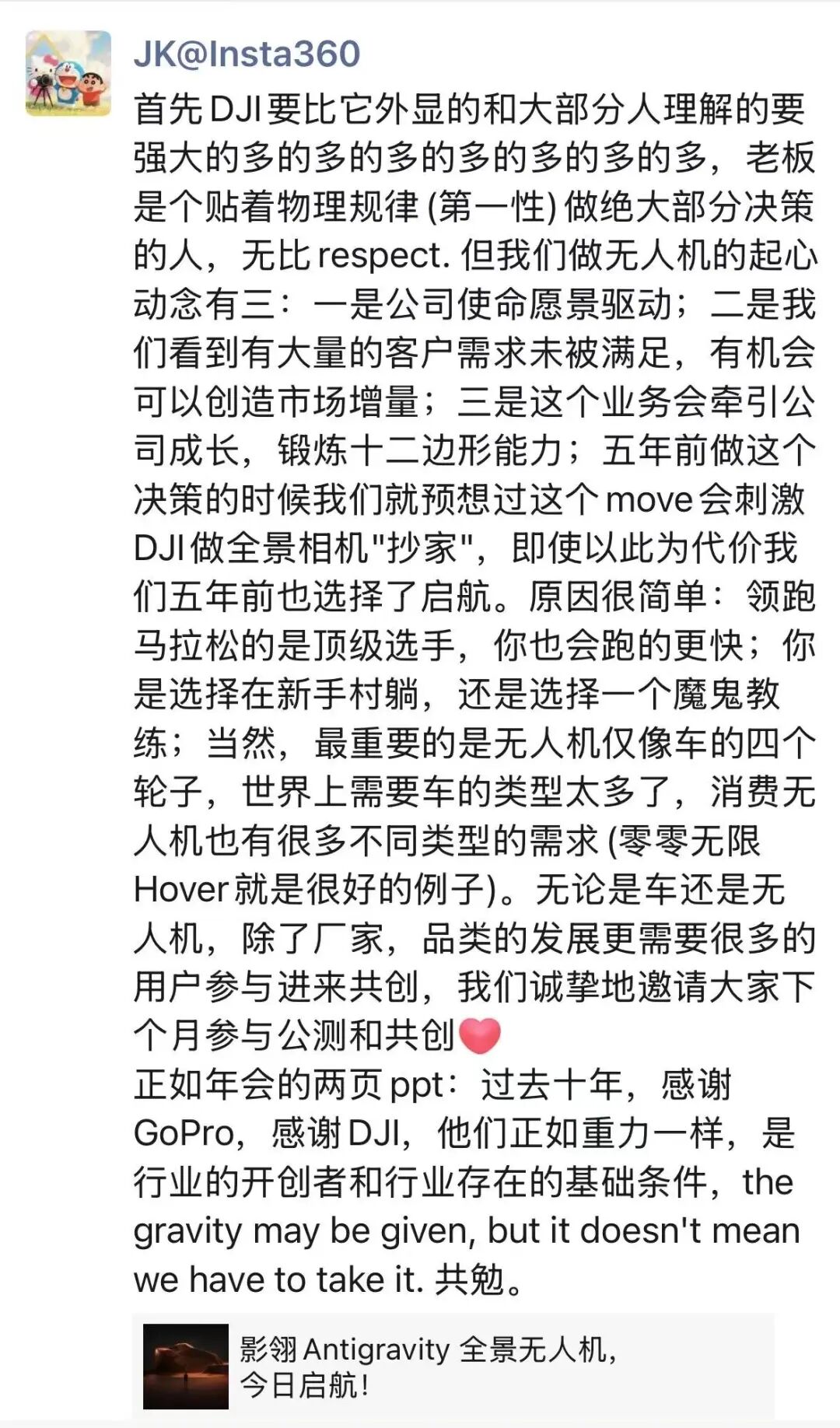
Caption: On July 28, Yingling Antigravity — co-incubated by Insta360 — announced its first panoramic drone; Liu posted on WeChat Moments the next day
Part 02
On Products and Industry
-
Having a single hit product and continuously expanding product lines are not contradictory at all. I see them as hedges. Because you can't guarantee that your core product's sales, market share, margins, and competitiveness will remain stable. Developing new products is fixing the roof while the sun shines — buying insurance.
-
The drone business is necessarily a dimensional upgrade. Choosing the most complex domain to build capabilities is certainly difficult, but like running a marathon, choosing to lead the pack is how you train yourself fastest and pull the entire team forward.
-
We don't make products that are "about the same as others but half the price." We make products priced similarly to — or even more expensive than — competitors, where users still feel they're getting great value.
-
"Find the nail first, then build the hammer" is our most important product methodology. For example, when a customer wants to buy a hammer, what they really want is a hole in the wall. Why do they want a hole? Because they want to hang a painting. If the frame could stick to the wall on its own, that would be a new market. I believe markets are infinite; it depends on what customers truly want.
-
Consumer electronics is a battlefield for smart people. The core is that the factors underlying product differentiation are numerous — technology engineering chains, talent density, and so on. There are far more smart people here than in other consumer categories. You're always competing with the smartest people.
15. Consumer electronics has no moat, so far. This isn't false modesty — we've tried to build one, but haven't yet. What's a threshold? Something where time can close the gap, eliminate it. What's a moat? Something where effort doesn't matter. Consumer electronics is a category where "genetic mutations" constantly occur. Technology keeps updating; if you don't iterate, someone will quickly surpass you. All foundations of brand-building rest on product advantage.
-
We tread on thin ice every day, watching trends, product and technology iteration speed, and margins. GoPro is the "old master" that created the category; as a younger challenger, we want to take it on — it's human nature. When we saw each other's revenue and profit statements in Q1 2024, we saw massive opportunity.
-
This is Insta360's tenth year, but livestreaming is something we did in 2014. The night we were coding in the office, GoPro went public. Seeing its promotional video, we thought it was cool. That naturally inspired us to make imaging tools, but we didn't actually enter GoPro's赛道 until three years later. The seed was planted then.
-
The greatest human trait is never learning from history. I want everything; I'm constantly bursting with product ideas, wanting to make things ahead of the entire era.
-
It comes down to a company's original intention. Ours is to create new things around our target customers. Our mission is to help people better record and share their lives — this is our first choice.
-
Our business requires continuous cash investment; sustainable cash can't come from external investment, it must come from operations. We were fortunate to become profitable starting in 2017, with products that "sell at volume from day one" — from a financial perspective, that's the best model.
-
Insta360's most fundamental starting point remains how to create new products. Making money is validation of efficiency, not creation for survival. There should be a balance between defending territory and creating.
Part 03
On Users
-
Imaging is an eternal human need. It can build independent worldviews and game rules. Imaging spans countless products; needs differ vastly across scenarios. Even taking a photo — today you might like this filter, tomorrow it changes. On Douyin there are thousands of effect templates, but even the coolest effect gets old after two days. Like clothing and fashion accessories, imaging is an open world.
-
Internally, our demand innovation department does market and consumer insights — for example, what are motorcyclists' pain points and psychological needs? We research demand thoroughly first. This department isn't evaluated on how many reports they produce, but on how many product innovation ideas originate from their reports.
-
Consumer choice logic broadly falls into two categories: one, you solve a specific problem for me that no one else has solved, so I choose you. The other, I don't know what to buy, but this brand is bigger and cheaper, so I'll buy this. We take the former path.
Part 04
On Organization and People
-
Before the IPO, someone told me, "JK, once Insta360 lists, you'll be the youngest CEO on the STAR Market." Psh, I thought that five years ago. Sure, it feels good, but that's about it. Going public is just a milestone; it doesn't solve today's problems. Honestly, the pressure is greater now, because the real battles haven't even begun.
-
This gold chain on my neck was a wedding gift from relatives; I only recently dug it out to wear. Actually, the whole look should include sunglasses — forgot them today. I want to change my image for company meetings, to hide my emotions a bit. My work often involves things falling short of expectations, and when I express that in meetings it can get intense, creating a high-pressure environment where people are afraid to speak up or make decisions.
27. The hardest thing since starting the company remains matters related to people. Resolving team cohesion, collaboration, and conflict issues. Selecting, deploying, motivating, and evaluating people.
-
One of my "-1s" (direct reports) whom I considered my "closing disciple" was poached by a company running 200 business lines simultaneously. I don't know if they made him an offer he couldn't refuse, but from my perspective, I felt betrayed. Later I didn't confront him; I even messaged: "Why don't you come back?" He didn't reply.
-
Insta360 has 3,000 people today. Four years ago we proposed "changing tires while driving" — the difference being that four years ago it was a car that had gone 80 kilometers, and now it's one that's gone 250. (Only now seriously thinking about organizational issues) Actually, it's a bit late. The better timing would have been five years ago. Back then, the company had fewer than 300 people. If I could go back five years, I probably wouldn't have expanded the business so quickly; building the team first or taking one thing deeper would have been a better rhythm.
-
Many giant companies may have one business supporting others, but we earn hard money. One person digging a hole in one link means everyone else has to fill it. This made me realize an important issue: our organization lacks elements of self-upgrading. So although our business targets are systematically set, product R&D targets were only systematically managed starting in the first half of last year. I recognized the importance of setting complex targets and the critical role of team collaboration within them, and began practicing this.
-
Whether doing livestreaming early on or cameras later, our core joy has been creating tools. So, I hope the company endures based on creation, not on my controlling resources and copying whatever赛道 looks good — that's not the logic. Also, I hope we're a learning organization, because the money we earn comes from developing and accumulating knowledge. This shares similarities with universities, but there aren't many organizational examples to reference in the business world.
-
I've also been rethinking the ranking of our company values. Previously it was customers first, employees second, shareholders third. Now I'm carefully considering swapping first and second. "Employee development first." Before, I always thought about what to do first, then what kind of people were needed to do it. Now, I'm thinking more about how to build the team, develop talent, and let them define how to do things better.
Part 05
On Jingkang Liu
-
I'm quite impulsive, which has a lot to do with never receiving negative feedback in the past. In college I was pretty outrageous — once got a disciplinary probation that nearly prevented graduation (hacked the school system and synthesized a "Nanjing University average face" from 7,000 student ID photos). But after that, there wasn't much negative feedback. I'm fairly self-centered, thinking more about my relationship with the world, myself as one link in a chain.
-
From day one of entrepreneurship I wanted to make serious money, and I still do today. But family is a major motivation for me. Insta360 has a trait: both I and my -1s are quite family-oriented. By your thirties and forties, there's always work you don't want to do — so why endure it? Or rather, what incentive do you get for doing good work? A young man living alone doesn't spend much, but once you have a family and kids, it's different — the feedback from incentives changes. Family is the common denominator for most men. As Cantonese people say: "When family is harmonious, everything prospers."
-
I think I count as an entrepreneur now. I have a personal distinction between founder and entrepreneur: whether you've started thinking and doing things to make a company enduring. If you just want to build a business, many things don't need to be done. But if you want the company to endure, you have to think about and do many things.

Recommended Reading
The flow of money, the rise and fall of people