Spring Comes Quietly to Guomao
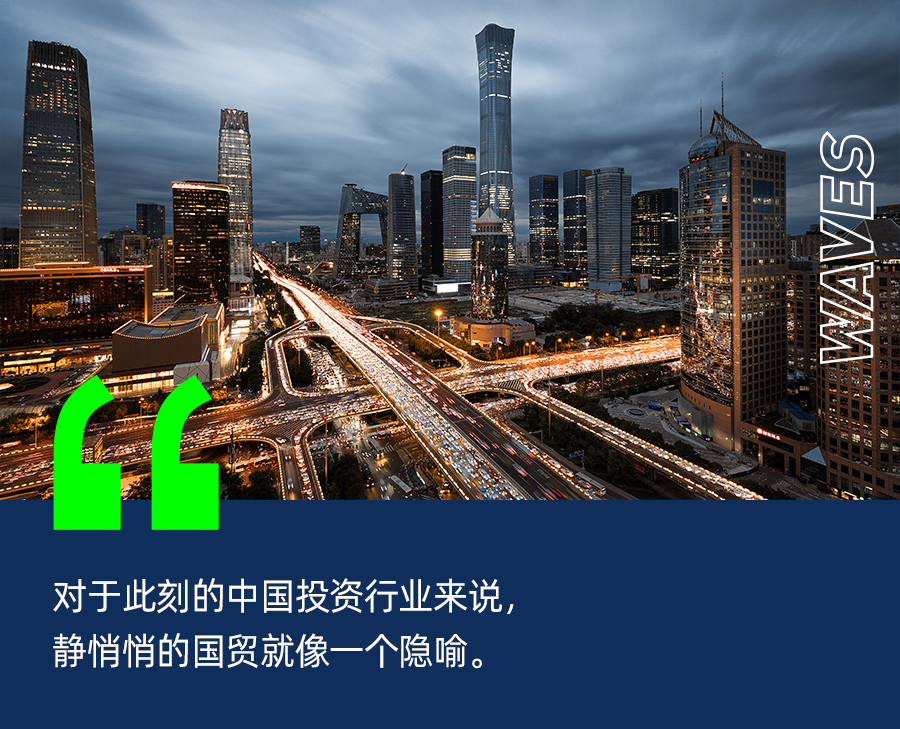
For China's investment industry at this moment, the eerily quiet Guomao feels like a metaphor.
By Lili Yu, Ren Qian
Edited by Jing Liu, Xuan Yang


This spring, Guomao is eerily quiet.
On May 5, an investor living in a nearby high-rise apartment photographed Jintong East Road at dusk. This main artery of the CBD runs north-south, just steps from Phases I and II of the China World Trade Center (CWTC), connecting landmarks like the Kerry Center and Fortune Financial Center. At this hour, it would normally be crawling with traffic. Now, only a handful of delivery riders cut through the emptiness.
Two days earlier, Beijing's COVID-19 press conference announced temporary lockdown measures for CWTC Phases I, II, and III — including the mall, office towers, and hotel.
This is now the third year of humanity's coexistence with the pandemic. Many are exhausted, even numb. Localized lockdowns rarely stir much reaction anymore. But Guomao is different.
As the city's financial nerve center, Guomao is to Beijing what Central is to Hong Kong, or Lujiazui to Shanghai. It hosts nearly half of the Fortune Global 500 companies, over 70 multinational corporations, more than 250 international financial institutions and law firms, and a cluster of China's most active VC and PE funds — ZhenFund, GSR Ventures, KKR, Primavera Capital, Yunfeng Capital, Warburg Pincus, among others — plus what may be Guomao's largest tenant, CICC.
In some sense, CWTC Phase III, with the priciest rents in the entire CBD, has also been a symbol of the rise of China's new economy and private equity industry over the past decade-plus. Its first fund tenants largely moved in after 2008 — the year of the Beijing Olympics, and widely considered the dawn of the mobile internet era. It was the fastest train China's funds ever caught.
Like any financial summit, the place reeks of urban sophistication and money. Beyond the gym on the 77th floor, the bar on the 80th, and the terrace on the 6th, the first-floor "Beersmith" is a regular haunt for investors. The coffee shops may not be especially dense — perhaps ten inside the office towers — but amid the Chinglish conversations, you can hear virtually any well-known company name, and what they're worth.
Though some funds have chosen to set up elsewhere as the city's commercial map has decentralized. Hongshan, Northern Light, BlueRun, and China Growth Capital are in the nearby China Central Place. Gaorong, Source Code Capital, and Joy Capital are in Wangjing. Hillhouse Capital and GGV are in Liangmaqiao. And a number of firms are based in Zhongguancun and other areas. Yet no one doubts Guomao's status as a landmark of China's investment industry.
COVID has undoubtedly been a massive variable for work. But for China's tens of thousands of investors, deeper forces are at play: when low-hanging fruit grows scarce; when viable sectors keep narrowing; when investment opportunities have undergone systemic change — with some no longer even fitting the fundamental logic of the investment business itself.
Data from Zero2IPO tells the story: in Q1 2022, China's equity investment activity dropped 27.5% year-over-year; disclosed investment amounts fell 47.1%.
For China's investment industry at this moment, the silence over Guomao feels like a metaphor.

Anywhere within Beijing's Fifth Ring Road, you cannot ignore the Guomao complex. These concrete towers standing at the end of Chang'an Avenue are impossible to overlook, yet feel strangely distant.
Especially CWTC Phase III — where the elevator from the 1st to the 80th floor takes just 38 seconds — a building that almost represents a life elevated above reality.
A professional who transitioned from traditional industries several times before landing in an investment firm's portfolio management role told Anyong Waves that only when she learned to dress "appropriately yet understatedly," habitually watched her calories, became fluent in English, and could accurately identify luxury brands along the way did she feel she had begun to "fit into Guomao." For years, every time she took the elevator from the 32nd floor transfer up, she could viscerally feel that life of "ascending into the clouds, capable of anything."
Perhaps this explains why funds, typically seen as masters of wealth, gravitate toward offices here. One dual-currency fund investor even told us that for many years, countless startups coming to Guomao for meetings would feel "a sense of ritual, as if at the summit of capital markets."
Thus even amid Beijing's glut of office space, Guomao's rents remain stratospheric. We understand that CWTC Phase III, for instance, held steady at roughly 30 RMB/day/sq.m in 2021, peaking at 33 RMB, and is now set at 25 RMB. That's higher than China Central Place, and far above another building favored by VCs in recent years — Genesis.
Because of these steep rents, an interesting phenomenon emerges: Guomao attracts more PE funds than VC. Typically, the former manage larger capital pools and have bigger office budgets.
The establishment of CWTC — especially Phase III — carries strong historical significance. The tower was completed in 2007, and its first tenants largely moved in around 2008. To one institutional investor, this timing made it "practically a symbol of the China opportunity." CCV founding partner Wei Zhou still recalls his daily routine at KPCB: sitting in the office or at some café in The Place, he could meet entrepreneurs from all corners of the country.
But around 2014–2015, he noticed the winds shift: increasingly, investors were the ones making the trek to startups.
After much deliberation, when founding CCV, Zhou moved the office to Wangjing — closer to early-stage companies, where elevators were always packed with coders from big and small tech firms. Newer funds like Gaorong, Yunqi, Joy Capital, Source Code Capital, and Hillhouse followed, making Wangjing another VC hub after Guomao, China Central Place, and Sanyuanqiao.
The gradual exodus of venture capital from Guomao reflects not just a radical shift in the investor-founder relationship, but also the broader restructuring of China's industrial landscape.
In the mobile internet era, headquarters of leading companies like ByteDance, Meituan, and Didi mostly clustered in Beijing, giving many dollar funds a natural geographic advantage. But in recent years, as investment sectors have fragmented, more opportunities have dispersed across the country, with different industries becoming heavily dependent on entirely different regions.
This industrial decentralization means VCs and PEs based in Guomao and China Central Place are constantly flying around. An investor in advanced manufacturing, new energy, or biotech likely has a travel map dense with Yangtze River Delta cities. Those in consumer electronics, robotics, or cross-border e-commerce need frequent access to Shenzhen and Dongguan. For new consumer brands, it might be Shanghai, Guangzhou, or Changsha.
Sector-hopping and investor mobility have become routine. An education investor switching to agtech, a media and entertainment investor moving to consumer brands, web3, or metaverse, an AI investor pivoting to hard tech — all unremarkable.
The primary market is reorganizing its order.

The ways COVID has disrupted investors' travel routines is the most common story we've encountered lately.
One dollar fund partner based in Guomao, unable to return to Beijing due to shifting prevention policies, first flew to Hebei, then hiked for an hour across into Beijing territory — a circuitous homecoming. Meanwhile, Guowen Zou, founder of healthcare-focused financial advisory Kaisheng Capital, after eating instant noodles, ham sausages, and tea eggs in his hotel for over ten days due to lockdowns, joked to us: "My hair is now even more explosive than Eddie Peng's." Losing over 10 pounds, however, was an unexpected bonus.
Stories like these may be a drop in the ocean amid the pandemic. But investors may be the profession most dependent on business travel.
For years, one VC partner would post his annual flight record at year's end — treated as evidence of an investor's diligence.
Xi Yu Geng, CEO of advisory firm LightStream, told Anyong Waves that the VC/PE industry is fundamentally a people business, meaning it relies heavily on judgment of individuals and face-to-face interaction. One state-backed fund investor told us: "When you can't meet offline, your read on people inevitably becomes distorted."
An investor at a dual-currency PE fund in Guomao told us he had previously calculated the office's per-capita desk count at four. But with many colleagues working remotely, the figure reached eight in recent months — "even the cleaning staff and drivers had multiple desks."
This isolation has also led to a buildup of negative emotions, leaving many in precarious mental states. One Shanghai-based financial advisor told Anyong Waves that in a recent video call he arranged between a founder and a partner at a top domestic VC, before they even got to the funding discussion, the two erupted into a heated argument over their differing views of the current situation. This FA professional, who had never seen such a scene in nearly 20 years in the business, gave up mediating after half an hour and hastily ended the call.
Of course, COVID's impact on investors extends far beyond harder travel and virtual deal-making. More noteworthy is the structural fracture the entire primary market is facing.
One FA that completed tens of billions in transactions last year told us that from Spring Festival to now, their deal volume is only in the low hundreds of millions in USD. This partner repeatedly emphasized that over the past decade-plus, the primary market has seen many cycles of boom and bust, with seasoned investors always stepping up to say "summer insects cannot speak of ice." But this time, the complexity has left no one daring to assert anything with confidence.
An investor at a multi-billion-RMB dual-currency fund near Guomao told Anyong Waves: for all of 2022, they have barely deployed capital. This is the state of many funds. Their main task is no longer investing, but portfolio management.
This investor told us that starting last year, their team began frequently using the phrase "beyond classical VC investment logic" to describe industry changes. Partners who for years loved to say "imaginative" began regularly asking in internal meetings: when exactly does this project start generating exits.
In the view of one partner at a top FA firm, this industry has always had less liquidity than others. "Perhaps because it's ultimately a respectable, reasonably well-paying profession." But now, that stability and continuity is itself being disrupted. This partner also revealed they are rebuilding their dynamic personnel lists, because many institutions have begun layoffs — "including partners at large funds."
The overall pessimism among dollar funds, from LPs to investors, has long been undeniable. But some investors see similar gloom spreading to certain RMB funds, with fundraising equally problematic.
One state-backed fund investor told us that with many LPs' operations suspended, their funding sources have lost many possibilities. "Moreover, many LPs need to conduct on-site due diligence and roadshows, but now they can't even meet face-to-face — it's simply impossible to execute."
In this market sentiment, even though lockdowns have limited impact on investors who don't need to be desk-bound, it feels more like a psychological hint that the industry has entered a prolonged hard mode.
When reality disappoints, the past gets filtered into something glittering. In interviews, some investors began telling Anyong Waves they miss 2020.
2020's beginning was equally rough. But as governments worldwide rolled out stimulus, liquidity flooded markets and quality assets in both primary and secondary markets surged. Many guochao consumer brands and enterprise services shot skyward.
Then the situation reversed sharply: the sudden freeze in online education put the long-term fate of dollar funds in China into repeated question; Pop Mart and Perfect Diary's IPOs ignited consumer investment, only for the "wealth-creation dream" to evaporate within a year; the wave of pre-IPO investors who piled into healthcare during the STAR Market boom are now largely deep underwater; and community group buying, once seen as China's biggest internet war, may have been the shortest-lived fad of all.
"All that is solid melts into air," one longtime Guomao investor told Anyong Waves.
A partner at a top FA firm said that beyond carbon neutrality and web3, which still have some noise, investment opportunities are otherwise unremarkable. As intermediaries who may need direction even more than investors, they are actively trying to create new deal flow.
In a few days, Guomao will likely return to normal. Jintong East Road will clog again. The cafés will fill with people talking big. The towers will stand straight into the sky as ever.
But this temporary stillness has let some see another side of the world. As the portfolio management professional mentioned earlier told us: every day she would pass a high-end porcelain shop in Guomao. Because her timing was consistent, she always saw the saleswoman in her pencil skirt, climbing a small ladder, lifting a cup or dish with her right hand while wiping the lower shelf with her left.
Day after day, she felt she saw Guomao's "other side" — a side that, of course, included the occasional layer of dust.
Image source | Visual China
Layout | Guoyun Xiao