After Traveling Halfway Around the World, a Post-'85 Woman Decides to Start a Business in Peru | An Yong's World View
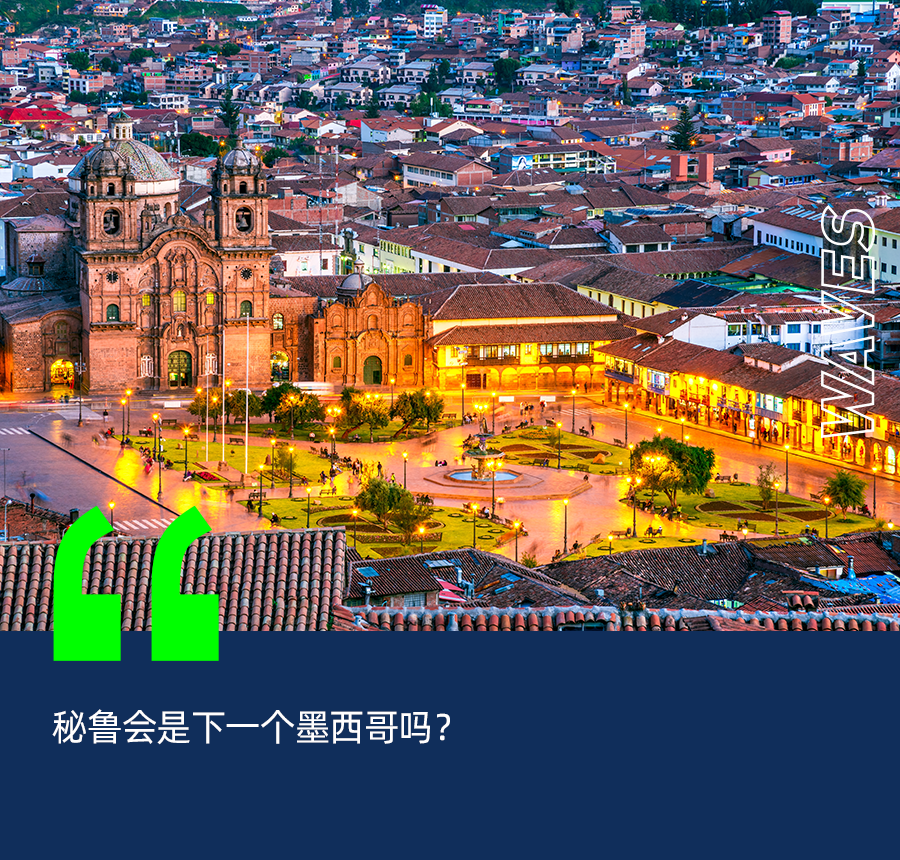
Will Peru Be the Next Mexico?
By Qian Ren
Edited by Jing Liu

Peru, a "neighbor" 17,000 kilometers across the Pacific from Beijing, has captured global attention. First came a state visit by China's president, followed by a joint statement deepening the comprehensive strategic partnership during the APEC summit. For venture capital and entrepreneurship, the key takeaway was the inclusion of emerging sectors like circular economy, sustainable agriculture, industrial and supply chains, and digital economy investment in bilateral cooperation. The two sides also pledged to advance collaboration in exponential technologies: artificial intelligence, robotics, IoT, blockchain, data analytics, nanotechnology, and telemedicine.
At the opening ceremony, Peru's president declared that the country "opens its doors to capital and investment funds from around the world," emphasizing Peru's legal and economic stability and its "clear rules of the game."
Today, Peru ranks as China's second-largest investment destination in Latin America, trailing only Brazil. This is especially true in infrastructure, energy, and mining. The power company that supplied electricity for APEC summit venues including the presidential palace, Lima city government, and airport — Peru's Luz del Sur — is actually a subsidiary of China Southern Power Grid, which completed its acquisition just months ago. Similarly, Peru's largest power company, LDS, was acquired and operated by Yangtze Power, a subsidiary of China Three Gorges Corporation, back in 2020.
The most eye-catching project is the Chancay Port north of Lima, a $3.6 billion China-Peru joint venture that locals affectionately call Peru's "Shanghai." The first phase of Chancay Port will cut maritime shipping time between Peru and China to 23 days, reduce logistics costs by over 20%, generate $4.5 billion in annual revenue for Peru, and create more than 8,000 direct jobs.
Despite the vast physical distance, exchanges between the two countries stretch back more than four centuries. As early as the beginning of the 17th century, Chinese arrived in Lima via the Manila galleon trade through Mexico, becoming the first wave of Chinese immigrants. In 1849, Peru passed an immigration law to import Chinese laborers. On October 15 of that year, the first group of 75 "contract workers" set sail from Macau aboard a Danish merchant ship, arriving at Peru's Callao Port after 120 days at sea. Today, Peru boasts the largest Chinese community in Latin America and the highest rate of Chinese political participation in the region.
For Chinese entrepreneurs seeking to go global, what opportunities does Peru actually offer?
Waves spoke with Duan Qi, a serial entrepreneur who has built businesses across Latin America. She is a rare figure with educational and professional experience spanning China, Europe, and multiple Latin American countries including Ecuador, Mexico, and Peru. Coming from China's traditional industries, she navigated the global expansion wave, eventually choosing to set up a factory in Peru. She brings deep knowledge of international engineering, manufacturing, cultural industries, and fintech across the region.
We may not find definitive answers in a single story. But the shifts of the era, the direction of the tide, and personal choices — embedded in each step of her career transitions — may offer some insight.
"Waves Worldview" is a new column from Waves. Over the past three years, we have gradually built out a series of globalization content, and we are now systematically rolling out more in-depth coverage. Latin America remains our current research priority.
The following is Duan Qi's account, as told to Waves and edited for publication:

A Life Across the Spanish-Speaking World
I majored in Spanish and spent a year as an exchange student in Spain during my junior year. Right after graduation, I was posted to Ecuador as an employee of China Railway Engineering Group (CREC), following the national "going out" strategy. CREC was primarily bidding for large-scale infrastructure projects in Latin America — railways, roads, bridges.
Over three years, I rotated through roles from interpreter to founder and manager of the human resources department. I resolved labor union issues that bedevil Chinese companies, studied Ecuadorian law, wrote analyses of Latin American labor unions, and handled difficult project disputes at every level. This experience taught me, from every angle, "how to work with Latin Americans and get things done."
After experiencing the full project cycle and accumulating business development experience, I returned to Beijing. Then I pivoted to Mexico, joining a private commercial real estate development firm in Mexico City, where I built the company's external affairs department from scratch.
At that time (2015–2018), Mexico hadn't yet seen a major influx of Chinese companies. Most were in traditional sectors: CREC, PowerChina, China Harbour Engineering, CNOOC; telecom firms like Huawei and ZTE; and some banks and financial institutions. Chinese companies were barely visible in Mexico's large infrastructure projects — those contracts typically went to European firms from Spain, France, and Germany, or to American, Brazilian, and Mexican domestic companies. But in just two short years, 2020–2021, China's "infrastructure mania" claimed several landmark Mexican projects: the Maya Train, the Mexico City Metro Line 1, and others.
Those years coincided with the USMCA negotiations. I gradually felt the changes and hopes this agreement brought to Mexico. Mexican economic and political figures made no secret of their admiration for China's rapid economic growth during the same period. They were plotting a development path with "Mexican characteristics," weaving a "Mexican Dream" for their people. I slowly sensed that the future of global transformation would unfold in Latin America.
After leaving Mexico, I joined a Shanghai-based foreign consulting firm focused on Spanish-speaking markets worldwide.
The business logic of consulting differs from the eight years I spent in physical industries — you interact with people across sectors and countries. Though this stint lasted only a year, it unlocked my understanding of virtually all Spanish-speaking countries globally, allowing me to observe Spain and Latin American nations' economic and political developments side by side.
So now I've returned to Latin America, witnessing the surging wave of Chinese manufacturing and internet companies going global, and planning to land my own dream here. On the manufacturing front, the factory project I'm involved with in Peru has officially begun processing various permits. In fintech, as local payment systems and consumer spending power grow, I'm working with local governments across major Latin American countries to prepare and launch related projects.

The Real Peru
When it comes to expanding into Latin America, many people ask me: which country should they choose?
I believe any overseas strategy detached from industry specifics and a company's development needs is one-dimensional and incomplete. Expansion strategy depends not only on a target country's political and economic factors — ruling party, exchange rates, inflation, currency stability, various taxes — but must also be weighed against the company's sector and core needs.
But one thing is certain: from Peruvian President Boluarte's visit to China in June to this APEC summit, the China-Peru strategic partnership has been advancing layer by layer.
The Protocol on Upgrading the Free Trade Agreement between the Government of the People's Republic of China and the Government of the Republic of Peru will strongly promote trade beyond traditional agricultural products and minerals, increasing exports of Peru's high-value fishery products, integrating global supply chains, and developing e-commerce — creating a better business environment for companies in both countries.
The recent Joint Statement on Deepening the Comprehensive Strategic Partnership also clearly outlines specific future cooperation directions.
Particularly significant is the iconic China-Peru joint project — the Chancay Port, now operational. This port transforms Peru into a gateway for South American trade to Asian markets, directly altering global shipping history. In Peru, "De Chancay a Shanghái" (From Chancay to Shanghai) has already become a popular saying.
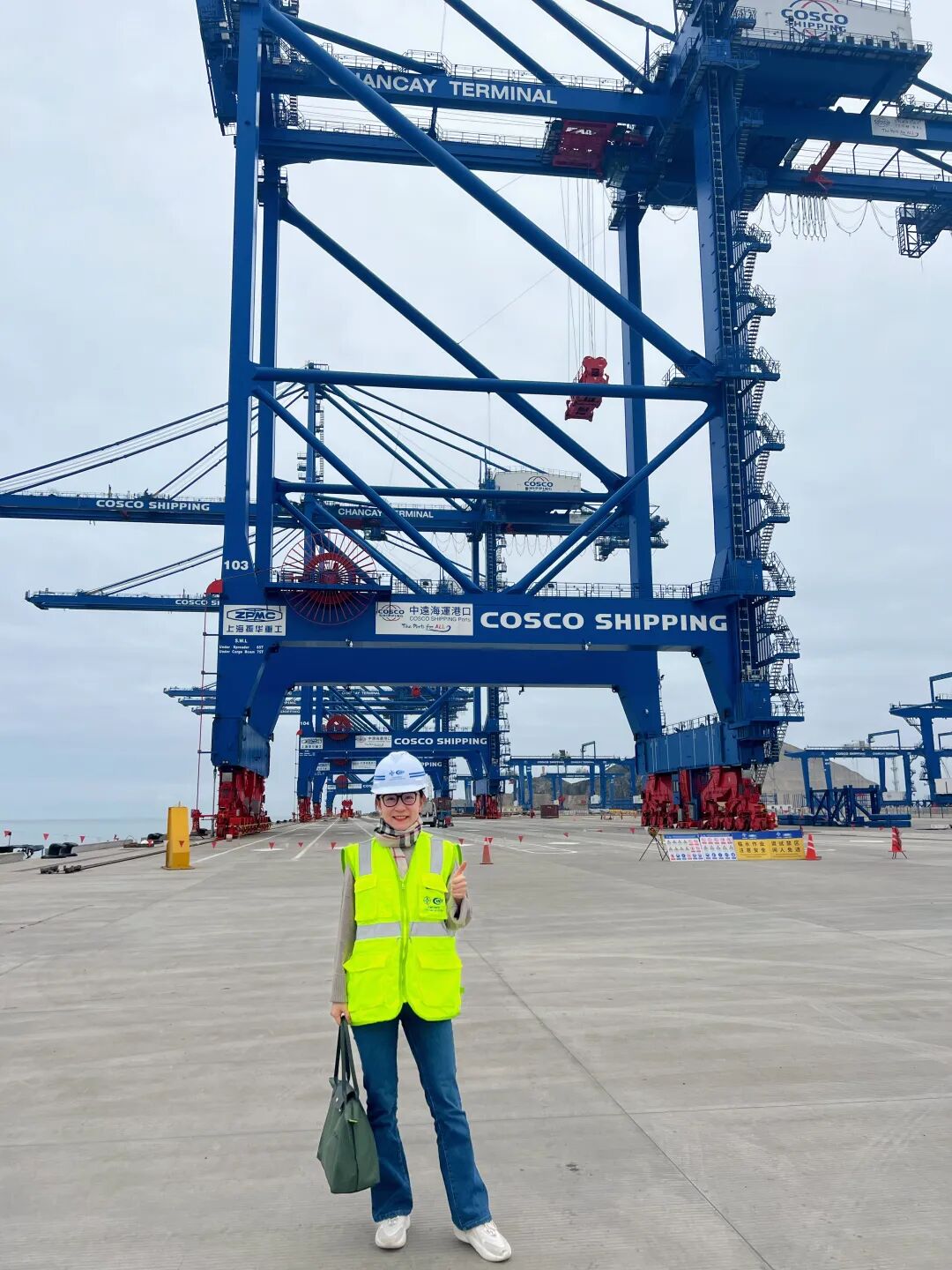 Visiting the Chancay Port under construction, August 2024 © Duan Qi
In recent years, as China's manufacturing sector has sent strong signals of going global, I've been researching the feasibility of extending operations to Latin American countries. Peru is one of the "blue ocean" countries I've identified.
Although Peru's overall industrial manufacturing technology remains at what I'd call a 2.0 level — concentrated in agricultural and livestock products, apparel and accessories, food processing, building materials processing, and mining product processing — the Peruvian government has in recent years introduced a series of tax incentives to attract domestic industrial manufacturing development. These include customs duty refunds for exported goods and special customs and tax regimes for special economic zones.
Currently, very few Chinese-funded factories have actually landed and begun operations in Peru. The space for capital to enter, accelerate industrial upgrading, and diversify industry categories is enormous. Peru is projected to rank second in Latin American industrial production within two years, behind only Mexico.
When you leave home for a foreign country, the first things you examine are market space and stability. Based on my own observations, Peru is one of the few Latin American countries where the economy doesn't fluctuate dramatically with changes in political power — it's entirely market-determined. Housing prices in capital Lima have barely changed over the past decade. Inflation has stayed around 2% for years. The USD exchange rate has held steady at roughly 1:3.7.
The Peruvian government's efficiency and seriousness also exceeded my expectations. Take my current project: in early communications with the Peruvian government, officials from the Beijing branch office to the Lima headquarters were extremely proactive. In the three months before our official inspection trip, we held nearly 10 video conferences, and they produced over a dozen updated reports related to the project.
With a 13-hour time difference, they would often come to the office at 7 a.m. Peru time for meetings with us. During our on-site visit, the government arranged the full itinerary and assigned two officials to accompany us throughout. Sometimes after one meeting, if we felt we needed to add another, they would immediately send official communiqués to coordinate timing, location, and participants.
When communicating with potential local partners, we once received a service quote ten times above market rate. A Peruvian government official immediately told me: "This company is trying to deceive you — don't believe them. You need to meet with more companies of the same type and decide carefully. Some Peruvian companies see foreign faces and try to take advantage. Before you invest, you must do thorough market research. We will fully cooperate. You need to understand the real Peru."
You can sense pragmatism and sincerity in countless details. This may be connected to the status of ethnic Chinese in Peru.
Peru has the highest rate of Chinese political participation in Latin America. In politics, Chinese-Peruvians have served as congressional speakers, prime ministers, and cabinet ministers; congressional representatives and local officials are numerous. In business, Chinese-Peruvians have long operated in retail, restaurants, and construction, with some retail chains becoming industry leaders.
Chinese-Peruvians born in Peru are called "tusan" (from the Cantonese "tosan," meaning "native-born"). They generally strongly identify with this identity, and many can clearly trace which ancestor was the Chinese immigrant. People of Chinese descent make up one-tenth of Peru's population — a staggering figure — so Peruvians are naturally friendly toward Chinese people.
Food capital Lima hides over 4,000 Chinese restaurants called "Chifa" — a homophone for "eat rice" (吃饭), from the affectionate call of Chinese laborers: "Time to eat!" The Chinese Benevolent Society (Tong Hui Zong Ju) in Lima's bustling downtown has nearly 140 years of history, bearing witness to China-Peru friendship.
China and Peru are indeed in a "honeymoon period." According to the Chinese Chamber of Commerce in Peru, China's total investment in Peru stands at least $35 billion, spanning mining, infrastructure, energy, telecommunications, and services.
Chinese enterprises' major investment activities in Peru trace back to 1992 — when Shougang Group purchased 98.4% of the nearly bankrupt Peruvian state-owned iron mining company for $118 million, including permanent exploration, mining, and operating rights to its 670.7 square kilometers of mining concessions.
Today, Chinese-funded enterprises of all kinds are flourishing in Peru. For example, China Minmetals Corporation invested in the Las Bambas mine, which has paid over 12.8 billion yuan in taxes to the Peruvian government since beginning operations in 2016.

If You Can't Beat Them, Join Them
When I first arrived in Latin America over a decade ago, I assumed it would be similar to Africa. I later discovered the objective conditions were far better than imagined — after all, 300-plus years of Spanish rule meant its economic and judicial systems, traditional customs, and national consciousness were deeply shaped by European culture.
But this history also leaves Latin Americans with mixed feelings toward Spain, so they commemorate their independence wars in various forms. Simón Bolívar and José de San Martín, the liberators of the Americas, have squares named after them across Latin America — they represent the region's national spirit.
Ecuador was my first Latin American country. Located on the equator, it's small in territory but complete in geography and rich in resources. Capital city Quito sits high in the Andes.
I'd say half my temperament was worn down by Ecuadorians. For instance, when we'd schedule meetings with locals, they'd always reply "mañana" (tomorrow). But when tomorrow came and you asked again, they'd say "mañana" again. If by Wednesday it's still "mañana," that week was basically a wash. Weekends? Complete disappearance.
Because they deeply value family atmosphere, weekends are absolutely for family. All work communications are automatically blocked — texts, calls, emails, all ignored. For Chinese people who value efficiency and precision, this work rhythm is incredibly difficult to adapt to, and deeply frustrating.
Later we got clever. If we wanted a meeting next week, we'd start asking from Monday, confirming every other day until it was locked in. And on the meeting day itself, we'd remind them again. Even then, showing up late was standard operating procedure.
Once I went to the national tax office to handle something. There was a fee that, if unpaid immediately, would incur a fine. But when the government office hit us with the "mañana" attitude, I got anxious on the spot. The clerk looked at me, baffled: "Why are you angry? Please calm down. I told you to come back tomorrow, so you can only wait until tomorrow." We both knew this "tomorrow" could stretch indefinitely. We ended up paying the fine.
But in stark contrast is the serious, even rigid execution of Latin Americans — especially Mexicans and Peruvians.
For example, the gardener we hired in Mexico was extraordinarily responsible about trimming and shaping trees, with meticulous attention to detail. On a project, we could have used more cost-effective materials and finished faster and easier, but the owner and supervisor refused simply because the material's "standard" wasn't from their own country. They were willing to pay significantly more for the "standard."
In Peru, I found Peruvians' work ethic rivals or even surpasses that of Chinese people. I'd receive messages and emails from lawyers and government officials at midnight — completely overturning my impression of Latin Americans as the embodiment of "relaxed." At the same time, Latin Americans are deeply humane and care about human welfare, something visible in urban infrastructure.
A Latin American friend once told me: "Work isn't everything in life. We work to better enjoy life." Another said: "We never kneel to make money." These two sentences struck me profoundly. I began to understand and accept Latin American work practices — unheard-of concepts in China like "biweekly pay," and Ecuador's Labor Law-mandated "dignity wage."
If you try to hustle in Latin America, it's like punching cotton. So after all these years working with Latin Americans, I've learned one thing: if you don't understand it, join it — and you'll absolutely unlock another possibility in life.
As a post-85s woman, what strikes me most after over a decade in Latin America is this: you must forget your age and gender at work to earn everyone's respect.
The difficulties, only you yourself truly know. I've broken down in tears at negotiations when pressure mounted and consensus seemed impossible. I've spent days on construction sites communicating with workers or holding alignment meetings, then returned to camp offices at night to organize employee files, documents from the national labor department, and study local laws.
One thing I felt particularly proud of: a Visto Bueno (employee bad record) that many Chinese companies had failed to obtain from the national labor ministry — through my team's efforts, we successfully registered two local workers who had violated work norms.
Many stories are unfolding in Latin America, and we're resolving quite a few "incidents." Regardless, the path for Chinese companies expanding overseas now is: doubt Latin America, understand Latin America, and ultimately become Latin America. After all, we're on their land, doing what we want to do.
Waves is recruiting fellow travelers to join us in the regions we cover. If you're interested in globalization themes, we invite you to scan the code and participate in the Waves Odyssey survey. We look forward to pooling ideas and building an interactive, exploratory "globalization journey" community.
Image source | IC Photo