Baichuan's First AI Application Investment: Building an Investment-Focused Xiaohongshu for Gen Z
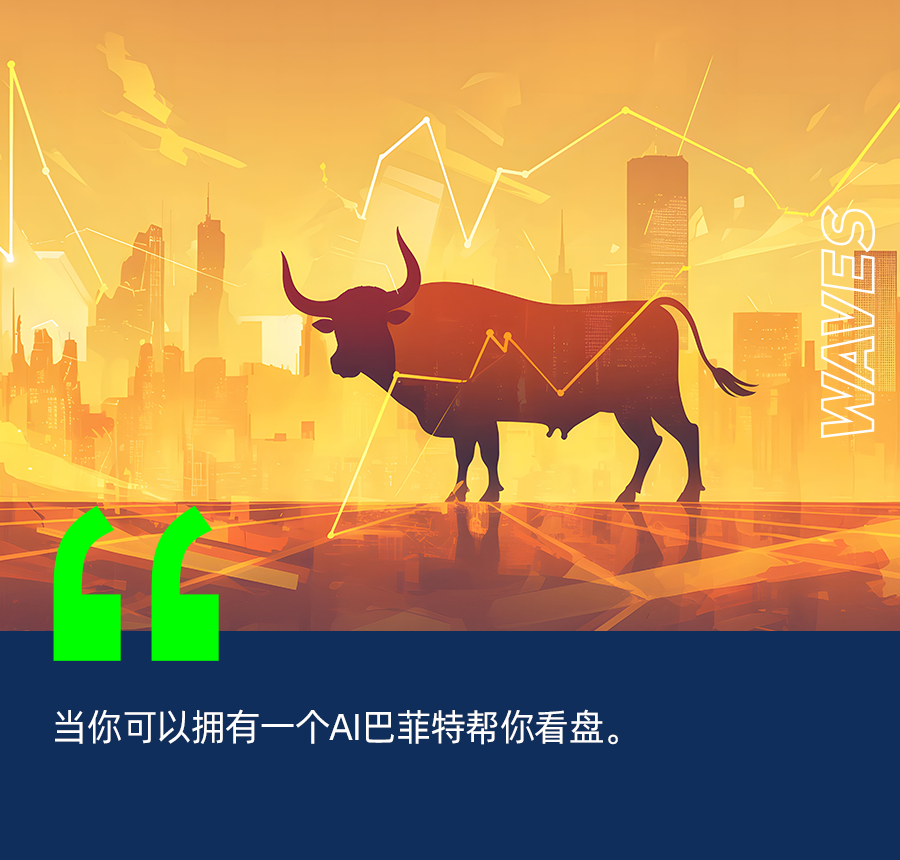
When you can have an AI Warren Buffett watching the market for you.
By Lili Yu
**

Wang Xiaochuan, founder of Baichuan Intelligence, was her first boss. Tang Jie, a professor at Tsinghua University's Department of Computer Science and Technology, was her project advisor. And she served as the undergraduate counselor for several founders of Moonshot AI. Among China's AI application entrepreneurs building on foundation models, few have navigated the interpersonal map of China's base-model world as prominently as Xu Danqing. Of course, none of this quite matches her other bond with large language models: on the day ChatGPT was born in 2022 (December 1, China time), she gave birth to her first child.
For a female founder, this was, in a sense, a fateful calling. More rationally considered, she is also among the most qualified people to tackle AI + finance right now.
As early as her junior year in 2009, Xu studied under Professor Ma Shaoping at Tsinghua's AI Lab, using deep learning methods on social and news data to conduct research on financial market prediction. She went on to publish two papers as first author at top AI conferences and received the global Siebel Scholars Award in 2012.
After graduation, Xu first built AI assistants at Sogou, then spent over a decade in fintech, working at Xiaomi and DataYes (Tonglian Data), continually exploring how to better integrate AI technology with financial scenarios.
During the 2024 Spring Festival, Xu founded ZhiCe LingHang (智策领航), an AI-native application company focused on finance. Not long ago, ZhiCe LingHang received a strategic investment from Baichuan, becoming the first AI application company Baichuan has ever invested in. It has already launched its product CaiDaZi (财搭子), with a mini-program version now live.
On how to redefine an investment tool for Gen Z investors, and how an AI + finance application company can break through the gaps between tech giants, large model companies, and traditional financial institutions, Xu has her own thinking. Below is her account:

The First Three Term Sheets
In February 2023, before my maternity leave had ended, I returned to DataYes. Around then, Professor Tang Jie reached out, hoping I would join Zhipu AI.
Back when I was studying at Tsinghua's Department of Computer Science, Tang Jie was my project advisor, and we attended many academic conferences together. We had also talked extensively during Zhipu's early startup days.
That day, we spoke at length. He shared his 5-10 year vision for Zhipu, and his earnest faith in AGI deeply moved me, pushing me to think about what my own life's mission would be for the next decade.
It took me about a year to answer that question. My experience in fintech over the past decade taught me that AI only shines when combined with real-world scenarios. So I decided to build one of the first AI-native applications for AI + finance.
After the 2024 Spring Festival, I quickly assembled a five-person core team. I then went to Professor Tang Jie and asked if he would support me. He said no problem. Zhipu had a Z Program providing investment and technical resources to startups, but since it was still an incubation fund at the time, it could only co-invest. He had me go gauge the market.
After talking to four or five firms, I received three term sheets. The first was from a top-tier fund that had invested in many AI companies. Their managing partner had been remarkably prescient during the mobile internet era. We discussed MoE architecture, the particularities of finance, and the AI application ecosystem at length. Drawing parallels to the previous generation of mobile internet development, he told me the road ahead would be long, and that I needed to stockpile ammunition, patience, and expectations — making sure I got on the field and stayed there.
Then a senior alumna introduced me to Tsinghua's innovation and technology investment platform Muhua Venture Capital. She happened to also be a seed-round investor in Baichuan, so Muhua and Baichuan decided to invest in us together.
Wang Xiaochuan and I had actually known each other for quite a while. Around 2012, when I was a graduate student at Tsinghua, he was pursuing his PhD in our AI lab. Later, from 2013 to 2015, after I joined Sogou, he became my first boss. At the time, our team was doing algorithms for Sogou's innovation project Xinling Xizhu (which later became the Lingxi assistant). For two consecutive years, we won Sogou's CEO Award for making massive revenue contributions. Because of this, he had a very strong impression of me.
At the base model layer, we haven't chosen to bind ourselves to any single foundation model. We use our own business data to fine-tune our own models. On the application side, we've built a flexible model router that uses different foundation models for different tasks.
We call Baichuan 4 for data structuring tasks, Zhipu's All Tools for function calling and viewpoint classification tasks, Kimi for long-text expert opinion summarization tasks, and DeepSeek for long-chain reasoning tasks. Meanwhile, we use our own models for cross-model collaboration and reflection tasks. The collaboration between StepFun and Cailianshe is one of our benchmark references. Beyond that, we also delegate many deep analysis tasks to Claude 3.5, even though it's not as cheap as domestic models. As for products from major tech companies, we treat Qwen as an important open-source supplement. Doubao, we tested early on and the results weren't great, and since we're a small team, we haven't gone back to study it further.

Defining a Good Investment Tool for the AI Era
What we most want to do is help Gen Z young investors redefine a professional yet simple investment tool.
Our insight came from recognizing that many traditional financial information products like Flush (同花顺) and East Money are basically designed for mature investors aged 30-49, while investors aged 20-35 have experienced a sea change in how they interact with information, yet their needs aren't being well served.
We wondered: could we build a Xiaohongshu for the investment world in the AI era? CaiDaZi was born from this thinking. During our recent closed beta, we attracted far more young users than expected. CaiDaZi's interaction format resembles Xiaohongshu, focusing on images, text, and light social features, centered on the expression and interaction of investment information and "post-information."
By information, I mean it has to be objective, not subjective essays. Post-information means that in the past, news was just news, and after publication, a different group of people would comment on it. In the AI era, real-time news can be interpreted and its relevance to individual users expressed in a unified way.
The many variables that large models bring can solve numerous pain points in finance that existed before — this is what excites me most.
First, they can make the professional simple. Traditionally, professional content tends to be complex — valuation models require Excel plugins, you need to understand DCF models, you need a pile of key assumptions. AI can let users grasp just a few simple core logics and that's enough.
Second, they can make static knowledge dynamic. The combination of large models' deep reasoning capabilities with expert knowledge base chain-of-thought (CoT) abilities can connect an expert's viewpoint with a specific question in real time, turning static knowledge into a dynamic process. So you can see the historical thought chains of investors like Dan Bin or Warren Buffett, matching users' portfolio questions with experts' investment styles for real-time generation.
Additionally, AI can simulate professional investors' thinking patterns, producing explainable, comprehensible reasoning. In our past work productizing alternative data, we typically could only do sentiment scoring on all text data — bearish, neutral, bullish, and so on. AI can make holistic judgments on continuous text and multimodal information, which was impossible before.
These variables are sufficient to redefine investment tools, and represent an opportunity ten or even a hundred times larger than the existing market. Many of these changes are revolutionary. Individual investors, who were previously just "retail investors" — paying for the entire market yet receiving the least information, at the very bottom of the information food chain. Large institutions, meanwhile, enjoyed access to many buy-side and sell-side analyst expert services by paying hefty fees. Large models allow individual investors to access the expert knowledge services that were previously locked in closed chains, at much lower prices — this is a process of democratization and equalization of expert knowledge.

Everyone Should Have a Prompt Every Day
A major difference between this generation of AI 2.0 and what came before is personalized expression and personalized task processing. The previous generation of AI brought recommendation algorithms. In that system, it's a continuous collaborative filtering between people and information. It's a platform logic — to optimize click-through rates and revenue from people's information consumption, to improve platform efficiency, a person is symbolized, replaced by countless tags and labels.
Our product CaiDaZi doesn't do recommendation platforms. We're all about extreme personalization. Between the traditional dimensions of people and information, we add a new alignment dimension: each person's current investor persona. It's concretized as a prompt — different for everyone, updated daily, providing explainability and interactivity between people and information, and alignment with investment values.
With previous recommendation systems, if you didn't want to see something, you could only click "not interested" — in that process, people often felt quite helpless. Now we've inserted an abstraction layer between people and information. It's like I can make the expression of people and information visible, not just those symbolized things from before.
Of course, extreme personalization brings costs. If you compute for every person, every day, the corresponding inference costs, energy consumption, and time become enormous. As Kai-Fu Lee often mentions with TC-PMF — emphasizing that in development and application, one must comprehensively consider technical feasibility, cost controllability, and product-market fit — we also balance carefully, pursuing industrialization to the extreme while chasing personalization.
Many people ask: there are already many traditional financial service providers on the market — Flush has WenCai, Wind has its smart assistant Alice. Why do we need to do this?
Our answer is that this is something for disruptive, AI-native applications to do.
Many traditional companies have to consider short-term ROI on investment and need to fight organizational inertia. Even if they incubate a new product, they need to restructure their organization and customer architecture, which are high-risk endeavors. Not to mention, changing users' mental models about existing traditional products is very difficult. All revolutions require new organizational forms — this is why I chose to start a company.
Many people doing AI applications worry that as model capabilities evolve, they might get sniped or swallowed by tech giants or large model companies. But finance has enormous particularities — high requirements for high-quality synthetic data and scenario reward functions, things that foundation model companies or tech giants can't accomplish.
Moreover, our accumulation of data and understanding of users are unique. As users keep asking questions here, or watching, browsing, or leaving comments, the more they interact, the more we understand their individuality. So our moat is built level by level, and is irreplaceable.
This is what we most want to do for the next decade. It will be very difficult, but we hope the information flywheel we build can bring companionship and certainty to Gen Z young investors in an uncertain investment market.
Image source | IC Photo