The Gambler's Mirage in a Downturn: When a Fund Goes All-In on a Single Company
In the investment industry, it's as ubiquitous as air. When markets plunge, it also faces the greatest risk.

By Zhuxi Huang
Edited by Jing Liu


The Safest Bet, Yet the Riskiest
After five months of waiting, the stone hanging over Chen Peng's heart finally dropped.
In the summer of 2021, AI drug discovery company XtalPi completed its Series D round, reportedly at a valuation of 13 billion RMB. Among the known participants in this $400 million financing were OrbiMed, Sino Biopharmaceutical, Hongshan, and 5Y Capital — but there was also a scattered group of lesser-known investors.
Chen Peng was one of them. As the founder of a new fund, Chen had caught wind of XtalPi's fundraising as early as March 2021. In the AI drug discovery space, XtalPi was an absolute star. Its founding team came from MIT, and over seven years it had attracted investments from more than 30 prominent funds including Tencent, SoftBank, Sequoia Capital, and SIG Asia Investments. News had also broken that XtalPi was planning a US IPO.
For investors, this seemed like an opportunity not to be missed: a sector leader with a clear path to listing.
The investment process was hardly smooth. Even with connections to multiple GPs, Chen had to hustle from pillar to post, eventually securing a small allocation through an early-stage investment firm founded in 2016 with a portfolio spanning both China and the US. "Capital calls in June, close by early August — the whole SPV was nearly $30 million," Chen told An Yong Waves (暗涌Waves). At the time, he also brought in some LP friends he knew to invest alongside him.
This is the classic case fund. In the investment industry, its counterpart is the blind pool fund — what most people understand as a traditional VC or PE fund, where capital is raised first and deployed afterward, with considerable uncertainty about the eventual targets. Case funds exist for certainty: the project comes first, then the capital.
The most famous case fund in Chinese business history is arguably the privatization of Qihoo 360. In the first half of 2015, the US-listed Qihoo 360 decided to end its American listing and return to A-shares, launching a privatization process. The transaction size approached $10 billion, to be financed through bank loans, equity capital, and rollover equity.
According to reports at the time, institutions including CITIC Capital, Da Cheng Fund, and Ping An Bank all received allocations in the 360 privatization. One domestic fund that secured a $50 million slice even issued wealth management products with minimum subscriptions of 1 million RMB, demanding a 10% deposit and rapid capital commitment. Wang Gongquan, formerly a founding partner at CDH, publicly stated that he was constantly approached by capital providers asking him to help secure Qihoo 360 privatization shares. After returning to A-shares, 360's market cap once soared to 300 billion RMB, delivering handsome returns to a cohort of backers.
"For every 'good project' you can imagine, there's probably a case fund behind it," a dual-currency fund investor told An Yong Waves. Companies including ByteDance, Genki Forest, SenseTime, and PingCAP — when you drill down through their ownership structures — all have case funds directly or indirectly in their cap tables.
In the investment industry, they have become as ubiquitous as air.
Case funds typically emerge alongside seemingly effortless wealth opportunities. This is evident from their two waves of growth: Tianyancha data shows that from 2010 onward, the number of Chinese limited partnerships with "only one investment target" peaked twice — at 2,000 in 2014 and 25,000 in 2019. These nodes correspond to the "mass entrepreneurship and innovation" campaign and the Chinese IPO wave. In 2021, when global liquidity was at its most accommodative, this number reached an unprecedented 55,000.
What followed is well known. From June 2021, the market turned sharply. A large number of growth-stage and pre-IPO companies found themselves trapped in an exit logjam. XtalPi also paused its US IPO plans.
When planned exits become distant prospects, investors at every stage suffer. The obvious logic is that later-stage investors, who paid higher costs, are more severely impacted — and this is precisely where case funds most commonly appear. Yet compared to PE firms with diversified portfolios, case funds face more devastating failure because their risk cannot be distributed across multiple bets.
In a market that has become harder to read, this ostensibly safe investment is the least safe of all.

Loss of Control
In the summer of 2021, a pitch deck titled "Hive Energy — Pre-IPO Power Battery Project" began circulating in investment circles. Across 24 pages, it prominently featured "six highlights": "large addressable market, rapid revenue growth, strong shareholder background, leading technology capabilities, top-tier talent pool, strong IPO prospects" — each point sharply distilled during circulation, with projected timelines for listing and investor exits attached.
Hive Energy, as the company was known, was seen by some as "aiming to become the next CATL." Since 2018, it has raised over 20 billion RMB from 59 named institutional investors.
One financial institution's investor received the materials at 4 p.m. on a workday, only to be told urgently: "Deadline is 6 p.m. today."
This is how many case funds make their debut: "Get in quickly," "Opportunity knocks but once." The project sponsors — whether would-be investors or mere information brokers — typically manufacture a sense of scarcity and urgency.
According to An Yong Waves, some institutions that exploit information and channel arbitrage to run case fund businesses hold regular roadshows nationwide, targeting small and medium entrepreneurs. "They use big names to fleece wealthy people in second- and third-tier cities who may know nothing about private equity," an industry investor told us.
To some extent, case funds can serve as an important capital supplement to the primary market. Their backers partially overlap with VC and PE practitioners or institutions, but a substantial portion are actually unfamiliar with the industry. "Strictly speaking, many wouldn't qualify as suitable investors," the above investor noted. All investments carry risk, but case funds clearly carry more — and many backers may not fully appreciate this.
On the other hand, a significant number of case funds involve layered subcontracting in practice. The Qihoo 360 privatization illustrates this: to execute the deal, 360 constructed an elaborate holding structure — two SPV platform companies, Tianjin Qixin Zhicheng Technology Co. (valued at $4 billion) and Tianjin Qixin Tongda Technology Co. (valued at $11.7 billion), which held all of 360's businesses and assets.
Behind these two SPVs lay an enormous roster of backers in the 360 homecoming feast, with more than five layers of complex architecture beneath. Beyond Chairman Zhou Hongyi and President Qi Xiangdong, there were 39 institutions in two broad categories: three "Xin"-prefixed Qihoo 360 employee stock ownership plan (ESOP) platforms, and 36 external investors including insurance capital and private equity firms. No fewer than ten A-share listed companies participated, with commitments ranging from tens of millions to $400 million, occupying positions from the third to the fifth layer.
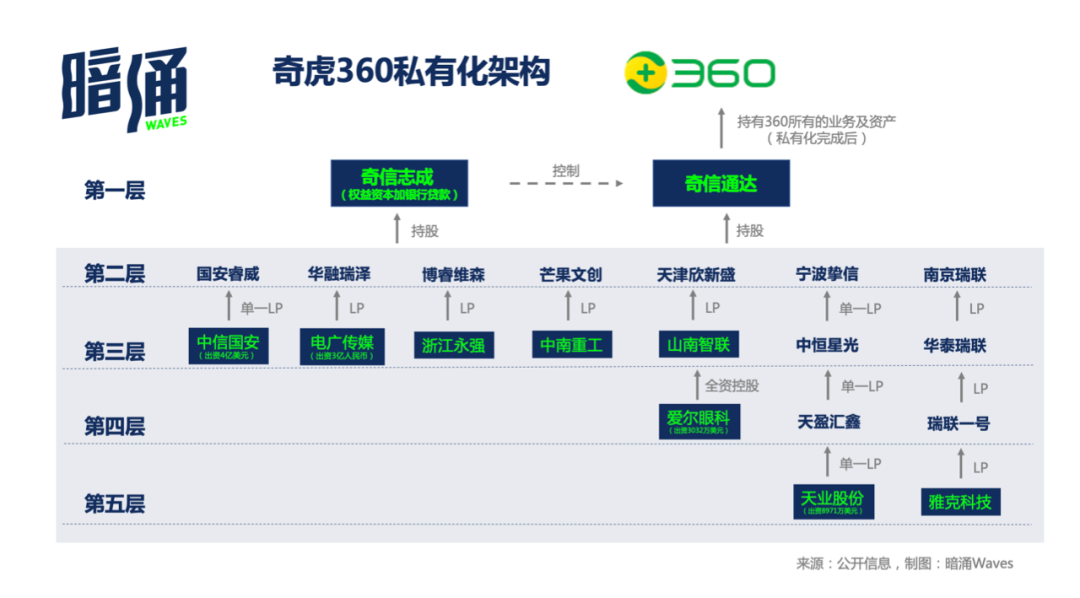
Of course, the Qihoo 360 privatization was a happy success story. But what shouldn't be overlooked is that this "layered subcontracting" nature creates enormous communication barriers between case fund investors and the project company itself.
An entrepreneur who participated in a case fund shared his experience with us: "After wiring the money, two years of complete silence." He repeatedly approached the intermediary for project updates, but was met with growing indifference. The awkward reality was that his only channels for information were public disclosures and this increasingly cold intermediary.
"The key problem is that disposal rights over the allocation aren't in our hands — they're with the middlemen," an investor who participated in a case fund for NIO told us. He invested during NIO's pre-IPO stage in 2018, then lived through the company's dramatic ups and downs, with virtually no say of his own. The decision to sell rested entirely with the fund sponsor, which he believes cost him multiples of potential returns.
Even professional investors sometimes don't escape unscathed.
A recently exposed case: in 2015, a primary market investor participated in a case fund for autonomous driving startup ZongMu Technology through an institution called "Collaborative Innovation Fund." ZongMu had just announced a 1 billion RMB financing round. This should have been a lucrative investment, yet the investor ended up in a dispute with Collaborative Innovation Fund.
According to his account, during a capital reduction and withdrawal process, the GP failed to handle the LP's allocation according to contractual procedures. The two sides disagreed over the exit process, eventually taking the matter to court.
As noted earlier, investing in case funds appears to pursue certainty, yet many participants told us that once the wire clears, the remaining time is largely passive.
It's worth noting that this challenge exists even in traditional GP-LP relationships. As Zhou Lin, fund formation partner at Han Kun Law Offices, told An Yong Waves: "As an LP, theoretically you don't control the fund's management and operations, whether in a blind pool or a defined pool fund."
But because case funds have more complex internal structures and more mixed participants, "the sense of losing control is stronger for investors," an FA who has worked on multiple case fund transactions noted.
Compared to institutionalized investing, case funds also have characteristics of underground activity, which compounds the passivity. Chen Peng told us that in his XtalPi investment, "every critical step had to follow the lead investors' timeline."
As the folk saying goes: the one giving money is the grandson; the one asking for it is the grandfather.

Hidden Agendas
Let's return to the original question: in a Chinese primary market that was flush — even excessively so — with capital, why did we need case funds at all?
In the US PE industry, there's a term: club deal. The phrase has been somewhat distorted in China, becoming shorthand for funds "group-buying" investments together. But its origin refers to a common type of large transaction: when facing an outsized deal, institutions pool capital to invest jointly. This is precisely what some case funds look like.
For instance, in Lianjia's roughly 6 billion RMB Series B round, China Renaissance led with $350 million. Fan Bao once told us: "Our per-fund single investment ceiling is 15%, so we definitely hit the cap on this one, and later brought in other investors to co-invest." According to An Yong Waves, this included RMB and USD syndications, with capital ultimately deployed through case funds.
For a considerable number of GPs, fundraising is a drawn-out endeavor, and raising a case fund (defined pool fund) is far simpler than raising a blind pool fund. Multiple fund partners who spoke with An Yong Waves explicitly described this as a "transitional fundraising tactic."
Jianwei Li, partner at Zhencheng Investment, once told us that since establishing contact with Evernote founder Yi Tang in 2018, the two had built sufficient mutual understanding and trust. So when Evernote launched its Series B in 2021, Zhencheng quickly raised a single-project fund to lead the round.
"Evernote wanted us to lead, to help design the entire transaction structure, and to provide strategic support — and in turn, Evernote also introduced some potential LPs to us," Li noted. The investment also expanded the firm's AUM and added to its track record.
To raise capital more effectively, some GPs package allocations from their next fund together with star project shares as a bonding deal. An investor at an overseas sovereign wealth fund told An Yong Waves: "Now when some GP managers come to us for fundraising, they first tell us about a great project allocation they have — talk for 30 minutes — then spend 30 minutes on their fund strategy. Finally they tell us: the precondition for getting the project allocation is also investing in their fund."
For newer institutions, case funds also lower the barrier to "proving themselves." Linhua Chen of FA firm Huanghe Capital told An Yong Waves: "To do a blind pool fund, you first need to prove your professionalism. In our FA work, when we encounter highly certain projects, we use the project as a foundation to attract LPs." Currently, Huanghe Capital has two single-project funds in late stages — one preparing for an A-share IPO, another that has filed its A1 and is awaiting Hong Kong listing hearing.
In the relationship-dense investment world, case funds are sometimes viewed as a form of social currency.
A US-dollar fund less than three years old is currently running a "relatively certain" case fund. Its partner told us that allocations are mainly distributed to existing and new LPs, with no plan to charge management fees: "We're essentially doing it as a public service, bringing them along to make money."
The above reflects sponsors' perspectives. From institutional LP perspectives, their desire to participate in case funds, beyond seeking high returns, is actually to get closer to projects and facilitate their own direct investments. This is also one of the more controversial motivations among domestic LPs.
Then there's another category of backers — the non-suitable investors mentioned above — whose motivations for participating are more varied. "Some hope to find direction for their future, some want to network with industry people, but certainly most are looking to make quick money," said someone who has participated in multiple case funds.
From a business standpoint, none of this is objectionable. But in practice, considerable distortion occurs.
For example, a foreign fund-of-funds once complained to An Yong Waves about an anecdote: in a well-known VC fund they invested in, one mega-unicorn was actually invested in mainly through a separately established SPV. The fund had long claimed this project as its own, yet as a main fund LP, their benefit was extremely limited. This illustrates the potential interest conflicts between case funds and main funds.
Zhou Lin of Han Kun Law Offices also told us: "Case fund investing actually places high demands on the manager GP. The manager must allocate energy to be responsible to LPs, fulfilling the duty of a 'prudent manager.'"
But in most scenarios, from fund managers' perspective, blind pool funds remain the strategic focus regardless, deserving more of their time and energy.
As for the party that stirs the most market sentiment — intermediaries — theoretically they should perform some project screening and risk disclosure. But many people we interviewed said that from intermediaries' profit perspective, their top priority is typically not the project's fundamental quality (for instance, some consumer-facing companies with decent name recognition may have poor fundamentals in industry insiders' eyes).
"These are clearly high-risk equity products, yet many sponsors privately promote or promise a guaranteed return rate. You could call it a form of capital mismatch."
"If you look at case funds with a stock-picking mentality, it's a bit like retail investors choosing stocks. It depends on whether you trust the fund manager or your own judgment," a dual-currency fund investor offered An Yong Waves. In the past, consumer-facing projects had loud brand recognition, so most people's judgment might have been adequate. But now there are more B2B projects, constantly packaged as "metaverse, top X in vertical chip sector" — "increasingly hard to distinguish good from bad."

A Guide to a Dangerous Game
**In China, the explosive growth of case funds over the past 5 to 10 years was driven by: abundant market liquidity attracted to the VC/PE industry and its constant myth-making, with capital wanting to catch this era's express train.
Objectively speaking, as a financial instrument, "single-project fund" is a neutral term. But in a market environment that's less than friendly to it, what can improve one's odds?
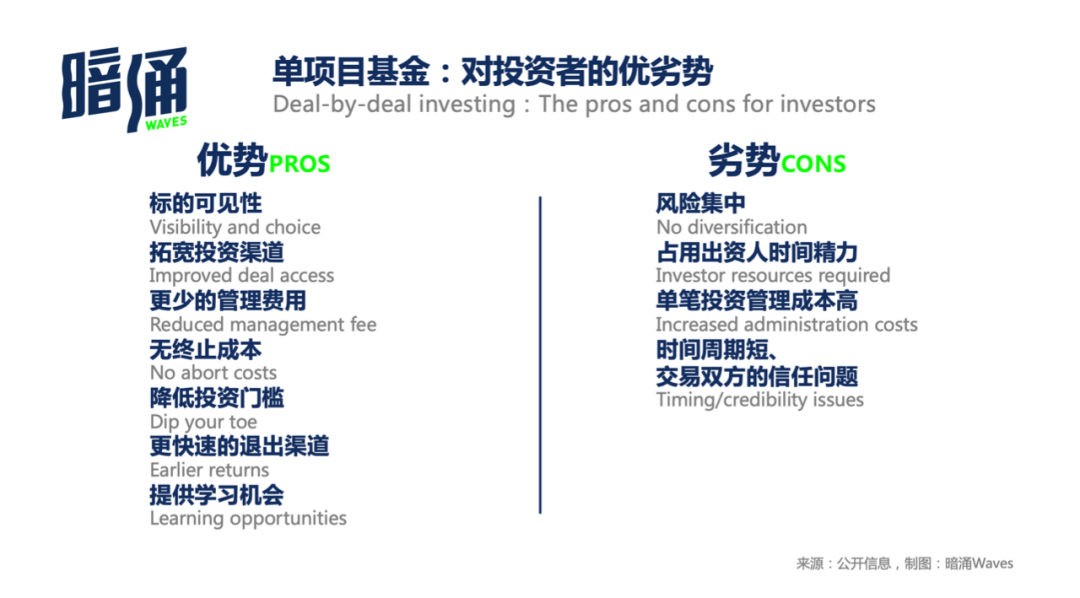
In May 2021, Richard Le Liard, partner at offshore law firm Bedell Cristin, produced a checklist on case funds, exhaustively laying out the pros and cons of this investment model.
Advantages included: target visibility, broadened investment access, lower management fees, no abort costs, reduced investment thresholds (dip your toe), faster exit channels, and learning opportunities. Cautions included: concentrated risk, high professional demands, short time horizons, high per-investment management costs, and trust issues between transaction parties.
From an operational standpoint, first comes stage selection. Since most early-stage projects have excessively high failure rates, they're generally unsuitable for case funds — which is why most case funds concentrate on later-stage companies.
Second, the investor. Having read the above, the risks of single-project fund investing should be abundantly clear. For high-net-worth individuals, unless it's a familiar sector, it's better to invest through professionals, family offices, or institutional investors.
Then there are more granular concerns. For instance, in a nested structure, what layer do you occupy? On critical terms like "liquidation preference" that affect exit sequencing, inattention may leave you last in line.
The final point, and the most critical for any investment behavior: diversification. When uncertainty is the only certainty, a case fund should be just one of multiple wealth management options. As the old saying goes: in investing, never bet everything on one hand.
(At the interviewees' request, Chen Peng is a pseudonym.)
Image source | Pexels
Layout | Yunxiao Guo