The AR path is grueling, but Xu Chi still wants to know what the finish line looks like | WAVES
Those without ideals don't grieve.
By Muxin Xu
Edited by Jing Liu

Walk into XREAL's Beijing office and you'll find superhero figurines prominently displayed — Iron Man, Thor's hammer, the Infinity Gauntlet. These are all from Chi Xu's personal collection.
A streak of personal heroism runs through Xu's entrepreneurial journey, culminating in his latest product launch. On December 5, XREAL unveiled its new AR glasses, christened the XREAL One — the world's first consumer-grade AR glasses with native 3DoF support. In an industry that has seen little technical transformation in recent years, this was major news.
In 2017, Xu left Magic Leap to return to China and found XREAL (formerly Nreal), developing and manufacturing consumer-grade AR glasses. To date, XREAL has raised over $300 million in total funding, with investors including Alibaba, Kuaishou, NIO Capital, iQIYI, Hongshan, and Gentle Monster. According to industry analysts, following its latest $60 million strategic funding round, XREAL's valuation has surpassed $1 billion.
But the B-side of this story hasn't been so smooth. The XR industry emerged in 2015 yet never achieved mass-market breakout. The track is littered with casualties — even an industry titan like Apple announced the discontinuation of Vision Pro just 16 months after launch.
For startups in many sectors, designing proprietary chips and building in-house factories would be considered excessively heavy strategies. But for AR companies still in the first half of their journey, with incomplete supply chains, anyone seeking to push user experience boundaries has little choice.
"Have you noticed that I don't simply enjoy the success of entrepreneurship? In other words, I'm not someone who only cares about results, who'd be happy succeeding at whatever. I can't just pivot directions today and switch tracks tomorrow. What I want more is to see real results in AR." Midway through our interview, Xu suddenly offered this self-assessment.
And this self-developed chip release serves as something of a benchmark — for Xu and for the entire AR industry.
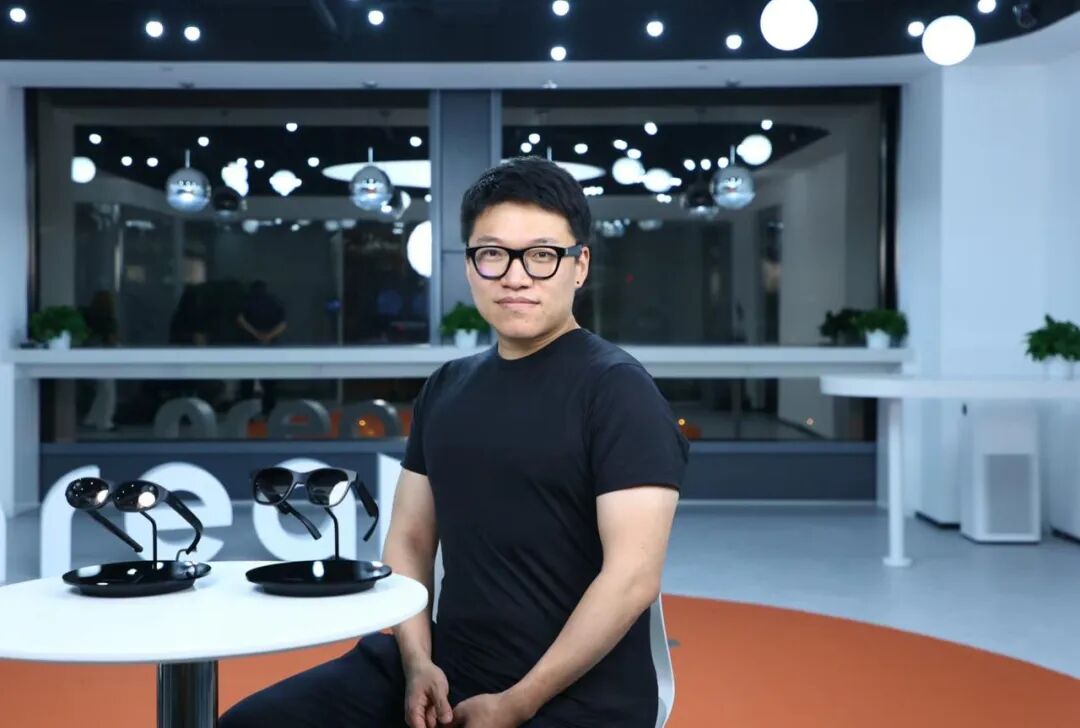
Chi Xu of XREAL. Photo provided by interview subject.
"WAVES" is a new column from Anyong / Waves. Here, we bring you stories and perspectives from a new generation of entrepreneurs and investors.

The Heavy Strategy of a Startup
Traditionally, AR glasses have been criticized on technical grounds — excessive latency, violent screen jitter, and so on. In Xu's view, these are precisely the problems the X1 chip is designed to solve.
Xu told Anyong WAVES: Thanks to the X1 spatial computing chip developed over nearly three years, the XREAL One compresses latency to 3 milliseconds — compared to 12 milliseconds for Apple's Vision Pro. And thanks to the X1 chip, native 3DoF spatial anchoring is finally achievable, meaning the screen stays fixed in front of the user rather than moving with them.
The 3-millisecond latency is a godsend for gamers, while spatial anchoring aims to let more users adopt AR glasses as productivity tools — a stable extended display.
The difficulty of self-developing chips needs no elaboration, especially in AR, a "hellishly difficult" track. Yet XREAL seemed determined to raise the bar from day one. In its third year, Xu established his own display supply chain in Wuxi — the world's first fully automated AR optical production line.
Why would a startup choose such a heavy strategy?
Perhaps anyone in hardware shares the same instinct. Three years ago, when Xu first met William Li, the latter's conclusion after trying the glasses was: "You need to do chips." At the time, Xu was preparing to pour newly raised funds into chip development.
Xu told Anyong WAVES: 60% of the XREAL One's components are custom-designed — rare for a startup, since typically only an industry Alpha does this. Most startups choose to source from supply chains, but the consequence is that the supply chain's ceiling becomes your ceiling.
"It's like the difference between Apple and other phone makers. Only Apple custom-designs its chips, displays, and linkages. That's the essential difference between an Alpha and a follower — and user experience is entirely defined by the industry Alpha."
That's the idealistic framing. The B-side is that AR is ringed by giants — Meta and Apple are aggressive; Google, ByteDance, and other domestic titans are watching hungrily. For startups squeezed in between, outrunning the supply chain may be the only moat. Because once supply chains mature, companies like Huawei and Xiaomi can easily enter the space, take the best pipelines, and leave no room for smaller players.
At the start, Xu had estimated AR would break out around 2020–2021. In retrospect, that was clearly too idealistic.
After more time in the trenches, Xu's conclusion is that XR remains in the first half. Using smartphone development as analogy, 2012 was the mid-game inflection point — before it, the competition was hardware technology; after it, consumer and marketing capabilities.
Thus, even though time is the enemy of startups, Xu continues directing more capital toward longer-payback, asset-heavy technical development.

"People Without Ideals Don't Get Hurt"
"If you're writing about me, it's basically the story of an idealist struggling in the real world." At the end of our interview, Xu offered this summary himself.
Xu felt his first twenty years went smoothly — he was smart, worked hard, and could get almost anything he wanted. He tested into Zhejiang University's Chu Kochen Honors College, then went to the University of Minnesota for his PhD.
"Then I hit low points in life, suddenly losing a lot. I realized many things are beyond your personal success or status." Life is like this; so is work and career.
On his first day at NVIDIA, Xu was brimming with ambition to apply his CPU and GPU theoretical knowledge from graduate school to NVIDIA's future architectures.
That same day, a senior gave him this advice: grind LeetCode, go to Google or Facebook — because many things have nothing to do with your abilities, and software pays over $100K more per year than staying in chips.
His time at NVIDIA disappointed Xu. Everything he'd researched in his PhD, everything he considered valuable, had already been validated at NVIDIA. As an engineer, there was in fact very limited scope to contribute meaningfully.
Until he interviewed at Magic Leap. It was an extremely secretive company — you signed NDAs before interviewing, went through five rounds still in the lobby, and employee badges read scientist, artist, or magician. "But you could see fire in everyone's eyes."
That fire reminded Xu of his own "iPhone moment." He first watched Steve Jobs's iPhone keynote the day after the livestream, in an era before mobile internet when people still downloaded keynote videos to watch. That didn't diminish his shock at the iPhone's technical and experiential innovation.
Xu's second decisive moment came at Magic Leap. When he tried their AR prototype, he became convinced this was the next terminal that would replace phones.
In 2017, Xu resigned and returned to China to found XREAL. The domestic XR industry was then at its peak — a heat not seen again for many years.
Worth noting is Magic Leap's ending. This July, Magic Leap conducted mass layoffs and announced it would stop self-developing headsets, closing the book on a story of a "star company degenerating into an AR fraud."
Xu later joined a Clubhouse debate on "Why Magic Leap Failed." Theories abounded — too impatient for success, capable of zero-to-one but not one-to-N.
"But if you ask me, it's always the CEO's fault. When any company messes up, you can always blame the CEO." Xu said.
Xu is a CEO who also functions as CTO, and in his view, for any company doing disruptive product innovation, the number one must understand technical boundaries. That's why Jobs succeeded then, and Musk succeeds now. The counterexample is Apple Vision Pro's failure — "If Jobs were alive, this thing with 10 sensors would never have shipped."
A classic superhero story probably needs these elements: talent, hitting rock bottom, getting back up unyieldingly, and finally defeating the villain.
Xu loves such stories, partly because he sees himself in them. At least in the first half.

It Takes Time
"Let me tell you a story." Xu said.
"A group of people are sharing how they got from the first floor to the fifth. Some say it's because they kept doing push-ups in the elevator; others say it's because they stayed perfectly still. But we all know the elevator's rise had nothing to do with them."
The unfortunate part is that the AR industry never truly squeezed into that elevator. The fortunate part is also this — because that elevator is slowing down, squeezing in will become very difficult, and some may even get thrown out. Adapting to the changing pace of the era has become a generational challenge, while XREAL and the AR industry it inhabits have long grown accustomed to the pain of climbing stairs on foot.
"XREAL's strategy from day one was to first complement phones, then gradually talk about replacement — so the first generation was a lightweight, split design. XREAL has done many things wrong, but this was a crucial step we got right." Xu told Anyong WAVES: "I've learned something since starting my company. If you need to get every step right to succeed, you've definitely chosen the wrong track and wrong timing."
But what frustrates Xu is that investors often care more about timing than he does. The question he hears most: "What year will this industry break out?" As if if it breaks out a year later, capital should enter a year later.
At this point Xu typically fires back: "When Microsoft invested in OpenAI, did they ask this question? Because if ChatGPT was that important, did one year earlier or later really matter?"
In Xu's view, AR is equally important. As Kevin Kelly predicted, in the future everyone will have an AR device. He even adapts Plato's cave allegory: "The devices we currently use are all 2D flatscreens — like people who've faced walls their whole lives, only to turn around and discover the real world is three-dimensional." "Compressing the information world into a small box is unreasonable. I believe the dimensional upgrade of interaction, display, and computing is inevitable." Xu said.
Throughout our interview, Xu repeatedly said "it takes time" — but not limited to evaluating his own venture. It applies more broadly.
Xu recalls his return to China coinciding with the golden decade of mobile internet, when the Copy-to-China model achieved massive success. For investors and entrepreneurs who reaped fruits there, this long became a path dependency. The regret is that this dependency is now failing.
Xu has also met many who once achieved enormous success, but when debates went deep, he found their proudest achievements ultimately came down to luck. Luck is certainly part of strength, but you can't keep using luck's logic at every crossroads.
This is XREAL's seventh year. Many companies investors compared it to at founding have slowly vanished — like a moving bus, with people getting on and off, and some riding from start to finish. Xu wants to know what the finish line looks like, but he's also clear that this is beyond his personal success or status. Just as with this X1 spatial chip release — no one can look back after New Year's and know whether this will prove a disruptive transformation, or merely a splash in AR's unfathomably deep waters.
But this may ultimately become less important to Xu. "Right now I just hope that when I reach the finish line, I see this is a massive track. If it's not, I'll accept that too — then we'll just enjoy the process." Xu said.
Image source | Provided by interview subject