ChatGPT is the talk of Silicon Valley, but the buzz is theirs.
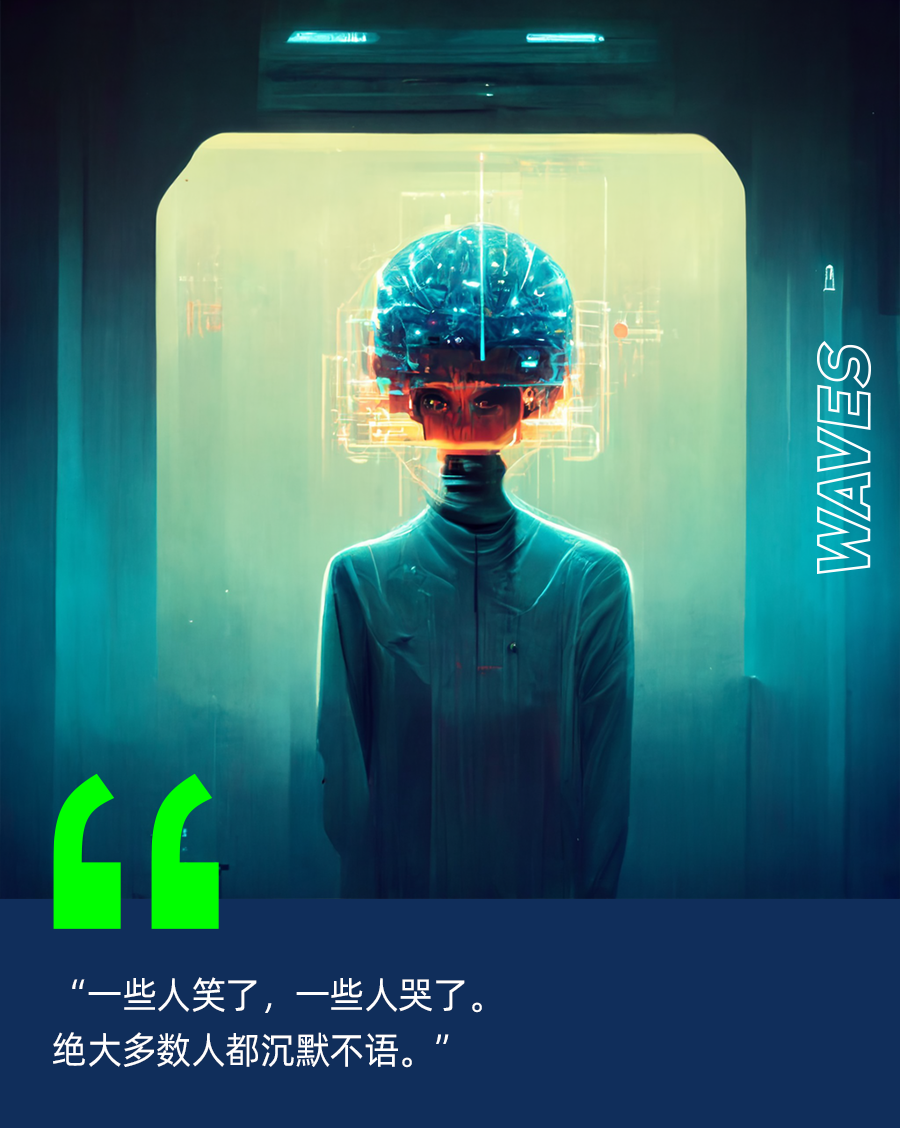
"Some people laughed. Some people cried. The vast majority fell silent."
By Lili Yu, Lixin He
Edited by Jing Liu

The past week has been one of those rare moments when Chinese and American VCs found themselves in sync.
Like Elon Musk, many Chinese investors fell into what he called "the damn crazy ChatGPT loop." They tirelessly probed and even tried to trip up ChatGPT, and enjoyed every minute of it.
This intelligent dialogue system has been laden with significance. It's no longer the chatbot people once understood it to be; it's even seen as a disruptor of existing search engines, the "first milestone" on the path to artificial general intelligence.
As is widely known, investment themes have been scarce in the US lately. Combined with the recent wave of Silicon Valley layoffs, ChatGPT's arrival seemed especially striking — "Silicon Valley is completely pumped."
The buzz spread to China too. One investor told Anyong Waves, "Recently all of us, whether we used to look at new energy or semiconductors, are talking about AI," feeling that "something big is shifting here."
In venture capital terms, ChatGPT resembles the recently viral AIGC — both fall under the AI track. In recent years, after China's AI bubble burst, the sector has been in a prolonged slump, with many funds having enterprise software or other sector investors cover AI part-time.
From the perspective of Zhang Xingchen, who leads Source Code Capital's early-stage fund Yisu, if you categorize ChatGPT as a conversational text generation capability within the broader AIGC space, it's undoubtedly "one of the biggest investment themes this year." Because he's been tracking frontier tech developments, he found ChatGPT's birth expected: AI insiders had long been anticipating OpenAI's release of GPT-4, so this could be called the arrival of "GPT-3.5."
GPT stands for "Generative Pre-trained Transformer," a model trained and developed by the AI company OpenAI. After multiple iterations, ChatGPT is its conversation-optimized language model, positioned between GPT-3 and the soon-to-be-released GPT-4.
Some investors told us that the reason for launching ChatGPT between GPT-3 and 4 may be to collect more test data to better tune GPT-4. Of course, fundraising considerations could also play a role — using a consumer-facing product to generate buzz.
Over the past year, discussions about the decline of domestic dollar funds have been endless. But when speaking about ChatGPT, multiple investors used a long-unheard phrase: "a platform company opportunity." Some even believe this is an opportunity that "could let TMT investors work another 15 years."
The reality may not be so optimistic.

A Leap
As for how good ChatGPT is, social media is already flooded with examples and praise. Anyong Waves also tried asking a few questions:
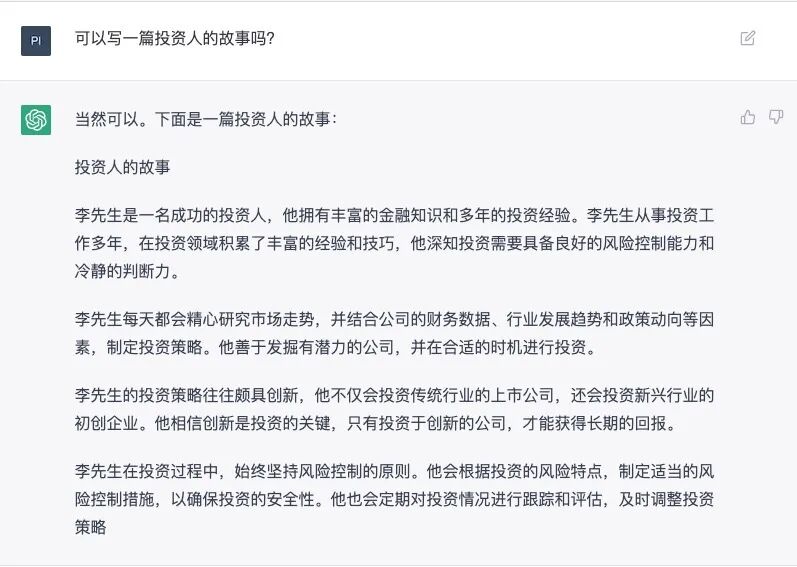
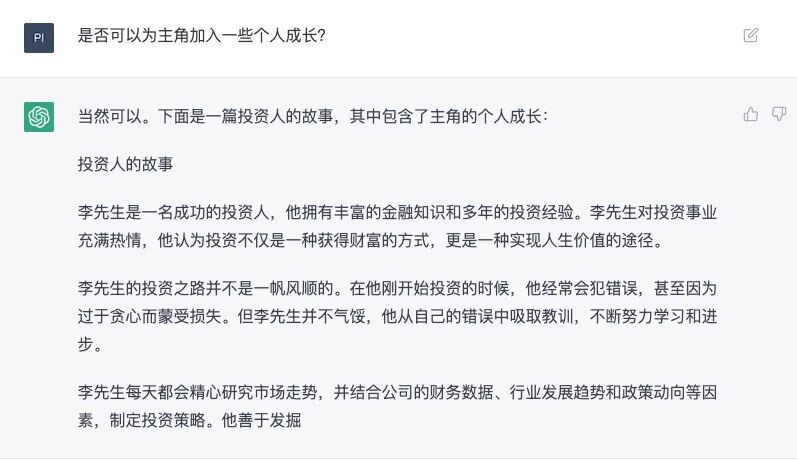
For instance: "Can you write a story about an investor?" When pressed with follow-ups like "Can you add some personal growth?" and "Can you expand on the investment failures?" ChatGPT showed its more machine-like side: merely swapping out names, company names, and some phrases, it told essentially the same story throughout.
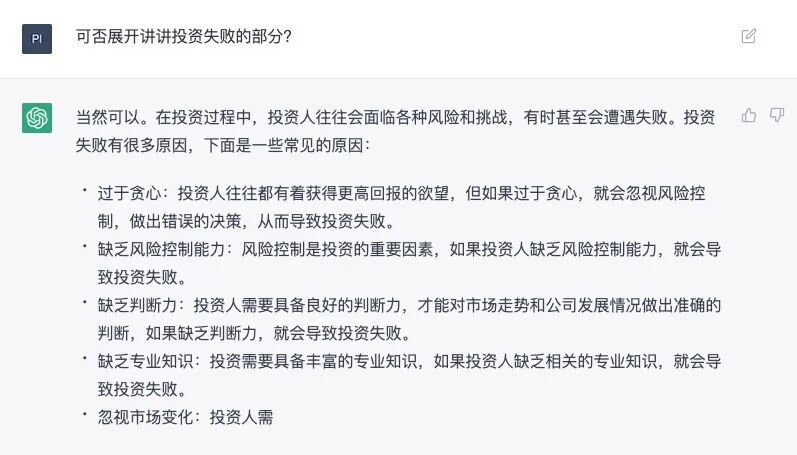
When asked "Who are some famous venture capitalists?" it produced a string of well-known business names, most of whom were entrepreneurs.
Others encountered similar talking-past-each-other moments when asking about quantitative strategies and art criticism.
Of course, for a product still in limited testing, such imperfections are inevitable. To some extent, the quality of ChatGPT's responses heavily depends on how the questioner phrases and follows up on questions. This makes crafting better prompts a key skill. So we can't rule out that some of the impressive exchanges being showcased may be the result of the questioner refining their queries multiple times.
Time will solve these issues. As a dialogue bot, one of ChatGPT's notable advances is its ability to learn from human feedback, displaying continuity and memory across multi-turn conversations. In Zhang Xingchen's view, "This is quite a leap."
Beyond that, compared to GPT-3, its common-sense reasoning has also improved. For example, if you input: "If Columbus arrived in the Americas today, how would he react?" GPT-3 would give you a pile of stories. But ChatGPT would first note the historical facts about Columbus — that he once reached the Americas — before engaging with your hypothetical scenario.
Ren Bobing, executive director and general manager of the Frontier Tech Fund at Sinovation Ventures, told Anyong Waves that two weeks before ChatGPT's release, they were still in Silicon Valley communicating with OpenAI executives, who had hinted they were doing more optimization around InstructGPT. In his view, ChatGPT improved understanding of user intent and result accuracy, and could even challenge premises and proactively admit mistakes. This technology builds on InstructGPT, with reinforcement learning from human feedback at its core, then fine-tuned with data to become more human-like.
Regarding some of ChatGPT's less-than-ideal responses, Fangbo Tao, founder and CEO of Mindverse, believes there are two main reasons. First, ChatGPT currently lacks the ability to retrieve real-time information from external sources, so many responses are based on the model's understanding of older training data and can be imprecise. Second, because ChatGPT is a multilingual model with more English-language data and more thorough training, its Chinese responses are comparatively weaker. Of course, from day one, ChatGPT was designed to solve users' normative, task-oriented questions rather than provide emotional companionship. "Compared to an interesting AI character, it's more like the next generation of search engines."
Some investors believe that not answering emotional questions "doesn't mean the underlying model lacks the capability, but that this functionality has been intentionally disabled," due to training focused on how ChatGPT responds to questions.

Whose Game?
Like the previously viral AIGC, ChatGPT is also built on the continuous scaling of the Transformer algorithm.
In the view of Shi Yunfeng, an investor at 5Y Capital, if you compare the transformer to a "brick" with general computing capabilities, then the recently hot AIGC is like a Jiangnan garden created by combining relatively small-scale language models with diffusion models. ChatGPT, by contrast, is an entirely different order of magnitude — it's like directly stacking up a monumental human achievement like the Great Wall.
This is the classic game where scale drives qualitative change, which also means not many companies can participate in the new round of AI. "Unless you're a ten-billion-dollar company, it's hard to keep up with this game." Because the investment required — whether in algorithm teams or training, calling upon massive computing resources often costs tens of millions of dollars — is a threshold that even excludes some academic talent at American universities. Only the AI labs of giants like Google Brain, DeepMind, OpenAI, and Facebook AI Research can lead.
This highlights two major hurdles for China's participation in this round: massive capital and scarce talent. An AI investor at a dollar fund told us that while China's AI capabilities in computer vision are decent, talent in natural language processing and large models in this paradigm is very scarce. And poaching engineers from Silicon Valley is far from as simple as "the early mobile internet days, when iOS engineers would do."
Ren Bobing at Sinovation Ventures also finds the current situation unusual. On one hand, "Foundation models in text and image have produced hugely deployable results, much of it open-source." But on the other hand, "top companies are iterating so fast that the compute threshold and R&D capabilities put the vast majority of startups and research institutions out of reach," which means "more AI scholars' innovative research is blocked by compute, and more AI startup teams are becoming leaner, no longer building large AI teams as before."
But for investors still hungry for platform-scale opportunities, AIGC and ChatGPT remain exciting. An AI investor at a top fund used the example of platform companies that emerged after phones got cameras to emphasize: AIGC also represents the emergence of a new input medium. And the logic behind ChatGPT is: beneath the threads of search, recommendation, and conversation, there are often the greatest companies of each era. If search was the biggest opportunity on browsers, and recommendation the biggest on mobile, then the next opportunity may be conversation.
American VCs seem to share this conviction more strongly. Several authors of the 2017 paper "Attention Is All You Need" (which introduced the Transformer model) have started companies, almost all valued around $1 billion. And OpenAI has long been a decacorn.
Ren Bobing at Sinovation Ventures recently visited overseas scientists, VCs, and entrepreneurs. In his view, overseas "more companies are still using GPT and Diffusion capabilities to build products in niche verticals, and unicorns have emerged in both directions." Yet he also believes "overseas VCs remain cautious about this direction, not generalizing from the hype around a batch of new companies."
What about China's situation?
Regarding ChatGPT, most investors believe that in the short term, opportunities for startups are limited. Those with relevant capabilities likely come first from major tech companies — Baidu, Tencent, ByteDance, then Huawei, Alibaba, etc., including the Beijing Academy of Artificial Intelligence (BAAI) and IDEA.
In the view of an AI investor at a dollar fund, Chinese companies' advantage lies in rapid application deployment and finding product-market fit afterward. For early-stage startups, this is certainly a good time to raise funding. Indeed, over the past five or six months, dozens of AIGC-related startups have raised or are raising rounds. "The top VCs have either already invested or are looking," Zhang Xingchen at Source Code Capital's Yisu told Anyong Waves. These companies are mostly building applications in familiar scenarios based on open-source models.
But there's also a predicament: for now they're all creator tools, and user retention among ordinary users is certainly poor, so they haven't formed a content consumption loop. Of course, "it's like early cameras — it takes time," as one dollar fund's AI investor told Anyong Waves.
In this investor's view, this is the current situation on both sides of the Pacific. It's just that in the US, subscription or productivity tools may be easier because users have better payment willingness and habits, whereas in China it's much weaker, more likely becoming "a strategic product that's free to use."
Ren Bobing believes domestic AIGC-related companies are rapidly emerging, including both consumer and enterprise-facing ones. But China's enterprise software and consumer tool ecosystems differ greatly from overseas, and product directions are more clustered. "We'll be cautious in deploying and may even incubate some new directions." There are also new technologies in development, including dialogue and multimodal, "but in the short term they're still far from commercialization."
Zhang Xingchen, meanwhile, isn't worried about finding good business models. "The key is technology, product, and data — whether you can solve real needs. As long as you can build it, business models will follow." He noted that going forward, many startups will likely achieve better conversational results in specific domains based on ChatGPT or more OpenAI API interfaces, as well as domestic platforms like BAAI. However, China may first need to train a Chinese large model from scratch.
Of course, this isn't a new phenomenon for Chinese and American VCs. Numerous fields that have generated massive returns for US VCs — fintech, enterprise software, and even crypto today — have yet to make money for Chinese investors, and some are already restricted sectors. This is the reality that Chinese VCs, once trying to follow Silicon Valley's shining example, must confront.

"Some Laughed, Some Cried, Most Were Silent"
How much will ChatGPT, or broadly AIGC, change humanity?
One AI investor who calls himself an AI believer believes that machines can't replace physical-world interactions, but that general intelligence has already been "broken through to a great extent." And one harsh conclusion may be: "Surpassing human intelligence may not be as hard as people think."
An investor focused on Web3, digital twins, and related areas told Anyong Waves, "Imagine when a robot has absorbed and synthesized centuries of knowledge — how large is the gap between its deep thinking and a modern person's?" His answer: "Smaller and smaller."
Indeed, voices about powerful AI replacing many professions have never ceased. And the emergence of broadly defined AIGC will undoubtedly impact many fields including image and content production. In the above AI investor's view, content generation in forms from voice to text to image will all see growth, with conversation likely being the most important killer application.
But all this remains distant. Though Ren Bobing also believes AIGC "has high imagination for generating short videos and 3D animation at the creation level, or giving robots stronger environmental understanding, task understanding, and human-computer interaction at the interaction level," he doesn't think it will significantly impact employment, because "AIGC can only complete part of a task; it's still largely auxiliary at many stages — for example, generated images need refinement, generated paragraphs need polishing, AI-generated content is hard to publish directly as professional material." "Even at the conversation level, ChatGPT's current performance is far from perfect." "In many niche scenarios, similar products haven't yet emerged."
Yesterday, in an article by Ethereum founder Vitalik Buterin about his experiments using ChatGPT for coding, he noted that while ChatGPT can speed up coding, errors occur during the process: "AI is improving rapidly... however, AI is far from replacing human programmers."
But OpenAI CEO Sam Altman believes "AI has become the next true technology platform since mobile internet." Fangbo Tao at Mindverse says that broadly defined AIGC's "generative AI as a new AI paradigm marks AI applications moving from point solutions to general-purpose." And generality is precisely the foundation for AI's further proliferation and even becoming infrastructure.
For investors, the more critical question is timing. Multiple investors we interviewed said they're still looking through fog at this stage. "It's like investing in livestreaming, but you can't tell if it's 2005 or 2015."
In any case, we're drawing closer to that thrilling yet terrifying moment. As Yuan Liu, partner at ZhenFund, reflected with emotion: it brings to mind Oppenheimer's hollow-eyed words after the first atomic bomb's successful detonation — "Some laughed, some cried. Most people were silent."
Images | Midjourney
Layout | Guo Yunxiao