Chinese in Saudi Arabia: Flowers, Desert, and Dampened Dreams
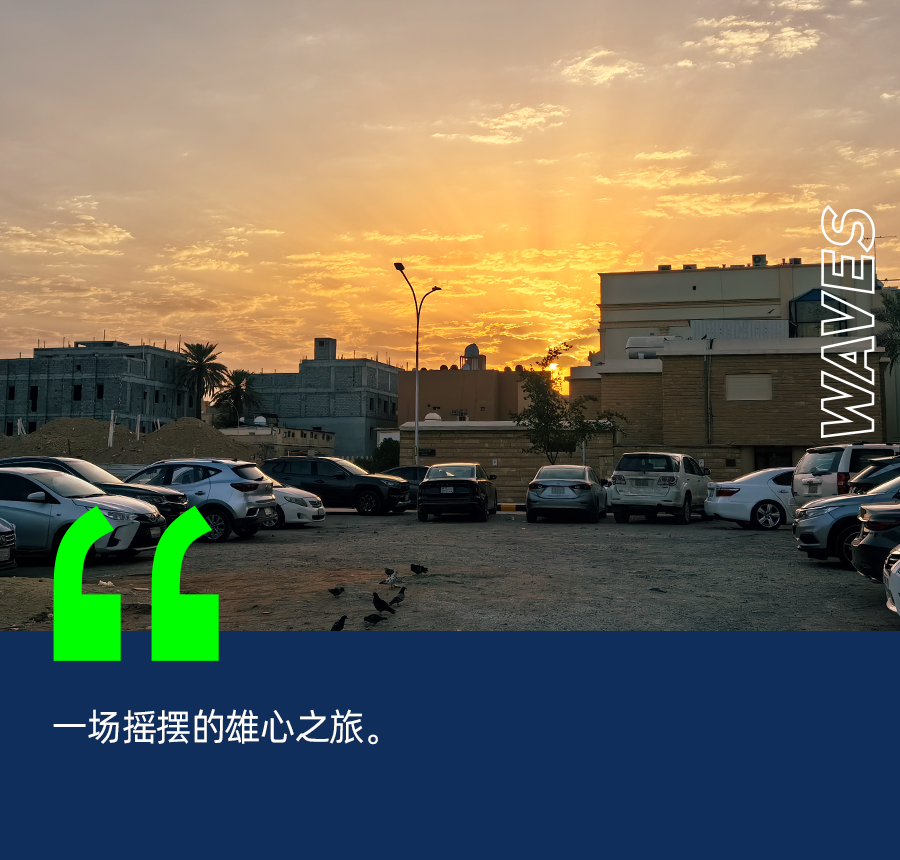
A wavering journey of ambition.
By Qian Ren
Edited by Jing Liu


Flowers in the Desert
Rain fell without warning. As people streamed out of the venue, they were hit by a pungent smell. The sun was nearly down, and before them stretched an endless desert.
"Whoa! It's actually raining," a Chinese companion cheered.
This is Riyadh, the capital of Saudi Arabia. As an arid city, its annual rainfall is just one-quarter of Beijing's.
"Waves" first arrived in Riyadh on the second day of LEAP 2024 — a tech summit hosted by Saudi Arabia that drew dignitaries and tech companies from over 180 countries. Because Riyadh's traffic is so notoriously bad, the conference was held some 80 kilometers outside the city in a barren wasteland, where Saudis had hastily constructed a venue exceeding 140,000 square meters.
Officials later revealed that the four-day LEAP drew 172,000 visitors — far surpassing that year's CES in the US (135,000) and MWC in Barcelona (100,000).
This once again fed the popular imagination of Saudi Arabia: extravagant, theatrical, and fiercely ambitious.
Over the past two years, this mysterious kingdom has repeatedly captured the world's attention. You've surely heard the legends: The Line, a linear city projected to cost over $500 billion; at least 16 individual mega-projects each exceeding $100 billion; and the recently announced Dragon Ball theme park in Riyadh, spanning over 500,000 square meters — roughly ten times the size of Tokyo Dome.
Among those prospecting for gold locally, a saying circulates: "The world looks to the Middle East; the Middle East looks to Saudi Arabia." It signals a singular conviction in Saudi opportunity.
Over the past year, "Waves" repeatedly heard reports of "hundreds of GPs" traveling to the Middle East to raise capital, with entrepreneurs from every industry following in their wake. Unlike the more familiar UAE or Qatar, going to Saudi Arabia seemed to promise something more — an expedition of ambition. In this most populous yet still-undeveloped Gulf nation, everything was just beginning.
But Chinese entrepreneurs quickly ran into a wall.
Several hard realities have already settled: Chinese funds looking to raise capital? Essentially no chance. Startups looking to expand? Tremendously difficult. Earlier arrivals have already become cautionary tales. People even began joking: "Just like back home, investment here is really just investment attraction!"
In the wave of globalization, Saudi Arabia is a microcosm: scan any market worldwide, and the "low-hanging fruit" has largely vanished. And every so-called "land of milk and honey" carries its own peculiar hardships, even impossibilities.
This was the purpose of "Waves'" journey. In March and April this year, we visited Saudi Arabia twice, interviewing over a dozen people living here — entrepreneurs, small business owners, and those who arrived by chance. They showed us a more multidimensional "Middle East fever," a group of people trying to make "flowers bloom in the desert."

The Damp "New Mecca"
When you arrive at King Khalid International Airport, you'll feel an immediate familiarity: every sign is posted in Chinese — the only language besides Arabic and English. On the highway into the city, billboards read "Welcome to Saudi Arabia" in Chinese characters. Locals greet you with halting "ni haos," and some specifically emphasize: starting in 2023, Saudi Arabia made Chinese its second foreign language.
With this mixture of familiarity and strangeness, "Waves" drove to the LEAP venue. We caught the conference's most electrifying moment: a conversation with TikTok CEO Shou Zi Chew. "We hope to invest more and become more localized in this vertically developing country," the handsome face said with easy confidence, speaking expansively of Middle East opportunity and Biden becoming a TikTok creator. His appearance was seen as signaling TikTok's major push into Saudi Arabia.
In recent years, virtually every globally prominent business leader has landed at King Khalid International Airport. Last October, the "Desert Davos" — the FII conference — was held in Riyadh, with BlackRock, JPMorgan, Citibank, Blackstone, and other institutions symbolizing global wealth flows all in attendance. Among them was Neil Shen of Hongshan.
Jerry Li, founder and managing partner of eWTP Arabia Capital, told "Waves": "Over 2,000 institutions and companies have come to visit us — it never stops." As an earlier discoverer of Saudi opportunity, eWTP arrived here five or six years ago and secured support from the Saudi government and sovereign funds, making it a sought-after advisor for Chinese companies going global.
A Huawei Cloud local staffer gave us an example: after many meetings, she would take photos with visitors. From April 2023 to the present, her phone holds at least 138 such photos.
The source of all this, beyond the leaders' meeting between the two countries a year and a half prior, is a plan called "Vision 2030." It outlines three main Saudi objectives: to become the heart of the Arab and Islamic worlds, a global investment powerhouse, and a hub connecting Asia, Europe, and Africa; and to reduce oil's share of the economy while driving transformation.
"Only Saudi Arabia has both the conviction and the capacity for infrastructure," a Chinese person who has worked locally for many years told us — hence the particularly intense demand for investment attraction.
"It's a lot like Shenzhen in the 1990s — everything to be built from scratch." "Waves" heard this repeatedly in interviews.
Before reaching Riyadh, we transited through Jeddah and encountered many Muslim pilgrims heading to Mecca. Today's Saudi Arabia seems to be the "new Mecca" in the hearts of entrepreneurs worldwide.
But within less than a year, the narrative took a sharp turn.
An investor at a sovereign fund in a neighboring Saudi country told "Waves" that unlike Chinese entrepreneurs expanding to other regions, the "Middle East fever" originated with funds, not startups. "Because this place seems to have endless money, just like their inexhaustible oil." Most Chinese GPs, he said, would tour several Gulf countries with the sole purpose of raising capital.
As someone in his early thirties, he had over the past three years hosted countless Chinese fund partners, many decades his senior. The process sometimes struck him as absurd: "The reality is very few funds can actually get money here. So why do people keep coming in waves?"
In November 2022, when "Waves" first reported on the Middle East fever, we already pointed this out. Now fund enthusiasm for Saudi Arabia has gradually cooled. Over the past year, besides a small number of Chinese mega-funds securing Saudi investment, we understand that only a handful of institutions including eWTP Arabia Capital have received substantive commitments.
It's not just funds. Over the past three years, Alibaba, SenseTime, Pony.ai, and other Chinese tech companies have reached agreements with Saudi Arabia worth hundreds of millions of dollars, but the price has been steep. "Every deal comes with strings attached," a local entrepreneur told us — such as exchanging market access for technology.
If not, one must find other ways in.
Zeekr, the electric vehicle brand under Geely Auto, was the first domestic EV brand to launch in Saudi Arabia. This February it entered four Middle Eastern countries — the UAE, Saudi Arabia, Qatar, and Bahrain — using a master distributor model, partnering with leading local dealers. Its UAE partner, AWR Group, has a subsidiary, AAC, that holds exclusive distribution rights for Nissan, Infiniti, and Renault — giving it formidable market position.
In practice, Zeekr controls overall store construction standards while dealers handle subsequent investment and building. In Saudi Arabia, Zeekr focuses mainly on B2C retail while also serving high-end B2B customers. On pricing, the Zeekr 001 starts at 230,000 Saudi riyals (approximately RMB 441,500) and the Zeekr X at 174,000 riyals (approximately RMB 334,000).
"The incomplete charging infrastructure and low new energy vehicle penetration rate in Saudi Arabia's auto market are our main challenges," Wang Hao, Zeekr's Middle East head, told us.
Zheng Jiaxin began exploring Middle Eastern markets including Egypt, the UAE, Saudi Arabia, and Bahrain in 2011, ultimately finding Saudi Arabia the most profitable. He partnered with a Saudi businessman to establish GCCPay, achieving some success in Saudi payments. But with that success came increasingly severe risks of online fraud and money laundering.
For example, a user would submit a repair request on a service website, then receive a call from someone posing as a repair technician requesting a verification code to schedule service. Once the user provided the code, their bank card would be drained. Such cases occur frequently across the Middle East. Though GCCPay uses advanced protection systems to identify and block suspicious transactions, and has strengthened cooperation with local regulators, this has caused payment business costs to spike dramatically. "It's not as rosy as imagined," Zheng Jiaxin told "Waves."
When people discuss the "Middle East fever," comparisons to the Southeast Asia fever of several years ago are inevitable — still the largest wave of Chinese companies going global. Then, people exhausted every imagination of the "time machine" model, conducting entrepreneurial experiments across humid Southeast Asian nations. But the Middle East story is clearly different.
The difficulties extend to daily life.
As an Islamic nation, Saudi Arabia prohibits alcohol. Saudis' abstention is so absolute — according to one Chinese e-commerce entrepreneur — that when they produce wet wipes for the Saudi market, they must avoid alcohol content. There are obviously no bars here.
Even within the Middle East, Saudi customs are relatively conservative (though much relaxed now). For instance, men and women previously couldn't sit at the same table, and women had to wear very concealing abayas.
Entertainment is also scarce. There is no KTV, no bars where young men and women can dance together. The occasional public party or electronic music festival is enough to trigger waves of excitement. Besides horse racing, all gambling is prohibited. Beyond family gatherings, the most public hobby is probably watching football matches. At night, when you enter cafés or restaurants, virtually every television screen is showing a match. Cristiano Ronaldo even announced recently on social media that he would open a restaurant in Saudi Arabia.
The lack of entertainment is perhaps only one dimension. Saudi Arabia is vast and sparsely populated: 2.25 million square kilometers inhabited by just over 30 million people. Walking Riyadh's streets, the view resembles urban villages in southern Chinese cities, scattered with villas of varying sizes. These houses have high exterior walls; outsiders can barely glimpse inside. The entire city feels isolated and desolate.
But this isn't the whole story either.

Lessons from the First Movers
Looking out from the office towers of King Abdullah Financial District, one sees scattered construction cranes and a cityscape almost entirely devoid of high-rises. This is Riyadh's new CBD. eWTP Arabia Capital occupies the fourth through ninth floors of this building; besides the ninth floor for its own use, the other five floors are given to its invested strategic partners. Amid blue-green buildings, one of eWTP's joint ventures — Alibaba Cloud's orange logo stands out vividly, already a landmark of the new district.
eWTP came to Riyadh in 2018. This earlier arrival brought direct dividends: virtually every entrepreneur or local government visiting Riyadh for the first time would stop by their offices.
Jerry Li's attitude toward this has two sides: on one hand, it shows how hot Saudi Arabia truly is; but on the other, most people "are just here for a day trip."
He says Chinese companies coming here have essentially two objectives: find money, or sell goods. But people rushing in and out initially just want to "take something away." This doesn't work. What's needed is deep industrial integration — "solving problems from a local Saudi perspective."
People in venture capital are usually more optimistic, believing the combination of early entrepreneurs and investors can quickly revitalize a market. But Jerry Li's view is: at least at Saudi Arabia's current stage, it remains a venture capital desert — "no ecosystem, no investable targets."
In eWTP's first fund, tech and digitalization companies still comprised a large share. But the second fund expanded into fintech, logistics, healthcare, entertainment, and other sectors — many of these companies were targets eWTP found in Asia to meet Saudi market needs, or deals they "orchestrated" to push leading companies into joint ventures with Saudi local firms.
This creates an interesting phenomenon: many people think eWTP is an investment institution, but Jerry Li realized early on: "We're not a VC, nor a traditional financial investor in the conventional sense."
When we tried to get Jerry Li to define eWTP, he didn't give a clear answer. But for someone who began entrepreneurship in the early 2000s, "what we are" matters far less than "what's missing" and "how to do it."
For instance, at Saudi Arabia's current stage, infrastructure problems must be solved first — so what's more needed are leading, mature, influential strategic multinational corporations.
Thus when they discovered local shortages in cloud services, data centers, and logistics transportation difficulties, eWTP introduced Alibaba Cloud to form a joint venture with local telecom giant STC, and brought in J&T Express with its international logistics capabilities. "Let multinational enterprises with greater industrial voice do this work." In the integration process, management and cultural conflicts are inevitable; eWTP hopes to play the role of coordinating "messenger."
eWTP also invested in Raha, a Kuwait-based company mainly engaged in e-commerce and warehousing logistics. After investing, they brought the founder to China, visiting numerous Chinese robotics companies, ultimately facilitating a strategic marriage between Raha and Shanghai-based logistics robotics company Quicktron.
On the day of signing the strategic cooperation agreement, Quicktron CEO Xie Xuan recalled that even after receiving investment years earlier from a fund under Saudi Aramco, Quicktron still spent two to three years figuring out how to enter the Middle East market. When eWTP introduced them to Middle East local enterprise Raha, they gained new perspective — the founding team flew to Kuwait to investigate, then signed the cooperation agreement with Raha.
In a sense, eWTP is a typical Saudi entrepreneurship story: adapting to local conditions, not copying mechanically. There are many such stories.
In 2023, Linear Capital founder Huai Wang visited Saudi Arabia. He shared an observation in a journal entry: one Chinese entrepreneur wanted to do e-commerce in Saudi Arabia but discovered there were no street addresses. This entrepreneur had to work hard cooperating with various local government departments, and over several years completed the electronic addressing.
J&T Express, which eWTP helped introduce to Saudi Arabia, is another example.
Xiao, J&T's Middle East CEO, told us that unlike domestic delivery workers who generally use electric tricycles, Saudi Arabia is vast and sparsely populated with large per-capita delivery areas, "not a single true highway," so delivery workers mostly use cars. In remote desert areas, camels are even needed for last-mile delivery. Saudi Arabia and the UAE don't have national address databases; people typically use landmarks on certain city streets as references for destinations, creating logistics difficulties. Meanwhile, because digital payment isn't widespread, 60% of online purchases still use cash on delivery, meaning higher rejection and return rates.
These factors combine to make logistics costs in Saudi Arabia very high, with per-delivery prices approaching $4-5. "The country's e-commerce volume is growing, but compound growth (annual growth rate is six or seven percent) is limited — unlikely to explode unless we can reduce courier company costs to one-tenth of current levels, then we have a chance to make money," Xiao said. Going forward, they will build front warehouses here.
Recently, eWTP Arabia Capital led a consortium of Middle Eastern investors to inject tens of millions of dollars into J&T Express to optimize and upgrade its Middle East and North Africa markets, including the UAE and Saudi Arabia. Besides bringing in Middle Eastern investors, J&T also plans to list on the Saudi Exchange as a next-stage strategic priority.
Huang, MICO World's Middle East head, believes Saudi Arabia remains a social entertainment "treasure market" with sufficient scale and depth, but entrepreneurs setting foot here need more patience and tolerance. "Doing business here, you must first consider 'what can I do for Saudi Arabia,' then think 'what can Saudi Arabia bring me,'" Huang told "Waves."
He gave an example: because offline entertainment channels are scarce, Saudis are exceptionally enthusiastic about watching YouTube videos — the same video's view count in Saudi Arabia can far exceed that in the US itself (the US population is roughly 20 times Saudi Arabia's) — showing the huge gap in local spiritual needs.
But Saudis have their own understanding of social entertainment products; the American "global product" approach may not fully satisfy them: American social products emphasize "posting photos and text," while Saudis' preferred social method is "chatting." In Saudi malls, you often see locals with long wired earphones hanging from their ears, strolling and chatting the whole way.
A long-time local entrepreneur told us that companies achieving quick results in Saudi Arabia share several characteristics: 1) all-in (decisive commitment, permanent staffing, mobilizing all company advantages to connect resources); 2) simple models that can be understood and seen most straightforwardly by Saudis.
Jerry Li offered an optimistic projection: based on past years' experience, companies newly arriving in Saudi Arabia typically need to "pay tuition" for the first two years — even higher than entering the Indian market. But by the third year, the possibility of performance "taking off from the ground" is "ten times, even dozens of times higher than other markets."
"So first understand it, then think about what you should do." In our interview, Jerry Li repeatedly emphasized having "reverence" for the market.

This Is Not a Multiple-Choice Question
Whether you question or promote Saudi Arabia, for most entrepreneurs who come here, attitude isn't what matters most. Behind their actions lies both enthusiasm for opportunity and resignation to circumstances.
eWTP embodies the objectivity and calm of having experienced complete cycles. As one of China's earliest investors focused on globalization, eWTP's two founders have invested across Japan, India, Southeast Asia, Africa, and the Middle East for over 15 years, even having been stationed in India for nearly five years. It wasn't until early 2018 that they shifted focus to Saudi Arabia.
Previously, Jerry Li had come to Saudi Arabia by chance: in 2016, following an early investment in a gaming company to attend an offline event where entry required having recharged over $500,000 — hundreds attended.
This gave him a feeling of something long lost: "In a developed country, a high-level, condensed reform environment, condensed entrepreneurship — you probably won't find such opportunities for the next ten years."
Now, beyond Saudi Arabia, eWTP has opened offices in multiple overseas countries, extending their Saudi experience to other regions.
In 2020, sensing the Saudi government's further determination to push financial market reform, eWTP invested in establishing Sahm.
At an exhibition area at LEAP, "Waves" met Zhang Ting. His dark skin made him look like someone who had lived here for years. As CEO of online broker华盛证券 (Huasheng Securities), he jokingly called himself the "eternal runner-up," always seeking opportunities beyond the China market — though he admitted previous attempts had limited success.
When Zhang Ting first came to Saudi Arabia in 2021, he treated it as just one stop in a global survey. But a four-day itinerary made him realize this might be "another market worth our full commitment for a long time, after Greater China."
His analysis was rational: though among Saudi Arabia's 30-plus million people, the truly wealthy number only in the hundreds of thousands, most could be considered middle class, and those under 35 comprise nearly 70%. This group's characteristics: "like spending money, have no living burdens, and were exposed to various investment products early."
After two years of R&D and preparation, Huasheng passed trading license approval, becoming the first online broker after Saudi Arabia opened its internet finance sector. They then gave their Saudi company a distinctly local name: Sahm (Arabic for "stock," pronounced sa-ham). Two months since launch, Sahm's data has already reached what Huasheng's Hong Kong product achieved in all of 2016; local client trading activity is roughly double that of the Hong Kong product.
During a weekend break in our interviews, "Waves" flew to Jeddah, Saudi Arabia's second-largest city. Passing a Chinese restaurant, we were startled to see a Chinese sign at the entrance reading "Welcome xxx Company Delegation" — last year, this restaurant became famous for hosting the Chinese reality show "Divas Hit the Road."
In Jeddah's old city, we put on the white robes locals wear. This instantly made us the center of attention: people on the street smiled, waved, and engaged us in broken Chinese.
Walking Saudi streets, you always see posters with two faces: Crown Prince Mohammed bin Salman and his father. Born in 1985, the younger Salman is the one who changed everything.
MBS is the sixth son of current Saudi King Salman bin Abdulaziz Al Saud, born in 1985, a Leo. The most crucial assessment of him is "reformer." Some say he once compared himself to a great figure in modern Chinese history.
Passing through Jeddah, we happened upon an F1 Grand Prix. By the Red Sea, American singer Alicia Keys performed on stage for over an hour. Such a grand, sound-and-light-filled spectacle — "Waves" hadn't seen one in a long time. Audiences from around the world cheered and danced to the music. There were almost no locals in traditional dress; instead, the "Waves" authors still wearing white robes seemed the odd ones out.
It was a fantastical experience. Ignore the setting, and you could hardly tell whether this was New York, Singapore, or Jeddah.
"Hard to imagine that in a country where women (six years ago) could just start driving alone, people can already be this rock-and-roll," a Chinese tourist we encountered after the show described it.
Indeed hard to imagine. At a time when the whole world seeks new growth and resists the sinking feeling of decline, one place still brims with the imagination of everything just beginning. Though the money here isn't easy to earn, and it's certainly not "dumb money," and there's even loneliness that can be hard to endure.
What is happening in Saudi Arabia represents the typical circumstance of this generation's globalization wave: a market full of opportunity, but not easily seized.
This reminded us of driving to the LEAP conference: traffic was completely gridlocked the entire way — 80 kilometers could take four hours. But in the uninhabited desert, this was the only road.
Image source: "Waves" photos taken in Saudi Arabia