Money, Contradictions, and ESG
*Who Cares Wins*
Research | Yi Zhang, Zhuxi Huang

How should humanity coexist harmoniously with nature, society, and ourselves? This is hardly a new question, but as of 2023, climate change, energy supply, geopolitics, wealth inequality, and other crises continue to intensify, squeezing humanity between massive and multiplying challenges. These problems keep threatening — and even destroying — the future we want to reach. Across the globe, from corporate management and investors to policymakers, social enterprises, and national governments, everyone is searching for answers and solutions.
Near the end of 2023, the closely watched UN Climate Change Conference (COP28) was held at Expo City Dubai in the UAE. The conference made breakthrough progress on numerous issues including the Global Stocktake, transitioning away from fossil fuels, renewable energy and energy efficiency targets, carbon capture, utilization and storage, the Loss and Damage Fund, financial support from developed to developing countries, and forest protection. Though still far from truly solving these problems, there is no doubt that the global community is taking them seriously.
Rewind to June of this year, when the International Sustainability Standards Board (ISSB) issued its first two official standards: IFRS S1 General Requirements for Disclosure of Sustainability-related Financial Information and IFRS S2 Climate-related Disclosures. With these releases, "global capital markets entered a new phase for sustainability-related disclosure": companies will now use these standards to present their sustainability achievements and progress in a more robust, comparable, and verifiable manner.
In fact, discussions and practices around sustainable development aren't happening only in specific markets like the US or Europe. Against a backdrop of growing global demand for sustainability, and as China's economy shifts from quantity to quality, ESG principles are increasingly aligning with the country's development priorities. ESG-based actions have rapidly spread across domestic sectors. Chinese VC/PE firms in particular have been continuously innovating and expanding their investment strategies around ESG principles, integrating them into investment decisions — ESG investing is gradually becoming the consensus and behavioral standard for leading institutions.
According to the UN Principles for Responsible Investment (UN PRI) website, 137 Chinese institutions have joined UN PRI to date, including 99 investment managers, 3 asset owners, and 35 service providers. Among them are active domestic primary market players such as IDG Capital, Hillhouse Capital, 5Y Capital, CPE, Centurium Capital, Joy Capital, and CCV.
Looking at domestic investment data, while overall investment activity has slowed, VC/PE capital flowing to ESG-related sectors (such as biotech/healthcare, clean energy, and new chemical materials) totaled over 150 billion yuan across approximately 2,083 deals, accounting for roughly 30% of disclosed totals. In fact, compared to other forms of financing, VC/PE's inherent characteristics naturally align with sustainable investing. For example, VC/PE typically channels capital into cutting-edge science, driving the innovation needed for sustainable development while enabling technology commercialization, ultimately benefiting environmental and social outcomes. VC/PE's longer lock-up periods also match startup growth cycles, allowing firms to provide value-added services like technical expertise, industry connections, and management skills throughout the journey, ultimately capturing value appreciation. More importantly, when VC/PE institutions invest with ESG principles, they can establish ongoing observation and monitoring mechanisms over portfolio companies, exercising positive institutional influence — if a company fails to develop in a healthy, sustainable manner, it won't receive follow-on funding.
In short, VC/PE's practice of ESG principles in the business environment has effects that begin small but run deep. Through investment actions, portfolio empowerment, and IPO exits, VC/PE firms participate throughout the critical stages of a company's development from zero to one, laying the earliest foundations for "sustainable development."
Against this backdrop, we began ESG observation and research in 2021, and launched a new round of our annual "China Equity Investment Institutions ESG Practice Survey" in August 2023, widely soliciting thoughts and practices from hundreds of investment institutions.
Based on comprehensive institutional data (AUM, investment performance, exit track record) and written materials across six dimensions of ESG investment practice (ESG management committee structure, specific performance of ESG principles guiding investments, ESG post-investment empowerment of portfolio companies, commercial impact of representative ESG cases, ESG-related certifications held by the institution and its members, and other ESG-related philanthropic activities), we ultimately selected 36Kr's 2023 "Top 50 Best ESG Practice Investment Institutions in China."
Below is the full list of 36Kr's 2023 "Top 50 Best ESG Practice Investment Institutions in China":
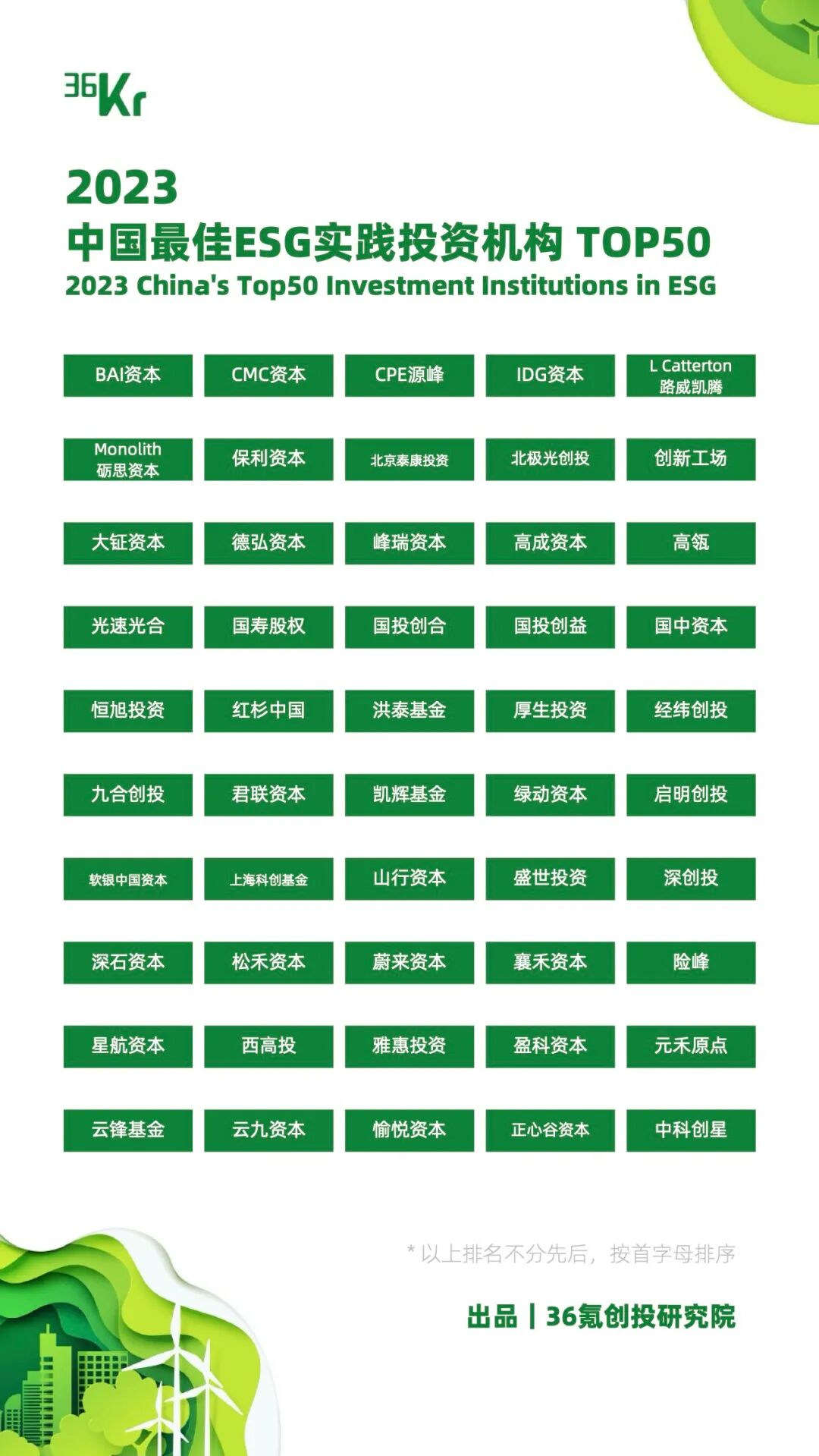
From this survey, we have four key findings:
> Finding 1: Well-Equipped ESG Committees — Cross-Functional, Multi-Layered, Highly Collaborative
ESG investment management committees play a vital role in investment institutions, serving as the "brain" that ensures ESG policy execution across the firm, makes decisions on major ESG issues in potential investment opportunities, and provides direction and guidance. Among surveyed institutions, nearly 70% have established relatively mature ESG investment management committees, including Centurium Capital, DCP Capital, China Life Equity, Shenzhen Capital Group, SDIC Unity Capital, Cathay Capital, and others.
The committee's lead is typically the firm's founding managing partner or chairman — this top-level involvement signals the institution's serious commitment to ESG investing. For example, Songhe Capital's founding partner Li Wei, DCP Capital's chairman Liu Haifeng, Matrix Partners China's founding managing partners David Zhang and David Su serve as their respective institutions' ESG leads; SDIC Unity Capital has its general manager and CEO Liu Wei as the overall ESG responsible party.
Beyond this top-leader model, dedicated ESG director roles have become increasingly common. In ESG investment strategy formulation and practice, the ESG director/specialist can supervise and facilitate between internal and external teams, ensuring ESG policy execution in day-to-day management. For instance, Cathay Capital's Chief Impact Officer is Matthieu, formerly CEO of Michelin Ventures and previously an advisor at PwC; Centurium Capital has an ESG director who reports directly to the ESG committee.
Compared to our surveys in previous years, institutional ESG responsibilities have become more specific and clearly defined. Cross-departmental collaboration is a standout feature this year, with ESG committee members drawn from different departments. For example, Centurium Capital's ESG committee comprises partners, the general counsel, CFO, IR director, and ESG director; Houssenne Capital's ESG management committee consists of founding partners and the head of social and environmental management.
As ESG develops in China, more institutions are prioritizing the recruitment of external experts and globally-minded talent to advance ESG work. Qiming Venture Partners engages PwC as an external advisor for regular training, ensuring ESG issues are fully incorporated in pre-investment and post-investment processes. L Catterton's global ESG management committee includes representatives from different regions and departments who jointly advance and monitor the firm's ESG strategy and initiatives.
In 2023, investment institutions have made progress in both the form and substance of their ESG management committees. Top-level involvement, dedicated ESG management positions, cross-team collaboration, external expert support, and hiring global talent — these represent concrete advances in how institutions are driving ESG investment practice this year.
> Finding 2: Diverse and Detailed ESG Investment Practice
In our survey sample, an increasing number of institutions are developing and refining relevant strategies and processes through practice. Detailed ESG investment concepts and indicator metrics now run through fundraising, investing, management, and exit.
Different institutions have distinctive approaches to ESG investing, with a notable shift from "negative screening lists" to "positive assessment lists." For example, Gozhong Capital conducts ESG-based self-assessments and cross-departmental peer reviews at both project initiation and investment committee decision stages. Matrix Partners China places greater emphasis on identifying non-financial risks during due diligence, and has developed preventive measures or remediation plans in its decision-making process.
To ensure ESG awareness translates into concrete action, PE firm DCP Capital has established standardized processes for ESG work. In investment sector selection, over 70% of DCP Capital's investments directly align with E (Environmental), S (Social), and G (Governance).
Sinovation Ventures, which focuses on early and growth-stage companies, began promoting ESG investment concepts in 2014. After years of refinement, all departments have adapted to relevant processes, applying ESG investment strategies comprehensively across all projects and strictly following ESG Officer review throughout investment decisions.
The fact is clear: ESG investing plays an important role in driving sustainable development, and direct investment in environmental protection, energy conservation, emissions reduction, and green low-carbon initiatives is a defining characteristic of Chinese market investors today.
In our survey, we found that whether early-stage, venture, or mid-to-late-stage institutions, all emphasize adapting to ESG trends going forward, focusing on "dual-carbon economy" investment opportunities in green sectors such as electric vehicles and new energy. Some green development sub-funds that have emerged in recent years impose strict limits on investment scope, focusing primarily on energy conservation, emissions reduction, clean energy, circular economy, and green manufacturing.
> Finding 3: Compared to E and S, Attention to G Needs Improvement
The survey found that while the primary market is increasingly emphasizing and investing in E (Environmental) and S (Social), there remains more room for improvement in G (Governance).
"G" in ESG refers to corporate governance — a company's conduct regarding governance structure, transparency, independence, board diversity, executive compensation, and shareholder rights. Through mutual supervision and checks among investors, boards, and management, governance promotes scientific decision-making and ensures a company's sustained healthy development. If E and S represent a company's external responsibilities, then G is its internal responsibility.
At the corporate governance level, our survey found that only a minority of institutions demonstrate clear attention. For example, Yunjiu Capital's portfolio company Jingling Group mentioned serving 4 million digital group leaders for employment, of which 3.2 million are women, advancing fair labor practices.
Houssenne Capital's research on its portfolio companies found that in 2022–2023, approximately 75% of companies conducted pandemic prevention and poverty alleviation activities, about 88% established environmental and social management systems, and 100% set specific environmental and social management goals and action plans, tracking energy and resource consumption in their operations. However, only about 50% took active and effective measures in employee rights protection, improving working conditions, promoting employee career development, and women's leadership.
Greater institutional attention to the "corporate governance" component helps drive portfolio companies to build more transparent, fair, and effective governance systems, improving decision-making efficiency and risk management capabilities, and promoting broader implementation of sustainable development in business.
> Finding 4: ESG Investment Cases Concentrate in Five Key Directions
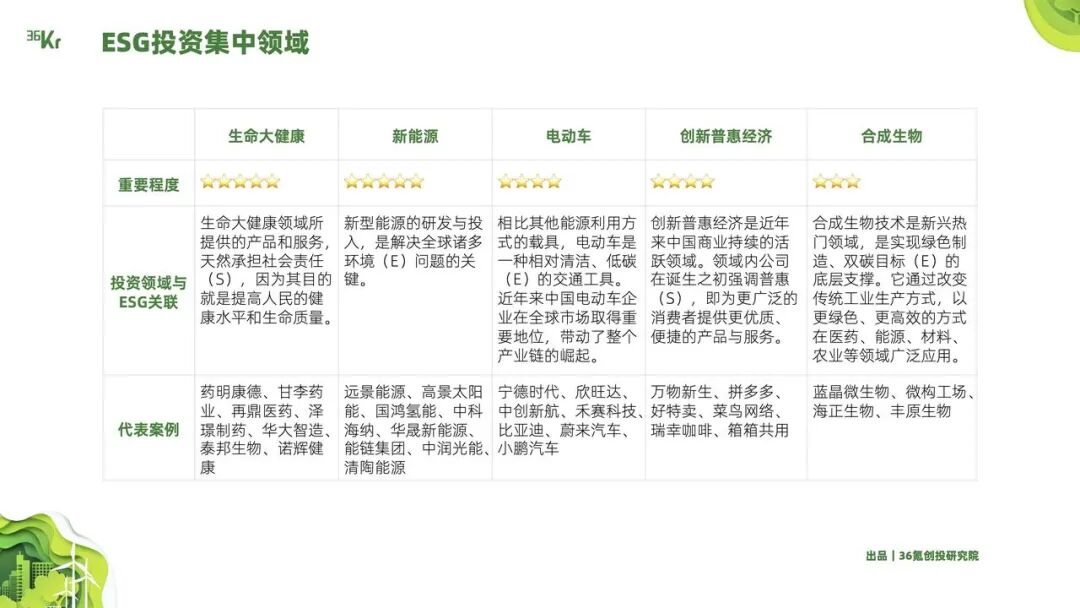
Compared to our ESG investment institution surveys of the past two years, the 2023 survey and list selection gave greater weight to portfolio companies' ESG performance. In the 2023 Best ESG Practice Investment Institution survey and solicitation, each institution recommended 3–5 portfolio cases for consideration. Survey results show that recommended ESG investment cases concentrated primarily in five directions: "life sciences and health, new energy, electric vehicle supply chain, inclusive innovation economy, and synthetic biology" — these are current hotspots and key focus areas in Chinese business development.
At the same time, based on 321 ESG practice cases submitted by listed institutions, we identified a group of companies that are actively practicing ESG concepts and principles with outstanding performance and innovative practices in this area, providing referable experience and models for ESG progress in Chinese business and serving as exemplars. Below are notable ESG practice cases across ten sectors:
> "Renewable Energy" ESG Case: Envision Energy
Envision Energy is a well-known Chinese new energy company dedicated to accelerating the digital transformation of global renewable energy. Beyond its own structural energy transformation, Envision uses digital tools to collect monthly carbon emissions and energy consumption data from suppliers, tracking supply chain progress. "100% of key suppliers with no corporate social responsibility incidents, 100% completion of digital carbon inventory by end of 2023, and 100% green electricity manufacturing for products supplied to Envision by 2025" are the three sustainable goals Envision has set for suppliers. These goals now apply to over 130 major suppliers including Schaeffler, Rothe Erde, Gangrui Precision, and Amsoil.
> "Circular Economy" ESG Case: ATRenew (Aihuishou)
ATRenew integrates ESG into its business model, creating a complete closed loop in used electronics recycling spanning C2B, B2B, and B2C across the full industry chain, merging its business with circular economy principles. ATRenew has established a three-tier ESG management committee structure, with an ESG committee under the board responsible for advancing ESG management system construction, implementing ESG strategy, and optimizing goals. ATRenew is also a member of the UN Global Compact, committing to support corporate responsibility initiatives and their principles in human rights, labor, environment, and anti-corruption.
> "Textile Decarbonization Services" ESG Case: NTX (Changsheng Technology)
NTX is a sustainable infrastructure solutions provider for the textile industry. Its core business includes cold transfer printing equipment manufacturing and textile dyeing and printing sales. Its cold transfer technology NTX®Cooltrans® can dramatically reduce pollution, carbon emissions, and water consumption in the dyeing and printing process, achieving up to 90% water savings, 65% energy savings, and 40% reduction in dye usage. NTX has become a partner for Fortune 500 companies including Adidas in achieving carbon neutrality goals.
> "Power Batteries" ESG Case: CATL
Chinese power battery company CATL plays a strong driving role in overall carbon reduction across the new energy vehicle supply chain. In 2022, CATL achieved cumulative carbon reduction of 447,200 tons, with carbon emissions per unit product down nearly 25% year-on-year; greenhouse gas emissions reduced by 47,700 tons of CO2 equivalent through photovoltaic power generation, with green electricity usage ratio rising to 26.6%; water consumption density dropped over 20% year-on-year. Moreover, CATL has linked ESG performance indicators to relevant department performance, implementing reward and penalty measures based on annual assessment results.
> "Full-Chain Logistics" ESG Case: Cainiao Network
Cainiao Network is among the first Chinese logistics companies to launch green initiatives. Through electronic waybills, box-packing algorithms, and intelligent route planning, Cainiao has developed a green solution covering the full chain of "orders, packaging, transportation, warehousing, and recycling." In fiscal 2023, Cainiao reduced packaging material usage by over 184,000 tons, and Cainiao Post stations reused 23.82 million cardboard boxes. Additionally, distributed photovoltaic capacity on Cainiao warehouse roofs increased from 24.9 MW last year to 30.0 MW, and combined with clean electricity trading standards, achieved carbon reduction of 21,003.2 tons in fiscal 2023.
> "Smart Mobility" ESG Case: XPeng
XPeng is a Chinese smart EV company that emphasizes shaping a green value chain. XPeng's Zhaoqing base emphasizes green initiatives in product design, manufacturing, and resource recycling to reduce vehicle lifecycle carbon emissions. For example, XPeng recycles 100% of stamping scrap from its original production line, reapplying it to vehicles through a series of processes to reduce carbon emissions from aluminum body materials. In 2022, XPeng's delivered EVs reduced lifecycle carbon emissions by 1.72 million tons, photovoltaic power generation contributed to 14,188 tons of carbon reduction, and annual charging volume equated to approximately 577,200 tons of carbon reduction.
> "Consumer Brand" ESG Case: Luckin Coffee
Luckin Coffee is a well-known Chinese domestic coffee brand with over 10,000 stores covering nearly 240 cities nationwide, providing Chinese customers with high-quality, high-value, and highly convenient products and services. From 2020–2022, Luckin Coffee completely rebuilt its corporate governance system, establishing a governance structure with clear division of responsibilities, balanced authority, and effective checks and balances, while focusing on five segments — R&D, procurement, storage and transport, production and sales, and customer feedback — to build a food safety and quality management architecture running through the full value chain, a pivotal move in Luckin Coffee's history.
> "Energy Ecosystem" ESG Case: NaaS (Nengliang Lian)
NaaS is among China's earlier enterprises focused on energy digitalization and one of the country's fast-growing energy unicorns. NaaS serves nearly 33,000 gas stations and 575,000 charging piles, providing customers with one-stop solutions and distributed energy management solutions. Currently, NaaS has extensive business units including Tuanyou, NaaS EV Charging, Nengcheng Technology, Nengqi Technology, and Zhongnenglian, with a service network covering approximately 1,800 cities and towns nationwide, spanning multiple energy categories including oil, electricity, hydrogen, and gas.
> "Life and Health" ESG Case: New Horizon Health (NHH)
NHH is China's first biotech company focused on home-based early screening for high-incidence cancers. NHH is committed to "moving the checkpoint forward" in cancer prevention, promoting early screening, early detection, and early treatment among high-risk populations through home-based screening products and services, reducing incidence and mortality rates of high-incidence cancers. For colorectal and gastric cancers — the highest-incidence cancers in China — multiple NHH products have been launched and commercialized. Additionally, NHH has built an ESG governance structure from board to execution level, with the board bearing overall responsibility for ESG, ensuring ESG concepts are incorporated into corporate strategic goals and daily operations.
> "Carbon Enterprise Services" ESG Case: Carbonstop
Carbonstop has focused on carbon management since its founding in 2011, driving industries to conduct carbon emission calculation, carbon management, and carbon reduction, ultimately achieving carbon neutrality. Carbonstop's core product is the carbon management SaaS platform "Carbon Cloud," which has served over 1,200 global clients including BATJ, Starbucks, SKP, Dow, CNOOC, Hualong Aviation, and Porsche. Over more than a decade, Carbonstop has accumulated over 150,000 carbon emission factors across 200+ countries, which will gradually open to all users, allowing consumers to directly choose low-carbon products based on product carbon information when shopping online or offline.
Additionally, based on this survey, we will hold the "Dark Current Waves · ESG Themed Salon" in mid-January 2024, inviting official ESG organizations, industry experts, and primary market practitioners to discuss topics including but not limited to:
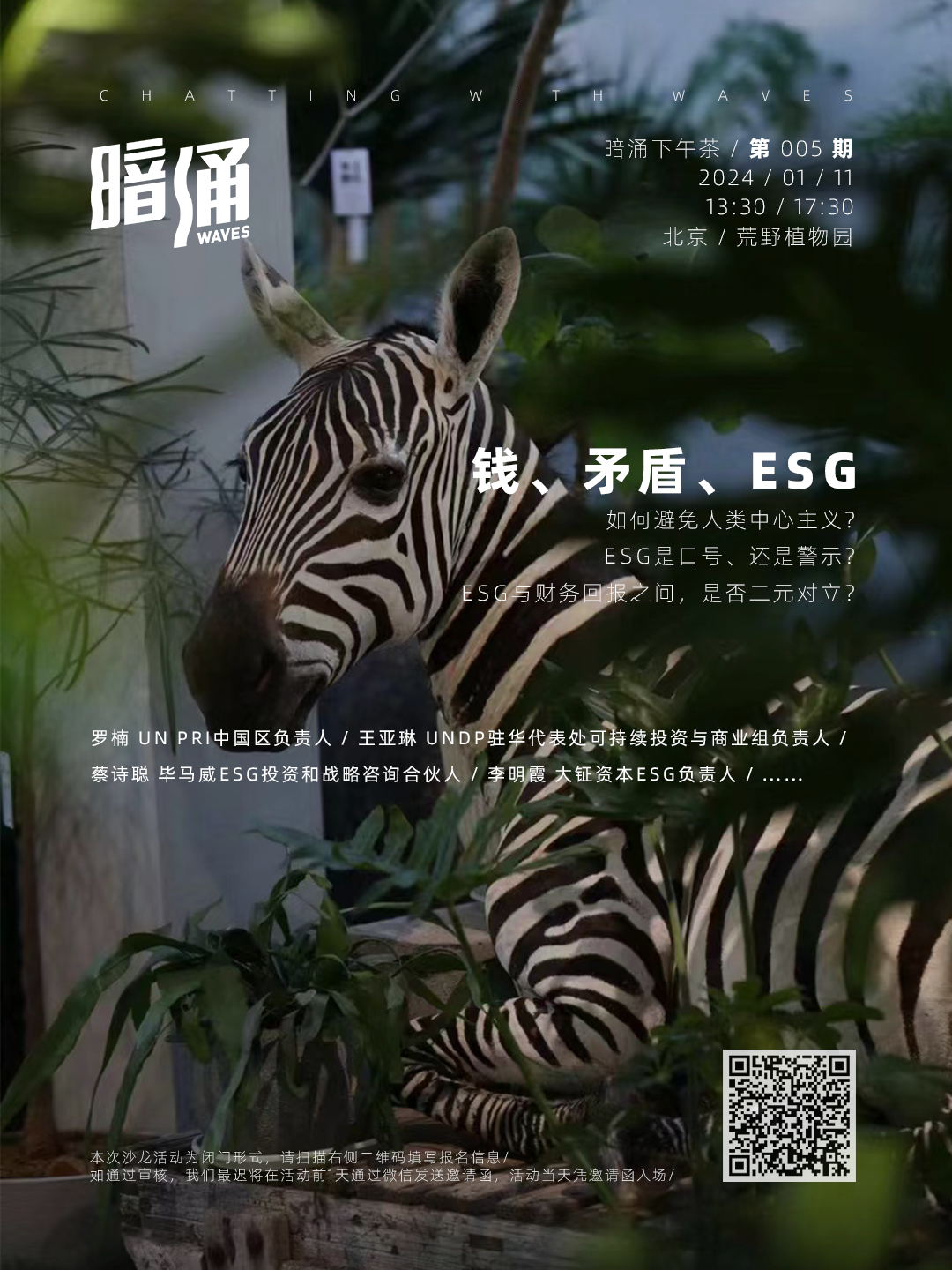
Image source | IC photo
Layout | Xuemei Guo