Exclusive | Moonshot AI's valuation reaches $3 billion in new round; Tencent joins after Alibaba
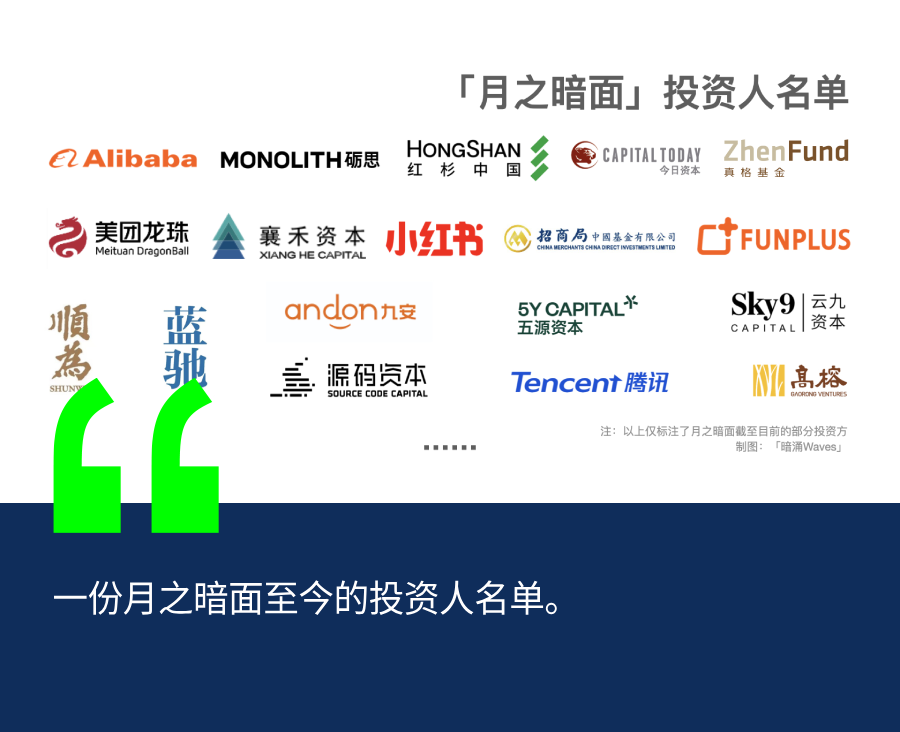
A full list of Moonshot AI's investors to date.
By Lili Yu
Edited by Jing Liu

AnYong Waves has learned that Moonshot AI's fundraising is still ongoing, with its latest round now valued at $3 billion. Sources say new investors include Tencent and Gaorong Capital. This means the Chinese large language model startup has officially entered the 20-billion-RMB club.
The new round's launch marks the closure of the previous one. In mid-February this year, Moonshot's new funding round exceeding $1 billion was a milestone in LLM startup financing history, valuing the company at $2.5 billion at the time. We later learned that the first tranche to actually close was $800 million, led by Alibaba and Lishi Capital. But this didn't include additional investments from existing shareholders, or institutions whose processes were still ongoing due to the Spring Festival holiday.
According to AnYong Waves, the later participants in this round also included Source Code Capital, 5Y Capital, Sky9 Capital, and BlueRun Ventures. One source told us: "Moonshot's current shareholder list is a luxury lineup encompassing at least over twenty investors," including but not limited to: Alibaba, Lishi Capital, Hongshan, Capital Today, ZhenFund, Meituan Longzhu, Xianghe Capital, Xiaohongshu, China Merchants China Direct Investments, FunPlus, Andon Health, Shunwei Capital, BlueRun Ventures, 5Y Capital, Sky9 Capital, Source Code Capital, Tencent, and Gaorong Capital.
Tencent's appearance is, in some ways, surprising. Alibaba was already Moonshot's largest shareholder with a 40% stake. Choosing one tech giant often makes another hesitate. And compared to Alibaba Cloud's importance to Alibaba, Tencent Cloud is clearly less central. Not long ago, an AI investor told AnYong Waves that after game license approvals tightened late last year, Tencent held an internal review meeting to "tighten unnecessary investments," where the calculus was: "If we're putting new money out, we need to calculate whether it beats buying back Tencent stock." All of this makes Tencent's investment seem unusual.
Yet it's also understandable. Among the major tech companies, Tencent clearly can't focus solely on building its own LLM like ByteDance or Baidu — it hopes to achieve strategic goals through external investments. Even before Moonshot, Tencent had already invested in Zhipu AI, Baichuan Intelligence, and MiniMax. Tech publication The Information reported that this investment could pave the way for collaboration between WeChat and Moonshot's chatbot.
Some investors believe the viral success of voice assistant Kimi may have been a key variable in Tencent's decision to invest in Moonshot — "hard not to make Tencent, sitting comfortably atop the social media throne, nervous." After all, Tencent's investment team once missed Yiming Zhang right under its nose, and Tencent clearly doesn't want to repeat that story. This also reflects the mindset of many VC and corporate investors: fear of missing out.
A corporate investor told us that in this new wave of LLM frenzy sparked by Kimi, Moonshot was probably "the easiest project to get through investment committees" among the major LLM companies, because "partners at virtually every institution have likely tried Kimi." Beyond some dollar-denominated VCs, the most anxious to get in included listed companies — "especially some mid-tier ones."
A dollar fund investor told us that recent new entrants into LLM investing include not only some dollar VCs making follow-on investments and listed companies, but even some major state-backed RMB funds and insurance capital. But whether even larger capital will follow, and how to solve the commercialization challenge for LLM companies — "they'll have to face that reckoning sooner or later, but right now it's still a complete fog."
LLM entrepreneurship may be the most agonizing tech boom in history.
It swept through the global tech landscape like a storm, building consensus rapidly — then just as quickly splintering it. The realist camp, represented by Allen Zhu, managing partner at GSR Ventures, has maintained a relatively pessimistic stance. He argues that this generation of LLM startups faces a harsher environment than the previous wave of AI companies like SenseTime: no technical differentiation between companies, each generation of technology requiring fresh capital infusions at exponentially rising scales; and without viable business models, each generation's monetization window lasts only two to three years. After OpenAI released GPT-4o, Zhu's new assessment on WeChat Moments was: "Model companies not deeply tied to major tech platforms are basically already out."
Some are desperate to get in. Others watch coldly from the sidelines. This is the unique spectacle of China's LLM boom.
Image source: AnYong Waves