Exclusive | Yungang Huang and Source Code's New VC: Back to Classic Playbook
Back to the classic VC playbook of "a pizza is all it takes."
By Lili Yu
Edited by Jing Liu

China's VC industry is in the midst of a transformation. An Yong Waves has learned that Yungang Huang, managing partner at Source Code Capital, will take full charge of and independently operate the firm's Venture fund starting from its next vintage, under the new name "Code Rhythm Capital" — meaning "ride the wave, rhythm the future." The rest of Source Code's investment business, including its Growth fund, as well as its startup services, portfolio management, and exits, will remain under the leadership of founding partner Yi Cao.
Previously, Source Code's investment operations were divided into Venture and Growth stages. The core change here is that the next Venture fund will be entirely entrusted to Yungang Huang, covering the full lifecycle from fundraising to investment, management, and exits.
In China, spinning out a new organization from within a large fund platform is a rare move. But according to Yungang Huang, this is "a proactive transformation amid great change." In his view, as dollar-denominated VC rapidly converges on AI and globalization, organizational agility has become increasingly critical. Returning to a "six- or seven-person team that can share a pizza" — a "craftsman-style, more primitive VC" approach — "allows us to better accompany early-stage founders in refining ideas and calibrating direction," making it more competitive in today's early-stage investing landscape.
Source Code Capital is a representative of China's new generation of VC firms. In recent years, many of these newer funds expanded significantly in fund size and headcount, which inevitably brought slower information flow and declining decision-making efficiency — both of which are especially critical for VC. So in a sense, Source Code's adjustment is also a proactive response to the decision-making and efficiency challenges that come with scale.
Source Code may not be alone in this. As the market enters an adjustment period, platform-style institutions face no small challenges, and more funds will likely adopt diverse approaches to address today's pressing, ever-shifting realities.
The changes aren't limited to early-stage investing. Source Code's Growth fund is also evolving. Han Guang on the Growth team was recently promoted from Executive Director to Managing Director. The investor, who joined Source Code four years ago, has spent 12 years in the investment field and been involved across the full chain of fundraising, investing, portfolio management, and exits. His representative deals include Tasteit (Tasiting), Wonderlab, and Indel (car refrigerators).
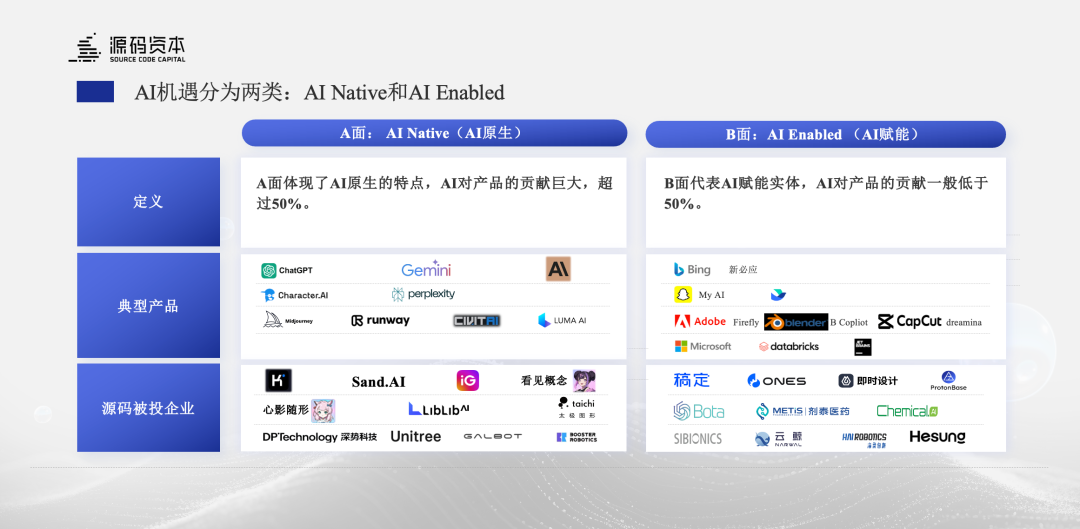
Additionally, An Yong Waves obtained a recent speech by Yungang Huang focused on the AI industry. He divides AI opportunities into two categories: AI-native and AI-enabled. The former reflects AI-native characteristics where AI contributes more than 50%, while the latter represents AI empowering physical industries, where AI's contribution is generally below 50%.
Yungang Huang added, "AI is just one of the most important technological variables in Source Code's investment process, but not the entirety." Following several possible threads of AGI, and based on the standard of "understanding both models and products," Source Code has already invested in language model Moonshot AI, video model Sand.AI, and Galaxea Robotics, among others.
Below are excerpts from Yungang Huang's remarks at Source Code Capital's 2024 USD Investor Closed-Door Meeting:
AI investing is not a one-way street. It has both bright prospects and potential risks. Today, I will delve into the two sides of AI investing — the A side and the B side — presenting our investment analysis and strategy for the AI field.
We believe AI opportunities fall into two categories: AI-native and AI-enabled.
AI-Native (Side A): AI-native refers to products or services where AI contributes more than 50% — that is, AI is the core of the product or service. Typical products include ChatGPT, Gemini, the new Bing, Character.AI, and others. These products primarily rely on AI technology to deliver services or create value.
AI-Enabled (Side B): AI-enabled refers to products or services where AI contributes less than 50% — that is, AI serves as an auxiliary tool or technology that enhances existing products or services. Typical products include Adobe Firefly, Blender, Microsoft Copilot, CapCut, and others. These products incorporate AI technology to augment functionality or user experience.
This wave of AI began with OpenAI's founding in 2015
In the tide of technological innovation, artificial intelligence has become a key force driving social progress and economic development:
Tesla Optimus: Walking speed improved by 30%, weight reduced by 10kg. Now capable of performing specific complex tasks in factories.
Sora: Video length extended to one minute, with excellent quality. A team of three can produce impressive short films in just 1.5 to 2 weeks.
Investment: In 2024, AI giants' capital expenditure is expected to exceed $100 billion. Global primary market AI investment has surpassed $40 billion. OpenAI has raised $14.3 billion cumulatively, with its latest valuation exceeding $80 billion.
AlphaFold 3: Research projects that once took scientists years can now be completed in days, with overall accuracy above 80%.
ChatGPT: Reached 100 million monthly active users just two months after launch. 2023 recurring revenue reached $1.6 billion. April 2024 visits hit 1.86 billion, surpassing the new Bing.
Generative AI uses deep learning algorithms to learn underlying patterns in data, then applies this knowledge to generate entirely new content — such as realistic images, persuasive text in various creative styles, and even music and video works.
The major players in generative AI remain concentrated among internet giants: Tencent, Facebook, Amazon, Microsoft, Google, Alibaba, and Baidu have all made substantial investments in this revolutionary technology.
Generative AI is disrupting industries across different domains:
Content Creation: Imagine AI-powered tools that can generate marketing copy, scripts, musical compositions, and even product designs in various creative styles.
Product Design: Generative AI can help designers create new, innovative products faster and more efficiently.
Scientific Research: Generative AI can be used to simulate complex systems and accelerate scientific discovery.
Business Operations: Generative AI can help enterprises improve efficiency and productivity by automating tasks and generating reports.
At Source Code Capital, we are excited about the potential of generative AI and are actively investing in AI startups. Our investment strategy focuses on three key factors:
Investing in early-stage and growth companies. This is because generative AI is a rapidly evolving field, and we want to be at the forefront of innovation.
We look for companies with strong technical teams and clear product vision. We believe an excellent team is crucial to bringing these complex generative AI models to life.
Finally, we invest in companies with the potential to become market leaders. We believe generative AI has the potential to create entirely new markets, and we want to back the companies most likely to seize this opportunity.
The Two Sides of AI Investing
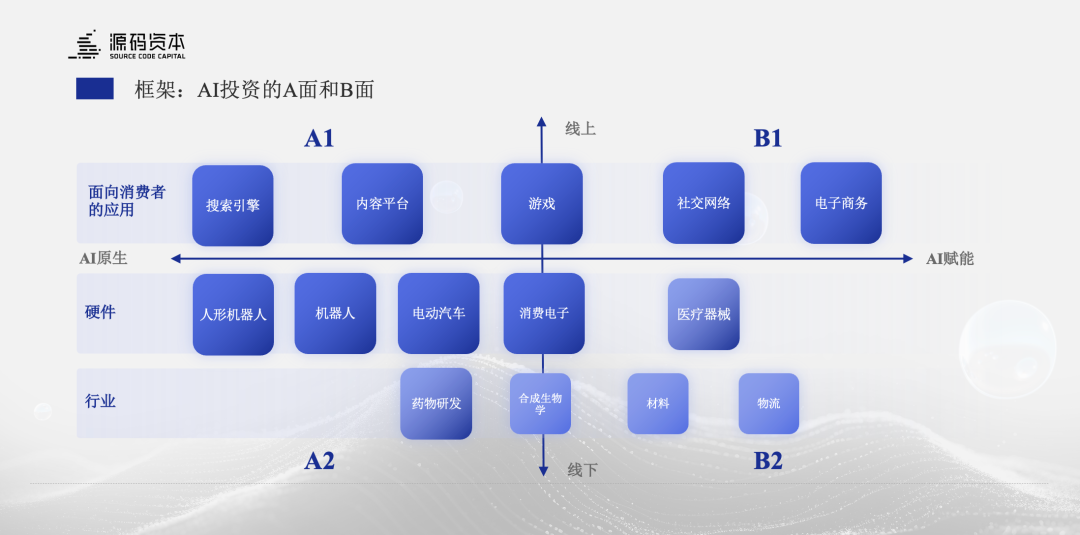
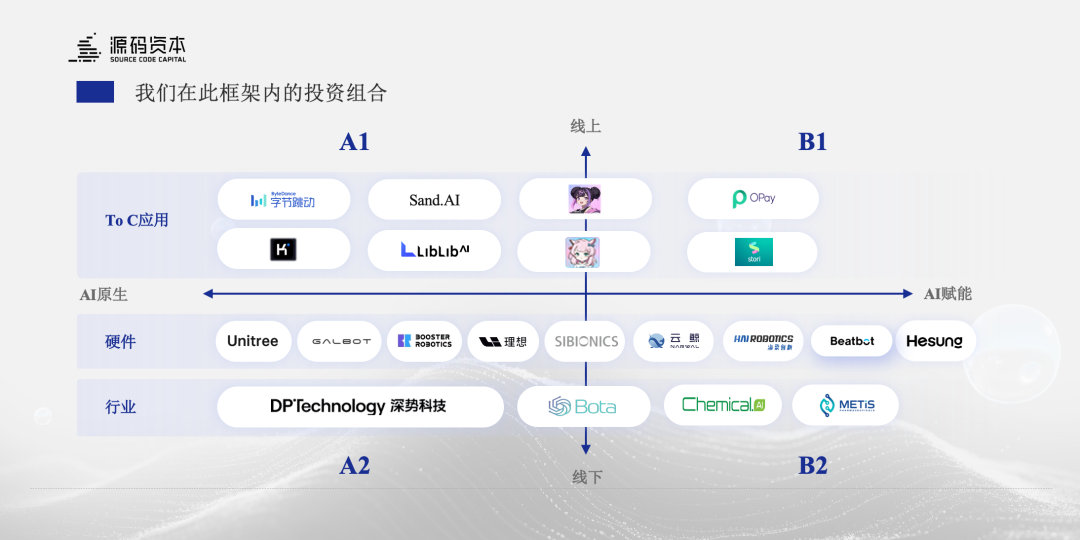
We believe that from AI-native to AI-enabled, from online to offline, the current major domains can be mapped to four quadrants.
Online (A1 and B1): A1 refers to consumer-facing applications — products that directly leverage AI technology to deliver services, such as search engines and content platforms. B1 refers to products that enhance user experience or service efficiency through AI technology, such as social networks and e-commerce. Gaming sits between them.
Offline (A2 and B2): A2 refers to products highly dependent on AI technology, such as autonomous vehicles or advanced robotics systems, as well as AI-driven drug discovery. B2 refers to products that integrate AI into existing offerings to improve performance or add new features, such as in medical devices, materials, and logistics.
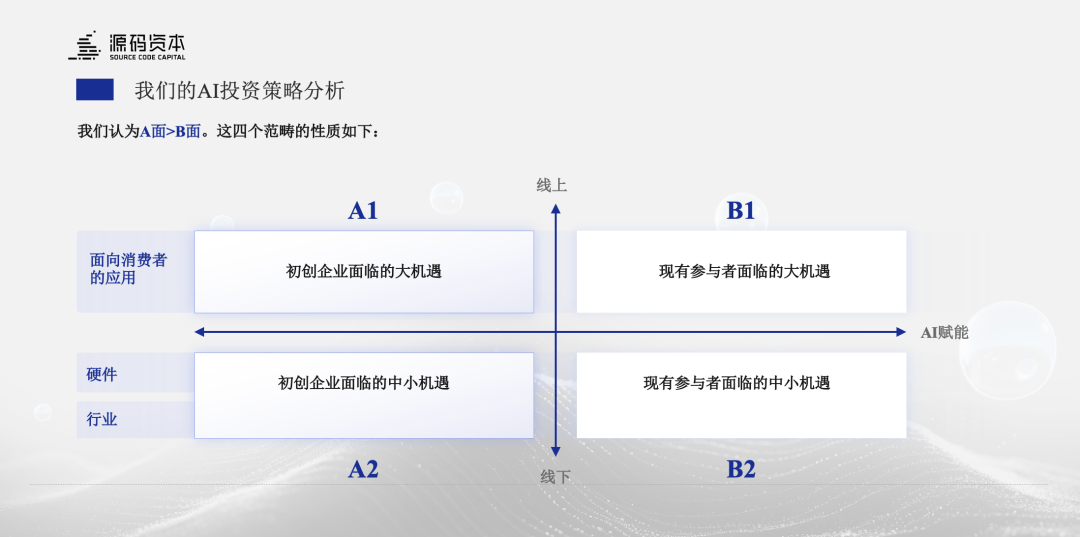
Investment Opportunities: Side A > Side B, AI to C Applications > AI + Hardware > Industrial AI
AI to C Applications: AI-native products represent major opportunities for startups, because products and services directly facing consumers can quickly gain market feedback and have potential for rapid growth and scaling. Such applications typically require strong user experience and high personalization, with AI technology playing a key role.
AI + Hardware, Industries: This category of AI-native products represents medium-to-small opportunities for startups. It involves integrating AI technology into hardware products, such as smart home devices and wearables. These products may require longer development and market acceptance timelines, and are constrained by industry-specific factors.
In our AI investments, we favor enterprises that can directly leverage AI technology to create new value and deliver innovative services or products — those with disruptive potential at the frontier of AI technology.
At the same time, when evaluating investment opportunities, we pay special attention to AI applications that can rapidly respond to market demand, with high innovation and user orientation. We selectively seek out and support those enterprises most likely to lead industry transformation and achieve commercial success, thereby building a diversified portfolio with high growth potential.
So what will continue to drive progress and commercial success in AI?
We believe the following key factors are essential:
Improvement in Foundation Model Capabilities: Continuously optimizing and enhancing AI's foundation models to achieve more accurate, more efficient intelligent processing capabilities.
Reduction in Inference Costs: Lowering the computational costs of AI applications through technological innovation, making them more accessible and easier to popularize.
Upgrade of AI Infrastructure: Investing in the infrastructure required for AI, such as cloud computing platforms and big data processing centers, to provide solid support for AI technology applications.
Each Generation Has Its Opportunities; Embrace Youth
In the AI era, technology, products, and infrastructure are developing rapidly in parallel. This requires entrepreneurs to not only have forward-looking technical cognition, but also to begin building products at the early stages of technological development. The requirement for entrepreneurs to simultaneously possess product intuition and technical capability means that AI founders today are younger than before. Because only those with very strong predictive ability regarding rapidly changing technology can build a good product.
Ten years ago, the release of the iPhone 4 catalyzed the mobile internet explosion, and those born in the 1980s chose to start businesses between ages 21 and 30. Now, as the AI wave arrives, more and more highly educated, smart, path-dependency-free young people born in the 1990s and mid-1990s are emerging — there is no shortage of talent on the supply side. This year may well become a dividing line for the age cohort of AI "major success" founders. They have faster learning and adaptation capabilities for new technology, giving them particular advantages in the AI field.
We believe that each generation has its opportunities, and each generation invests in its own. The AI era offers unique opportunities for young people. Their technical capabilities, innovative spirit, and high acceptance of new technology position them to succeed in this domain. Embrace youth — we will always bet heavily on young people.
Passion brings change; rhythm welcomes the future. Together with more young people, we will embrace this great era.
Image source: IC photo
Layout: Yao Nan