How Did Chinese Silicon Valley Entrepreneurs Build the "Tesla of RVs"? | Waves World View
Travel light.
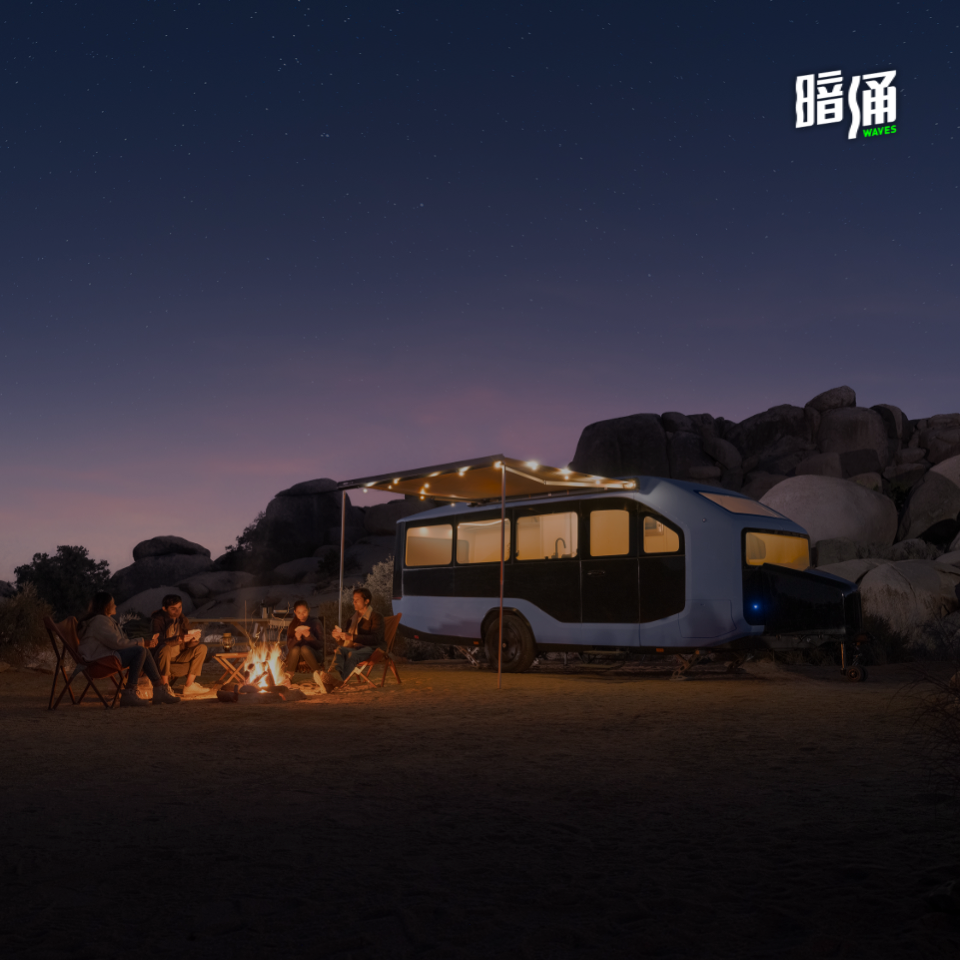
"Travel light." By Qian Ren
Edited by Zhiyan Chen

In 2025, the narrative of Chinese consumer hardware going global has officially entered the "deep water."
From smartphones and robot vacuums pushed to their absolute limits, to 3D printers and humanoid robots conquering markets worldwide, Chinese entrepreneurs have nearly reshaped the entire hard tech landscape. Yet in one sector — an industry worth tens of billions of dollars annually, often called the "largest single product" in consumer hardware — the RV (Recreational Vehicle) — the rules have long been governed by an extraordinarily primitive "workshop logic."
America's first RV was born in 1910. Even after towable trailers matured in the 1950s, the manufacturing process remained heavily dependent on manual labor, with digitization close to zero. One industry insider once put it bluntly: this is the only market in the world that "abuses its users year after year and somehow survives."
After the pandemic, Bingrui Yang decided to break this stagnation. A quintessential Chinese-American elite who had lived in Silicon Valley for nearly two decades, led touch and display system module development for the iPhone 5 through 12 series at Apple's headquarters, and later served as an autonomous driving executive at both Zoox and Cruise, he spotted a disruptive opportunity during one "miserable hour" while camping in Yosemite.
In 2022, Pebble Flow was founded in Silicon Valley. It is a hybrid that defies easy categorization: an RV manufacturer, an EV accessory, and an "embodied intelligent mobile space" equipped with an NVIDIA ORIN chip and a 45kWh battery.
In recent years, the typical playbook for Chinese hardware going global has been "strong domestic supply chain + overseas sales channels." But with Pebble Flow, we see a more compelling variation. This is a company "born global": headquartered in Silicon Valley, founded by a Chinese entrepreneur, with a core team of American elites from Apple, Tesla, and Cruise, supported by a supply chain that spans the entire globe.
This July, Pebble Flow began deliveries of its first mass-produced self-propelled camping trailer, starting at $109,500. It eliminates the anxiety of backing into a campsite — and has triggered a market repricing of what it means to be "the Tesla of RVs."
To date, Pebble Flow has completed three funding rounds. Its shareholder roster includes Photosynthesis Ventures, Hongshan, Yuanjing Capital, INCE Capital, and U.S.-based funds UpHonest Capital and Alumni Ventures.
Recently, Anyong Waves sat down with Bingrui Yang for a long conversation. We talked about the late-night "itch" that Silicon Valley veterans can't shake, the combined force of Chinese and American supply chains, and how to execute a "dimensional reduction strike" in a slow business using the engineering foundation of autonomous driving.
The following conversation has been edited by Anyong Waves —
Part 01
Reinventing the Clunky RV with Autonomous Driving Technology
Anyong: From iPhone to autonomous driving — those are pretty cool résumé lines. RVs sound like a "clunky" space by comparison. Why this?
Bingrui: It was a decision driven by both reason and emotion. On the emotional side, the pandemic fundamentally changed how people live. "Live, work and play from anywhere" stopped being a slogan and became an irreversible trend. Many of us on the team are camping enthusiasts. We crave that ultimate freedom.
On the rational side, there's the business case. In America, RVs aren't a niche market — they're core culture. One in ten American families owns an RV. That's a massive installed base. But the more interesting number is the other nine out of ten. Ask them "would you want a mobile home?" and most say yes. So why don't they buy? Because the experience is terrible.
Anyong: How terrible?
Bingrui: It's an incredibly antiquated industry. Once, a mainstream American RV media outlet interviewed me, and the reporter opened by saying: "Forget the interview, let me vent first." He'd been covering the industry for decades and considered it the only business that "abuses customers long-term and still survives."
If you rent a conventional RV, you'll find it's essentially "workshop-style house building" — wooden frames stuffed with appliances. Traditional RVs average about 100 days of use before components start failing. They're built to construction standards, not automotive standards. They can't handle road vibration.
Anyong: What was your first experience towing a trailer to a campsite like?
Bingrui: It was post-pandemic. I arrived at the campsite after dark, and the first task was backing a massive trailer into a narrow spot. There was a line behind me. People were watching. My wife was trying to direct me from behind, but I couldn't hear a word she said. It took a full hour to get parked. Afterward, my wife didn't want to talk to me. Even for experienced drivers, it's an absolutely high-stress moment.
With conventional trailers, range also drops dramatically. If your truck shows 300 miles fully charged, towing might cut that to 100–120 miles. A 200-mile trip means two charging stops — which means finding a large lot to unhitch, charge, and re-hitch. Massive hassle.
Anyong: Even so, going from autonomous driving to RVs — in many investors' eyes, this is a "slow business" with heavy investment, long delivery cycles, and high education costs. How did you convince yourself and your team?
Bingrui: Starting a company really comes down to three questions: Can we do it? Is it worth doing? Do we want to do it?
Technically, autonomous vehicles may not be fully deployed yet, but the underlying perception, battery, and motor technologies are mature. They can absolutely be transferred to the RV scenario. So "can do."
Market-wise, the U.S. RV installed base is enormous, and 90% are towables — completely different from China's motorhome-dominated market. The ceiling is extremely high. So "worth doing."
As for "want to do" — that anxiety in Yosemite, that terrible user experience, and the ultimate freedom of taking your home anywhere once you solve it — it created an instinct: if I don't solve this, I won't sleep well at night. I'd feel an itch on my back.
Anyong: So you see RVs as a market where "technology transfer" can create massive upside?
Bingrui: Exactly. We're using automotive supply chains to execute a dimensional reduction strike on the RV industry's "workshop-style house building." It's a classic "high barrier, high ceiling" integrated business.
Anyong: On product form, why did you firmly choose the trailer over the motorhome, which is more common in China?
Bingrui: This starts with reading the U.S. market. Ninety percent of American RVs are towables. The deeper logic is about decomposing the product experience. With motorhomes, there's an eternal compromise: bigger vehicle, more comfortable living, but miserable to drive — sometimes won't fit in standard parking; smaller vehicle, fun to drive, but cramped to live in.
The best solution is simply separating "driving" from "living": one vehicle for mobility, one for habitation. The biggest pain points of towable trailers are the towing itself and the backing anxiety. Pebble Flow has auxiliary propulsion, dramatically lowering the towing barrier. At camp, unhitch and remote-park. Once we solve these pain points with autonomous driving tech, it has only advantages, no drawbacks.
Anyong: You launched and began delivering your first production RV this year. What's user feedback been like?
Bingrui: We've been delivering in volume, and feedback has been excellent. One recent delivery was to a Cybertruck owner — a classic early tech adopter. He'd never towed before and was very worried about range and handling impact. After using it, he posted specifically: "Tow with Confidence." Because Pebble Flow has power assist, he couldn't feel the several-ton mass behind him.
He also called out our InstaCamp feature — one button, stabilizers deploy, stairs extend, lights come on. He said it's as natural as iPhone's "slide to unlock." Our smart features essentially let anyone operate an RV as easily as a remote-control toy.
Anyong: Pebble Flow's most visible selling points are Magic Hitch and Remote Control Parking. For a team with autonomous driving backgrounds, this should be straightforward?
Bingrui: It's a process of asymptotically approaching 1. Magic Hitch involves vision algorithms and motor control. Get it wrong and hit the user's car — disaster. Terrain is the big challenge. Flat concrete is easy. But real user scenarios are often wild campsites. We've iterated countless times, training on gravel, mud, and slopes to achieve commercial deployment with safe, convenient user experience.
Anyong: Why hadn't anyone done this before?
Bingrui: There are no unsolvable technical problems. There was just no team with real product definition capability and deep user pain point understanding.
Anyong: Many competitors have gone with range-extender solutions. Why does Pebble Flow insist on pure electric?
Bingrui: We debated pure electric versus range-extender. Range-extenders address range anxiety. For motorhomes, if pure electric range is hard to push high, range-extenders make sense. But for towables, the tow vehicle determines range. If the tow vehicle is out of charge, a range-extender in the trailer doesn't help. And if the tow vehicle is gas-powered — which most American RV owners use — there's no range anxiety to begin with.
Research shows 85% of RV trips are under 200 miles one-way. Pebble Flow's 45kWh battery and power assist help the tow vehicle share load, achieving 300 miles of range. The vast majority of users won't have range anxiety. Adding a range-extender for that 1% extreme long-distance scenario would sacrifice interior space and cost — violating our efficiency principle.
This is a user-logic tradeoff. For many American EV owners, gas versus new energy is a principled, either-or issue. They deeply dislike burning fuel in their vehicle. They think: "I'm already driving electric, why keep gasoline in my RV? Why go to a charging station AND a gas station?"
Part 02
A "Mini Tesla" of Energy and Space
Anyong: Your team includes people from Apple and Tesla. Who do you benchmark against when fundraising?
Bingrui: In business complexity, we're closest to Tesla (EV + energy + software). But in seamless product experience, we have Apple's soul. Our positioning is "Mini Tesla" for RVs and the broader camping ecosystem.
We actually ran the numbers. If you bought a comparable Airstream, it'd be about $135,000 — but it's just an empty shell. Pebble Flow isn't just an RV; it comes standard with a 45kWh LFP battery.
What does that mean? If you bought Tesla Powerwalls separately, each is 13.5kWh. We're packing the equivalent of 3.5 Powerwalls. And that's not counting that it's an instantly usable ADU (accessory dwelling unit) — building an ADU in California costs at least $250,000.
Anyong: So you're really selling a three-in-one: RV + energy storage + mobile workspace.
Bingrui: Right. Many investors initially saw only hardware sales. But just as Elon Musk doesn't just sell cars, we've already broken beyond the narrow definition of RVs. Going forward, we'll build a full ecosystem integrating RVs, energy, data, and AI.
Anyong: As a hardware company, supply chain and manufacturing are the biggest "pits." What challenges have you faced?
Bingrui: Unlike consumer electronics, you can't just mail an RV back for replacement if it breaks. If an RV fails on the road, you need local service capability like automotive 4S shops. Our after-sales system is now faster than many traditional RV manufacturers. If a user's vehicle has issues, we fix it in days. Traditional manufacturers might have 60-day queues. Pebble is disrupting after-sales too, and user feedback has been excellent.
Anyong: How did you get your first users?
Bingrui: As a DTC company, users have been joining since our announcement over two years ago. They're incredibly loyal seed users — some waited two years. I make time to talk with them. Some literally cried at delivery. It's true — because they finally got an RV they were satisfied with. Before we launched, they wanted someone to build exactly this product, but no one did.
Anyong: Recently there's been domestic market discussion of similar directions. Some consumer electronics and hardware-background companies are looking at overseas RV markets.
Bingrui: Competition means the market is waking up. That's good. If no one competes with you in a track, you probably chose wrong.
But many companies coming from consumer electronics fall into the "hammer looking for nail" trap. They might have excellent motor tech or vision algorithms (the hammer), then force-fit a scenario (the nail). What they often miss: an RV isn't consumer electronics, it's automotive logic. It involves extremely complex global supply chains, regulatory certification, and heavy offline service.
Part 03
A Global Company Making Life Lighter
Anyong: Your team is a Chinese founder leading American elites from Apple, Tesla, and Cruise. From a domestic perspective, this is inherently interesting.
Bingrui: (Laughs.) Our CTO Stefan was a core early figure at Tesla Autopilot, personally recruited by Elon Musk, then poached by Apple to lead AI for their car project.
When I found him, he was already accomplished and thinking about retiring. I talked with him for 15 minutes about what I wanted to build. His eyes lit up. He said: "Bingrui, you are killing me." Turns out he owned a traditional RV himself and knew every pain point intimately. It clicked immediately. We have many such elites on the team — people who grew up camping in RVs or are outdoor enthusiasts.
Anyong: Does this Chinese founder + American executive combination create management friction?
Bingrui: There's definitely friction, but it's more complementary. Actually, our common language isn't English or Chinese — it's product, passion, and drive to make a difference in the world.
Our team has a special atmosphere. Many engineers used to work late at big tech companies and go home almost embarrassed to tell their kids. At Pebble, they proudly drive Pebble Flow home and tell their children: "Look, this is the car Dad built. We can take it camping." That pride transcends culture.
Anyong: As a Chinese-founded global company, how do you understand China's advantages?
Bingrui: Our global supply chain system includes outstanding Chinese supply chain teams.
Using the world's most advanced engineering logic and ultimate supply chain to build a product with intensely local demand. RVs are deeply tied to local culture — you can't expect to push a standardized product globally. That's precisely our moat.
Anyong: In the current geopolitical environment, has there been internal debate about taking U.S. dollar fund money versus Chinese dollar fund money?
Bingrui: From day one we defined ourselves as a global company. Our investor roster is very "global": Photosynthesis Ventures led our seed round, then Hongshan, Yuanjing, and U.S. domestic funds. Capital is smart. What they care about is whether this is a business that can transcend cycles.
Anyong: If one day the market stops asking "who does Pebble resemble," how would you want the world to define you?
Bingrui: I want Pebble defined as a company for Lighter Living.
One of our first users said that after using Pebble Flow, he could never go back to traditional RVs — just like after driving electric, you can't go back to gas. That's the definition we most want to see.
We're not just building vehicles. We want to liberate humanity from tedious survival tasks to truly enjoy life.
Layout by Nan Yao | Images courtesy of interviewee


Recommended Reading

The flow of money, the rise and fall of people