Investors in the Wheat Field
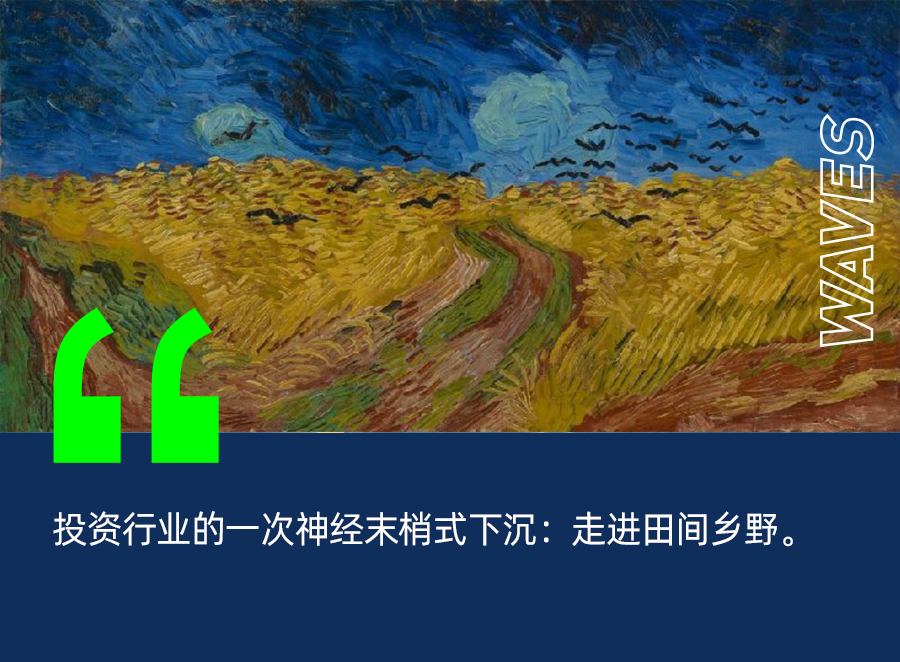
A Nerve-Ending-Style Descent into the Investment World: Into the Fields and Countryside.
By Yi Zhang
Edited by Lili Yu, Jing Liu

Only when he saw crows and pigeons circling and perching beside the towering feed silos of the chicken farm did Du Zonglin finally breathe easy.
This was a farming base in Guyuan, Ningxia. The facility operated under closed, sterile conditions — entering the chicken houses required air showers, mist disinfection, and numerous other protocols, making due diligence no easy task for an investor. Seeing the birds around the feed silos confirmed to him that "there's real feed inside," not just for show. To verify the entire chain was truly "closed-loop," the Fengshang team had already made trips to manure processing sites over ten kilometers away and chick hatcheries dozens of kilometers distant.
A few months later, in early 2022, Fengshang Capital invested in Huang Tian'e, a pasteurized egg brand, in a round totaling over 600 million RMB. The Guyuan, Ningxia farming base was one of four breeding locations Huang Tian'e had already established.
Behind Huang Tian'e lies a minor phenomenon in the investment world in recent years: agricultural investment, long neglected, neither "sexy" nor particularly exciting, has suddenly become competitive.
Earlier, in June 2021, another rising star in agriculture — grain brand Shiyue Daotian — completed a 1.45 billion RMB Series B led by Hongshan and Yunfeng Capital, with participation from Qicheng Capital, CMC Capital, and Taihe Capital. In December, dairy brand Adopt a Cow raised a Series B led by Meituan Longzhu. And this year, following Huang Tian'e, low-temperature yogurt brand Simple Love announced its Series C in March.
According to statistics from agricultural service platform 35Dou, in 2021 alone, China's agricultural and food sector saw over 86 funding rounds on the primary market, with total investment reaching 15.387 billion RMB.
One obvious shift in recent years: investors have stepped out of office towers, diving deep into laboratories, factories, and warehouses. This time marks an even more extreme, nerve-ending descent — into the fields and countryside. The investor holding coffee by day may find themselves bouncing along on a motorbike and eating at a roadside stall by night.
To evaluate agricultural deals, some investors have spent years traversing the three northeastern provinces, North China, and other agricultural regions. They've not only pored over Ministry of Agriculture documents on breeding, multiplication, and promotion — understanding how breeding technology works, how hybridization happens — but also grown accustomed to meeting agricultural entrepreneurs over homemade grain liquor at roadside stalls. In cities with bathhouse culture, like Shenyang, they've discussed deals with founders while soaking in communal baths.
Panda Capital founding partner Li Lun's travel map last year included over forty counties in Guizhou. Having just met a team capable of reverse-breeding over 100 potato varieties before our interview with Anyong Waves, he was heading to a cattle farm in Chengdu the next day. He spends one week each month immersed in frontline cattle farms and blueberry bases. The investor who first made his name backing Mobike now defines Panda Capital as a VC focused on agricultural technology.
Many investors have begun paying attention to agricultural technology; some have gone all in. They make intensive visits to rice, potato, egg, and chili pepper operations, to blueberry, raspberry, beef cattle, and shellfish farms. The vocabulary on their lips has shifted to: breeding, synthetic biology, alternative proteins, smart agriculture, functional food additives.
But investors quickly discovered the situation wasn't as straightforward as they'd imagined.

From Not Getting It, to Recognizing the Storm
As early as September 2019, Du Zonglin of Fengshang Capital learned about Huang Tian'e through what he calls an investment contact's "childhood friend's American roommate."
Initially, he didn't pay it much mind. For one, he admits that "agricultural deals really were inconspicuous" at the time. For another, Huang Tian'e's funding round was already sizable.
This investor, who had previously worked in investment roles at Zhejiang Daily Media and Fenghou Capital, specializing in entertainment and sports, later joined Fengshang Capital — a typical consumer fund with portfolio companies including Genki Forest, Shizuren, Jenniflora, and Lelecha.
But by early 2020, he suddenly realized this was a miss.
His reasoning came from three angles. First, Huang Tian'e's positioning and strategy. China's egg market is worth 300 billion RMB, mostly unbranded "free-range" eggs. Huang Tian'e had carved out a niche targeting urban white-collar bakers and children, building recognizable brand equity. Second, its industrial chain capabilities. A brand alone can't create moats; supply chain is essential. Huang Tian'e owned its own farms and processing facilities, meaning deep upstream integration. Third, the broader channel transformation. New retail had already burned through cash to complete last-mile delivery.
To validate this thesis, they launched research immediately — leading to the opening scene described above.
In fact, beyond Guyuan, Ningxia, they visited Huang Tian'e's bases in Beihai, Huzhou, and Mianyang. This due diligence further confirmed the company's breeding and management capabilities. Fengshang investment VP Zhao Xiao and colleagues also conducted stakeouts at Hema and other offline channels, spending months on field research from users, distributors, and partners to gather firsthand intelligence.
But by the second half of 2021, when Fengshang decided to invest, the landscape had transformed: entry was only possible through personal introductions or existing shareholders. To build deep trust, the Fengshang team went all in. Zhao Xiao, based in Chengdu, maintained constant communication with the company.
By then, Huang Tian'e had already taken off. This Sichuan-based company didn't just sell eggs — it owned a heavy-investment industrial chain encompassing chick hatcheries, parent-stock farms, and feed mills.
According to Frost & Sullivan data, in 2020 Huang Tian'e achieved a 77.6% penetration rate in the pasteurized egg category. That year, sales grew over 10x, with repeat purchase rates ranking first across all egg products online. Another telling figure: China's egg market totals 300 billion RMB, but brand penetration is only 5%, compared to over 50% in Europe and America.
Almost simultaneously circulating among investors was another project: Shiyue Daotian.
In early 2020, when Qicheng Capital — a private equity fund whose team has retail and e-commerce backgrounds — analyzed sales data from JD.com and other platforms to find more recession-resistant consumer staples, they unexpectedly spotted a "dark horse with remarkable market share and sales growth": Shiyue Daotian. From 2017 to 2020, the company's compound annual growth rate reached 60%.
Even so, when Qicheng Capital made a sole investment in Shiyue Daotian in the first half of 2020, many didn't understand — China's venture capital industry was at peak consumer frenzy. Everyone was chasing flashier new consumer brands or more distinctive discretionary products; few were scanning basic staples like rice and grains.
Many investors genuinely felt the competitive pressure from peers. Thus, after an initial meeting in March 2021, investors and Shiyue Daotian moved to closing within a month. By June, the grain brand completed its 1.45 billion RMB Series B led by Hongshan and Yunfeng Capital, with CMC Capital, Taihe Capital, and existing investor Qicheng Capital participating.
Interestingly, most of this new wave of agricultural investors and institutions previously focused on broad consumer plays. Both Huang Tian'e and Shiyue Daotian were seen as extensions of consumer investment.
Qicheng Capital, which began investing in consumer in 2016, didn't initially treat agriculture as a separate sector. But the consumer-focused firm quickly discovered that deep supply chain integration, drilling down industrial chains to directly reach product origins, was becoming mandatory homework for a new generation of brands and retail companies. Especially in 2021, when new consumer reached its zenith and many novel consumer products proved not merely unprofitable but loss-making, companies like Shiyue Daotian — combining "brand strength," "scale," and "growth" with actual profitability — showed their advantage.
Yunfeng Capital, the PE firm, first observed the trend of agricultural product branding through e-commerce platform category data. But out of caution, the investment team traveled to agricultural regions across Northeast, North, Northwest, and Southwest China. They studied core technologies like hybrid breeding and molecular breeding with agricultural scientists, while analyzing macro policy to understand agriculture's future direction. Beyond that, investors had to go native — drinking homemade grain liquor with founders at village restaurants, moving from researching upstream and downstream industries to understanding the growth DNA of individual enterprises.
Shiyue Daotian's branding story, in fact, stretches back much further.
It began as a family business in Northeast China that had spent decades growing, processing, and selling rice. Yunfeng Capital executive director Lu Shan told Anyong Waves: "Founder Wang Bing is extremely sensitive to retail channel transformation under the internet. Though he never worked at an internet company, through self-study he developed an internet operations management philosophy uniquely suited to his enterprise, along with an understanding of new retail. He compiled over a dozen notebooks of learning, which he regularly shared with his organization."
Originally, Wang Bing came to Beijing from the Northeast to wholesale rice at the Wangsiying agricultural market in Southeast Fourth Ring Road. Around 2012, while most peers still didn't understand e-commerce, he began selling his own branded Northeast rice directly to consumers on online platforms — a pivotal leap from product distribution to brand building.
In the view of Qicheng Capital executive director Wan Xiao, "once agricultural products are branded, they gain pricing power and attractive margins."
And in the assessment of Taihe Capital director Jiang Kaiyang, FA for Huang Tian'e's funding round, the present moment represents a favorable era for branding basic ingredients like rice, flour, oil, meat, eggs, and poultry.

The Agriculture You Don't Know
"Neither Lorentz nor Poincaré seized the opportunities of their era, because they clung to old ideas. As Lorentz later said, Einstein didn't miss the point because he had a freer vision of space and time," and "to have a free vision, one must be able to examine the same subject both up close and from afar."
In a sense, Li Lun's early 2022 WeChat reflection applies to agricultural investment today: you can stick to preconceptions, or you can look anew from a different angle.
For a long time, agricultural investment was neglected, but it had its own cycles of prosperity.
KKR, the veteran private equity giant that entered China in 2005, made agriculture one of its priority sectors from the start, building positions in Modern Farming, COFCO Meat, Sunner Development, and other upstream enterprises capable of scaled breeding. Gao Feng, founder of Fengshang Capital, served as executive director at KKR and participated in these agricultural investments throughout, building deep industry knowledge that laid groundwork for Fengshang's earlier search for and ability to "understand" Huang Tian'e.
CDH Investments, born in 2002, invested in Mengniu Dairy at its founding. It later backed meat processor Yurun Food, feed company Haid Group, Modern Farming, Shuanghui Development, and Hetao Liquor.
The agricultural investment wave after 2010 more resembled a branch of the O2O era. Companies like Dafengshou, Yimutian, Huochebang, and Tuliuwang emerged to address information asymmetries in agricultural machinery, products, and distribution. Their models were largely "order online, buy agricultural inputs offline, distribute from origin, facilitate product circulation."
Looking back at these two previous agricultural investment waves, it's clear that traditional PE firms dominated — indeed, some dollar-denominated PEs were already investing in chicken and cattle farms back then. What's starkly different this time is the greater presence of VC institutions in agricultural companies' cap tables.
Qicheng Capital and Taihe Capital have begun treating basic ingredients as a significant portion of their investment targets. Du Zonglin, partner at Fengshang Capital, told us that "Huang Tian'e is our benchmark in agriculture; we need to establish the benchmark first." For other agricultural projects, Fengshang prioritizes whether they create long-term value for an industry or society. Panda Capital was even more definitive in telling Anyong Waves: "Our internal consensus is that agriculture is the best investment赛道 for the next ten years."
The circumstances facing agricultural investment today are also transformed. In January 2021, the State Council issued its 18th "No. 1 Document" on agriculture since the 21st century, bringing entirely new possibilities for transformation across the agricultural industrial chain.
In Li Lun's view, past constraints on agricultural startups stemmed from insufficient social capital inflow, forcing ag-tech companies to build closed loops from breeding through planting to sales themselves — greatly increasing overall difficulty. "With policy support, social capital inflow will no longer be a problem."
Additionally, Du Zonglin identifies demographic shifts as one backdrop for this agricultural opportunity. Specifically, "urbanization will become more pronounced, meaning the potential consumer base will expand. Meanwhile, if there are fewer farmers but 1.4 billion people still wake up needing to eat, the trend toward industrialization of agriculture will also strengthen."
Li Lun sees the maturation of China's "commodity distribution system" as a milestone for the industry. In recent years, Pinduoduo solved the first-mile distribution for agricultural products; new retail players like Hema, Dingdong Maicai, and Meituan Maicai achieved three-kilometer home delivery. "Mature logistics and distribution networks have largely catalyzed consumer demand for quality and digitized agricultural products. And when entrepreneurship in agriculture emerges, it needs to optimize upstream supply chains." In his view, "the integration of primary, secondary, and tertiary industries within agricultural product chains — no one has done this yet."
Yunfeng Capital's Lu Shan divides agricultural investment into three directions: agricultural technology, agricultural branding, and agricultural industrialization. Around these three directions, he expects not only a wave of agricultural consumer companies but also the emergence of ag-tech enterprises in areas like technology-enabled breeding, automated farm machinery, and low-carbon cultivation.
Talent is often investors' most critical variable for assessing an industry. Traditional agricultural entrepreneurs tend to be too grassroots — certainly a necessary factor — but investors are seeing the emergence of founders who better understand strategy, marketing, and consumers.
Among Shiyue Daotian investors we interviewed, nearly everyone voluntarily highlighted one distinctive trait of founder Wang Bing: he can fluently discuss Zeng Ming's strategic thinking and Alibaba's new retail system. Huang Tian'e's Feng Bin, in Du Zonglin's assessment, not only understands brands and consumers but possesses exceptional strategic depth.
Some investors have also noticed the increasing emergence of second-generation leaders returning from overseas or Wall Street to take over family businesses where the first generation built deep supply chain expertise. "These young people, unlike traditional farmers keeping handwritten ledgers, have strong awareness of financial compliance — basically raising annual audits by the Big Four in their first meeting with investors."
The influx of capital has made this once-quiet赛道 appear bustling yet bewildering.
One entrepreneur claims to have installed various underwater and fence monitoring devices and sensors for crab farming by Taihu Lake in Wuxi — not only moving toward pollution-free cultivation but recording each crab's entire growth journey. Another investor frankly told us that some entrepreneurs now flocking to agriculture are "running concepts," attaching themselves to hot terms like smart industry and carbon neutrality, when their actual aim is to "scam for land and subsidies."

Complexity, Fragmentation, and Uncertainty
The new wave of agricultural investment appears formidable, yet Jiang Kaiyang of Taihe Capital — who served as FA for both Shiyue Daotian and Huang Tian'e — stated forthrightly to Anyong Waves that "while agriculture is a good赛道, it's not easy to invest in."
First, agriculture is a slow industry. Lu Shan told us: "Agriculture has stable production cycles. In the north, crops can only be planted once a year; in the south, generally two seasons at most three. This natural law cannot be changed, meaning agriculture won't show explosive growth like internet or consumer companies."
Shiyue Daotian represents two generations of exploration; Huang Tian'e's founder Feng Bin has been raising chickens for twenty years. A tech-sector investor sighed to Anyong Waves, "The AI crab-farming company I previously invested in is still validating its recirculating aquaculture system after six years."
Moreover, agricultural products show clear cyclical characteristics. Du Zonglin told Anyong Waves, "Because chickens mainly eat corn and soybean meal. South America is the largest corn-growing region — if a typhoon hits, there are production shortfalls. Soybean meal has similar cycles." These fluctuations cause violent cost swings.
The uncertainty from cycles can be brutal. An agricultural investor told Anyong Waves: take chicken farming — when capacity expands and chicken numbers rise, you might profit for three years, but when the cycle turns three years later, the more you raise, the more you lose.
For livestock farmers, once African swine fever hits, there's almost no recovery. An ag-industry investor told Anyong Waves that Inner Mongolia once had a hog farming enterprise valued at over 100 million RMB. A few years ago, it was hit by swine fever. Watching tens of thousands of pigs fall in waves, "there was nothing they could do." Not only was survival of already-fattened pigs in question, but burying the dead on rented land was a significant expense. In the end, "the pig farmer became a dishonest debtor, his whereabouts unknown."
Another major challenge in agriculture is whether stable scaling is possible. This requires companies to control upstream costs stably, maintain downstream channels, and sustain profitability. In one agricultural investor's view, this difficulty has kept agricultural investment from being sexy: it demands large-scale investment with long industrial and supply chains, yet can't command branded prices downstream — directly leading to low PE and PS multiples in secondary markets.
To some extent, Huang Tian'e broke this vicious cycle through branding and industrialized farming. Panda Capital partner Li Lun also believes a major part of Huang Tian'e's scarcity lies in "the capability to raise tens of millions of chickens," combined with their ability to commercialize and brand eggs effectively.
Shiyue Daotian, following a similar branding path, has validated this model's feasibility. By building its brand and establishing stable procurement relationships with upstream farmers, Shiyue Daotian created greater value per mu of farmland. Qicheng Capital's Wan Xiao told Anyong Waves that after partnering with Shiyue Daotian, farmers' annual incomes became more stable and substantially higher.
But those capable of reaching this point are exceedingly rare. This makes truly investable agricultural targets quite limited.
Jiang Kaiyang told us, "When consumer investors look at agriculture, their first question is usually whether this category can produce a brand, but companies like Shiyue Daotian and Huang Tian'e are too scarce."
More targets, in Wan Xiao's view, "either have single categories or concentrated channels — in short, they haven't proven category and channel expansion capabilities." Moreover, "to brand basic ingredients, you must invest in supply chain — at least 5-8 years," which deters many VC institutions.
Yunfeng Capital, representing PE, also repeatedly emphasized in our interview that agricultural investment at this stage still requires deep industrial chain immersion, and that branding agricultural products must connect to upstream supply chain construction.
Additionally, in many investors' eyes, agriculture is a typically non-standardized industry, creating practical problems. Audit difficulties, for instance. One agricultural investor told Anyong Waves: "Many farmers still prefer cash transactions, hand-to-hand," which "creates many challenges during audits."
Ridiculously, pig and fish farming make inventory verification extremely difficult. Entrepreneurs frequently working in rural areas told Anyong Waves: "Contract farming for pigs or chickens is hard to truly self-operate and control. Because cutting corners on feed, substituting sick pigs for original ones in returns — these things are hardly uncommon."
One agricultural investor noted that, to some extent, much of agricultural investment's complexity stems from agricultural ecosystem society, which in turn reflects the urban-rural divide. "Commercial society is built upon human society. Cities and villages are at different development stages, so their corresponding commercial societies are necessarily at different stages." This means agricultural investment often implies connecting two vastly different systems, even mutual accommodation across different historical phases.
After systematically evaluating numerous agricultural projects, one investor repeatedly mentioned in our interview that a major takeaway was: "a deeper understanding of Chinese society."
This means that to invest well in agriculture, on one hand "you must lower your standards for evaluating agricultural projects" — descending to the commercial environment of villages and towns, establishing compatible business rules within their frame of acceptance. On the other hand, you must "optimistically believe that there are always better people solving these problems."
In our interviews, nearly every investor focused on agriculture voluntarily mentioned their stance: long-term bullish, yet cautious. For investors who have experienced too many "China venture capital fads," this represents a rare exercise of restraint and calm.
Image source: Wheat Field with Crows (Vincent van Gogh, 1890), Van Gogh Museum, Amsterdam
Layout by Yunxiao Guo