Hesai Group surged 10% in its IPO — a promising start to 2023
Get moving!
By Muxin Xu

On February 10, Hesai Technology rang the opening bell on the Nasdaq, becoming the "first Chinese LiDAR stock" with a raise exceeding $200 million and a market cap surpassing $2.6 billion. It also marked the first hard-tech company from China to pursue a US IPO since the start of 2023.
For a US IPO market that had been frozen for months, this was a sign of thawing. Just eleven days into the new year, on January 30, QuantaSing had listed on the Nasdaq as the first major Chinese adult learning company to go public in the US — a year and a half after Didi's ill-fated listing and the "double reduction" policy that gutted China's education sector. On February 6, Lichen China, a financial and tax services provider, also made its Nasdaq debut. But Hesai, with its $2.6 billion-plus valuation, was undeniably the brightest star.
2022 had been a "cliff-like winter" for US listings. According to CVSource data, only 14 Chinese companies listed in the US that year, raising a combined $582 million — a 96% drop from 2021.
Among these, aside from Atour Hotels' November listing as a genuinely large-cap Chinese IPO, and the epic meme-stock anomalies that were AMTD Digital and Addentax Group, most were small and medium enterprises raising less than $50 million. No wonder Hesai, valued at over $3 billion, has given the market such a jolt of confidence.
From another angle, Hesai also signals warming temperatures for US dollar funds that spent 2022 talking about "lying flat." Looking at Hesai's funding history, USD-brand funds feature prominently: Lightspeed China, which led five consecutive rounds starting in 2018 and held a 17.5% pre-IPO stake as the company's largest institutional investor; Qiming Venture Partners, which participated in the Series C and D; and Hillhouse Capital, which joined the Series D.
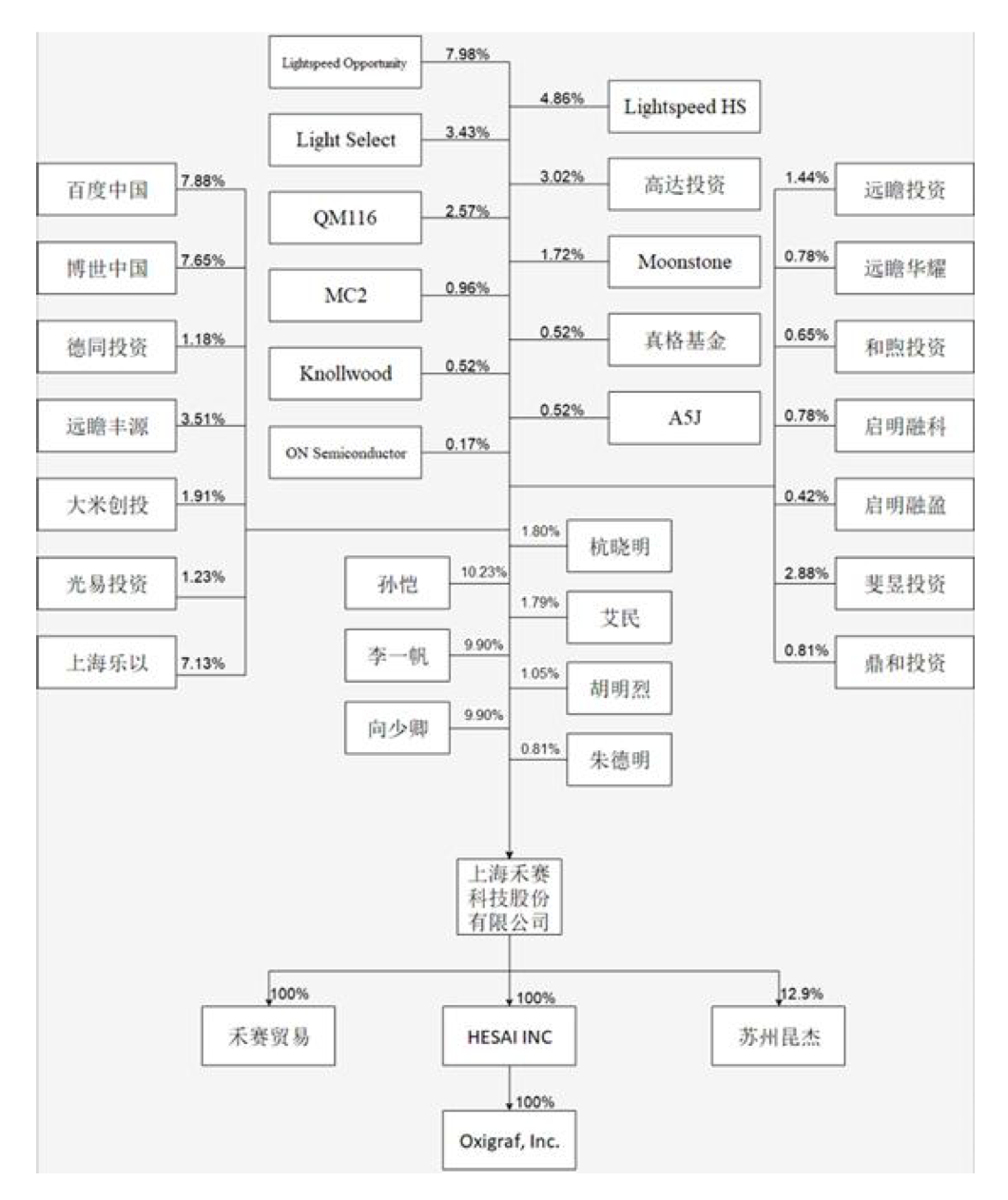
(Source: Hesai Technology prospectus)
Notably, as early as January 2021, Hesai had filed for a STAR Market IPO, targeting 2 billion yuan in fundraising at a valuation of roughly 13.3 billion yuan. But by March, it had withdrawn its application.
Yet just three months after pulling its STAR Market filing, Hesai continued to attract capital and immediately launched its Series D — widely interpreted at the time as a signal of its pivot toward an overseas listing. In June, Hesai closed a $300 million-plus Series D led by Hillhouse, Xiaomi, Meituan, and CPE, and in November announced an additional $70 million from Xiaomi's strategic investment arm, bringing total funding from Hillhouse, Xiaomi, Qiming, Lightspeed, Meituan, Bosch, Baidu, and others to over $500 million.
This sustained investor enthusiasm traces back to Hesai's track record. The company's core product is LiDAR for generalized robotics applications — essentially "eyes" that measure precise distances between objects and sensors by emitting laser beams. In the fiercely competitive global LiDAR market of 2022, Hesai consistently led the pack, notching several "world firsts": number one globally in ADAS (autonomous driving and advanced driver assistance systems) pre-installation mass production design wins, number one in L4 autonomous driving LiDAR market share, and number one in total revenue for automotive LiDAR.
"With iterative software development, autonomous driving will eventually be realized, and LiDAR is the core hardware in that space — it directly impacts the entire industry's progress. From an investment perspective, this is an excellent track," said James Mi, founding partner of Lightspeed China.
Hillhouse Capital told Anyong Waves that in recent years it has made substantial systematic investments around manufacturing upgrades. In its view, backing Hesai wasn't merely about positioning within autonomous driving or the automotive supply chain. The underlying logic: Hesai, through formidable engineering capabilities, achieved higher-quality, lower-cost, mass-producible products — a textbook example of manufacturing supply chain innovation.
Duane Kuang, founding managing partner of Qiming Venture Partners, told Anyong Waves that after beginning to study the autonomous driving upstream and downstream ecosystem, his team identified LiDAR as the most critical, most expensive, and most technically demanding component on a self-driving vehicle — with Hesai standing out as the clear leader.
Though LiDAR is an industry where product iteration moves at breakneck speed, Kuang believes Hesai has built genuine commercial moles in at least three dimensions. First, product strategy: by establishing dominance in L4 first, then rolling out L2+ ADAS LiDAR for mass adoption. Second, technical barriers. Third, strong international commercialization capabilities. Despite the market's rapid growth, LiDAR remains relatively small-scale, so focusing solely on the US or China carries limitations — Hesai's ability to compete globally is a key advantage.
Hesai's IPO also aligns with shifting winds in the primary market.
The tech revolution in primary markets began in earnest six months ago. In previous Krane interviews, investors consistently expressed strong conviction in "tech investing" to Anyong Waves — making this "first LiDAR stock" on US markets feel like a milestone medal for tech investors. Yet investors also voiced concerns about the challenges of deeply industrialized tech investing: bubbles in new energy, the commercialization predicament of AI, and chip semiconductors entering treacherous waters. Hard-tech investing remains a long and difficult road; cautious optimism is still warranted.
But after the Lunar New Year, investors have visibly picked up the pace. Those who tightened travel schedules in 2022 due to COVID policies have embarked on "revenge travel" in 2023 — with itineraries covering Wuxi, a semiconductor hub; Shenzhen, a high-end manufacturing stronghold; and Hangzhou and Wuhan. One investor told us that on flights, every passenger seemed to be poring over new energy materials.
In China's capital markets, IPOs remain the primary exit channel. But in 2022, severe valuation inversions between primary and secondary markets created a pattern of inflated primary-market valuations and high post-IPO破发 rates, making exits increasingly difficult. Fortunately, new stock破发s gradually declined in the second half of the year.
Entering 2023, global investor confidence in China's economy and stock market recovery has been building. The wave of Chinese concept stocks returning to Hong Kong listings is expected to continue. But for tech and innovation-driven companies, the higher valuations available in US markets remain distinctly more attractive. Less than two months into the year, ChatGPT has become a national obsession; during the recent holiday, travel and consumer spending have shown signs of revival; and new energy vehicles plus upstream battery industries continue to draw massive investment interest.
One way or another, 2023 is a year worth looking forward to.
Image source: Visual China
Layout: Du Meng