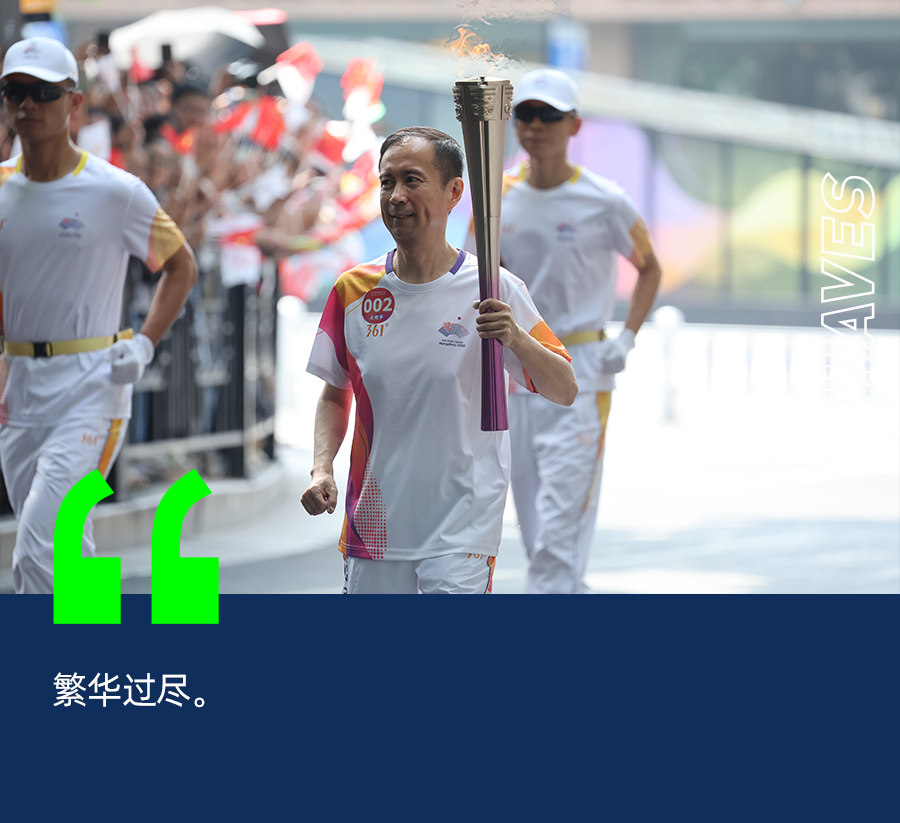
Is investor Zhang Yong someone to watch?
The revelry has ended.
By Muxin Xu
Edited by Jing Liu

Expected, yet unexpected. Daniel Zhang has stepped down as chairman and CEO of Alibaba Group, but also as chairman and CEO of Alibaba Cloud — with Eddie Wu, the group CEO, taking over. The man who once simultaneously held four positions at Alibaba, making him the company's most powerful professional manager, now retains only his status as an Alibaba partner. This came as a shock. When Zhang relinquished his group-level roles three months ago to go all-in on Alibaba Cloud Intelligence Group as its chairman and CEO, it appeared to be a long-term arrangement. "No one knows what happened in between, but it was sudden — it seems like Wu was dispatched as a firefighter," multiple Alibaba employees told Anyong Waves.
Recent news had only added to the confusion. On the 23rd of last month, Alibaba Cloud and GeekPark jointly invited more than 20 Chinese large model entrepreneurs to Xixi Wetland in Hangzhou for a closed-door face-to-face discussion. Zhang named the gathering "Xixi Dialogue." From photos that circulated online, Zhang — known as Xiaoyaozi — appeared to be rallying the core forces of the large model ecosystem, seemingly gearing up for a major push at Alibaba Cloud.
The closed-door session covered numerous topics: GPU scarcity, the inadequacy of open-source model Llama 2 leaving entrepreneurs caught between cost pressures and ethical dilemmas, and the mismatch between ToB application demand and supply.
Among these, the question Zhang faced most was: "In the large model era, is cloud itself a technology or a product?" His response was direct: "Cloud itself should be a product — and not just one, but a series of products."
Though Alibaba Cloud had organized the event, Zhang arranged no promotional content for the Tongyi Qianwen large model. In his view, in this cross-technology era prone to producing Hyper Scalers, everyone needed to engage with the technology itself. What Alibaba Cloud needed to secure was a more fundamental role: that of cloud computing service provider. "To play this role well, you cannot afford to not understand large models. If we weren't building Tongyi Qianwen, we might not even figure out how to help all of you entrepreneurs," Zhang said.
In this "honorary retirement," Alibaba gave Zhang both substance and face: beyond bestowing upon him the first-ever "Distinguished Alibaba Fellow" title in company history, it announced a $1 billion investment to support him in establishing a future-oriented technology fund.
Like many entrepreneurs who have seen their share of glory, Xiaoyaozi is set to become an investor.
Everyone understands what it means for competitors when Zhang enters investing. As a top-tier manager who has spent years on the front lines, he can quickly grasp any potential portfolio company's data, strengths and weaknesses, and resource needs — he likely already knows the people running the company. An investor with money, connections, and capability is a formidable presence.
The trajectory from "honorary retirement" at a major tech firm to investor is hardly unprecedented. In 2017, former Meituan COO Albert Gan joined Hillhouse Capital as an operating advisor, spending half a year on post-investment value-add at portfolio company SEA, the Southeast Asian e-commerce platform. He also invests personally, focusing on consumer sector projects whose founding teams carry the Meituan DNA. Qi Lu took a different path: after serving as vice president at both Yahoo and Microsoft, he toggled between founder roles at Y Combinator and executive roles at Baidu before ultimately founding MiraclePlus, essentially a Chinese version of YC.
But one question facing Zhang is: Is this a good year to be doing investments? And with $1 billion, no less?
Looking at Zhang's background, deals circling the Alibaba ecosystem might seem like the natural choice. But with consumer-facing opportunities drying up, his sector options — like those of all investors — appear relatively limited. Some speculate that AI is an area he cannot avoid. Yet judging by the current primary market, AI's maturity is arguably insufficient.
Whether Zhang can break down the barrier between professional manager and fund founder remains to be seen over a longer timeframe.
What's notable is that the task of steering Alibaba's massive ship now falls to Joseph Tsai and Eddie Wu — and the man known as "Wu Ma" founded Vision Plus Capital back in 2015, with investments spanning hard tech, industrial manufacturing, healthcare, and international expansion. A representative case is Li Auto, which Vision Plus backed from Series A onward.
For Wu, with such weighty responsibilities now on his shoulders, how much energy he can continue to devote to Vision Plus remains an open question. But sources close to Vision Plus told Anyong Waves that the firm's operations have long been distributed across multiple partners, so the impact should be limited.
Image source: IC Photo
Layout: Yunxiao Guo