"Late to the Party": How Xiaomi and Huawei Are Outflanking Legacy Automakers
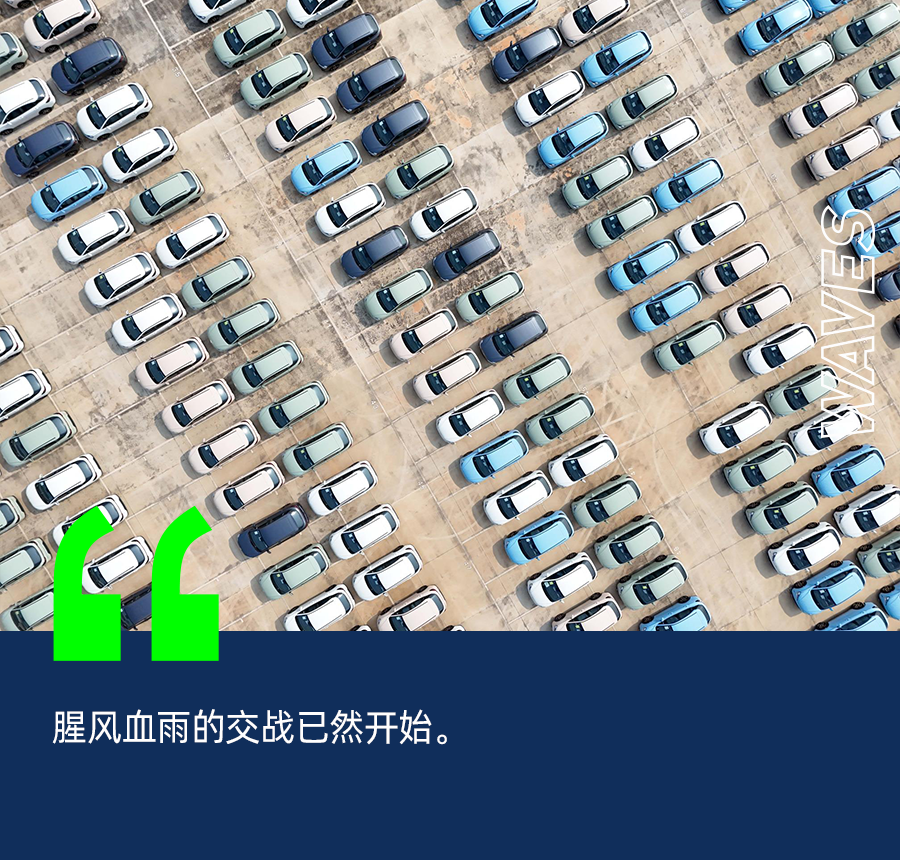
The bloody battle has already begun.
By Lili Yu

Whether it was the stunning product launch or Lei Jun personally hosting livestreams to talk about the SU7's first days on sale, Xiaomi's torrent of traffic has made traditional automaker executives squirm in their seats — and even forced them to take action. Last month, Yin Tongyue, the 60-something chairman of Chery, personally hit the road for a livestream with Luo Zhenyu. He described the experience with a mix of exasperation and resignation: "Learning from Yu Chengdong, learning from Lei Jun — they're forcing this old man in his sixties to come out here." A day later, Wei Jianjun, the famously low-profile and enigmatic chairman of Great Wall Motor, made his livestream debut. And even earlier, this reclusive traditional automaker had appeared at Xiaomi's auto launch event.
The sudden white-hot intensity of the auto marketing war stems largely from the fact that China's car-making arena has been invaded by fierce new titans like Xiaomi and Huawei.
This is a new bloody moment. First came the whirlwind of Xiaomi's SU7. Data shows that Xiaomi Auto set sales records: 10,000 orders in four minutes, 20,000 in seven minutes, 50,000 in 27 minutes, and 88,898 in 24 hours. One slightly hyperbolic comparison puts this in perspective — "it's almost BAIC New Energy's entire sales volume for last year." And the Xiaomi Auto marketing campaign that began on December 28 last year was more like a flowing feast of controversy and escalation, spanning technology to design to price. Some self-media observers have called this publicity battle the single greatest spread of any Chinese NEV model across multiple dimensions — trending search frequency, sustained duration, and depth of analysis.
Then there's Huawei, Xiaomi's old friend and rival from the phone era, which re-launched the Luxeed S7 — its collaboration with Chery — at a spring product briefing. Though Huawei, unlike Xiaomi, chose not to build complete vehicles and instead positioned itself as an automotive solutions supplier, its AITO Wenjie brand, co-launched with Seres late last year, also sent chills through traditional automakers and the upstart trio of NIO, XPeng, and Li Auto alike. Data shows that after 2024, the Wenjie series claimed China's new force brand sales crown for three consecutive months. Li Auto, which led with crushing dominance in 2023, was surpassed by the newcomer "sales champion" AITO Wenjie in Q1.
Among China's new force automakers, Xiaomi and Huawei are undeniably late arrivals. Many have even come to see Xiaomi Auto as the last new brand to enter Chinese car-making. But this latecomer carries outsized expectations. Before the SU7's launch, some investors predicted it might challenge the Model Y — 2023's best-selling vehicle in China.
The entry of these behemoths has also jolted the existing car-making landscape. Even as Xiaomi Auto still faces hellish production ramp-ups and quality verification hurdles, competitors can't sit still in the face of its overwhelming momentum.
Last month, IM Motors, a subsidiary of SAIC, issued another apology for incorrectly labeling Xiaomi SU7 specs during its April 8 evening launch event. Between self-justifications, the statement included one emotionally complex line: "We have neither the intention nor the ability to challenge Xiaomi Auto's torrential traffic."
In conventional wisdom, the automobile represents the crown of industrial fields — the highest degree of integration at the largest scale. Even if the shift from ICE to NEV represents a significant dimensionality reduction from engine and transmission technology to motors, power electronics, and batteries, Dyson and Apple's abandonment of car projects after heavy investment shows that building cars is no smooth road.
So what new cracks allowed Xiaomi, Huawei, and other phone-makers — once outsiders — to slip in and even dominate long-established traditional automakers? Can Xiaomi, which conquered the phone era with a cost-performance strategy, repeat yesterday's story with cars? And more critically, where might these two ecosystem-carrying, agile catfish — Xiaomi and Huawei — steer this sprawling melee that includes aggressive upstarts like NIO, XPeng, and Li Auto, traditional automakers eyeing the fray, and gradually awakening joint ventures?

When Torrential Traffic Falls on an Ancient Industry
The seamless connection between Xiaomi, Huawei, and the auto industry begins with the obvious transformation underway in this ancient sector.
Shen Linlu is an industry veteran with over a decade in China's auto parts sector, followed by new energy investment work in Germany. He compares the electrification cars have undergone in recent years to "the moment phones went from feature phones to smartphones." Around 2016–2017, many mechanically controlled automotive functions were replaced by electronic structures and motors, reaching a critical inflection point. These changes meant that "cars began transforming from heavy-industry-attribute bulk consumer goods into consumer electronics products."
When cars become consumer electronics, Xiaomi and Huawei are no longer outsiders by definition — and the entire consumer electronics playbook gets imported into this ancient industry.
Traditional auto manufacturing is an arena imprisoned by certainty: after nearly a century of winnowing, only four or five global oligarchs remain. All competitors move at roughly the same development pace, and each generation's sales volume is almost predictable. Shen believes this explains why traditional automakers responded so sluggishly to the new force upstarts. The consumer electronics latecomers, by contrast, brought far more violent speed and far more formidable software development capabilities — after all, if a phone goes 3–6 months without a new version, consumers forget it exists.
Beyond this, Shen argues that what truly allows consumer electronics giants like Xiaomi and Huawei to dominate traditional automakers is their ability to persuade consumers. "Consumer goods and consumer electronics companies — their grasp of consumer psychology and feelings, and their marketing approaches, are completely different from traditional automakers." And this is a fatal blow to an auto industry accustomed to arrogance, to telling its own story rather than the consumer's.
In his view, Tesla's strong sales in Germany illustrate the service gap starkly. "A Tesla breaks down, you press one button, someone responds in three seconds, within half an hour they dispatch a car to swap yours out, and they're incredibly polite. Try that with BMW or Mercedes."
Many auto investors share a common judgment: the core automotive capability of the future will be algorithm-driven, rapid-iteration, user-experience-focused software prowess — not the cost, scale, or brand concerns that dominated traditional auto manufacturing. A dollar fund auto investor told us that as early as 2017, they felt the real players in this space hadn't yet entered, and their back-of-envelope list of likely entrants included Apple, Huawei, DJI, and Xiaomi.
In this investor's view, many Chinese NEVs sell well abroad precisely because they've brought the mobile internet experience into cars. "These companies also use mobile internet metrics like user time spent and login frequency — the kind of app-centric control methods — to evaluate performance, giving them crushing advantages in user experience over ICE vehicles."
Additionally, he sees another sudden advantage for phone-makers in the auto space: their cost control capabilities in scaled manufacturing. "It's like traffic in the mobile internet era — whoever controls core traffic, you simply can't compete with them."

Can Xiaomi Repeat Yesterday's Cost-Performance Myth?
After entering the phone industry, Xiaomi leveraged its clear cost-performance positioning to complete the consolidation process — squeezing out foreign brands and eliminating shanzhai manufacturers — ultimately carving up the market with Huawei, Apple, vivo, and OPPO. In December 2023, Xiaomi surpassed Apple to become China's top smartphone seller by volume, with 16.5% market share.
Will this aggressive Xiaomi repeat the same cost-performance myth in the auto industry? Multiple auto investors believe it won't.
A veteran industrial capital investor told us the reasons it won't replicate: when Xiaomi entered phones, the waters were relatively blue; NEVs already have major players like BYD and Geely who have pushed cost-performance strategies to their limits. Auto customers also show higher loyalty than phone buyers. And while phone supply chains are relatively short — a few hundred suppliers — cars may have over a thousand, leaving limited consolidation room for Xiaomi.
Another dollar fund auto investor believes the auto industry won't quickly form the kind of oligopolistic structure seen in phones. Phone industry profit models let manufacturers capture most margins because competition ultimately converged on precision-manufacturing semiconductor elements like cameras and screens — meaning phone-makers could achieve relative price monopoly through investment or other means.
In NEVs, competition remains far from converged, and core auto suppliers aren't so easily held hostage by OEMs. Giants like CATL and Inovance are themselves expanding their business scope, making them resistant to being captured by any single sub-sector.
Though monopoly won't emerge, multiple auto investors believe these consumer electronics players will likely capture 20–30% market share.
As for Huawei, the open question is how many automakers its collaboration model with Seres, Chery, and others can actually scale to.
One industrial capital auto investor compares the Huawei-Seres partnership to Android in the phone world. In his view, examples of such comprehensive cooperation that form genuinely positive interactions are rare — "software service integration is so deep that cooperation requires complete acceptance from the other party, but that's like marriage — one side rarely fully listens to the other." The Luxeed S7's second launch itself illustrates that simultaneously managing multiple brands and coordinating power and interests isn't easy, so how many companies can form this model with Huawei remains to be seen.
Industry sources told us that as software and data capabilities become the core competitive battleground for the next auto era, ultimate big players won't want to achieve this through procurement. So the likely outcome is a Tesla-led camp including NIO, XPeng, and Li Auto — mostly solving autonomous driving in-house, more like Apple's iOS. A larger group will leverage brand or other advantages to partner with tech companies Android-style, procuring third-party autonomous driving and other services. And the remainder will be giants like Huawei and Xiaomi with especially outstanding software capabilities.

Where Will 2024's NEVs Spiral?
The entry of Xiaomi and Huawei has jolted more automakers awake, turning this sprawling melee of new forces, traditional automakers, and joint ventures into an even more scorched battlefield.
The first to exit will undoubtedly be joint venture brands. In NIO Capital Li Yao's view, long-term, Chinese domestic brands will capture at least 70% of the total auto market. In fact, some second-tier joint ventures in more easily substitutable price segments have already left China, and even remaining premium lines look pessimistic. In MingShi Capital partner Xia Ling's view, in 2024, 800V high-voltage platforms, 4C/5C batteries, and 480kW ultra-fast charging will become standard for Chinese NEVs — 400km of range in 10 minutes is the threshold product capability for new pure EVs. "Look at BBA — they'll mostly remain on 400V platforms until 2026. If 400km charging takes 10 minutes versus 30–40 minutes, that's a qualitative experience difference."
Other domestic brands are fated to fight to the death in this brutally competitive Chinese market.
First comes the blood-soaked price war. From Tesla's declining per-vehicle gross margins, we can sense that NEVs have been on a clear continuous cost-down trajectory, and 2024 has obviously opened this curtain wide.
As early as 2022, having detected abnormal NEV competition, one dollar fund auto investor pulled their research team to analyze the auto industry's century-long history. Then, while many funds were still investing in vehicle sub-sectors — heavy trucks, commercial vehicles, niche SUVs — they resolutely abandoned vehicle investments entirely, because vehicles were entering a new cycle of intense competition that could last 10 years or longer.
The foreseeable vicious price war also worries NIO Capital's Li Yao. He cites the painful history of Chinese motorcycles in Southeast Asia. Chinese motorcycles once captured 80% market share there, but as many manufacturers engaged in bottomless price competition, overall product quality declined, ultimately surrendering the entire market to Japanese competitors who followed.
Second is the technology war. In 2024, one clear new development is that intelligent driving and smart cockpits are increasingly accepted by consumers. Behind this, large language models have unified the software stack, accelerating all iteration and evolution. Xia Ling notes that if Tesla can further reveal technical details of its FSD V12 "end-to-end autonomous driving" in 2024, autonomous driving will move one step closer to commercialization. Perhaps that's why 2024 is being hailed by some as the inaugural year of NOA ("high-level intelligent driving"), with many automakers targeting NOA deployment in 50–100 cities as their 2024 goal. In one industrial capital auto investor's view, autonomous driving truly becoming a clear selling point began with Huawei, followed by rapid catch-up from NIO, XPeng, and others.
Then there's the undisputed marketing war. Carrying the marketing DNA of the phone arena, Huawei and Xiaomi are forcing traditional automaker chairmen to personally take the field, hands-on with marketing operations, urgently making up for lost time on traffic.
Of course, at the end of Chinese automakers' frantic competition lies the option of going global.
Regarding Chinese automakers' overseas expansion, the dollar fund auto investor above sees one fresh trend: it's not just complete vehicles going out, but the entire upstream supply chain. He believes that in 2024, Chinese automakers opening factories abroad and hiring locals for management and output will become more commonplace — not explosive news like Fuyao Glass once was. Chinese NEVs can become absolute leaders not just in emerging markets, but also establish themselves and turn profits in mature developed countries, while cultivating dealer networks or user bases.
In NIO Capital Li Yao's view, this wave of going global differs from past exports in that it requires doing business locally. "It's not just selling cars there — you need to establish dealers, charging networks, and other service systems locally, and build brand recognition locally."
Regarding the endgame of this NEV melee, MingShi Capital's Xia Ling believes China's NEV penetration rate can exceed 50% by end of 2024, and reach 70% in 2025. Li Yao believes that if range anxiety can be eliminated, there's roughly another doubling of space long-term — "ultimately exceeding 90%."
But who ultimately laughs last is difficult to predict.
When studying the auto industry's century-long history, one dollar fund auto investor discovered that auto industry competition isn't unique to the NEV era — the ICE era also saw extreme competition every two to three decades. "Many automakers we know well, like GM, Volkswagen, and Toyota, have all experienced government bailouts."
And perhaps because of this brutal history, Musk often quips: "In a hundred years of American auto history, only Tesla and Ford haven't gone bankrupt."
Image source | IC photo