Huang Songyan, Linear Capital: I've Moved to Munich, Hunting for Deals Across Europe
Fresh opportunities are surfacing.
By Qian Ren, Yi Zhang
Edited by Jing Liu

A week ago, French AI startup Mistral AI announced a €600 million funding round, tripling its valuation in six months to nearly €6 billion (about RMB 46.8 billion). A little over a month before that, British autonomous driving startup Wayve raised $1.05 billion — the largest single funding round ever in that sector in the UK.
It's hard not to follow where the hot money is flowing, especially when it's coming from the world's biggest tech giants. Both companies count Microsoft and NVIDIA among their backers; Wayve's lead investor was SoftBank's Masayoshi Son.
In the global venture capital arena, Europe has long suffered from a lack of attention. Perhaps constrained by a fragmented market that resists unification, significant regional differences, and an inherent slowness in the European temperament, venture capital never quite fit here over the past two decades.
Europe missed its chances too, particularly during the internet and mobile internet eras — only China and the US cultivated hardware brands and software applications with user bases exceeding one billion.
But now Europe is making different ripples. Take London, the city that attracts the most foreign investment: according to London & Partners, the total value of London's tech ecosystem surged from $70 billion in 2014 to $621.5 billion in 2023. London currently boasts 104 unicorns. Venture capital in the city grew 800% over ten years, with total investment reaching $107 billion. In 2023 alone, international VCs invested $12 billion in London.
For perspective: in 2012, London saw just 39 VC deals. That number hit 634 in 2022.
Microsoft AI, OpenAI, and Google DeepMind — all bellwethers of the industry — have chosen London as their international headquarters. AI luminaries are also scattered across Europe, largely unknown to the outside world. For instance, the Technical University of Munich was the original source of the SORA overall technical architecture lab team; the University of Edinburgh is a cradle of AI and one of Europe's largest AI research centers; and the Tübingen region is home to someone ranked in the top 5 for Google Scholar citations.
Europe's industrial clustering is also far better than outsiders realize. In Zurich alone, Google, Meta, Microsoft, and other major tech companies have established R&D centers, each employing thousands of engineers. The talent pool in a single Zurich rivals that of all of China. London has nearly 1,300 AI companies — surpassing New York and double the combined total of Paris and Berlin.
Capital and talent are flocking to Europe. One trend: Chinese students who previously went mostly to the US are now diverting to Europe in large numbers. One investor specifically researched this and found that between the end of 2017 and the end of 2023 — a six-year span — the number of Chinese students flowing to Europe tripled.
Fresh opportunities are surfacing. Linear Capital, which began looking at the European market six years ago, has invested in over 20 European-background startups in Deep Tech areas such as robotics. Among them is AgiBot (思灵机器人), which acquired a star robotics company in Munich at the end of 2023 and strategically took control of BMW's robotics subsidiary, becoming a global unicorn in short order. Linear was the lead investor in AgiBot's angel round.
In 2018, Linear Capital was the first to discover the founding team freshly assembled from the German Aerospace Center, investing at the angel round and then continuously backing AgiBot for six years. Anyong Waves (暗涌Waves) has learned exclusively that AgiBot also recently completed a substantial funding round.
This deal not only generated "returns exceeding 100x" for Linear Capital; more significantly, it allowed Linear to develop a feel for investing in Europe and a proven, replicable methodology with enough flexibility.
For example, filling a market vacuum in Europe — early-stage investment opportunities. According to Linear's observations, Europe's old money remains conservative and risk-averse. While US-imported funds have clearly increased in the past two years, they mainly invest at later stages in Europe and don't cover the early stage. "In Europe, you even see surprising scenes where investors conducting due diligence on a company suddenly go on vacation and become unreachable."
Linear also prefers to invest in companies that are global-native from day one — meaning the company is oriented toward the global market from its founding, with China, the US, and Europe each being just part of its larger market; rather than starting as a business focused on one market and then going global.
This year, Anyong Waves has been presenting observations from frontline global investors and entrepreneurs on different regions and sectors. Building on this, we spoke with Songyan Huang (黄松延), partner at Linear Capital.
As the head of Linear Capital's robotics and Deep Tech investment — one of the firm's three main directions (AI applications; hard tech innovation represented by robotics; and frontier technology exploration in life sciences, new materials, and new energy) — his assessment after years of deep cultivation in Europe is: "Doing early-stage investment in Europe is like entering uncharted territory." Starting this month, Huang himself has relocated to Munich and is building out Linear Capital's European team.
The following are Songyan Huang's observations and reflections on the European VC market, from his conversation with Anyong Waves:
1. The emergence of new VC opportunities in Europe stems from two major shifts: talent flow and capital flow. Chinese students who previously went mostly to the US are now heading to Europe in large numbers; China was once a major reservoir for dollar capital, and now some of that money is flowing to India and Japan, with a substantial portion also going to Europe.
2. Europe actually has quite a few local funds, but they're very conservative and inefficient. US-imported funds have clearly increased in the past two years — A16Z, Cathie Wood's ARK, Coatue, Tiger, and others. But these funds mainly invest at later stages in Europe and don't cover the early stage.
3. Due to the absence of investment funds covering the angel to Series A stage in Europe, many entrepreneurs who originate in Europe take their first funding and then develop in the US. And for these European-native companies, the vast majority of initial-stage (angel) funding comes from just three sources — Family, Friends, and Fools. Early-stage investment in Europe is practically a vacuum.
4. It's not that Europe lacks opportunity; rather, the investment ecosystem and the absence of a unified large market have prevented the VC ecosystem from developing.
5. Europe is the birthplace of much original technology. Many top-tier experts in AI, robotics, and other fields are hidden in corners across Europe, unknown to the outside world.
6. I was once particularly worried about Europe's entrepreneurial atmosphere and the passion of its founders, so I spent a great deal of time talking one-on-one with professors from the top-ranked AI labs. One very surprising thing: we found a local British intern who quickly arranged for us to meet several well-known professors at UK universities for one-on-one conversations. These professors were extremely solid technically and highly enthusiastic about entrepreneurship.
7. Europe's entrepreneurial atmosphere is actually more pure, especially among R&D engineers. They start companies out of genuine passion — they want to figure something out — not driven by the fame and fortune behind entrepreneurship.
8. Some European founding teams do harbor reservations about Chinese investors, but most entrepreneurs are very open and willing to work with Chinese partners. More importantly, Linear Capital has a technical perspective and sufficiently deep, professional understanding of technology, enabling us to quickly resonate with founders in the language of engineers.
9. I don't believe a purely Europe-local business is investable. I prefer to invest in companies that originate in Europe but do global business — like AgiBot, Mistral, and others.
10. Linear introduced the lead investors for AgiBot's subsequent rounds. I believe it's not enough to just invest in good projects; you have to be helpful too. This is what I've always emphasized — combining European technology; Chinese production, manufacturing, supply chain, and engineer dividends; and global capital. Linear Europe can play an important role in bringing these three together.
11. The common thread among Linear's European investments is original technology, or technology with absolute competitive advantage globally. The founders must not only have very strong technical backgrounds but also be able to sell their products well.
12. Specifically, in Europe I focus on several city clusters: the UK, Switzerland, Germany, Belgium, and the Netherlands. Each region's scale is similar to a city in China, and each has several universities that aggregate talent and several leading companies with strong industrial pull. For example: Belgium has KU Leuven and world-leading microelectronics company Imec; the Netherlands has ASML, the world's largest semiconductor company, and Philips.
13. In terms of investment sectors, I mainly focus on AI, robotics, new energy upstream and downstream, and life sciences — with AGI and intelligent robotics as the key priorities for Linear Europe. Europe's new energy industrial chain is developing very well now; solar panels cover lawns across many parts of Germany.
14. What we're doing is somewhat analogous to bringing the YC model to Europe — assisting startups that have the willingness and ability to leverage China's advantages, connecting them with mainstream international investors, and helping them expand into international markets.
15. More importantly, we want to bring Chinese production capacity abroad, driving Chinese industrial chains and capacity exports. This is extremely meaningful. In the global industrial sector, China has clear capacity advantages, with numerous upstream and downstream companies in its industrial chains. We can use Chinese efficiency tools to help European entrepreneurs overcome their efficiency shortcomings, leveraging the advantages of Chinese supply chains and Chinese engineers.
16. When doing business overseas, it's either 0 or 1. There's no gray zone.
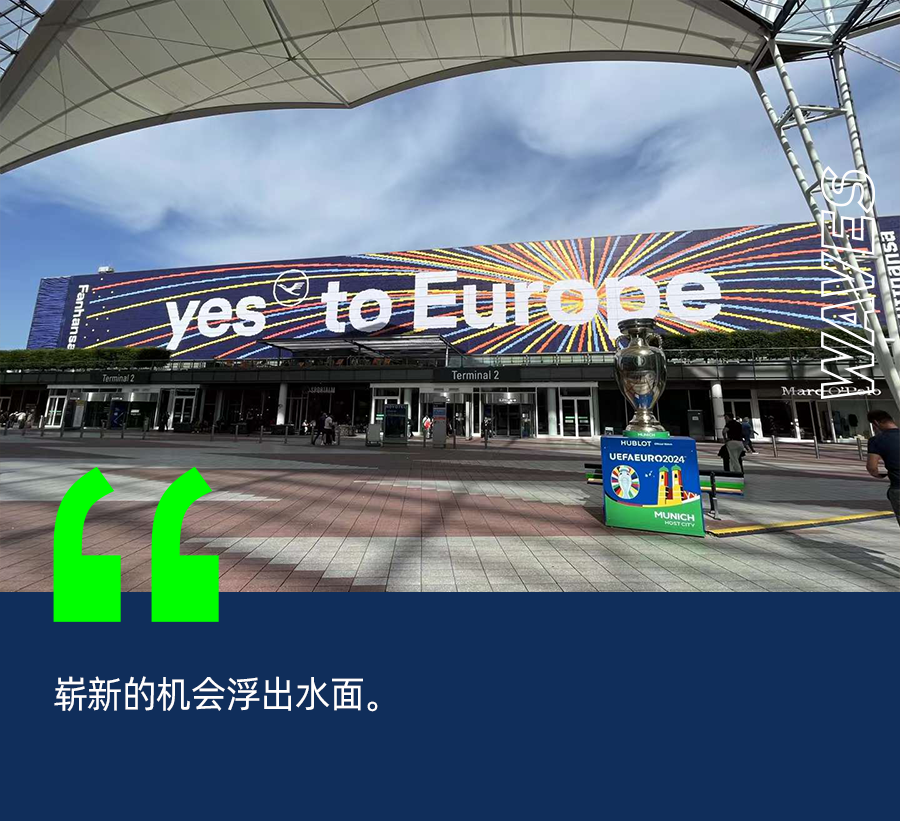
Image source | Photo by Songyan Huang outside Munich Airport
Layout | Nan Yao