Long Yu and Her Twenty Friends in Mexico | Waves World View
Someone said, "My whole life has been elevated."
By | Qian Ren
Edited by | Jing Liu

The U.S. election sent shockwaves across the globe. This election revealed the complexity of Trump's supporters: they defy stereotypes; they conceal yet occasionally betray their biases; beneath economic grievances lie deeper currents of cultural and identity politics... Europeans confess they no longer understand this country, or even how American society and politics actually function. And yet it is precisely this country that shapes the world's future.
During the campaign, beyond China, Mexico — the country of nearly 130 million people that has lately become the darling of Chinese companies going global — once again found itself at the epicenter of his aggressive stances on trade, immigration, and drug trafficking. Some couldn't help but worry: "Does this mean the investment thesis for Chinese VCs in Mexico has collapsed?"
Amid market agitation and anxiety, we spoke with Annabelle Long, founding and managing partner of BAI Capital. She has her own take on this question.
This past National Day holiday, during the inauguration of Mexico's new female president, BAI Capital organized a trip for more than 20 entrepreneurs and their families to Mexico. Long described this excursion as "the ceiling of all ceiling-level gatherings" — a concentrated display of BAI's international exploration.
Rewind to 2015, the first wave of mobile internet companies going global: BAI already had scattered international investments like Bigo Live, Club Factory, and OPay. In 2020, BAI moved quickly to lead the Series A+ in Stori, and has continued to double down in every subsequent round — its biggest "bet" in Mexico by far. Meanwhile, they have backed six other Mexican companies.
In early 2019, we interviewed Long. She spoke then about what BAI had gained and regretted over the preceding decade. Unquestionably, this was a fund that grew up alongside China's mobile internet era — from small, quick steps to gradually finding its groove, BAI proved its distinctive existence through a boutique fund approach.
But when the original master narrative dissolved, BAI rapidly found a new path. About Chinese companies going global, the risks and opportunities in Mexico, and fund survival methodology today, we spoke with Long.
"Dark Currents Views the World" is a new column from Dark Currents. Over the past three years, we have gradually rolled out global content; going forward, we will more systematically publish series coverage. Mexico is the focus of our first phase.
Below is the full conversation:

The Ceiling of All Ceiling-Level Gatherings
Dark Currents: Let's start with this trip.
Long: This was no spontaneous getaway. We spent half a year preparing for nine days and eight nights in Mexico, flying 20 friends 22 hours to the other side of the earth. We carefully constructed a space for a new generation of Chinese entrepreneurs to collide deeply with Mexico's top political elites and business leaders.
We deliberately timed our arrival in Mexico City with the inauguration of Claudia Sheinbaum, Mexico's first female president, and felt the nation's vigor for reform and renewal. A lifelong ballet student, elegant and dignified, Sheinbaum is known for her signature high ponytail and also holds a Ph.D. in energy engineering. Dubbed "Mexico's Merkel," she compiled an impressive record as mayor of Mexico City and won with a landslide of nearly 60%.
BAI has been cultivating Mexico for five years and understands more deeply the benefits and costs of its dependence on North America, especially the U.S. political economy. Within just two months, both countries welcomed new presidents. Looking back on our conversations then, they carry even more weight now.
As we parted, people told me this was a ceiling-level experience; some even said their lives were elevated. I felt I had finally lived up to their trust.
Dark Currents: Can you be more specific about who you met and what you discussed?
Long: The new Secretary of Economy, Marcelo Ebrard, also the cabinet's senior-most member, rushed back from hurricane relief efforts on his third day in office to receive our entrepreneur delegation. In a two-hour conversation that cut straight to the chase, he gave his sharpest, most honest assessment of what concerned everyone most: USMCA renewal and the competitive-cooperative dynamics between China, the U.S., and Mexico.
While emphasizing Mexico's inseparable relationship with the U.S. and the stricter regulation and tariff challenges Chinese enterprises would consequently face, Marcelo also expressed a positive attitude toward China-Mexico cooperation. He welcomed Chinese direct investment in Mexico's local market — in consumer, financial, and service sectors. Colleagues at the Ministry of Economy highly affirmed BAI Capital's investment results in Mexico, especially praising our support for Stori in advancing fintech, stimulating consumption growth, attracting international talent, and rapidly rising as a model Mexican startup.
On the judicial reform that has recently drawn heated discussion, he stated plainly that the previous Mexican judicial system's malady was its capture by roughly 800 vested-interest families, who had accumulated multi-generational influence across multiple fronts — making it inefficient, opaque, and unaccountable. The new judicial reform aims to create a more transparent and fair business environment and social mechanism, rather than the outside worry of excessive emphasis on social welfare and a left-leaning trend pandering to liberals.
When entrepreneurs pressed further, he on the spot asked staff to print out a judicial reform brief, distributed it to everyone present, and explained it in detail. This vigorous, resolute style upended many stereotypes of Latin America as lazy and bureaucratic.
One small detail particularly moved us: the Chinese guests' name cards on the table were based on the pinyin from our passports. During self-introductions, for ease of communication, the entrepreneurs naturally used their English names. I was amazed to find that two minutes later, staff had seamlessly swapped in our English name cards. The whole operation flowed like water —默契高效.
I also leveraged my connection to the HSBC board to arrange a closed-door exchange with José Antonio Meade, one of Mexico's most important politicians and scholars. He had served two terms as Finance Minister, plus stints as Foreign Minister, Interior Minister, and Labor Minister. A lawyer by training, he was once a highly favored presidential contender. On Mexico's political economy, arguably no one has a more profound and comprehensive understanding. His prediction then that Trump would win and his subsequent policy toward Mexico and China — in hindsight, all the more well-founded.
What delighted and touched me most was the confidence, ease, curiosity, and humility shown by the Chinese entrepreneurs on the trip. Their international vision, combat effectiveness, ambition, and relaxed demeanor also changed Mexican business circles' stereotype of Chinese "involution kings" who "slash costs with bloody blades, leaving nothing but scorched earth wherever they pass." Though we had prepared simultaneous interpretation, the vast majority of entrepreneurs could comfortably communicate in English.
Dark Currents: What was your original intention in organizing this trip with so many top entrepreneurs?
Long: This trip was actually BAI's annual "private board meeting."
The domestic venture capital industry has faced a difficult environment these past two years, and negative sentiment has indeed spread. When "everyone decelerates," it's easy to lose balance and direction. But I've always believed that facing real challenges requires holding bottom-line thinking while rejecting doomsday sentiment, maintaining positive action. Accepting reality doesn't equal giving up; lying flat is definitely not the way out. I don't buy the excuse that doing more means erring more — I want to see if there's another way.
I'm constantly vigilant against homogeneous complaints, which only lead to increasingly low-quality thinking and distance us further from truth. While lamenting that the golden years have passed, that there are no opportunities or exits, bitterly waiting for beta, and debating when the best vintage is, the next era has already quietly begun.
My BAI colleagues and I have been traveling this internationalization road for years. Annually, we spend more than half our time flying around the globe. The speed of global change is something you cannot grasp without experiencing it firsthand. China's most outstanding entrepreneurs are all seriously discussing survival in the next era — the proposition of internationalization is on nearly everyone's mind.
I had long been considering how to assemble a "gathering" for deep thinking, collision, and exchange, to find a "way to break through."
To assemble this gathering, first you need a venue. Europe, America, Japan, Korea, Southeast Asia — none of these are fresh to anyone. Opening minds on a new continent, in Mexico where few Chinese have ventured, seemed perfectly suited. With the venue set, whom to invite? These people needed similarities and differences in industry, comparable depth of thinking, their own success stories, and curiosity about the outside world; connection and match in age and interests.
Dark Currents: Spending eight days together in a distant place — what were the concrete takeaways?
Long: Our final group numbered about 20: legendary entrepreneurs and new-generation leaders who together command over 500 billion RMB in annual revenue and hold their fingers on China's economic pulse; pioneers of Chinese companies going global; and strategic investors from super-multinationals with trillion-level revenue. I'm deeply grateful for their trust, giving us their precious National Day holiday, some even bringing their families.
So we hoped to give them a more comprehensive, three-dimensional understanding of Mexico. Beyond arranging an after-hours deep tour of the renowned National Museum of Anthropology, watching folk ballet at the Palacio de Bellas Artes, and strolling the yellow-walled markets to experience street-level economy, we also visited the magnificent Sun and Moon Pyramids to contemplate the rise and fall of civilizations. This City of the Sun, built in 200 BC, was already one-third the size of Beijing in the Qing Dynasty.
Yet while Sanxingdui entered the Bronze Age, American cultures remained stuck with hard obsidian. In Frida's blue house, there are still traces of Trotsky's exile. The Museo de Arte Contemporáneo de Monterrey (MARCO) is my personal favorite — a work by master architect Ricardo Legorreta, who uses light so brilliantly and purely.
The collisions weren't simple surveys of business opportunities, but immersive experiences across humanity, politics, economy, consumption, values, and culture. Maybe it was the magical energy of cacti and agave — in this Mexican space, we discovered different angles and markets: so many possibilities, yet so many "thou shalt nots."
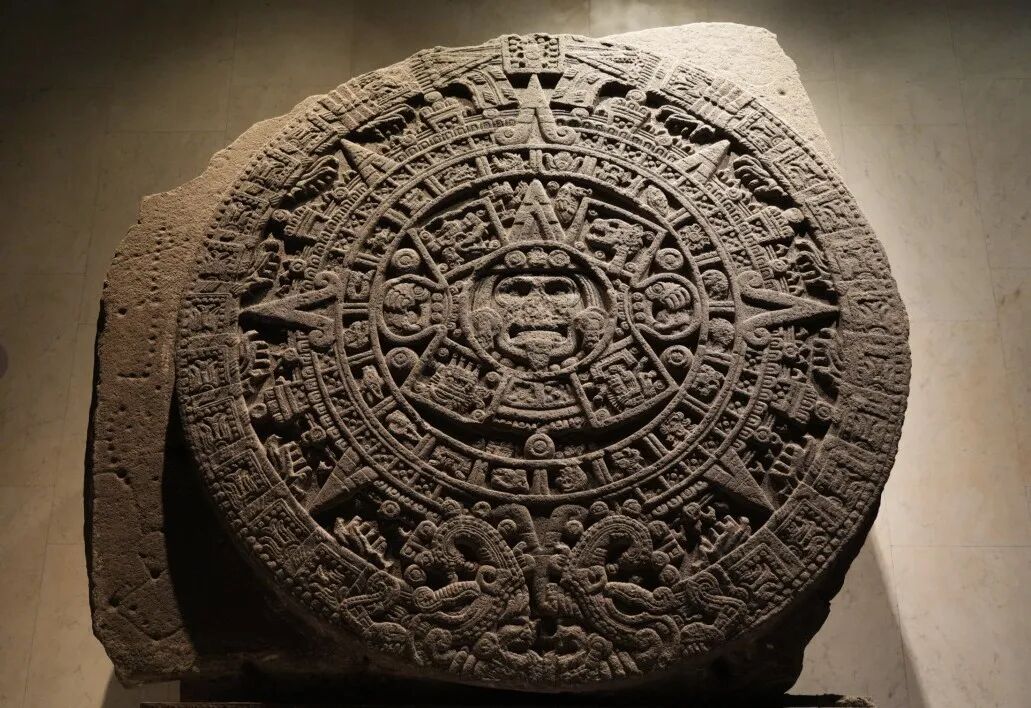
The Aztec Sun Stone, crown jewel of the National Museum of Anthropology © BAI
Dark Currents: What most concerned entrepreneurs who had never done business in Mexico (or even set foot there)?
Long: Navigating cycles and intergenerational succession — these are the topics we most wanted to learn from local entrepreneurs about.
Cinépolis CEO Alejandro Ramírez Magaña hosted us at the old-guard elite industrialists' club, sharing how he took over a Mexican family business and transformed it into the world's third-largest cinema chain through a series of innovations in content and experience.
In Monterrey, the industrial powerhouse, our old friend Carlos Montemayor personally spent the entire day with us visiting industrial parks and commercial real estate. His family owns more than half the land in Monterrey. Like the Monopoly games we played as children, the Montemayor family spent five generations buying up parcels and connecting them into contiguous swaths. They've seen it all — how industrial parks rose on this land, how commerce flourished, and they're accustomed to the cycles of history and the ebb and flow of great-power rivalry.
Today, supply chain relocation represents a massive dividend, but Trump's new policies will also bring short-term challenges. One entrepreneur in our group went "undercover" to an electronics mall under Carlos's portfolio and was delighted to discover his own company's phones on the shelves. Before arriving, few had realized that driving from Monterrey to Austin, Texas takes just over two hours.
This place reminds me so much of Shenzhen in 2000.
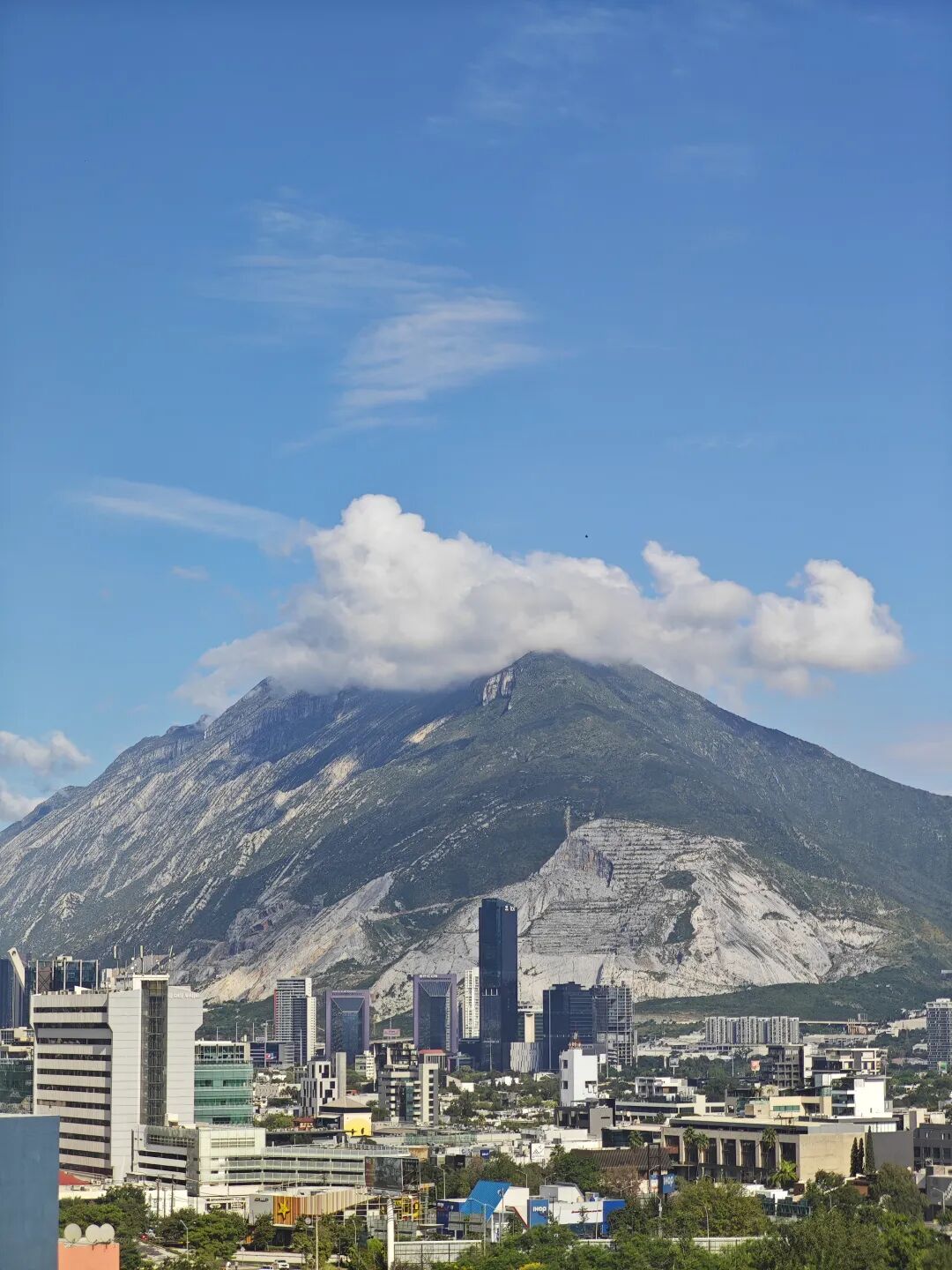
Monterrey, Mexico's economic "main artery" © BAI

The Double-Headed Serpent on the Cactus
"Dark Currents": Trump's return to office — what specific impacts will this have on Mexico?
Long Yu: Actually, during National Day week in Mexico, when we had closed-door conversations with former Finance Minister José Antonio Meade, economist Gabriel Lozano, and others, they had already foreseen and candidly acknowledged the concerns and challenges of a Trump presidency.
First, immigration. Trump has consistently emphasized strengthening border security and deporting millions of undocumented immigrants. During the past two U.S. administrations, Mexico has effectively become an extension of White House border policy — the "wall" Trump sought to build in his first term. With Trump's return, we may see the largest deportation program in American history, targeting approximately 11 million undocumented immigrants residing in the U.S. The most common country of origin is Mexico, accounting for roughly 4 million people.
Trump's inflammatory rhetoric has already sown deep fear in immigrant communities. Regardless of whether these policies are feasible or implementable in practice, they produce real effects — a significant chilling effect.
Remittances are one of the most distinctive and important sources of income for the Mexican economy. They have grown continuously for ten consecutive years since 2014. In 2023, remittances accounted for 3.5% of Mexico's GDP, and are projected to reach 3.7% in 2024. The U.S. hardline stance on immigration will indirectly affect Mexico's foreign exchange earnings.
On manufacturing, Trump will aggressively crack down on "Yangcheng Lake" circumvention. Many American companies want to build factories in Mexico for nearshoring, but Trump is deeply averse to industrial outflows from the U.S. to Mexico. He has proposed punitive tariffs on cars produced in Mexico, as well as on all companies that relocate manufacturing from the U.S. to other countries.
This could devastate an industry that exports nearly $90 billion in finished vehicles to the U.S., representing roughly 5% of Mexico's GDP. If implemented, it would undoubtedly send a massive shockwave through Mexico — though I don't believe these policies will ultimately materialize. Excessive punitive tariffs have already led many American automakers to abandon plans for Mexican plants. Of course, I'm particularly watching whether Elon Musk might change his mind, and whether Tesla's Gigafactory in Mexico will return to the agenda.
Furthermore, Trump has threatened to impose 10%-20% import tariffs on all other countries, including the EU. Given Mexico's proximity to the U.S. and its particular risk as a destination for shifted production capacity, Mexico's final tariff rate will most likely be equal to or greater than this number.
At campaign rallies, Trump directly addressed [President] Sheinbaum, warning that if Mexico didn't stop the "massive influx of criminals and drugs," he would notify her "on day one or sooner" to immediately impose a 25% tariff on all goods from Mexico.
Turning to China, Chinese companies seeking to simply repackage products through Mexico's "Yangcheng Lake" for resale in the U.S. will face greater challenges. Unlike other politicians, Trump is exceptionally sensitive to Chinese companies investing to relocate supply chains and industrial capacity to Mexico as a backdoor into the U.S. He has repeatedly declared that after taking office, he will strictly sanction such behavior and, through tariff increases, ensure that "not a single Chinese car brand produced in Mexico is sold in the U.S."
In the short term, manufacturing — especially automotive and consumer electronics — will face significant pressure. But the long-term trend of nearshoring still presents substantial opportunity and will be difficult to reverse.
"Dark Currents": In this context, how do you view the U.S.-Mexico relationship?
Long Yu: "¡Pobre México, tan lejos de Dios y tan cerca de Estados Unidos! (Poor Mexico, so far from God and so close to the United States!)" This famous lament from Porfirio Díaz, Mexico's strongman president, captures the complex historical emotions and tight practical interdependence between the two nations.
Geographically, Mexico is too close to the U.S. to escape its influence. This long-standing love-hate entanglement with America has already honed the country's resilience and diplomatic dexterity. Mexico has the opportunity to seek balance between the U.S., Latin America, and other countries including China. I would describe its圆滑、务实的平衡技巧 — its smooth, pragmatic balancing act — using the Feathered Serpent revered in Aztec culture. I call Mexico the double-headed serpent on the cactus. I believe it is sufficiently prepared to weather the storms it has long grown accustomed to.
Trump has called "tariff" the most beautiful word in the dictionary. Today, Mexico has already surpassed China as America's largest source of imports. The production chains between the two countries are deeply intertwined; substantially increasing tariffs would likely harm American companies and consumers as well. Tariffs might encourage certain domestic production, but at the cost of significantly higher prices for American consumers buying imported goods, exacerbating America's already severe inflation crisis.
In the early phase of Trump's term, bilateral relations may deteriorate and the Mexican peso could take a hit. However, Trump is a transactional person. I believe Sheinbaum will also demonstrate to the U.S. Mexico's efforts to reduce immigration, thereby avoiding the most economically destructive American policies toward Mexico.
Therefore, Mexico can leverage American business interests, particularly those dependent on the USMCA, to lobby against the Trump administration's tariff increases. Trump has indicated that after taking office, he will formally notify Mexico and Canada to initiate USMCA renegotiations. He emphasizes that this renegotiation will not weaken his previously negotiated deal, but rather seeks adjustments — particularly for the automotive sector — to further improve the agreement and fully capitalize on existing industry opportunities.
We met with current Economy Minister Marcelo Ebrard, who handled foreign affairs in the AMLO administration and has substantial firsthand experience dealing with Trump. I believe he should prove quite adept at maneuvering in U.S.-Mexico trade negotiations.
Small nations survive in the shadow of great powers, dependent on their forbearance. Mexico's economic ecosystem underwent dramatic transformation under NAFTA's influence; many traditional street vendors and informal economies were forced to adapt, and the emotions beneath the surface run deep and turbulent.
Meanwhile, given the similarity in per capita GDP between Mexico and China, China's development experience is regarded as a more "suitable," "targeted," and "effective" prescription than the Silicon Valley model — more readily accepted and adopted locally. Consequently, Chinese companies in Mexico enjoy considerable respect and welcome, thriving in their development. Xiaomi and Huawei command strong reputations in the local market; DiDi is gradually winning hearts and minds as well.
"Dark Currents": Recently, everyone was calling Mexico an investment hot spot. After Trump's election, some are saying the logic for Chinese VCs investing in Mexico has collapsed. What do you think?
Long Yu: I'd say no patch of hot earth belongs to simple-minded bandwagoners. Tourists inevitably leave when the tea cools; hot earth is cultivated. Even gold prospecting takes time and patience.
As the biggest beneficiary of the new U.S.-China dynamic, Mexico leveraged its nearshoring advantages to capture supply chain dividends, heating up its economy rapidly. In 2023, FDI reached $36.058 billion, a 30-year high, ranking 9th globally among FDI recipient countries — up two spots from 2022. As of July 2024, Mexico had attracted 146 investment projects with projected amounts exceeding $45 billion, creating over 65,000 jobs.
But in reality, this merely matches the $35.188 billion seen in 2013 — admittedly a year that included AB InBev's $13.249 billion acquisition of Grupo Modelo. Latin America's rosy picture has been painted for many years now. The "small flame" of Latin American emerging markets has long warmed American investors' hearts and then burned them — repeatedly. Calling this place a hot spot isn't an attractive new story for Silicon Valley and Wall Street; rather, it evokes mixed feelings that fail to excite.
So when we followed the线索 — the leads — to invest in Mexico, we dared not harbor any naive fantasies. Without delivering solid performance, international capital markets won't recognize you. The old playbook of simply telling stories and chasing growth absolutely won't work.
Currently, nearly half of Mexico's FDI comes from the U.S. In the short term, this portion will likely decrease. The peso has been weakening since May, and after Trump's election victory, it fell to its lowest level in 26 months at one point. We can't count on hot money pouring in and quickly forming a风口 — a market frenzy. Instead, we must be our own "bag holders," focusing on product development, business operations, and ecosystem building for healthy, pragmatic growth.
Many people mistakenly think of Mexico as South America's second-largest economy after Brazil. But if you open Wikipedia, you'll find Mexico defined as "located in the southernmost part of North America," with its northern border touching the U.S. So Mexico is not South America — it's North America, an extension of the American economy, almost part of it. The march of nearshoring won't stop. What BAI is very bullish on is Mexico's domestic economy, which will certainly be very robust in the medium to long term.
"Dark Currents": Why so confident?
Long Yu: During former President AMLO's term, Mexico's minimum wage increased substantially. In 2024, Mexico's daily minimum wage rose 20% to 248.9 pesos (374.8 pesos in the northern border free zone). Compared with the same period in 2018, this represents cumulative increases of 142.4% and 112.1% respectively. After 35 years of stagnation, Mexico's real purchasing power has doubled.
Unemployment hit its lowest level since 2006, with 22.3 million formal jobs added, bringing the total number of formally employed workers to 60.3 million and pushing the unemployment rate down to 2.9% — making Mexico the second-lowest unemployment economy in the OECD. Poverty also declined by 5 million people. Major infrastructure projects got built too: the Maya Train, the Tehuantepec Isthmus interoceanic corridor, airports and highways.
The new president, Sheinbaum, has a pragmatic and rational style. She has pledged to build "a government without corruption or lawlessness," promised to serve everyone, and positioned herself as an investor-friendly president.
Mexico already had a fairly robust manufacturing base — it's the world's fourth-largest auto manufacturing hub. Over the past two decades, manufacturers from around the world have begun building their own Super Factories in Mexico. Manufacturing connected to enormous underlying dividends and began creating steady demand for employment, gradually transforming street vendors into industrial workers. The whole country started industrial upgrading and consumption growth, taking off much like China did. We were fortunate to arrive here on the eve of that explosion.
But our investment logic runs in the opposite direction. Manufacturing has long chains, slow cycles, and delayed returns — it requires enormous cultivation. It's less suited to VC and better suited to large industrial players. Manufacturing has an amplification effect: amplify upward and you get consumption, retail; amplify further and you get financial services. Our investments actually move from the bottom up — we started by investing heavily in fintech to "monetize," then gradually penetrated into retail and supply chain, and finally look at manufacturing opportunities. It follows naturally.

A Beta Ready to Emerge
"Dark Currents": It's said that around 2020, you went abroad and met with many "Top Brains." Were they the ones who convinced you of Mexico's potential and importance?
Long Yu: Larry Fink, founder of BlackRock, told me every time we met in New York starting from 2019 that Mexico would be the biggest beneficiary of US-China tensions. At first I didn't have a concrete sense of it. It wasn't until I happened to invest in Stori in 2019 — getting my first "Mexico foothold" — that I had a real sample case.
All the macro logic I mentioned earlier was gradually confirmed in Stori. Mexico is the third-largest financial inclusion market in the world, after only China and the US — larger than India, Indonesia, and Brazil. People who had never been served by banks were now being served, and they embraced this digital foreign bank built by Chinese Americans.
The rise of the middle class, employment and wealth amplified by manufacturing, consumer confidence more precious than gold — people dared to borrow to consume, they had expectations for the future. These weren't things we could shape afterward; they were a Beta ready to emerge. Farmers who used to sell goods from street stalls now work at Huawei, at Xiaomi, having become manufacturing workers. They have job security, bank accounts, can borrow to buy homes and cars and consume. Now they can even shop with the Stori✖️Shein co-branded card — their wives are happy too. The whole country's spirit is surging upward.
"Dark Currents": Beyond the macro tailwinds, what other success factors does Stori have?
Long Yu: Honestly, when I first invested in Stori, I wasn't yet familiar with Mexico. But after investing, the company kept delivering excellent numbers. By January 2023, when I first went to Mexico, Stori had already become a unicorn — and that was what drove me to the other side of the planet. I was so curious, so curious how it had grown into a unicorn so quickly, that I had to go see for myself, to verify that what Larry Fink had told me about Mexico was true.
Stori is a truly international company founded by Chinese. Four Chinese American men decided from day one of their resolve to start a business in Mexico that they would find a local founder to join them — preferably a woman. Fortunately, they found Marlene Garayzar. In a fintech field traditionally dominated by men, Stori became Mexico's only female-led unicorn. Because of this, Marlene Garayzar also received a cordial reception from the new president, Sheinbaum.
I happened to attend an internal product launch event in Mexico City, where over 100 mid-level employee backbone gathered to celebrate on a weekend. I was surprised to discover that of the first 10 people I spoke with, they came from 8 different countries — Argentina, Venezuela, Colombia, as well as the US and even Germany. Increasingly modern Mexico City has a siphon effect on talent from around the world.
Marlene's husband danced and sang with his wife, bursting with pride. CEO Bin Chen, who appeared somewhat shy before investors, jumped onto a table waving his fist to pump up his colleagues, downing 10 tequila shots in a row — probably more unrestrained than at his own wedding. Stori's team is known in Mexico for being able to fight. Colleagues don't mind working overtime, but Work Hard must Play Hard — respect and encouragement are essential; the "corporate livestock" culture doesn't work.
What's been gratifying recently is that we've indeed seen direct "banding together" cooperation among overseas Chinese-funded enterprises, achieving 1+1>2 results. If you open Google Play and Apple's App Store in Mexico now, you'll find Stori's app downloads have suddenly surged recently, climbing to the top three, second only to Latin America's national app Mercado Libre.
This is like yesterday's replay of China's internet explosive growth story, and the driving force behind it is the Stori and Shein co-branded card partnership. Stori also helped Shein's massive active user base obtain credit limits, improving order conversion rates and increasing transaction values — this is a win-win. Stori will treat this kind of co-branded marketing as a standard operating practice going deeper, including partnerships with phone manufacturers, car companies, mobility companies, cross-border e-commerce platforms and more that are already happening. In the future, we will certainly see even stronger synergies emerging among Chinese enterprises.
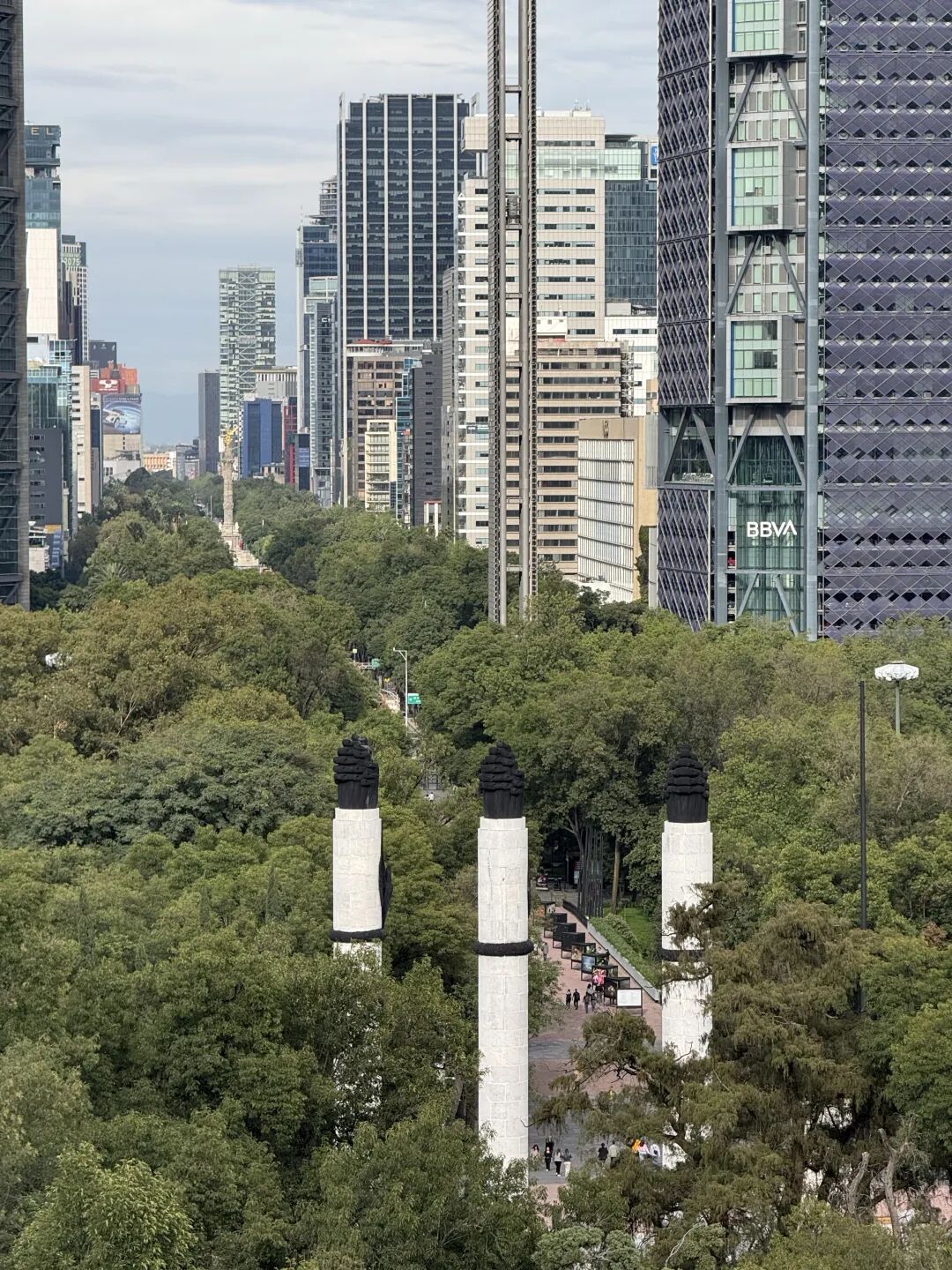
Increasingly modern Mexico City ©BAI
"Dark Currents": What are the most extreme cases of Chinese experience in Mexico?
Long Yu: Didi definitely counts as one. Among the Chinese enterprises we visited this time was Didi. Didi currently provides services in over 260 cities across 15 countries in the Asia-Pacific region, Latin America, and Africa, connecting more than 550 million users globally to meet their needs in mobility, food delivery, financial services, and more.
Didi entered the Mexican market in 2018, and now its business covers more than 50 Mexican cities, with deep penetration in mobility, food delivery, and flash delivery — deeply welcomed by Mexicans. From what we've learned in the local market, Didi's market share in Mexico is even larger than Uber's, while the Latin American local food delivery unicorn Rappi's market share has been declining.
What we see is not just Didi's success in Mexico, but how a truly international enterprise achieved it. There's a popular concept called "Glocal" — "Global" plus "Local Approach." Truly integrating into local culture, truly贴近当地民众的需要, respecting local market rules, rather than relying on price wars to leave scorched earth wherever you go — Didi is a model "Glocal" enterprise. In the future, we will also have deep collisions with Didi, jointly挖掘孵化, and launch a series of cooperations.
"Dark Currents": What does the Mexican market mean for BAI?
Long Yu: Mexico investment serves as a "model forging" presence in BAI's overall investment strategy. We want to systematically hone our playbook. In Mexico, beyond financial returns, we've actually gained more in experience and playbook returns. In a new, more complex era, the overall global Beta, if you don't consider the AI sector, is really quite small. So to improve hit rates, the approach needs to be more steady and precise, with stronger accuracy.
In Mexico we've been working to increase certainty, so that this portion of gains is created by you, not gambled on, and can't be taken away by others. Investing in Mexico has strategic significance for us that far exceeds the country itself — though of course it's also because this country has high Beta. We would never spend our investors' money practicing in low-Beta places.
There are many "tourists" in Mexico now, but those who can systematically execute may only be us. We plan to bring Chinese experience, and bring Chinese enterprises along to operate together — whether incubation, joint ventures, spin-offs, or team recruitment, we ourselves need to put in real effort to cultivate and促成这些事情的发生.
"Dark Currents": I heard you're about to announce a new project?
Long Yu: We partnered with a domestic portfolio company — Asia's largest auto fintech platform — to launch a new Mexican auto finance company, Mstar. In January this year, we took this portfolio company's management team to考察 in Mexico for nearly a month; upon return, everyone immediately decided to do it.
We're taking over the high starting-point risk control system, organizational structure, and other learnings from their China operations — they naturally already have deep service relationships with Chinese auto OEMs — and then we help find local teams. Mstar's operator has a background quite similar to Stori's founders, also coming from Capital One, inspired by the激励人心的创业故事 on this land, and chose to join.
During this trip we also happened to hold Mstar's signing ceremony. Many Chinese auto company representatives came to "show support" — together these representatives already account for annual volumes of two to three hundred thousand vehicles. There was a feeling of众志成城. From day one of its establishment, Mstar had 50% Mexican local employees. I shook hands and spoke with each of them; they joined from major banks, some being senior executives.
Chinese automakers' market share in Mexico has already risen from 10% to 20%, and will certainly continue to rise in the future. Chinese cars are simply well-made and affordable — extremely popular. What we need to do is first solve the loan solution for buying their cars — a very朴实 but clear demand. The entire auto finance market in Mexico alone is a $130 billion盘子. Mexico's largest unicorn is an auto fintech company. This massive market has encountered a structural opportunity, and it's China-related.
"Dark Currents": Some say Mexico now may be like China in 2015, a real-world metaphor for the time machine model. But this simple analogy is probably full of traps.
Long Yu: This shows a lack of humility — using the time machine model to套一下 and thinking everything can be done again. The broad direction is already right, but the key is to find what the detailed differences are. What are local people's real needs, what is their pulse? Grasping these well is the key to victory. Much Beta has nothing to do with you, but there is always Alpha within Beta.
Alpha is often not something you chase down — it's something you cultivate. That depends on each person's innate strengths. The key is to match your resources wisely, figure out what you're best suited for, and only then can you generate a steady stream of Alpha.
In March this year, we brought on two Mexican Venture Partners — both highly influential figures locally. They handle recruiting, strategy, and acceleration for us on the ground. So we've found our direction, our leverage, our resources, our playbook, and we know how to partner with people. This all sounds simple, but we're probably the only ones who've actually put in the work.
These are all our ideas, shaped from the ground up by us from initial founding. They're proprietary to us. We'll hold a large equity stake because we'll be putting in massive effort. We don't incubate small companies. I want these companies to surpass Nubank's loan balance within three years of launch. I want them to be Mexico's next unicorns.
Mexico currently has nine unicorns; BAI has already captured one. If we project twenty to thirty unicorns — or even decacorns — emerging over the next decade, that's highly probable. We want to capture or nurture three to five of them. It's not impossible.
An Yong Waves is recruiting fellow travelers to join us in the regions we're tracking. If you're interested in the globalization theme, we invite you to scan the QR code and participate in the Waves Odyssey survey. We look forward to pooling ideas and building an interactive, collaborative "globalization expedition" community.

Image source | IC Photo