China's "Native" NEO Lab Takes On World Models, Backed by Hillhouse Capital and Peking University-Affiliated Funds in Multi-Million-Dollar Round
The "Final Stop" for AGI.
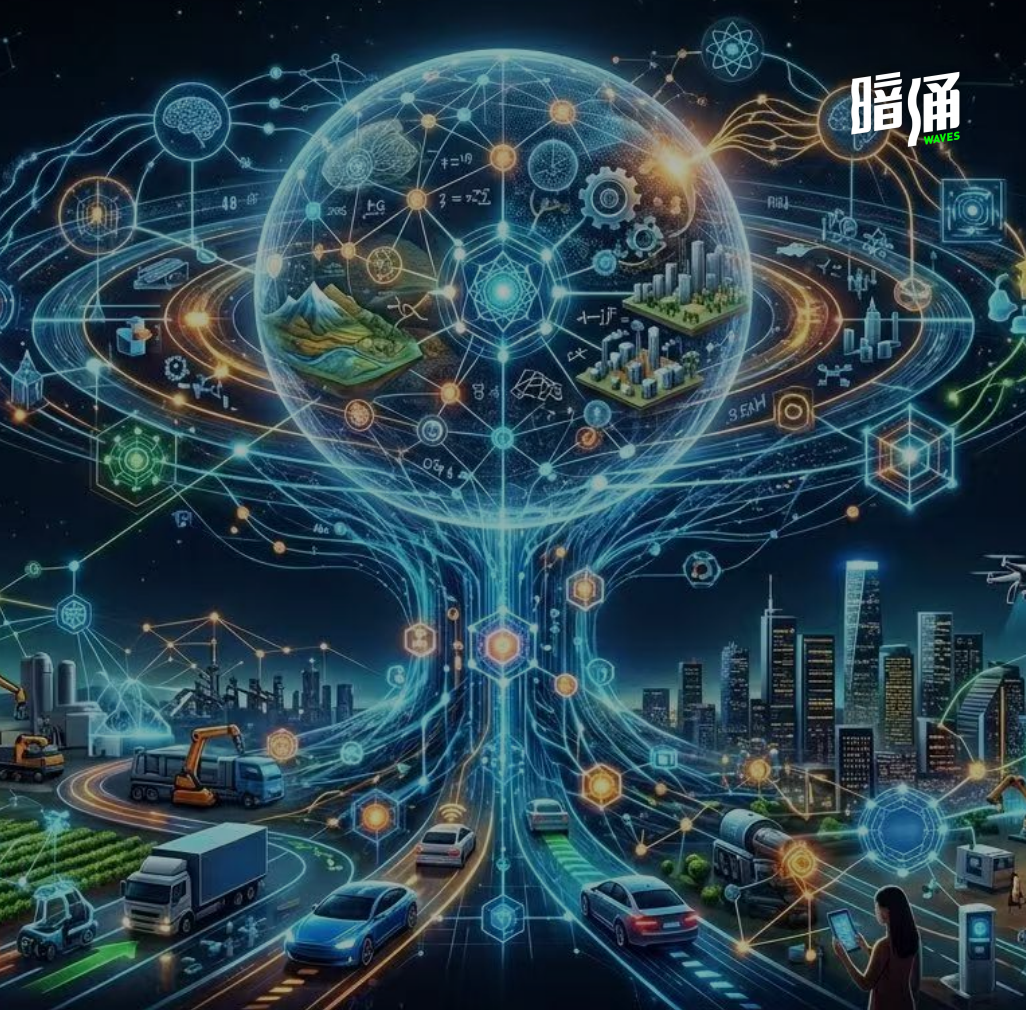
"The Last Mile of AGI." By Zhiyan Chen

Another major funding round has landed in the world model space.
"An Yong Waves" has learned exclusively that Inverse Matrix Technology has closed a first-round funding of over $10 million, led by Hillhouse Capital's venture arm and Yan Yuan Venture Capital, a Peking University-affiliated fund. The company's core founders are Jiaming Ji, born in 1998, and Boyuan Chen, born in 2004 — hailing from Peking University's School of Intelligence Science and Technology and Institute for Artificial Intelligence, and Yuanpei College respectively. The company will focus on world foundation models and reinforcement learning.
The raised capital will be directed primarily toward core R&D in world model technology and further team expansion, with Gao Capital serving as exclusive financial advisor.
As large language models have raced ahead, their potential ceiling has come under increasing scrutiny. The world model approach, championed by scientists like Fei-Fei Li and Yann LeCun, has gained significant attention. Enabling machines to truly understand the "real physical world" is becoming the most critical next piece of the AGI puzzle.
Inverse Matrix Technology's team plans to release its flagship model within 2026. Unlike current mainstream world models that focus primarily on visual fidelity, this flagship model aims to enable genuine "understanding" of physical laws — allowing it to respond to action commands with physically accurate predictions.
Global tech giants and capital markets have already begun positioning around world models. Recently, Fei-Fei Li's World Labs completed a new $1 billion funding round at a valuation approaching $5 billion. LeCun's AMI Labs also announced a $1.03 billion "largest seed round in European history."
For China's capital markets, having lived through the explosive growth of large language model companies, anxiety about "missing the next $10 billion opportunity" is spreading through the primary market. In recent conversations with investors, "An Yong Waves" has found growing attention toward world model startups.
Perhaps this once-"future track" now stands on the eve of a funding explosion.
Part 01
NEO Lab: A New Narrative of Hope
Currently, world model R&D globally remains in a state of chaos — no definitive technical path has emerged comparable to Transformer's decisive moment.
Fei-Fei Li's World Labs, for instance, leans toward a "spatial intelligence" narrative, centered on reconstructing and generating three-dimensional worlds so AI can comprehend the structure and relationships of physical space. LeCun pursues the Joint Embedding Predictive Architecture (JEPA) route, aiming for prediction at higher dimensions. Broadly speaking, whether to enable AI to "reshape the virtual world" or "move toward the physical world" has generated divergent choices among different frontier teams.
Precisely because the technology remains in such early stages, a new entrepreneurial form called "NEO Lab" (innovation laboratory) has rapidly risen abroad. Distinct from the wave of entrepreneurs leaving big tech, NEO Labs are typically led by elite scholars and young prodigies with access to the most cutting-edge academic information, situated at top universities or research labs. From DeepMind to World Labs to AMI Labs, NEO Labs have become one of the most compelling stories for overseas capital.
The logic isn't hard to follow — when the technological paradigm itself remains in "chaos" and no major company can claim to hold the ultimate path, the "laboratory brains" closest to frontier science become the scarcest asset. The fundamental reason NEO Labs, as a new commercial species, have received such frenzied capital attention is that they represent currently the only organizational form capable of continuously capturing and defining the next paradigm of AI.
In essence, capital is no longer betting on replication of mature business models or incremental innovation. It is wagering that these brightest minds can break through the critical threshold of underlying science before anyone else, thereby catalyzing vast opportunities in the next commercial wave.
From this perspective, though the form of entrepreneurial teams has changed, investors' underlying logic remains: in a new technological era, swing for the highest possible ceiling.
Part 02
Local, Young, Academically Grounded
So can China produce its own NEO Labs?
In prevailing tech narratives, hardcore frontier innovation always seems to emerge from Silicon Valley, led by luminaries from overseas top universities. When confronting such extremely frontier basic science innovation, Chinese entrepreneurs have more often played the fast follower — leveraging domestic engineering talent and data advantages, plus the operational muscle and user understanding accumulated by internet giants, to overtake on the application layer.
People have inhabited this narrative for so long. Might world models represent a genuine "generational breakthrough" opportunity for Chinese research teams?
Hillhouse Capital's investment in Inverse Matrix Technology already hints at this leading institution's answer. Given the frontier nature of world models themselves, judging and selecting the right people becomes the most critical part of the investment decision.
Unlike the existing template of "veteran big-tech executives + renowned scientists," Inverse Matrix Technology's distinguishing features are its local roots, youth, and deep academic character.
Jiaming Ji is a PhD candidate at Peking University's Institute for Artificial Intelligence, one of very few young researchers recognized by all three of Apple, Tencent, and Ant Group — a 2025 Apple Scholar (globally selected, only 2 from mainland China), inaugural Tencent Qingyun Scholarship recipient, and Ant Intech Scholarship winner (10 globally). Academically, Ji has published over 30 papers at top AI conferences, with his representative work receiving Best Paper at ACL 2025 as first author. His Google Scholar citations exceed 5,600, his open-source projects have accumulated over 32,000 GitHub stars, and model downloads have surpassed 5 million.
Co-founder Boyuan Chen is a fourth-year undergraduate at Peking University's Yuanpei College, AI track, ranked first overall in his class. Despite still being an undergraduate, he has already produced notable research output: a NeurIPS 2023 publication as a freshman, and as first author, a NeurIPS 2025 spotlight paper (top 2.6% globally) in his junior year, with his representative work receiving a NeurIPS Oral (acceptance rate of merely 0.35%). His Google Scholar citations exceed 2,000.
Notably, both Ji and Chen were named Peking University 2025 Students of the Year. This honor, selected annually from all undergraduates, master's, and doctoral students across the university, recognizes only 10 outstanding students with exceptional achievements in academic research, technological innovation, and other fields — among the highest honors in the Peking University student community. Ji became the first Student of the Year in the history of both the Institute for Artificial Intelligence and School of Intelligence Science and Technology, while Chen was the only undergraduate in AI among the 2025 recipients.
According to "An Yong Waves," beyond the two core founders, Inverse Matrix Technology has assembled over 30 top talents from Peking University's undergraduate, master's, and doctoral programs alongside leading algorithm researchers from major tech companies. Team members include international subject competition gold medalists, Huawei Ascend developer representatives, provincial gaokao top scorers, and others — covering core technical directions including world model foundation training, infrastructure development, and embodied intelligence.
Part 03
Reinforcement Learning + World Model
In this long race toward AGI, Inverse Matrix Technology has chosen to combine reinforcement learning with world models.
In Jiaming Ji's view, the core of the next AI paradigm will shift from static generation to interactive physical world prediction (Next Physical State Prediction). Just as RLHF (Reinforcement Learning from Human Feedback) was key to GPT-3.5's transformation into ChatGPT, the deep integration of reinforcement learning and world models may well be the optimal solution for breakthroughs in physical world interaction.
The team plans to release its flagship model within 2026. Unlike current mainstream world models that focus primarily on visual fidelity, this flagship model aims to enable genuine "understanding" of physical laws — allowing it to respond to action commands with physically accurate predictions.
In industrial scenarios, for instance, this means correct physical predictions: "If conveyor belt speed increases 10%, will products fly off?" "Will this robotic arm's trajectory collide with nearby equipment?" In gaming, it means creating a "learned physics engine" covering long-tail physical interactions and active physical interactions. This means the model no longer passively generates video that merely "looks like" reality, but can derive how the physical world "should" respond based on action inputs.
Jiaming Ji told "An Yong Waves" that looking further ahead, the team's ultimate goal is to build a general world model "capable of causal reasoning and counterfactual prediction in arbitrary physical scenarios" — enabling AI not merely to "see" the world, but to understand, learn, and apply the underlying laws by which the world operates, ultimately providing a "brain" for the physical world across embodied intelligence, serious industrial applications, open-world games, scientific simulation, and beyond.
A Hillhouse Capital representative stated that the firm continuously tracks foundational breakthroughs capable of defining the next AI paradigm. World models represent the inevitable path beyond language modeling toward general intelligence. In this underlying race to define the next AI paradigm, Inverse Matrix Technology demonstrates exceptional technical vision and talent aggregation. With acute technical foresight, the two founders have successfully assembled over thirty top research minds from Peking University and leading tech companies, constructing a research matrix of extraordinarily high talent density. "We are confident that through this irreplicable underlying originality, they will achieve genuine technical breakthroughs through this极致 high-density collaboration. To truly crack world models and accomplish the technical disruption that others cannot."
Li Jun, General Manager and Managing Partner of Yan Yuan Venture Capital, stated that this technology revolution represented by artificial intelligence has been fully validated in large models and embodied intelligence, but physical-world AI represented by world models has only just begun. Compared to current video generation models, embodied large models, and autonomous driving VLA models, world models address the foundational model problem of the physical world. Only by placing these models within the digital foundation of world models can ultimate intelligence in the physical world be truly achieved. On this track that so severely tests underlying basic research, Inverse Matrix Technology represents the Peking University voice, the absolute core, and the sole representative. Building world models is no ordinary engineering or compute stacking exercise, but a revolution in scientific paradigm. "The underlying research and technical capabilities for world models originate in universities. We firmly believe that the world model Inverse Matrix Technology is about to release will inject fresh momentum into the industry, truly crack this problem, and pioneer ultimate intelligence in the physical world."
With its first $10 million-plus round in the bag, Inverse Matrix Technology's journey has only just begun. As current capital markets hotly anticipate domestic AI: for the future of world models, what people expect is not merely an Eastern follower valued on par with American peers, but a true technological pathfinder that can genuinely represent China in advancing to the world forefront.
Layout by Meng Du | Images generated by AI

Recommended Reading

The flow of money, the rise and fall of people