The Most Controversial Hugo Award Winner: Hai Ya and the Dreams of Ordinary People
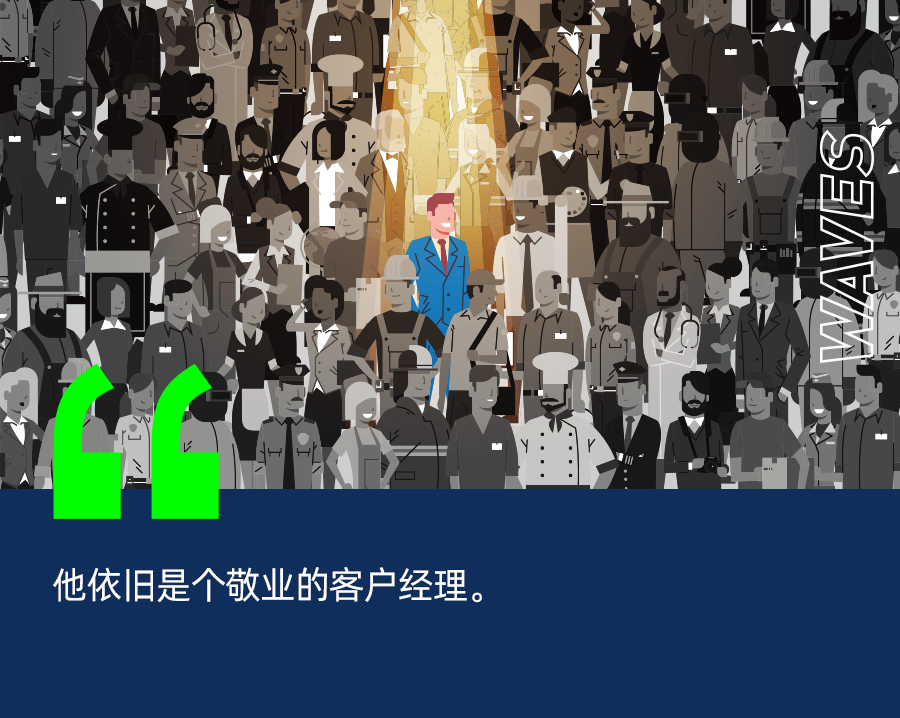
He remains a dedicated account manager.
By Muxin Xu
Edited by Jing Liu

Praise and criticism arrived in equal measure. The Hugo Award is known as "the Nobel Prize of science fiction." Since its inception in 1953, only three Chinese-language works have ever won: Liu Cixin's The Three-Body Problem, Hao Jingfang's Folding Beijing, and now Hai Ya's The Space-Time Painter. The first two were already towering figures in Chinese science fiction circles. Hai Ya, meanwhile, remains a mortgage account manager at a bank.
If you met Hai Ya for the first time, you probably wouldn't peg him as a sci-fi writer. At China Merchants Bank's tower in Shenzhen's Bao'an District, he wears his work uniform, looks exhausted, and speaks rapid-fire. His WeChat Moments contain nothing of himself: just a steady stream of property listings.
In the few days after winning, he gave over 100 interviews. This has made Hai Ya adept — he can quickly sense which answers avoid revealing personal information while slipping in praise for his employer. Still, he's not perfunctory; he maintains his politeness and patience.
During a rare break in the interview marathon, his first move upon escaping the press room is to call a colleague and explain why the interviews keep running long: "I'm someone who doesn't know how to say no, who doesn't dare interrupt reporters."
By many measures, Hai Ya is utterly unremarkable among Shenzhen's 20 million residents: 33 years old, 11 years at a major bank, settled in Shenzhen, married to his girlfriend, bought an apartment, has a nine-month-old child. This very ordinariness is partly why his win resonated so deeply.
On the evening of October 21, video of Hai Ya's acceptance speech spread across the internet. Holding his trophy, he said: "Every day I calculate my time, calculate my income, but on my commute home, I often look up at the stars." In subsequent interpretations, this was naturally extended into the "moon and sixpence" metaphor. Maugham's most famous novel, modeled on Gauguin, tells of a stockbroker who abandons work and family to pursue painting.
The difference: Gauguin became an Impressionist master. Expectations for Hai Ya fell flat.
Three days later, the sci-fi anthology containing The Space-Time Painter began plummeting on Douban at a rate of 0.5 points per day, now sitting at 5.6. The other volumes in the same series hover around 8. Most negative reviews poured in after the Hugo announcement, targeting prose quality, thematic depth, and "middle-school physics level."
Hai Ya frequents social media and has long been aware of such critiques. "I can be a bit more carefree about it," he told AnYong Waves (暗涌Waves). "Science has advanced to a stage where ordinary people can barely imagine such worlds anymore — the gap from daily life is too vast. I believe the best science fiction will always be popular literature."
Hai Ya repeatedly emphasizes his "ordinary person" identity in interviews, yet the Hugo's fame is enough to become an ordinary person's lever for transforming their fate. Indeed, officials have already announced that The Space-Time Painter's IP will be developed in Chengdu; the publisher urgently reprinted the book that same night, yet it still sold out overnight. Throughout this, Hai Ya has maintained an almost unbelievable composure. He says such matters can be left to the publisher; "the media won't be camping outside my door every day." He has also firmly stated he will not quit his job.
True enough, a week later, media headlines about him gradually dimmed, replaced by war, celebrities, and weather. Praise and criticism alike flashed past him at light speed — that's the splash a news story makes on the internet.
Hai Ya is a pen name. The man himself remains a dedicated account manager, with no intention of discarding that identity.

Fan
When Hai Ya heard his own name from Liu Cixin's mouth, he immediately stood up. Only after rising did he realize "Da Liu" wasn't finished speaking, making his sudden stand awkward. After a moment of helplessness, he walked onstage.
Before him stood Liu Cixin, the first Chinese Hugo winner — in some sense, more glorious than the Hugo itself. Hai Ya had read all his books in school; his favorite was The Devourer. In his view, those who only know The Three-Body Problem and The Wandering Earth haven't truly read Liu Cixin.
In 2019, Liu Cixin came to Shenzhen for a sci-fi convention. Hai Ya was just one fan among many; he went hoping for an autograph, but the line was too long, and he gave up before even reaching the end.
Yet now, with Liu Cixin before him about to hand over the trophy, Hai Ya seemed to blur that memory. He couldn't even recall what Liu Cixin said to him then. "Probably a few encouraging words."
At this moment, the eyes of everyone in the hall were upon him. Liu Cixin had already descended, returned to his seat in the front row, and was looking over too. Hai Ya suddenly had a flash of inspiration, recalling words from a preface Liu Cixin had written. Simplifying and adapting them, he spoke extemporaneously. This produced the widely circulated "looking up at the stars on the way home" remarks.
But Hai Ya was exasperated by the Moon and Sixpence interpretation. "That book you mentioned? I've never read it." He only remembers that when Liu Cixin heard his own words quoted, he seemed somewhat moved, his expression shifting.
"Though maybe that was my imagination," he quickly corrects himself. "Maybe it was just the light hitting his eyes."
Hai Ya vehemently rejects any description of him as "Liu Cixin's successor." To him, this moment belonged to "a fan and his idol."
The polite account manager rarely shows anger: "I detest that [successor] phrasing. We must follow basic physical laws — [handing over the trophy] is simply an object moving through space. All that meaning was imagined by you. Physiologically and legally, I can only be my parents' successor."
Long before Liu Cixin's Hugo win, he was already a towering figure in sci-fi circles, even interacting with fans in chat rooms. Hai Ya had once asked him questions and received replies. "The Hugo was the icing on the cake for him, not a lifeline," Hai Ya says.
He anticipates our question to point out the vast gap between their works, though this also relates to how sci-fi purists always favor hard sci-fi. "He writes novels; I write short stories. He writes extremely hardcore science fiction; I write soft sci-fi that many might not even consider science fiction," Hai Ya says. "Even setting aside all objective factors, if you compare our breadth and depth of knowledge vertically, the difference is enormous."
At the ceremony, Hai Ya experienced the luckiest day of his fan life.
At the subsequent banquet, Hai Ya held his trophy for a photo with Liu Cixin, who advised from experience: don't take the trophy through airport security — its distinctive shape causes major hassles.
What haunts Hai Ya is that he let slip two perfect chances to add Liu Cixin on WeChat — once during the photo, once at the banquet. But this regret passed in a flash. He consoled himself by telling others: "Da Liu looked exhausted. As fans, we don't want to add to his burden."

Teller
Hai Ya is from Xiangtan, Hunan, born in 1990. His parents were among the last employees of a state-owned factory in the area. In those years, SOE workers formed a small society: the workers' compound had public bathhouses, a cinema, basketball courts, and not far away, a Xinhua Bookstore.
When his parents were busy at work, they left their son in the custody of books. Hai Ya was interested in reading; his parents didn't restrict his choices, and he read many novels — Death Ray on a Coral Island, Columbus from America, Twenty Thousand Leagues Under the Seas — but these fantastical stories wouldn't take root for decades.
Hai Ya majored in economics in university, and near graduation caught China Merchants Bank Shenzhen Branch's campus recruiting presentation. It seemed a respectable, stable job, and for a generation that had lived through SOE restructuring, stability held eternal allure.
Hai Ya packed his bags for Shenzhen, and has worked at this bank for 11 years.
His first position was teller — the person behind glass when you deposit or withdraw money, sometimes doing physical labor like swapping cash cassettes in ATMs. Once in a hurry, he used too much force; the ATM latch snapped, and the cassette jammed completely. He and his mentor, wearing helmets and bulletproof vests, sat in an air-conditioned glass room in Shenzhen's sweltering summer, despairingly awaiting the repair technician.
This was a job close to money yet far from economics.
But Hai Ya never saw a problem with an economics graduate becoming a teller. He made peace with this upon graduation: "I think there's always a gap between what we study and what we do," Hai Ya says. He has a friend who studied civil engineering, dreaming of building the most famous bridges, but ended up laying asphalt; a girl who studied fashion design, wanting to make the most beautiful clothes, but started out at a sewing machine after graduation.
He seemed to leap past the age of easy self-importance, settling into the new character setting of ordinary office worker.
Later, Hai Ya moved from front desk to back office. With less demanding hours, he began writing again.
This was around 2016. Tian Xinghai, an editor at Ba Guang Fen Culture who had known Hai Ya since university, noticed the author had resumed writing. Tian published a short story for him titled Blood Disaster, which mainly reinterpreted the "flying guillotine" as a fungal colony — Tian described it as a Qing-dynasty Resident Evil.
In Tian's view, Hai Ya is a diligent author. He marveled that a busy finance industry professional could complete a novel in two months at 300 words per day. But Hai Ya himself saw nothing remarkable: "I just use the time others spend scrolling videos to write a little something."
In countless interviews, Hai Ya has dissolved all grand narratives and suffering narratives. Anxious middle-class mothers had already dissected Hai Ya's life when the news broke, posting questions: How can we raise an award-winning child?
But this resists methodology. Just as pain is the source of literature, rigidly disciplined Germans love their drink, and in cramped, rule-bound daily life, science fiction happens.
The outside world underwent booms and upheavals. Some found fame and fortune; others achieved financial freedom. Internet finance, related to his industry, once grew wildly; nearly every ordinary person wanted to taste wealth's pleasures. Hai Ya discussed this with peers his age, and decided it was still "each to their own life."
He decided to settle in Shenzhen. He and his girlfriend jointly bought a 40-square-meter apartment. This apartment gradually became a home; they married there, lived their lives, later upgraded to a larger place, had a nine-month-old child. Hai Ya's recent worry is "too many books" — books aren't expensive, but the housing to store them is. He joined the Douban group "Buying Books Like Landslides, Reading Them Like Pulling Silk," contemplating adding another tier to his bookshelf.

Writer
Hai Ya lives an ordinary life that he considers perfect. This perhaps helps explain why, when asked about "subsequent commercialization" or "building a personal IP," he firmly refuses.
Another reason: becoming a full-time science fiction writer is genuinely high-risk, not necessarily high-reward.
Chinese science fiction is a small circle. Science Fiction World magazine and Ba Guang Fen Culture are the country's only two dedicated sci-fi publishers, and among these, Chinese historical science fiction occupies but the tip of the iceberg. Previously, The Will of Heaven, set in the Qin and Han dynasties, was the most celebrated work in this subgenre, and also the best-selling novel before The Three-Body Problem.
Its author, Qian Lifang, was then a middle school history teacher in Wuxi. The Will of Heaven published in 2004, "sold roughly 150,000 over three or four years," and was later adapted into a web series. The writer's own change was merely: from history teacher at one school, to administrative teacher at another.
"From a writer's personal perspective, in the current climate you definitely hold onto your golden rice bowl and don't casually toss it aside," Qian Lifang told AnYong Waves. After her second novel was published and earned decent royalties, she had briefly considered quitting. But she recalculated: given her output speed, full-time writing income couldn't match her institutional job plus its hidden benefits like housing fund and health insurance. "Most writers are simply intellectuals, people who love writing articles and reading books," Qian Lifang says. At the sci-fi convention, she saw some full-time writers, mostly already retired — this made her somewhat envious.
At the Hugo ceremony, Qian Lifang, Hai Ya, and filmmaker Zhang Xiaobei shared a roundtable. The latter is founder of Space Fortress Culture, behind classic films like Tiny Times and Lost in Thailand. Zhang Xiaobei's advice to young authors at the forum: "Take the money and run."
Qian Lifang, also long immersed in sci-fi circles, considered Zhang's advice practically "from the bottom of his heart." In her view, commercialization involves too many unknowns; better to cash out while you can.
Hao Jingfang is an outlier. Three years after her Hugo win, Hao founded the general education project "Tongxing Academy," completing a pre-A round in the tens of millions led by Hongshan Seed Fund; "Hao Jingfang Film Studio" also received 3 million yuan in angel investment from NewGen Capital. Since then, she has more often appeared as an entrepreneur.
But entrepreneurship is nine deaths and one life. After the "double reduction" policy landed, Tongxing Academy struggled for a time; Hao herself wrote that she was "struggling on the edge of bankruptcy every day."
In any case, this is a transformation path fraught with difficulty. Hai Ya and Qian Lifang's choices are perhaps safer.
Hai Ya's The Space-Time Painter was inspired by Ted Chiang's Stories of Your Life, also the source material for the film Arrival. Hai Ya references the latter's classic premise: all physical laws are causal, except Fermat's principle — that light takes the fastest path. And if it is to choose the optimal solution, light must know its destination at the moment of departure.
This is indeed a philosophical question about fatalism: if everyone knows at departure that their destination is death, what is the optimal solution?
In Hai Ya's view, walking slowly is the optimal solution.
Image source | IC Photo
Layout | Yunxiao Guo