The Twelve Apostles of Musk's New Company | Has Silicon Valley Burned Down?
No one can resist the allure of the AI wave.
By Yinxia

On July 12, Elon Musk announced on Twitter the launch of his newest AI company, x.AI, with the stated goal of "understanding the true nature of the universe." He also said he would host an online voice chatroom on July 14 (Pacific Time) where netizens could ask questions of the team members, though no specific time was given.
Back in April, media reported that Musk had already established a new AI company. This announcement marks his first major move in the AGI space since publicly opposing OpenAI.
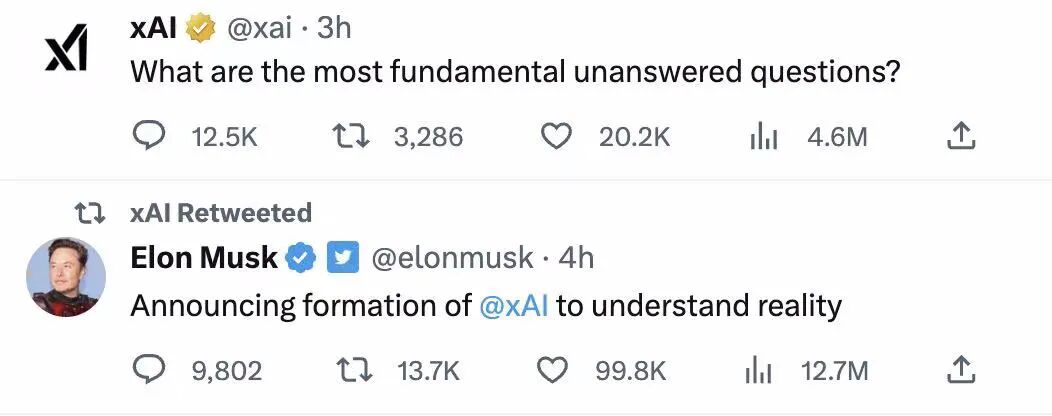
Twitter screenshot
Announced simultaneously was the list of 11 other founding team members, drawn from AI heavyweights including DeepMind, OpenAI, Google Research, Microsoft Research, and Tesla.
According to public information gathered by An Yong Waves, three have DeepMind experience, three have OpenAI experience, three were formerly Google Research Scientists, and one comes from Microsoft Research. All members have deep academic foundations and distinguished achievements in deep learning and machine learning.
Notably, four of the 11 members are Chinese: Yuhuai (Tony) Wu and Guodong Zhang, both graduates of the University of Toronto; Greg Yang, a Harvard graduate; and Zihang Dai, who earned his degree from Carnegie Mellon University.
Given that Musk won't livestream further explanations of what x.AI actually plans to do for another two days, analyzing these 11 people's backgrounds may give us a rough idea of the company's direction.
> Igor Babuschkin
Earned a master's degree in physics from TU Dortmund University in Germany in 2015, then continued physics research at the Large Hadron Collider at CERN in Geneva, Switzerland. Began deep learning research at DeepMind in 2017, where he spent nearly four years as a research engineer. Joined OpenAI at the end of 2020 and worked there for a year, then returned to DeepMind in 2022. Left this February to start the new company with Musk.
My goal is to demonstrate that deep learning systems are capable of much more than they can do today. I've worked on training neural networks to generate speech and images, to play StarCraft and to solve reasoning tasks like coding and mathematics......
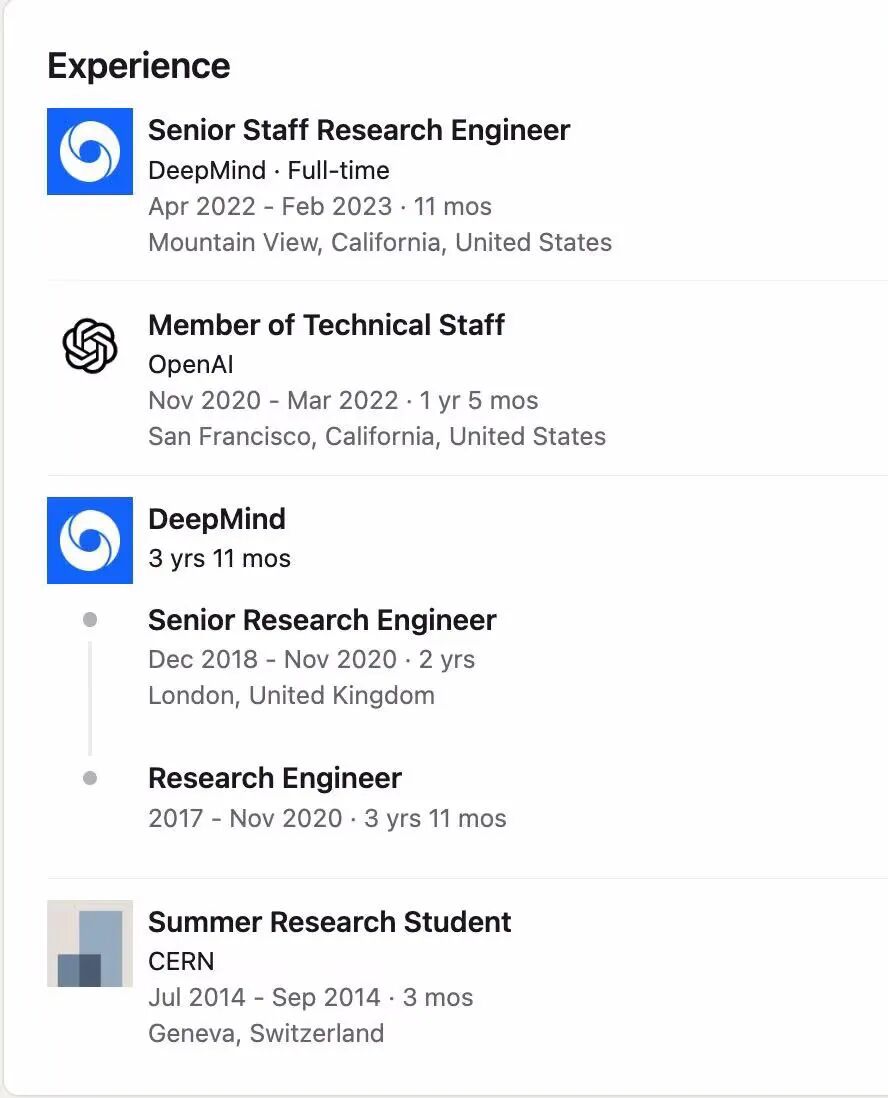
LinkedIn screenshot
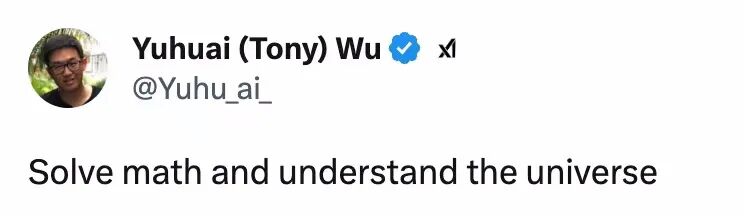
> Yuhuai (Tony) Wu
Earned his PhD in machine learning from the University of Toronto in 2021, then joined Google as a Research Scientist while also doing postdoctoral research at Stanford. Interned at DeepMind and OpenAI during his doctoral studies.
Twitter screenshot
> Christian Szegedy
Earned his PhD in mathematics in 2005; has done nearly 13 years of deep learning research at Google since 2010.
> Toby Pohlen
Bachelor's and master's in computer science from RWTH Aachen University in Germany; after graduating, spent over six years as a research engineer at DeepMind.
> Ross Nordeen
Technical program manager (TPM) at Tesla's Supercomputing and Deep Learning group; was previously pulled over to Twitter.
> Kyle Kosic
Master's in computer science from Georgia Tech; has worked at OpenAI since 2021.
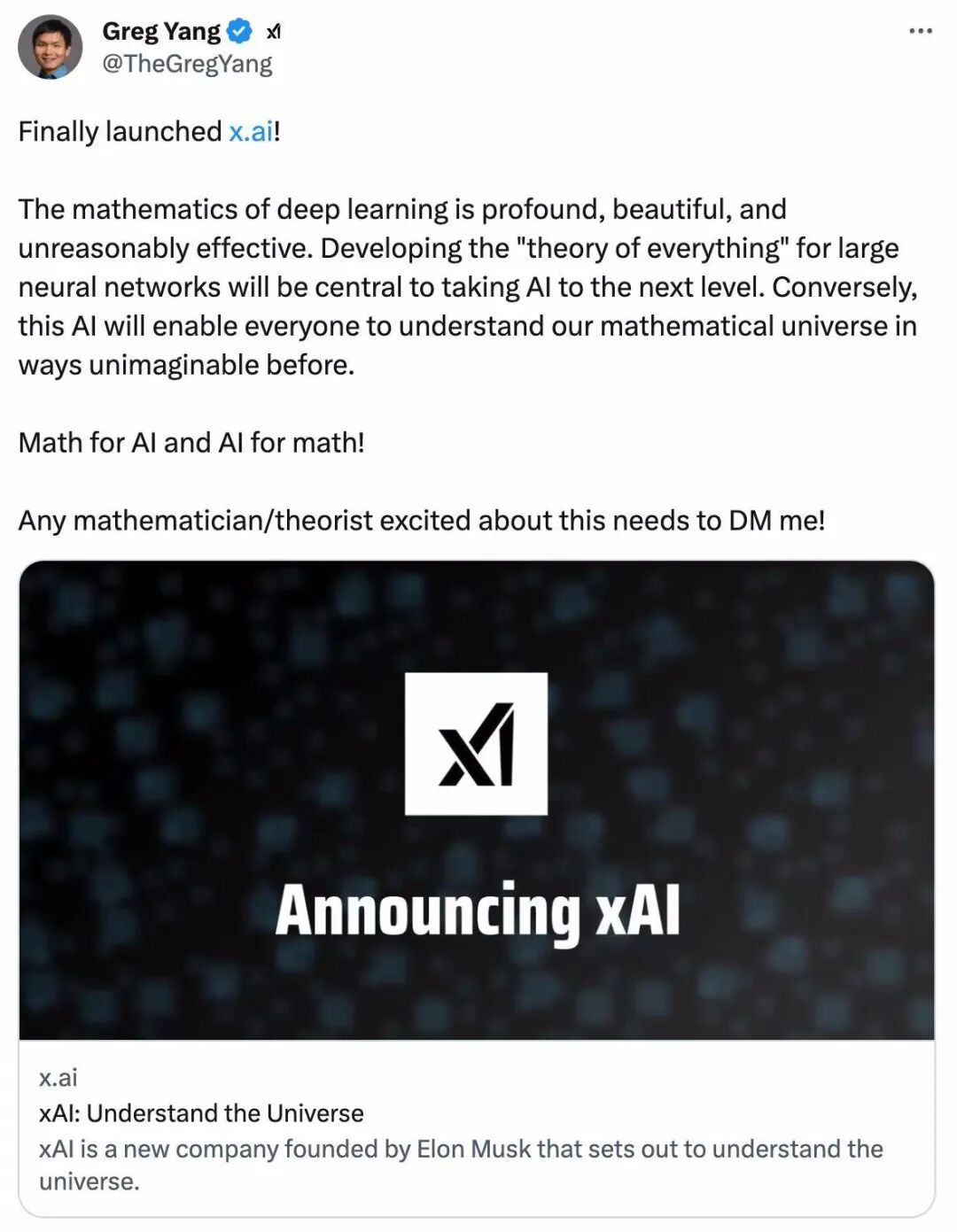
> Greg Yang
Graduated from Harvard's mathematics department. Took time off during college to pursue music, then became obsessed with deep learning research during a second leave. Joined Microsoft Research after graduation. Nominated for the Morgan Prize in 2018, an award recognizing outstanding undergraduate research in mathematics.
Twitter screenshot
> Guodong Zhang
Undergraduate degree from Zhejiang University, master's from the University of Toronto; recipient of Zhejiang University's Zhu Kezhen Scholarship.
> Zihang Dai
Undergraduate degree from Tsinghua, earned his PhD in computer science from Carnegie Mellon University in 2020, then joined Google as a Research Scientist.
The x.AI website is currently actively recruiting engineers and scientists in Silicon Valley.
Additionally, Musk has invited Dan Hendrycks as a safety advisor. Hendrycks directs the Center for AI Safety and earned his PhD from UC Berkeley. This addresses Musk's previous concerns about "AI threatening humanity." The Center for AI Safety is a nonprofit aimed at reducing AI's potential risks to society.
Since the beginning of this year, while OpenAI has been charging ahead, Musk hasn't stopped either:
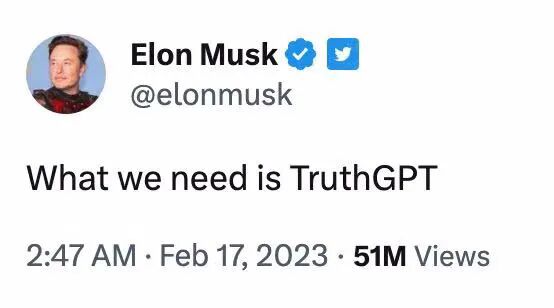
In February, he announced plans to assemble a team to build TruthGPT, genuinely dedicated to pursuing truth;
In March, he signed a joint letter with other industry leaders calling for OpenAI to pause its AI sprint;
In April, he purchased 10,000 GPU chips from NVIDIA — at the time, the industry assumed this was to build up reserves for Twitter's LLM.
Twitter screenshot
For now, x.AI appears poised to integrate with Twitter, Tesla Autopilot, Tesla Bot, and related teams on data and model development, helping Musk solidify his position in the AGI field.
In 2018, Musk left OpenAI due to two factors: first, disagreements over OpenAI's direction — Musk wanted to maintain its nonprofit status and continue exploring safer, more beneficial AI, while other partners wanted to raise funding and commercialize AI as quickly as possible; second, considering Tesla's own AI R&D, there was a certain degree of conflict of interest.
No one can resist the allure of the AI wave. Now, Musk has finally returned with his own hand-built team.
Image sources | Twitter/LinkedIn/Author's own photography
Layout | Du Meng