Ban one TikTok, and a thousand TikToks will rise in its place | Undercurrent Worldview
The Perils of Globalization for Chinese Companies
By Ren Qian
Edited by Jing Liu

No surprises, no twists. The TikTok saga has finally reached a new phase. Late on January 17, the U.S. Supreme Court issued its formal ruling: a 9-0 decision that the TikTok "sell or be banned" act does not violate the Constitution. The law does, however, offer TikTok a path to continued operation — through "qualified divestiture," meaning a sale.
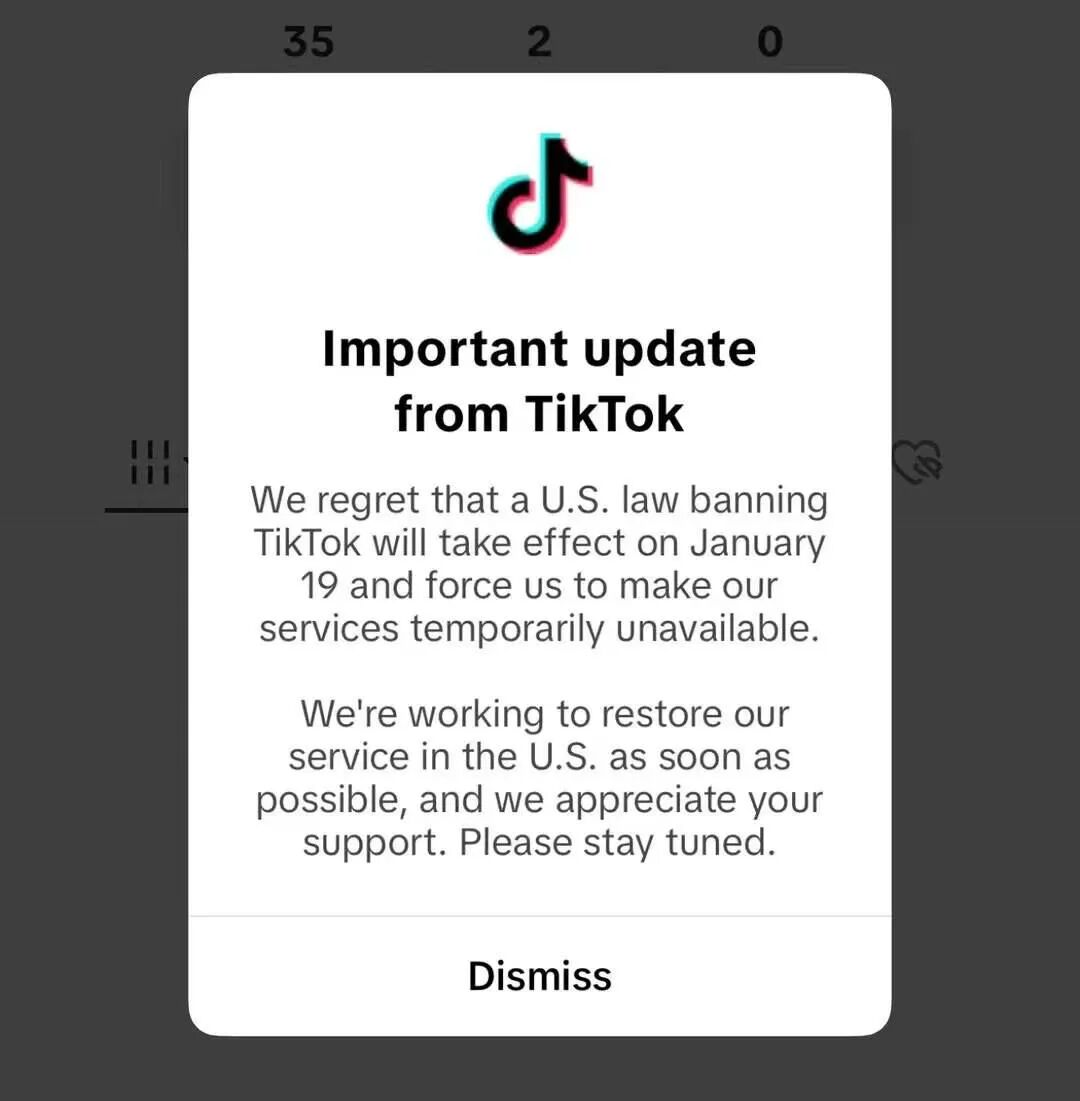
At 10 a.m. on January 19, TikTok pushed shutdown notifications to all users, covering every product operated by ByteDance and TikTok. Lemon8 (a photo and text community), CapCut (the international version of Jianying), Lark (the international version of Feishu), and even games from Moonton all went dark in the U.S.
This 1,600-plus-day drama will continue.
U.S. President-elect Donald Trump said he would "most likely" grant TikTok a 90-day reprieve on his first day in office, January 20, to temporarily avoid a ban. According to the latest from CNBC, AI search startup Perplexity has formally submitted a bid for TikTok, proposing a new merged entity consisting of Perplexity, TikTok US, and new capital partners.
Since the White House first signaled it was considering banning TikTok in June 2020, multiple forces have worked to pull the company back from the brink: lobbying U.S. authorities, changing TikTok's global CEO twice, launching the "Project Texas" initiative to maintain data localization — ByteDance pays Oracle $1 billion annually to serve as its "trusted technology provider" in the U.S., conducting security reviews of source code, and more.
But for now, as an extreme case study in today's global landscape, TikTok's fate remains unchanged.
In the context of deglobalization, TikTok is no longer a business story about how a tech company navigates disputes. It has become a convergence point for complex negotiations between a nation, corporations, and users.
Over the past decade or two, more Chinese companies have stepped onto the world stage. As globalization has further entrenched itself as a mainstream business ideology in China, the TikTok-style predicament is being examined and re-examined. A new generation of global companies like Shein and Temu cannot escape the same fundamental questions: Who am I? Where do I come from? Where am I going?
"Dark Flow Worldview" is a column by Dark Flow. We are rolling out a series of globalization-focused content.
For this installment, we spoke with several globalization observers from different backgrounds: Tim, a U.S. intellectual property and commercial litigation attorney; Mindy Huang, partner at Tsar & Tsai's New York office; Richard, a long-time overseas investor; and Zhao Peipei, a seasoned North America market industry expert.
We sought perspectives on a critical question: In an era where great-power competition has already permeated business and technology, how should Chinese companies understand and pursue globalization?
The conversation follows:

After TikTok, What About SHEIN, Temu, and RedNote?
Dark Flow: The ruling seems set in stone now. Is there any possibility of change?
Tim: A U.S. Supreme Court decision is final. Even Trump can't "change the law." Personally, I think the likelihood of TikTok saying a complete goodbye to everyone is relatively low. A sale is the most probable ultimate outcome.
Dark Flow: There were earlier predictions of a possible reversal, but that didn't materialize. Was this outcome within your expectations?
Tim: I personally felt the Supreme Court's rushed acceptance of this appeal was a misstep in itself. Justice Gorsuch, in his concurring opinion, said something honest: he felt the whole thing was rushed, giving the justices only a few days to consider and rule. This is extremely rare in Supreme Court history. So the opinion opens by emphasizing the hope that this decision will not "embarrass the future."
More ironically, this Supreme Court ruling actually provides a perfect legal basis for other countries to ban American apps. Under this opinion, any foreign app that collects user information and poses a potential national security threat can be banned — no actual evidence required.
The same logic applies to WeChat, to RedNote where TikTok refugees are now flocking, and other similar apps. These days, once you fit something into the kaleidoscope of "national security," any measure seems justified. I've been in the U.S. for over 20 years, and this is the first time I've seen a few apps cause such chaos.
Dark Flow: Some believe the TikTok ban is just an appetizer. For more Chinese companies operating in the U.S., is a collective bad situation coming? Temu, Shein, and so on?
Mindy Huang: Banning TikTok is not an "appetizer." There have already been a considerable number of enforcement actions against Chinese companies — the actions against Huawei after 2018, and various enforcement measures in the semiconductor and AI industries in recent years. The U.S. targeting of Chinese-background enterprises didn't start with TikTok, and it won't end there.
Take Temu as an example. The atmosphere we're sensing right now is very similar to what TikTok faced around 2019. Since late 2023, some China-skeptical think tanks have begun hyping up Temu's alleged "national security threat," and some lawmakers have pushed for investigations into Temu, raising concerns about data security, intellectual property, tariffs, and other issues.
Of course, so far, discussion of Temu in American society hasn't formed a broad social consensus. If Temu's so-called "national security threat" does become consensus in the U.S., it's not out of the question that U.S. legislative or executive branches could take more aggressive measures against Temu.
Around 2019, TikTok reached the point of Trump's 2020 executive order to ban it precisely through a series of such atmosphere-building and pushing. The current atmosphere for Temu is very unfriendly.
Tim: After Temu launched in the U.S. in September 2022, it expanded like it had hit a cheat code, with夸张 revenue growth figures in 2024. Temu's rapid rise overseas owes not only to its own efforts but also to a U.S. trade policy called the "de minimis provision."
Any package delivered directly to individual buyers, as long as it's valued under $800, can enter the U.S. duty-free. Of these, one-third of packages come from Temu and SHEIN — and that's a conservative estimate. Given these two cross-border e-commerce platforms' growth rates, that proportion is likely even higher now.
Bypassing tariffs while competing at lower prices — under the "cover" of this provision, Temu and SHEIN's existing advantages became even more pronounced, and Americans realized the severity of the problem. They said this policy's "massive loophole" was "becoming a runaway wildfire."
So they rushed to patch it. January 17 was President Biden's last working day in office. The Biden administration issued a proposal to tighten the "de minimis" duty-free threshold for low-value imports. Small and medium sellers relying on cross-border small parcels without overseas warehouse stock were hit harder by this reform. Of course, Temu and SHEIN's days won't be as easy as before either.
Dark Flow: Behind the TikTok ruling, regarding the targeting in the PAFACA Act — which names only TikTok and ByteDance — and whether this violates the Equal Protection Clause, the opinion again emphasized that Congress has the right to single out one or a few companies in legislation. Does this mean future "name-and-shame" legislation targeting Chinese companies could become more common?
Mindy Huang: In this TikTok case, the Supreme Court did not address equal protection or prior restraint issues. The reason is that U.S. courts at various levels have already confirmed multiple times that name-specific legislation does not violate the U.S. Constitution. There's already quite a bit of such legislation — for example, current legislative drafts under discussion in Congress include name-specific legislation targeting BGI Genomics, WuXi AppTec, DJI, and other Chinese-background enterprises.
This type of legislation was uncommon before 2018, but it has indeed become more frequent in recent years.

Attacking From the Mountain Down, and From the Valley Up
Dark Flow: What categories of Chinese companies are more likely to become targets?
Mindy Huang: Mainly two types —
One is companies in high-tech industries that the U.S. believes China could threaten, such as semiconductors, artificial intelligence, and biopharmaceuticals. When their technology development reaches a certain threshold that makes the U.S. feel threatened, targeted measures may follow.
The other is companies with large user bases in the U.S., or that have in some sense become American "infrastructure." TikTok and Temu-type internet companies are one category; another is companies that occupy large market share in certain niche sectors, such as Hesai Technology.
The U.S. toolkit contains many measures. Beyond targeted legislation like TikTok's, sanctions, export controls, punitive tariffs, and differential tax treatment can all be tools.
Zhao Peipei: Chinese companies going global can be roughly divided into three categories: ordinary tech products, mid-tier tech products, and high-tech products. Among these, high-tech products, due to their high visibility, are more likely to face TikTok-style issues.
For mid-tier tech products, the key to establishing themselves in the U.S. market lies in "high-design" capability — that is, strong manufacturing ability, high-complexity product design, and supply chain integration capabilities. These capabilities not only determine product competitiveness but also bring significant market growth opportunities. Ordinary tech products are relatively lower in manufacturing difficulty, need only focus on the product itself, and face fewer restrictions.
High-tech products involve complex ecosystems and supply chain design, so they generate more discussion. But these products tend to be highly portable — for example, internet and software, and even hardware can be rapidly transplanted through global contract manufacturing. Because these industries are difficult to manage directly through sanctions or tariffs, they can only be indirectly restricted through relevant regulations. Once in violation, they may be deemed "non-compliant."
Dark Flow: So the intensity of pressure varies by sector.
Zhao Peipei: Yes, and a company's competitive direction matters too: Are you climbing up from the valley (with the U.S. occupying a higher market position), or diving down from the mountain (with the U.S. in a lower position)? Some ToC applications in high-tech industries, such as the internet, tend to be industry-disrupting rather than industry-enhancing. Disruptive products are more likely to face suppression, while enhancement-type products are more welcomed.
For example, if an auto part is produced in North America through a joint venture with a U.S. company, and costs drop from $10 to $8, this kind of "industry enhancement" not only improves competitiveness but also brings more welfare to consumers, so it's very welcome. But if certain products disrupt an entire industry and it's difficult to prove they have positive effects on the local economy and employment — or might even threaten existing industries — then the risk of resistance is greater.
Richard: When the U.S. introduces protective measures, it prioritizes industries that pose serious, direct threats to domestic enterprises. Hisense and TCL have been going global for years, especially in color TVs and other areas, and have long been popular with American consumers. While they've encountered numerous issues in intellectual property and tariffs, their main competitors remain Japanese and Korean brands. Similar cases exist in other consumer electronics, restaurants, and other markets.
By comparison, e-commerce directly involves the immediate interests of tens of millions of American small and micro enterprises and brands. Communications, infrastructure, and media are strategically priority industries, involving not only security but also the daily lives of ordinary Americans. These sensitive areas are more likely to be the focus of policy restrictions and trade protection measures.
Dark Flow: Temu was registered as an American company from day one. If that's still not enough to avoid this, what else can Chinese companies do?
Mindy Huang: TikTok is also registered as a U.S. company. Its parent ByteDance is registered in the Cayman Islands, and ByteDance has substantial international investors from the U.S. and other countries. None of this prevented them from being targeted by U.S. enforcement.
A company's place of registration isn't the critical issue. The core is whether the U.S. government believes these enterprises pose a "national security threat," and the U.S. definition of "national security threat" has become increasingly broad — and can change dynamically at any time. We can only follow and assess in real time.
Zhao Peipei: From the perspective of the U.S. Beneficial Ownership Information (BOI) regime and the Corporate Transparency Act (CTA), whether a company is defined as a "Chinese company" depends primarily on the background of its actual beneficial shareholders, not the nationality of board members, executives, or operational staff.
Under this definition, a non-Chinese company can have large numbers of Chinese passport holders serving as board members, executives, or employees — as long as shareholders holding 25% or more of actual equity are non-Chinese passport holders, the company can still be considered non-Chinese (generally, shareholding exceeding 10% draws attention, especially when 2-3 family members form a concerted action arrangement that may achieve control over 25% or more).
Conversely, even if a company's board, executives, and employees are fully "localized," if its actual controlling shareholders include a high proportion of Chinese passport holders, the company may still be identified as a Chinese company.

Before Becoming a Global Company, First Become a Local Company
Dark Flow: For Chinese companies, what solutions can be anticipated and prevented in advance?
Tim: I think the first compliance issue to address is that everything must be genuine. Many Chinese companies use domestic agents who merely open shell companies in the U.S. with no actual business — some don't even have correct addresses. I've handled defendant cases for several companies that are quite large in the domestic market, and I felt very awkward. My biggest worry was lacking credibility before the judge. Even something as small as an address or phone number must be genuine.
Zhao Peipei: Compliance is the most basic requirement. Currently, the Corporate Transparency Act has been temporarily suspended due to litigation by domestic enterprises, but once implementation resumes, relevant companies must pay special attention to compliance requirements in actual equity allocation and reporting. The key to compliance isn't shareholder nationality, but transparency in reporting.
For example, if a company has non-Chinese passport holders as board members but the actual shareholders are Chinese passport holders who haven't been reported, that's non-compliant. If the reported information is accurate with no concealment or misrepresentation, even if the main shareholders are Chinese passport holders, it won't affect compliance.
The CTA's new requirements also need to include individuals who have actual influence and control over the enterprise, not just legal shareholders.
From a corporate governance perspective, most Chinese companies going global follow a logic of attacking from the valley upward, which is why they encounter compliance issues and sanctions with no recourse. What we encounter more often isn't issues with high-tech products, but with corporate governance standards. This takes time and experience to refine.
Dark Flow: So for Chinese companies, globalization is increasingly difficult as a "Global company," and more about becoming a "Local company"?
Richard: Chinese entrepreneurs, regardless of nationality, who want to succeed in the U.S. must comply with local laws, regulations, and cultural practices. In the short term, corporate governance, ownership, and legal structures should be independent of Chinese enterprises and investors, and management should be as international and localized as possible. Chinese entrepreneurs cannot change geopolitical relations, but they can achieve risk isolation and protection to the greatest extent possible at the legal level.
In the long term, Chinese entrepreneurs need to build localized ecosystems in their industry's upstream and downstream, while learning to use media, serve communities, coordinate government-business relations, and establish positive brand images aligned with American values. This requires generational turnover in management — a long and arduous road.
Zhao Peipei: From the technology industry perspective, there are currently two main trends: being comfortable being yourself, and actively localizing.
The former can reference the development models of Japanese and Korean enterprises 30-40 years ago. They focused on product R&D and supply chain localization, building companies controlled by localized teams. Many Japanese companies surpassed their home market share to become beloved brands among American consumers. They became fully culturally localized, with employees and operations integrated into the U.S. market, ultimately becoming nominally "Japanese companies" that were essentially American enterprises.
The latter is a familiar refrain. Achieving complete localization from a corporate DNA perspective is a complex and lengthy strategy requiring high professionalism and long-term planning. Enterprises must not only refine their products but also integrate into the local ecosystem, achieving comprehensive localization of design, supply chain, and manufacturing systems.
Image source | IC Photo