Using AI for In-Depth User Interviews, Backed by Lanchi Ventures, Hillhouse Capital, and Wang Huiwen
AI may not be great at companionship for a lifetime, but it can nail a one-hour interview.
"AI may not be able to keep you company for a lifetime, but it can nail a one-hour interview." By Zhiyan Chen

Waves has learned exclusively that Trooly.AI, an AI-native user research platform founded just four months ago, has completed a seed round of nearly $10 million. Investors include BlueRun Ventures, Hillhouse Venture Capital, and Wang Huiwen.
Unlike the countless grand narratives of "super individuals," "virtual companions," and "carbon-silicon symbiotic worlds," Trooly.AI wants to use AI to achieve a real commercial闭环. Its core product targets B2B clients with user research needs. Through multimodal Voice Agent technology, it specializes in 45-minute deep qualitative user interviews, enabling clients to set up and launch research plans in 10 minutes and delivering complete interview data and professional insight summaries within one day.
The two founders, Zhen Wang (Whisper) and Hao Sun (Zephyr), were once "deskmates" at Zulution AI.
Zulution AI was founded by Louis Yang, creator of Musical.ly (the predecessor of TikTok), and launched an AIGC character-playing conversation product called "Museland" in overseas markets in the summer of 2024. As the 5th and 13th members of Zulution AI, Wang and Sun both participated in that tumultuous pioneering effort in AI companionship. Museland once briefly ranked near the top of the charts in daily active users and demonstrated astonishing user stickiness — in specific emotional companionship scenarios, large numbers of users were willing to chat with a virtual character for hours on end, with single-user conversation rounds reaching into the thousands, and new user next-day retention once hit 40%.
However, in the spring of 2025, when the flywheel of AI companionship stalled, they both chose to leave and embarked on a six-month "wandering."
Before officially launching Trooly.AI, the two went through multiple failed ideas over six months. They tried product forms including using AI to eliminate information noise, AI stock trading, AI vocabulary learning, and AI paper reading, and even once planned to build an AI hardware device based on Voice Agent. It wasn't until they realized: in an era where AI drives the marginal cost of logic and content generation toward zero, the real moat is no longer "output" capability but the quality of "input." The most expensive asset is the user stories hidden in real life — the ones that provide core "information increment" for product decisions.
The final crystallization of this direction stemmed from Wang's experience as a "client" making purchases during his Zulution AI days. For product decisions, he once spent nearly 40,000 RMB hiring an external agency for research, only to receive just over 20 user samples after a month-long wait. Meanwhile, the conversation technology the two had accumulated through the Museland product — which could put people at ease — was naturally suited for deep qualitative interviews. With barely any further hesitation, Trooly.AI was born.
Wang told Waves that compared to the social pressure brought by human interviewers, respondents actually open up more easily when facing a "knowledgeable and gentle" AI, sharing hidden and profound emotions. In a recent study, a girl being interviewed in her car broke down in tears under the AI interviewer's probing, sharing her extreme loneliness after being kicked out by her parents.
"In user research, bare facts aren't that crucial. What matters most is the user's real story. Only by perceiving through stories the truest bond between users and products can we bridge the massive gap between what's in a product manager's imagination and the user's reality, and thereby shape products that are genuinely useful," Wang said.
Two people who had always been active on the front lines of to-C products ultimately found their entrepreneurial entry point in to-B, deciding to stitch together their technical accumulation with real business pain points. They told Waves that Trooly.AI takes its name from "Truly." In an AI era of information overload, they choose to return to first principles: letting authentic consumer insights reach product decision-makers directly.
Recently, Waves sat down with Trooly.AI CEO Zhen Wang and CTO Hao Sun in their brand-new office on Shanghai's West Bund, chatting in the winter sunlight.
The following conversation has been edited —
Part 01
Breaking Out of Product Managers' "Hegemonism"
Waves: What specific problem does Trooly.AI solve?
Wang: Simply put, we're an AI-native user research platform. If you're a product director going overseas and want to understand why female users in North America aren't buying your cosmetics, you used to need to find an agency, write an outline, and wait a month. Now, you just spend a few minutes on Trooly entering your intent, and our Agents will help you write a screening questionnaire, output a professional interview outline, find precise overseas users, and deliver complete interview results within 24 hours.
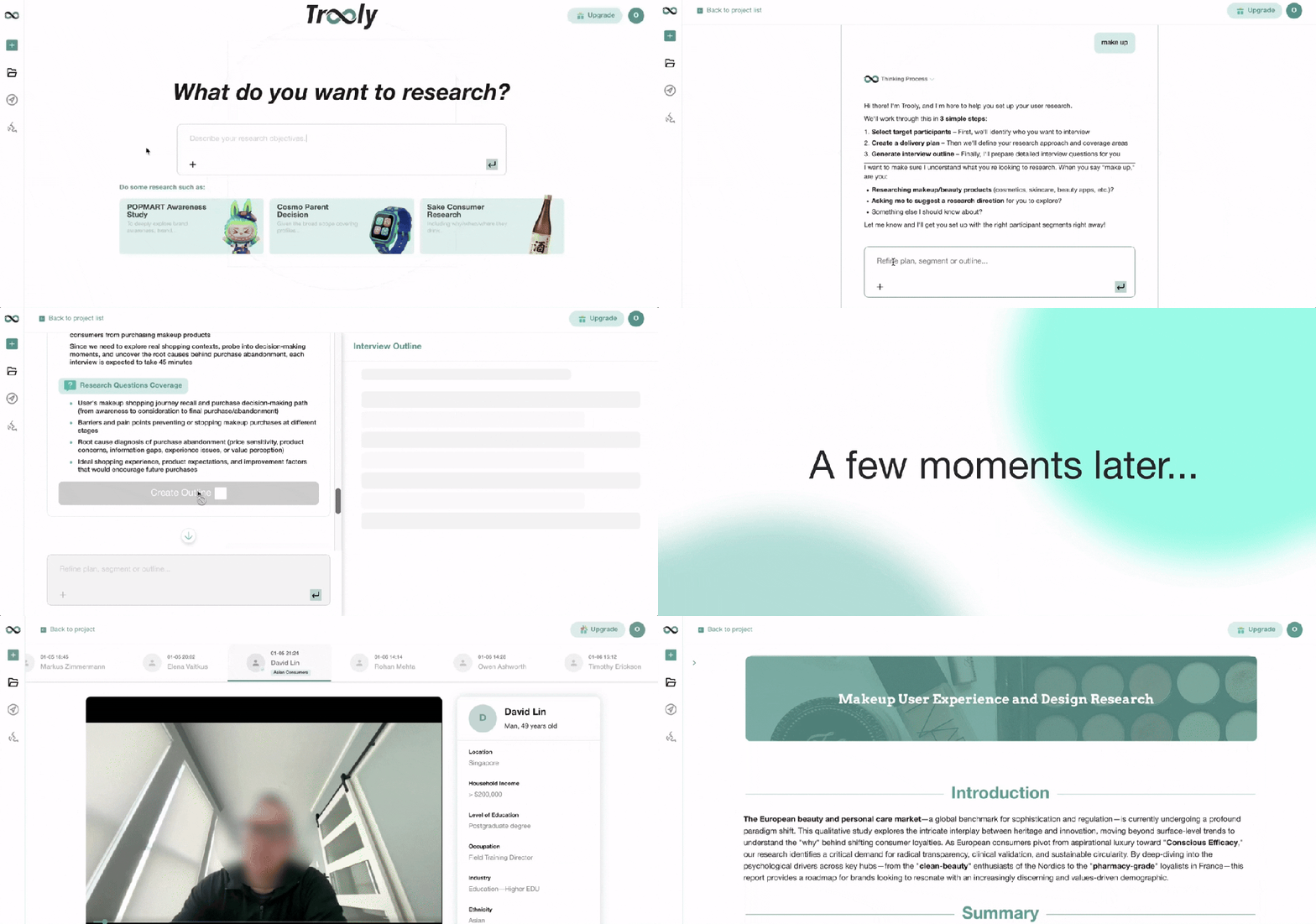
Trooly.AI interface | Image source: Provided by interviewee
Waves: Do you really need AI to send out user research questionnaires?
Wang: It's not simple Q&A, but a 45-minute deep qualitative interview.
Waves: How deep can AI go in user interviews?
Wang: We once researched an American girl who used an AI product. After the interview started, the AI asked why she needed this product. She was silent for 15 seconds, then started choking up. She said she had just been kicked out by her parents and was now living in her car. At that moment, the AI didn't ask "how are the features," but敏锐ly captured her emotion and began comforting her, guiding her to tell the story of her family. In that hour, she treated the AI as her only confidant. In the end, we obtained an extremely authentic purchase decision path and emotional motivation.
Waves: Why does developing a new product require knowing this?
Wang: Because in user research, bare facts are often just边角料. The core is the user story. Product managers must feel through interviews what the user's story really is, what kind of bond has formed between them and your product.
Many product managers at big companies, myself included, actually exist in a state of "hegemonism" for long periods, accustomed to relying on personal cleverness to "shoot from the hip" and set requirements. This approach essentially wastes company capital and resources on blind "horse racing." Often, our self-righteous changes are causing harm to users.
Waves: This doesn't sound like a hard need for product development. Why would potential clients pay?
Wang: The core challenge in developing new products is bridging the gap between what's in the product manager's imagination and the user's real world. Real stories with such intense emotion that they can make respondents cry provide the most critical information increment for decisions. Only when you truly "become friends" with users through conversation do you get the chance to correct your product intuition. This cognitive重塑 is the effective path to shaping genuinely useful products.
In fact, many clients have very high decision costs — gaming, 3C products, VC. A failed decision brings very substantial losses. These users deeply need thorough research to clear their fog and make more confident decisions.
Waves: Compared to existing user research service providers, what does your product improve?
Sun: In traditional user research workflows, launching a project easily takes one to two months, which is also an objective reason for intuition-based decision-making. By comparison, Trooly.AI's feedback speed is about 30x faster. We even have clients who completed the full闭环 of "recruiting to interviewing to producing reports" in 2 hours.
When building Museland, Wang once spent 40,000 RMB interviewing just 24 people. Through our platform, the same interview scale can cost 20% of what it used to.
Waves: What about compared to competitors also using AI for user research?
Sun: Many competitors are building a Chinese version of ListenLabs, doing AI voice surveys. But what we're doing is actually quite difficult — it requires very fluent conversation ability and good depth in follow-up questioning. These capabilities come from two years of accumulated experience, and they factually create a noticeably different experience.
Waves: From a technical standpoint, what's difficult about building this kind of AI interview?
Sun: The difficulty lies in controlling the rhythm of interaction. Ordinary Agents interrupt whenever you pause; they don't understand "thinking" and "sadness." We need to make the agent learn to build atmosphere. You can see that Trooly.AI's interface has no anthropomorphic figure, only flowing sound waves and soothing color schemes. Because we don't want users to role-play, but to enter a tranquil space.
At a deeper technical level, we've injected massive amounts of expert knowledge. The Agent changes state based on the user's cultural background, responses, and emotional signals, dynamically adjusting the depth of follow-up. This is more impartial than human interviewers, and more knowledgeable.
Waves: Ling Fan's atypica.AI has also been getting attention recently. By comparison, do you think clients will be more willing to pay for Trooly.AI?
Wang: We're called Trooly.AI — we interview real users, not virtual ones. Different client groups have different needs. I believe some clients will pay for atypica's product characteristics, and some will pay for ours.
Waves: When being interviewed on Trooly.AI, do respondents know the interviewer is AI?
Wang: We disclose it explicitly in the first second. But奇妙ly, precisely because it's AI, users feel no social pressure. Facing a human interviewer, you might become defensive due to skin color, accent, status gaps. But before AI, it can be a completely neutral, knowledgeable, and gentle "tree hollow."
We have a saying: We may not be able to do a lifetime of companionship well, but we can nail a one-hour interview.
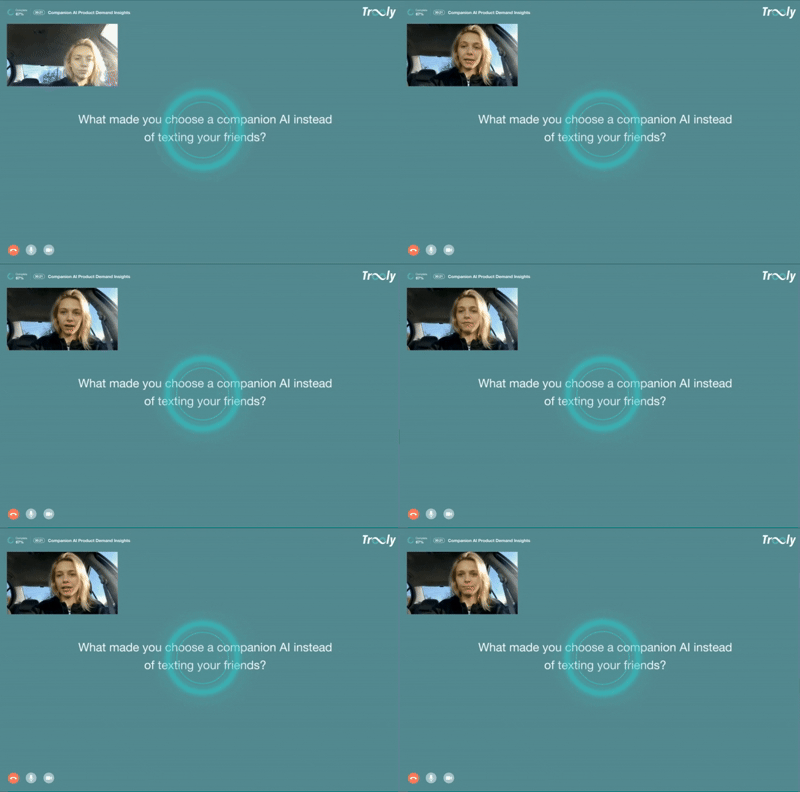
Trooly.AI user interview interface (anonymized) | Image source: Provided by interviewee
Part 02
The "Super Individual" Myth
Waves: Why leave Zulution AI in March 2025?
Wang: Our new user next-day retention could hit 40%, which is a very high level in the industry. But by January 2025, we found the data flywheel wouldn't turn anymore. No matter how we optimized the model, 40% was like an iron law — an unbreakable ceiling. I later discovered a paradox in AI companionship: over time, user interaction with the model enters diminishing marginal returns. Because the diversity the model provides has a ceiling; it has no real "information increment."
Sun: Our reasons for leaving were quite similar — both after Museland was shut down. I care a lot about whether things align highly with my interests. After leaving Zulution AI, I tried using interest content for foreign language learning, and used automated academic PR to accumulate 3,000 top-student followers on Xiaohongshu in a month. But I quickly felt something was off. It wasn't until Trooly.AI that we got that feeling of sparks exploding in our brains.
Having the underlying tech for AI companionship, plus big-company product manager know-how — that was Trooly.AI's starting point.
Waves: Come to think of it, you do seem to be doing user research the way you did AI companionship.
Wang: The underlying logic is indeed一脉相承. As long as it's conversation, it's fundamentally a process of human-AI interaction, and for communication to be effective, AI must provide a form of "qualified companionship." Our Museland experience made it very clear that due to marginal effects, long-term companionship struggles to maintain diversity. But this time, we can concentrate all our empathy construction, emotional feedback, and interaction techniques into this one hour of interview.
Waves: What was Louis's attitude when you resigned and started your company?
Wang: Louis and I talked very deeply. I've always viewed Louis as my mentor. He's incredibly charismatic and always able to give me quite helpful advice.
After leaving to start a company, Louis gave us a term sheet immediately, and the company's earliest operating funds were transferred to us personally by Louis.
Sun: I'm very grateful for Louis's help and trust. Louis is someone with extremely active thinking and a kind heart. Louis really buys into "super individuals" and "one-person companies," believing that with AI technology empowerment, one person can also create remarkable businesses from zero to one. He often mentions the Zulu Principle, which is also the origin of the Zulution AI name. The core logic: as long as you find a sharp enough, small enough切口 and project all your force into it, you can become an expert in that field in an extremely short time through high-intensity learning.
For a while we too believed that AI technology could补齐 personal短板, making a cognitively "hexagonal warrior" truly capable of independently supporting a company with complete functions.
Waves: But...?
Wang: Both Old Sun and I had half a year of摸索 alone. Later I realized that although AI can raise execution efficiency to 80 points, top-tier output still depends on human aesthetic judgment in specific dimensions. Even the most all-around individual cannot simultaneously reach extremes in both divergent innovation and structured logic — these two contradictory dimensions. And this innate complementarity is precisely why teams exist.
So now, compared to so-called "super individuals," we believe more in "small but elite" teams composed of top talent with single-dimension excellence. Companies of the future will indeed become smaller, but core competitiveness still comes from irreplaceable talent and deep collaboration, not from singular high-efficiency imitation.
Waves: One of you from Tencent and ByteDance, one a serial entrepreneur returning from overseas; one ENTP, one INTJ. How do you two usually get along?
Sun: Lots of切磋. I'm relatively logical, like drawing trees in my head. Sometimes I feel something's wrong but can't pinpoint exactly what. Wang has extremely strong information gathering and divergent abilities, often popping out with crucial information points that suddenly make everything clear.
Wang: I very much enjoy being corrected by Old Sun. The information in my head is scattered, extremely divergent connections; while he's extremely rigorous, with structured thinking ability. Divergence suppresses logic, while structure suppresses innovation. This has factually derived our current interview standard: hire people who can bring new long boards, not people who are uniform hexagonal warriors in every dimension. AI may be able to补齐短板, but it can't补齐 a person's "unique nature."
Part 03
Wang Huiwen's Check
Waves: I heard your seed round had two batches, and the second batch got many TS, but you only took Wang Huiwen's money. Why?
Wang: What I can say is, when talking with Lao Wang, the strategic advice he gave was piercing. He's someone who won the "Hundred Regiments War." Sitting before him, you can feel the "bloody smell" and killing aura on him.
Waves: For a B2B AI startup, is that killing aura so important?
Wang: Competition in the AI era is extremely brutal. The vast majority of AI applications will die, because they're just toys, unable to form effective services. Lao Wang looks at the battlefield. He cares about how you capture territory in a niche market, how you survive.
Sun: Plus, we're not building a tool, but constructing a value chain. We let "Builders" reach users' authentic voices directly.
Waves: Doing B2B business, surely some investors have questioned your sales ability?
Wang: Investors do ask. My current track record is: every major client I've visited personally has formed a partnership with us. I once brought a big-company "sales champion" to meet a client, and after the chat, that guy took a drag of his cigarette and said: "Good thing you didn't do sales before."
Waves: What's the secret?
Wang: I think the core of selling to major clients is sincerity and insight. Don't bullshit — those veterans can see through you at a glance. You need to directly find the pain point in their heart. On user research — "security," for example.
Waves: Security?
Wang: Many large enterprises worry their strategy will be leaked through AI. From day one, we've built极致 compliance transparency. I tell clients very clearly that Trooly.AI doesn't do secondary training on client data, and we pay extreme attention to甲方 strategic security.
Waves: What's your ultimate goal?
Wang: Our mission is "letting consumer insights reach product decision-makers directly." If product builders globally can bridge their imaginative偏差 through this method, reduce wasted resources, and shape genuinely useful products, that would satisfy my greatest ambition.
In this AI-era "Cambrian explosion," Trooly.AI wants to help more products evolve to their极致, excavate real needs, and find the optimal solution under natural selection.
Layout | Nan Yao Image source | AI-generated

Recommended Reading

The flow of money, the rise and fall of people