After Taking VITURE to #1 in North America, Gonglue Jiang Says AI Glasses Should Target Gamers
The farther something is from what a smartphone can do, the more valuable it becomes.
"The further you get from what a phone can do, the greater the value." By Muxin Xu

When I met Gonglue Jiang at VITURE's office, he was walking in carrying an armful of accessories. He was acting out a gamer's daily routine — besides the console itself, you need a big TV, cables, controllers, and so on. That's why gamers usually carve out a fixed corner and rarely move from it.
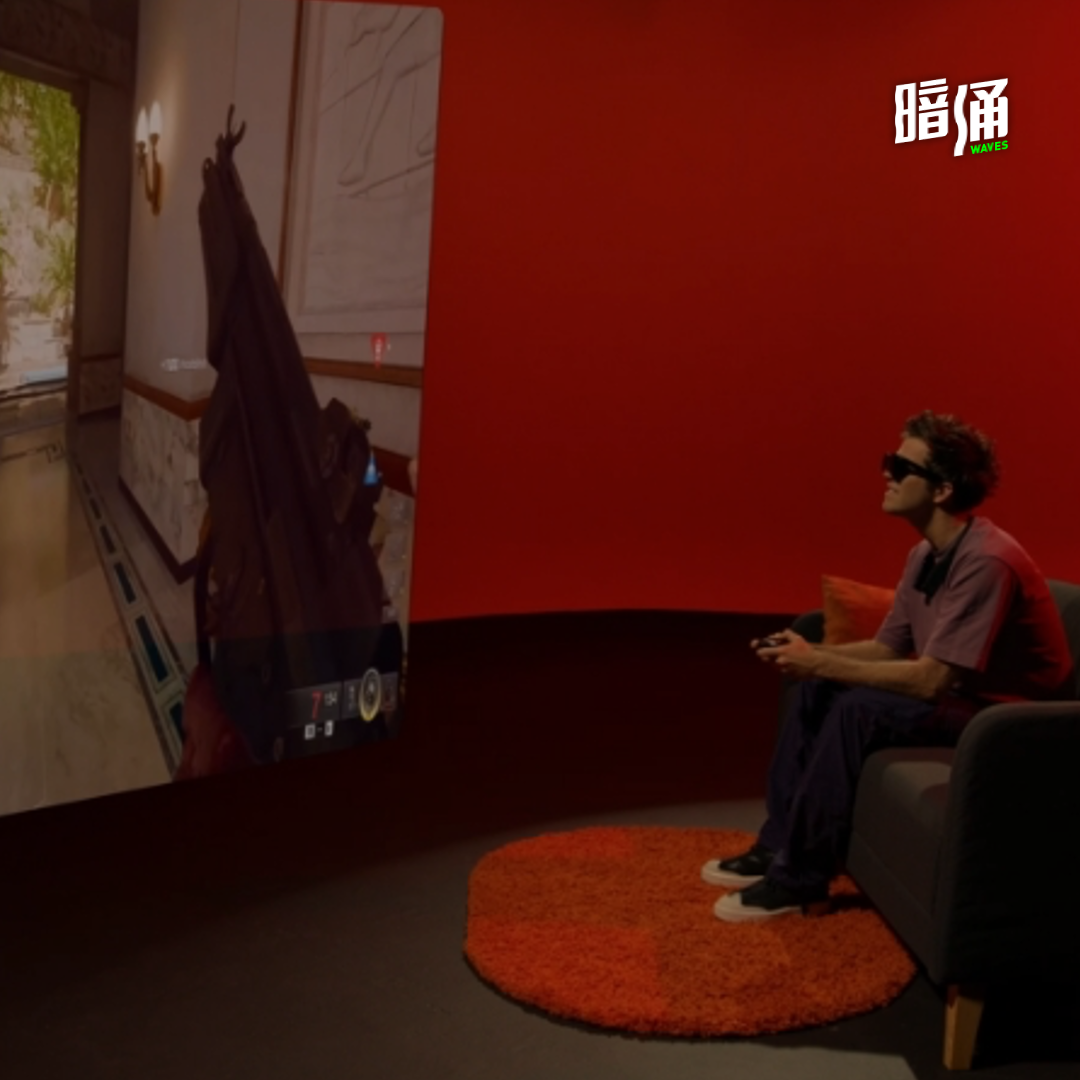
VITURE's AI glasses aim to replace that display, while Jiang has consolidated the remaining scattered accessories into a neckband — a wearable that hangs around your neck. With this setup, you can break free from physical space constraints. During your lunch break at the office, for instance, you could use streaming tech to fire up your PS5 at home and play a round of Black Myth: Wukong.
Since 2025, most AI glasses on the market have focused on lightweight productivity scenarios — presentation assistance, real-time translation — trying to replace phone or computer functions. But in Jiang's view, glasses need to find their maximum value point: the further you get from what a phone can do, the greater the value. VITURE is currently focused on supplementing the area where phones are weakest — immersion. That's why VITURE has consistently targeted gamers.
In May 2024, VITURE Pro launched in North America. According to IDC data, by Q4 of that year, the product had captured over 50% of the North American AR glasses market, making VITURE the first AR brand to enter Best Buy. With its overseas foundation gradually solidifying, VITURE decided to enter the Chinese market at the end of 2024.
Among current AI glasses founders, Jiang may be the least likely to look like a tech guy. He graduated from Harvard's Graduate School of Design, and his student projects won multiple design awards. He named his company Xingzhe Wujiang (The Traveler Knows No Bounds), inspired by a Yu Qiuyu book he read as a child.
His pursuit of aesthetics borders on obsession. For a "designer" founder, this aesthetic sensibility extends beyond product appearance to an almost compulsive fixation on whether the user experience is sufficiently perfect. One detail illustrates this: VITURE placed the heat-generating chip module on the outer side of the temple, near the temple tip — the part of the glasses farthest from the skin.
In the era of large models, we're constantly experiencing the shock of technological upheaval. But in Jiang's view: the underlying logic of a tech company shouldn't be selling a technology to users, but rather focusing on how users' real needs and pain points can be unlocked by new technology.
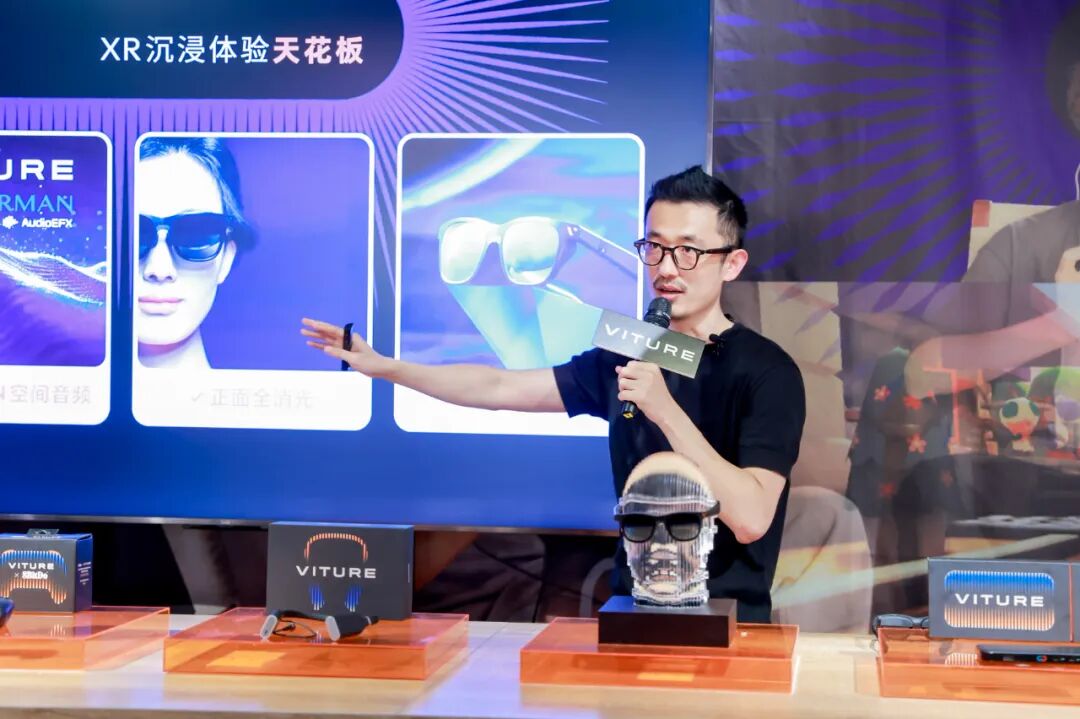
The interview follows:
"Dark Currents": This year, the most talked-about AI glasses features have almost all been related to lightweight productivity, yet you're exclusively targeting the console gaming path. Why?
Gonglue Jiang: Today, most user needs are already well-served by phones, computers, tablets, and watches. Adding a new experience to any of these devices carries near-zero marginal cost for the user. So it's not just glasses — any new hardware form factor needs to provide something that existing devices, especially phones, are bad at and that represents genuine, unmet demand. We believe phones' weak point is immersion, which is what created demand for tablets and foldable screens. And the application that gains the most value from immersion is console gaming. Of course, immersive needs for productivity and movie-watching also exist. But it's hard to define "office workers" or "movie watchers." Console gamers, on the other hand, are easier to define and find.
"Dark Currents": So what's the advantage of targeting console gamers specifically?
Gonglue Jiang: Gaming is the comprehensive test of a platform's computing power, display capability, and interaction design. Gamers have extremely high standards for experience. Steve Jobs' only job before founding Apple was at Atari, a game studio. NVIDIA also started out serving gamers. If you can satisfy this group, expanding and generalizing to other applications becomes much easier.
"Dark Currents": The neckband is indeed a very distinctive accessory, and well-suited to console gamers' needs. How did this idea come about?
Gonglue Jiang: Console gaming requires three devices: a big screen, a controller, and the console itself. Translating this to mobile scenarios, XR glasses replace the big screen, the controller stays the same, and the computing unit needs to be hands-free and portable — so the neckband is a near-perfect form factor. In today's network environment, streaming and cloud gaming can bring remote, powerful computing to the edge, allowing the neckband to be lightweight and stylish. Currently, this is our highest-selling bundle. VITURE has also won TIME magazine's Best Inventions of the Year and all four major industrial design awards.
"Dark Currents": 3D display is a very distinctive VITURE feature. When did it launch?
Gonglue Jiang: End of last year. Because AI has advanced phone NPUs, new phones now come with fairly powerful NPUs. So we pruned and fine-tuned a model that can run on the phone's local NPU, achieving two breakthroughs: first, high-quality 2D-to-3D conversion, enabling 3D-ification of all phone content; second, compressing the per-frame 3D inference time to 20 milliseconds, enabling real-time video 3D-ification.
"Dark Currents": In what scenarios can users currently experience this feature?
Gonglue Jiang: With the glasses directly connected to the phone, users can view 3D versions of photos and videos in their phone's gallery, or watch real-time 3D conversion of online videos. After launching this feature, we received a lot of user feedback. One user said that after his father passed away, he was going through his belongings and found a hard drive containing video footage of his father's life. He copied these videos and watched them using VITURE's 3D feature. He said tears kept streaming down his face, because it felt as if his father was still living right beside him. He believed this is what technology means for people.
"Dark Currents": That feature is really cool.
Gonglue Jiang: Creating a new product — whether hardware, software, or a combination — is ultimately about crafting a new way for people to experience the world. The AR industry has long been criticized for lacking 3D content. But if we use AI to upgrade existing content to a higher dimension, then the hardware can deliver much greater value.
"Dark Currents": How much have advances in AI large model technology since 2023 contributed to these new feature breakthroughs?
Gonglue Jiang: VITURE's 2D-to-3D capability primarily benefits from progress in vision large models. By training on massive image datasets, the model understands object information in scenes and generates depth maps (alpha layers). Previously, due to technological limitations, human records of the world remained two-dimensional. Yet our senses evolved to process three-dimensional spatial information. With the development of AI and XR technologies, just as we moved from black-and-white to color, digital content will evolve from the 2D era to the 3D era.
"Dark Currents": Currently, AI glasses have developed along several different branch paths, but are there any widely recognized milestone nodes in the industry?
Gonglue Jiang: The key metric is whether they can replace phone usage time. Looking at historical patterns, the essence of interaction device transitions (TV → computer → phone) is carving away usage time from the previous generation. Currently, users spend 4-6 hours daily on their phones. If AI glasses can reduce this by 20%, that marks a breakthrough. Glasses won't completely replace phones, just as phones didn't replace computers. They'll restructure time allocation, and the new paradigm will inevitably surpass the old one to become the dominant user interaction interface.
"Dark Currents": How do you think the current AI glasses industry can find product-market fit?
Gonglue Jiang: Smart glasses as a category have extremely high barriers to user adoption. Take Google Glass — even with powerful brand resources, R&D strength, and capital investment, it never achieved consumer market breakthrough. Most users are actually resistant to wearing glasses all day. Otherwise, why would contact lenses and vision correction surgery have such widespread demand?
So I believe products need to choose between "all-day wear" and "scenario-based wear." There's an essential difference between the two. A user might only need scenario-based glasses for one hour a day, but needs prescription glasses for 12 hours — making the latter 12 times more difficult. All-day wear products must adhere to the 40-gram weight threshold — an objective constraint of human ergonomics. Product design must establish a balance between functional innovation and wearability within this constraint.
"Dark Currents": According to IDC data, VITURE's sales in North America have been rising year over year. What do you think is the core reason?
Gonglue Jiang: It's multifaceted, but I believe the core is that our original intention isn't to sell technology to users, but to focus on user experience innovation — striving to create the maximum-value product at the intersection of new technological variables and unmet user needs.
"Dark Currents": VITURE has been developing in the North American market, but you now have an office in Beijing. What's your strategic plan going forward?
Gonglue Jiang: Both China and the US are must-win markets, but each has distinct characteristics. They differ greatly in user profiles, usage scenarios, distribution channels, and purchase decision-making. We believe the Chinese market will achieve later-mover advantage in product mindshare, and will also give birth to more innovative form factors and content.
"Dark Currents": Years ago, after your Infinite USB design won an iF Design Award, you wrote an essay titled "Dreams Are the Morning Alarm and Evening Coffee." You come across very much like a designer.
Gonglue Jiang: Mainly because I derive joy from creating products. Designers tend to have high sensitivity to the world — catching imperfections in that sensitivity, then filling them through product creation. In the XR industry, sensitivity to technology is equally important. There are enormous variables across the entire experience chain. You first need to find the boundaries of current technology before you can meet users' boundless needs.
"Dark Currents": Then why did you want to start a food delivery company while at Harvard?
Gonglue Jiang: I've always been interested in entrepreneurship, business, and problem-solving. While studying at Harvard, I noticed everyone was eating expensive, terrible food. To get cheap, good Chinese food, you'd need to drive at least 20 kilometers, and these restaurants had no lunch traffic anyway. So I wanted to solve this pain point. I built an automated platform connecting supply and demand — students could pre-order in groups from faraway but great restaurants, and merchants could use their idle lunch hours to prepare meals for centralized, free delivery. This model created a win-win for both user value and merchant value.
"Dark Currents": O2O was a business model on the wind at the time, with huge potential. Why abandon this venture?
Gonglue Jiang: It was entrepreneurial practice, but not my life calling. My passion has always been at the intersection of products, technology, and design — and XR sits right at that intersection. Only by finding what you love can you gain sufficient mental energy, resilience, and inspiration. The happiness from sustained investment doesn't come from the future; it comes from the present moment.
Image source | Provided by interviewee

Recommended Reading
Where Money Flows, People Rise and Fall