Wang Hua's Latest Prediction: The Biggest Difference Between the AI Era and the Mobile Internet Era Is Fulfillment, Not Connection
The first year is the golden window to capture the first-mover advantage on model dividends — start building now.
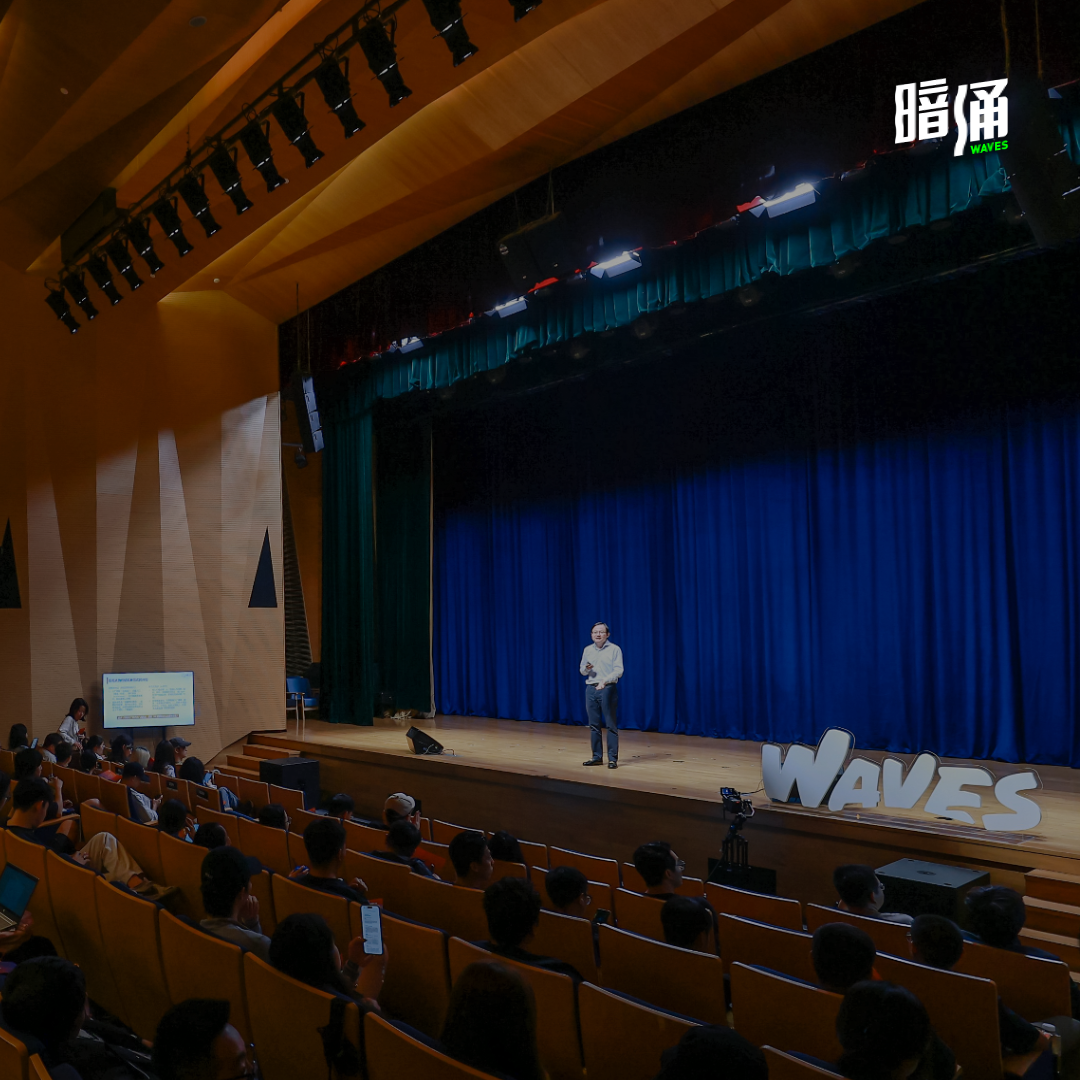
"The first year is the golden window to capture the first-mover advantage of the model dividend. Start your company now." Compiled by Lili Yu

In China's venture capital world, Wang Hua, co-CEO and managing partner of Sinovation Ventures, has long been known for his prescience. In 2008, he predicted the mobile internet wave ahead of time; in 2011, he laid out a "three-step" framework for how mobile would unfold. These "prophecies" were later vindicated one by one.
Qu Kai of "42章经" once argued that when it came to mobile internet, only two people were genius-level in trend prediction and strategic positioning: Wang Xing of Meituan, and Wang Hua.
Not long ago, at the 36Kr WAVES New Wave 2025 conference in Hangzhou, Wang Hua delivered a keynote titled Beyond Connection, Embrace Implementation: The 10x Opportunity of Agents and Multimodality.
In his speech, he pointed out how the AI era differs from the mobile internet era in paradigm, and argued that we are about to enter an AI age where gold is everywhere — and all AI entrepreneurs will share in the biggest dividend of their lifetimes: the model dividend.
The following is an edited transcript of his speech:
I'm very glad to have this opportunity to share some of my views and observations on AI entrepreneurship. "Beyond connection, embrace implementation" — this is what I've come to understand over the past two or three years from talking with many entrepreneurs and investors.
Part 01
The Old Paradigm of Mobile Internet
and the New Paradigm of the AI Era
First, let's discuss the old paradigm versus the new one. How is AI-era entrepreneurship different from what came before? Recently, many entrepreneurs I've spoken with feel anxious because models are advancing by leaps and bounds, yet they don't know what to actually build. Especially with giants like ByteDance, which casually launches dozens of apps in a matrix-style deployment — it feels like they've already done everything that can be done. Tencent, Alibaba, and other majors are all pushing hard too. What space is left for entrepreneurs?
My own feeling is: don't worry about this at all. Because these giants are still fundamentally the same companies from the internet and mobile internet eras. So even when they do AI, their entire entrepreneurial paradigm remains the mobile internet paradigm.
What was the mobile internet paradigm? Its core was connection. Connecting various scenarios and user groups together. So the central playbook was massive scale, huge user bases — monopolize the users in a domain, and you could connect transactions.
When these giants do AI now, their thinking is exactly the same. They're all targeting large-scale applications and massive user bases. And in this arena, entrepreneurs can't beat the giants. In the mobile internet wars, whether it was growth, user acquisition, or retention, they had enormous capital and existing user volume. When doing these things, they could even wait for you to finish first, then copy you. And still defeat you.
Kimi made exactly this mistake. Kimi had a one-year head start, but was quickly overtaken by Tencent and ByteDance. But in my view, this doesn't matter at all, because the biggest difference between AI and mobile internet isn't connection — it's implementation. AI can not only connect various information flows and transaction flows, but actually get things done.
Can AI do connection? Yes, but in the real world of business and value, connection accounts for only 10%-20%. Getting things done, delivering — that's 80%-90%. So even if we cede that entirely to the giants, we still have 80%-90%, which is 5-10x the value space. There's absolutely no need to compete with giants for the old user-platform, big-platform thinking — that 10%-20% connection market.
The giants won't compete with you for this either, because implementation across industries and domains comes in thousands upon thousands of varieties. They neither have the energy to do it all, nor can they possibly do it all. So the essential difference between old and new paradigms is this: the old paradigm of mobile internet, including the giants' paradigm, is about breadth. The new paradigm is fundamentally about depth. The old paradigm pursues scale; the new paradigm pursues high value per user.
If you're going for high value, vertical, deep markets, you're fundamentally not in the same race as the giants. And under the new paradigm, your starting point for thinking is different. In the mobile internet era, everyone was thinking: how do I get my first 100,000 DAU, how do I get to 500,000 DAU. But from an implementation perspective, it's like doing business. If you open a shop or factory, do you care about DAU? Even if you're in e-commerce, or even games, what you really care about is how to get your first $10 million in revenue.
Anyone doing real business and delivery cares about end results, final transaction volume. If you're going for depth now, going vertical and high-value, what you need to think about is where your first $10 million comes from. And in this, new-paradigm entrepreneurship — AI — offers unprecedented opportunities and tools.
China may be slightly behind the global curve. I've talked with many founders doing overseas expansion, including in Silicon Valley. They mention doing AI, doing revenue — say $1 million or $10 million ARR. And they've found that in the past year or two, especially the past six months to a year, AI has been the fastest-developing technology ever. Basically, hitting the $10 million milestone is 5-10x faster than in the PaaS or SaaS eras. Many companies have crossed both milestones within a single year.
Their approach is completely different from the mobile internet playbook, so the entire entrepreneurial paradigm has changed. The whole mindset, starting point, and methodology of entrepreneurship have shifted.
And right now happens to be the best timing for this new-paradigm entrepreneurship, because there's a massive wave of model dividends, roughly starting from half a year to a year ago. Because by the end of last year, from reasoning models to multimodal, models began making major breakthroughs.
Part 02
The Biggest Dividend of Our Lifetimes:
The Model Dividend
In the early days of entrepreneurship, we often talked about traffic dividends, traffic arbitrage — whoever captured the first wave of traffic dividends, whoever staked their claim first, would gain the upper hand. Giants fought to the death for traffic too.
Entrepreneurs are essentially looking for era dividends or leverage. There's no traffic dividend now, but there is the biggest dividend of our lifetimes: the model dividend.
From the end of last year, reasoning models began making large-scale advances, especially in the past six months, with model capabilities evolving very rapidly. Don't just look at benchmark rankings — the changes there don't seem that dramatic. But in many real application scenarios, things like instruction-following capability, tool-calling capability, and various coding abilities have all advanced very quickly.
Model performance in many domains, within just the past six months, has gradually impacted many vertical fields. From unusable to usable, from seeming like a toy to generating genuine amazement in users.
For example, in many vertical domains in the US, in healthcare, there's a company that started two years ago doing note-taking and organization for doctors and consultation records. Three or four months ago, after switching to a new model, user satisfaction suddenly improved dramatically. Every week, major medical institutions are signing up. Recently, they completed a new funding round at a valuation of over $5 billion.
And recently, we've seen a wave of vertical applications related to programming or Agents, like Lovable. If you look at what they're doing, it essentially relies on recent model improvements from Claude 3.7 to 4, making front-end programming genuinely usable. There are many such examples.
Recently, many companies are essentially doing one thing: when models become good enough, they find a vertical niche and become the first benchmark application to bring new model capabilities into that domain — then they become instantly famous.
For instance, if an experienced entrepreneur or developer looks at what I just mentioned, they'll find the company isn't doing that much. The core capability is essentially Claude 3.7's abilities — they just found a vertical domain of front-end developers, web developers, app developers, designers, and product managers, and packaged Claude 3.7's capabilities well for this audience. To put it somewhat extremely, even Manus's rise to fame came from being among the first to leverage Claude 3.7's model capabilities to create something stunning.
This is also why a domestic equivalent still hasn't emerged — because Chinese models haven't reached the inflection point yet, aren't good enough to produce something stunning. In legal, financial, and even restaurant domains, many companies have recently emerged, all rapidly leveraging the sharply improved model capabilities to hit that threshold. This is the typical model dividend at work.
And what are the giants doing? Model companies and tech companies are frantically competing on benchmark scores, on base model capabilities, and even when they build applications, they only care about the very largest ones.
For example, Google is clearly doing consumer AI; Anthropic is doing mass-market programming. This means model capabilities are improving very rapidly, yet in many vertical domains, applications are basically zero. And the giants aren't applying model capabilities to these smaller vertical domains, creating a massive potential energy gap.
Whoever can, shortly after a model capability upgrade, be the first to find a vertical domain where new model capabilities can deliver dimension-reducing strikes — they can rapidly gain a wave of users, buzz, scale, and funding opportunities. And for many of these things, as long as you have good enough ideas and find good vertical domains, many model capabilities can quickly demonstrate tremendous value.
Including something everyone thought was useless: math problem-solving capabilities. People used to think solving Olympiad math was just showing off, with no practical use. But in the past six months, in Silicon Valley, multiple startups have applied Olympiad math-solving capabilities to hedge funds and finance, using them for various financial model and algorithm iteration.
The first company to do this, regardless of how much "AI" it actually contains, raised at least $30-50 million.
In the coming year or so, model capabilities will continue improving rapidly. The giants are burning hundreds of billions on infrastructure, frantically pushing model capabilities, but not harvesting the countless application opportunities these capabilities enable. They can't harvest them all, and couldn't even if they tried. This rapid growth in model capabilities offers the best opportunity for us startups and entrepreneurs.
The giants have already built the model capabilities for us. For entrepreneurs now, the most important thing has become finding scenarios.
What kind of scenarios meet the requirements I just mentioned? Not necessarily large, but high-value, creating potential energy gaps. Not needing to be big, because you're doing implementation — you can produce effects that genuinely amaze users in ways impossible before AI. This is very different from the old paradigm.
For example, take $10 million ARR. How big a user base does this actually require? Much smaller than you'd think.
Take Silicon Valley as an example — I've talked with quite a few entrepreneurs there. $200/year, if it's a consumer app, this isn't on the high end — it's an average figure.
5,000 users is $1 million. 50,000 users is $10 million. If you're doing a B2B application, the companies I know mostly hit $10 million when they have just a few dozen genuinely paying users.
Many Chinese companies are also doing well there, which fits my logic very well. They did excellent product integration of language models with digital human technologies at the time, reaching $30-50 million ARR with just $50 million spent. Unlike before in China, where you'd build an app, not even have 1 million DAU, and wonder how to start monetizing. And on the surface you do free users, but is customer acquisition really cheap? Now for growth in China, counting Douyin and various channels, what's the average cost? And actual churn is very high.
In this paradigm, if you build something truly useful, truly valuable, this wave of entrepreneurs basically aren't spending on customer acquisition.
For example, for consumer apps, as long as you find a few hundred thousand people with genuine deep needs, genuinely productive, valuable people, even capturing 1/10 of that market gives you $10 million ARR.
Are there many such opportunities? Very many.
Just broaden your horizons. Think globally, across all industries.
By global, I mean: what model dividends do we capture? We capture global models, not just models usable in China. We target global markets — whether Europe, America, Southeast Asia, China — not just the China market. And don't just focus on internet stuff; look at all industries, thousands of trades.
In this, what's important isn't even just technology — it's knowing the real pain points in some vertical or industry, having deep know-how in vertical domains, knowing the tricks of doing business in certain verticals, and converting these into prompts and workflows that the most advanced models can understand. Truly making something distinctive and valuable at the core, without needing to be big.
There are many such companies. Like Rillet, which does general ledger accounting. The founders came from consulting and accounting backgrounds, and deeply understood how painful the financial systems and general ledger systems that SMEs use are. Especially those decades-old general ledger systems — all built for large enterprises, completely unbearable for SMEs.
But now AI automation capabilities are very strong. They essentially rebuilt general ledger accounting with models. In less than a year, they're already disrupting twenty-year-old products among SMEs.
Including Lovable — $50 million ARR, targeting designers and product managers. In the US, there are also many owners of small and medium restaurants, traditional restaurant operators doing online takeout and online ordering management. There are many such examples — all companies that rapidly emerged in the past year, especially the past six months, as various model capabilities improved.
So don't pursue scale; focus on real problems and pain points, pursue real value. And don't stay at the surface — the more specific and granular your problem, the better. Because current model capabilities work like this: when a problem is too broad, performance isn't great. When a problem is more clearly defined and specific, you can produce more stunning results.
Even so-called general-purpose tools now, like general search, can't beat a dedicated PPT maker at making PPTs.
Even Google and OpenAI's Deep Research is already very good, but when it comes to law or finance, they still can't beat specialized Agent companies that do research in these domains or connect to proprietary industry knowledge bases.
For example, regarding my first strategy — rapidly leveraging new model capabilities to gain traction before model companies catch up — people might worry about whether the moat is too shallow. Not at all, please don't worry.
I know some entrepreneurs or investors compare companies that rapidly rise using new models to "model wrappers." But this doesn't matter at all. Whether it's a wrapper or not, what matters more is whether you captured the first wave of traffic, users, and customers.
Second, unlike mobile internet back then, where user platforms that started with shallow layers could easily be disrupted by giants later — from an implementation and business perspective, the chain can be very long. Once you get your first customer base, say you start with something shallow in general ledger or sales, but once you have users, you can keep pulling backward, because any implementation business chain can extend very long. As long as you seize first-mover advantage and have a user base, your barriers can keep deepening. This is completely different from the thin platform layer of mobile internet.
As for choosing something very specific that seems to have a low ceiling — worrying about what happens after hitting $10 million ARR, or after getting 50,000 paying users, thinking 50,000 is too few — this doesn't matter at all.
Because with the logic of implementation, once you capture the first link in the chain, you can go deeper; the extension space is enormous.
Most importantly, move fast while the model dividend exists, while you have good knowledge and understanding of a particular vertical industry. If you don't have vertical industry knowledge yourself, find a partner who deeply understands a vertical, get your first bucket of gold, then keep digging deeper.
This won't produce the next trillion-dollar Google or Facebook, but it will produce tens of billions, even hundreds of billions in countless industry hidden champions.
Part 03
The Opportunity of Agents and Multimodality
Next, the biggest traffic dividend, the biggest dividend arbitrage, lies in two things: first, Agents; second, multimodality.
For the model dividend, these are the two areas where model performance will improve and change most rapidly over the coming year or so.
Agents seem very hot on the surface, but essentially they're about model tool-calling capabilities and reasoning capabilities — capabilities that, under the influence of reinforcement learning, are just beginning. Reinforcement learning still has roughly 10x room to scale up, meaning that in about the coming year, we'll see rapid changes and growth in model Agent performance across the board.
And this rapid change and growth may not show up in various benchmark scores, because these scores don't correspond to real model performance. For example, you'll find that in actual programming use, although Claude 3.7 doesn't have the highest scores, it's the most usable.
So in the coming year, base model companies will have two scaling laws:
One is on compute, improving model capabilities.
The second is doing large amounts of vertical-domain reinforcement learning on models. This won't improve benchmark scores, but will greatly improve model adaptability to various industries and domains.
As horizontal and vertical advances continue, if you pay attention to models, you'll find things that were very hard to do may become doable in three months.
People often talk about the second half now; actually we're still in the first half. For many current applications, they've just reached the point of being usable.
For example, take tool-calling. Currently, when a model calls about a dozen tools, basically MCP models start having various confusion and hallucination issues, and context is generally insufficient. But within 3-4 months, models will be able to call hundreds of tools simultaneously, context will become very usable, and it'll be cheap enough.
In a year, this growth will slow. Because the reinforcement learning dividend isn't infinite, so everyone must start their companies early — within one year is the golden period for model dividend growth, the golden period to get the first sip of soup.
After a year, when model performance is no longer growing and everyone starts homogenized competition, it's not that you can't do it then, but it'll be much harder than now.
The other model arbitrage is multimodality, images and video. Although previously in the consumer space, OpenAI's GPT-4o image generation caused quite a sensation, and Google's recent VeO3 video generation is already doing very good consumer-facing things.
But on the B2B side, multimodal development capabilities still have much room to grow, and from my conversations with many people building models, many will see major progress in about a year — including multimodal fusion, model controllability, motion controllability, semantics, longer video generation, etc.
Although our WeChat public accounts are already flooded with AI-generated content, it's largely consumer-facing. In B2B, there's still a big gap. Within a year or so, it'll see major progress like Agents.
You can draw an analogy: in October-November last year, people still thought Agents were a joke. But by this May, not to mention everyone's predictions, at Google there are already many companies genuinely using Agents to accomplish substantial business.
In October last year, when people used AI for programming, they could only do patchwork tasks. But at this point, Agents can independently write modules of thousands or even tens of thousands of lines of code, especially front-end, sometimes succeeding on the first try.
Multimodality and Agents, in the coming 10 months, will undergo earth-shaking changes just like the past 10 months. The breadth and depth of applications will rise a whole level from where they are now.
All this combined, looking globally and across all industries, this is truly a time when gold is everywhere — it depends on whether you can find a gold mine and dig deep.
I'm very glad to come to Hangzhou and share this. I think for Hangzhou and southern entrepreneurs, in the coming AI entrepreneurship era, it's an even better era than mobile internet was.
Frankly, in the mobile internet entrepreneurship era, there were major differences between southern and northern entrepreneurs. The North produced many platform companies — staking claims, building massive scale, high visibility, high-profile approaches.
The South produced many good companies like Pop Mart, including e-commerce, various such companies — many focused on revenue, on business operations. Even southern startups doing overseas expansion, cross-border, strong operations, strong commercial ability to directly generate revenue, including doing global markets — these were more common in the South. And all these characteristics fit the coming AI entrepreneurship paradigm very well: high value, global, not pursuing massive scale.
From the early mobile internet era to the first generation of AI startups, I also invested in many. Including in the AI 1.0 era, I invested in over a dozen unicorns, including autonomous driving solution provider Horizon Robotics. Now I feel the overall opportunity is 10x better than AI 1.0, because the global business market is 10x China's business market, and if AI does implementation, it's 10x what mobile internet's connection was.
I very much hope to have opportunities to collaborate with Hangzhou entrepreneurs, including southern entrepreneurs who came to Hangzhou today. Because Sinovation Ventures particularly loves investing in technology, globalization, and early-stage — we hope to have opportunities to create brilliance together with everyone in the mobile internet era.
Image source | On-site photography

Recommended Reading

The Flow of Money, The Rise and Fall of People