Guan Shanxing: I'll Tell Everyone When the Problem Arrives | WAVES
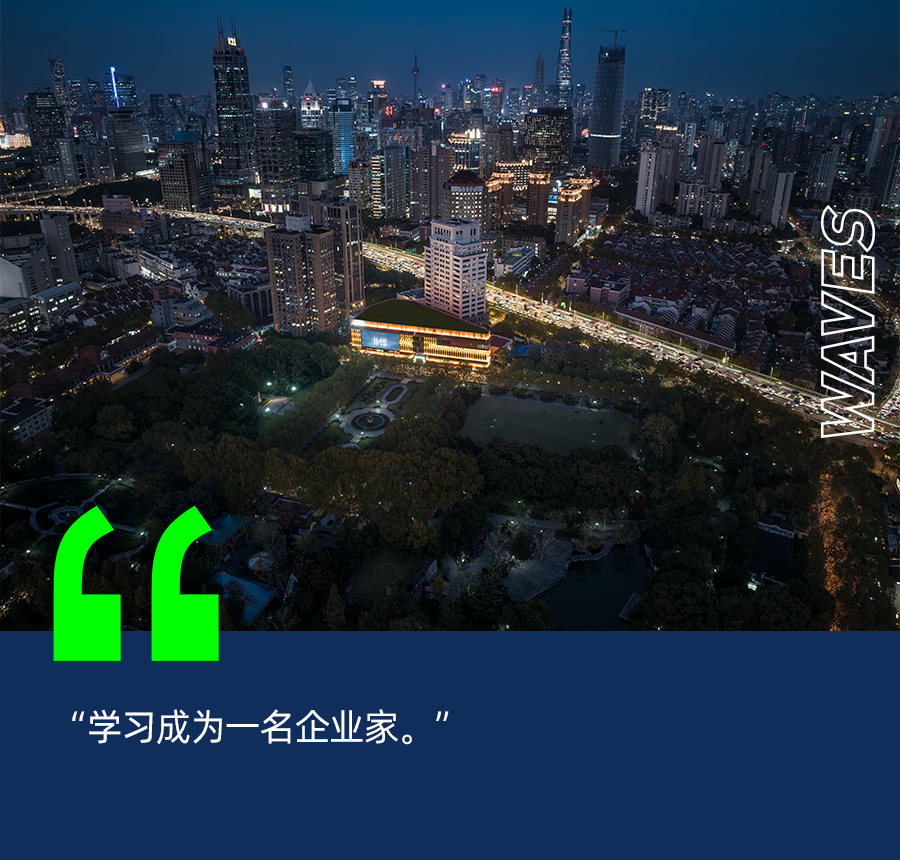
"Learn to become a (young) entrepreneur."
By Muxin Xu
Edited by Jing Liu

The first question most people ask Guan Shanxing after meeting him is: "How did you manage to get out of the investment industry in time? When did you see all this coming?"
In 2021, as employee number 9 at ZhenFund, head of its South China operations, and a young investor born in 1993, Guan decided to leave investing behind and become co-founder of INS New Paradise. It seemed like a good year to be in investing: Kuaishou went public with a market cap exceeding HK$1.2 trillion; fundraising totals were up 30% from previous years; and with the US dollar "flood," the global investment and financing market was booming. But in hindsight, 2021 may have been the last hurrah.
The investment industry was sinking, and Guan himself struggles to explain how he managed to "jump ship before it went under." There was an element of coincidence: in 2015, when Guan joined ZhenFund, Overwatch was the hottest game around, so Guan, Ying Shuling (founder of ZhenFund portfolio company Hero Entertainment), and Wu Dan (who later became CEO) would often play together. Then one day Ying suddenly came to him with a project, wanting Guan's advice as an investor. As they talked, Ying dropped the pretense: "You probably already figured it out — I actually want to pull you in to build this with me. An amusement park." That amusement park became INS New Paradise.
But for a generation living through uncertain times, coincidence is clearly not the whole answer.
"WAVES" is a new column by Anyong. Here, we bring you the stories and spirit of a new generation of entrepreneurs and investors. For more on them, follow WAVES New Wave 2024.

One Big Thing or a Way of Life?
When night falls, young people begin gathering at the entrance to Fuxing Park. If anyone stands there looking around, nearby taxi drivers eagerly point the way: "The place you're looking for is right inside — a building with an 'INS' sign."
INS New Paradise has been open for a full year now, with weekend foot traffic reaching 12,000 per day. The entertainment complex houses eight bars, nightclubs, and livehouses, plus restaurants and comedy clubs. Completely abandoning retail and concentrating entertainment in a single building, INS New Paradise is an anti-traditional format — so much so that when Guan was fundraising in 2021, he described himself as "the drinking version of Wenheyou." There was another reason for this comparison: Wenheyou had just completed its Series B at a valuation exceeding 10 billion RMB, and nearly every investor on the market was hunting for the next Wenheyou. Guan, having sat on the other side of that negotiating table, knew this all too well.
INS New Paradise ultimately closed a $100 million angel round. Ying Shuling's personal capital accounted for more than half, with the rest coming from a few familiar US dollar VC firms.
"But fundraising might be the only advantage I had as an investor-turned-founder" — Guan quickly ran into a wall.
Guan had planned to open a beauty salon where female customers could wash their hair and do their makeup before going out. He later realized this was a need he'd simply imagined into existence. Women don't leave the house looking disheveled, and they certainly don't wait until they reach INS to start applying makeup.
Noise was another headache. During renovation, to prevent sound from disturbing nearby residential buildings, the INS team brought in top acoustic engineering teams from Tongji and Tsinghua. They didn't anticipate that while the noise stayed inside the building, the drunk people making it would walk right out.
For the noise from people waiting for rides at the entrance, a straightforward "No Loud Noise" sign felt too harsh. Instead, INS New Paradise put up a sign reading "Grandma and Grandpa are asleep, everyone please keep it down," with a background image of an old man wearing headphones and dancing at a silent disco — an AI-generated poster.
For those who walked out, Guan had no solution but to pay out of pocket to install soundproof curtains for surrounding residents.
Force majeure was the harder problem to solve. INS New Paradise's grand opening came on June 16, 2023 — a year behind schedule, mainly because construction crews couldn't work during the pandemic. During the long wait, half the INS team left, and Guan had to divert energy toward keeping the remaining team stable.
"This is a traditional offline industry. Too many people still focus on immediate interests," Guan said.
Investing requires abstract thinking — distilling many different dimensions into patterns. But entrepreneurship confronts you with concrete problems like "drunk people wandering outside."
Nightclubs mainly target Gen Z, digital natives, yet Guan was surprised to find how "un-internet" this industry is. Today you can easily book a restaurant table through an app, but if you want to reserve a table at a nightclub, you have to find a person to connect with. The industry's workforce profile skews toward "born around 1980, dropped out of school early to work, started as bar busboys, servers, or salespeople, and gradually became managers. They're more easily motivated by short-term gains, but we want them to be more mission- and vision-driven."
Investing has leverage — you can nimbly move bigger things with less effort. But entrepreneurship requires sinking down into the details. INS's core team is nearly 100 people, but including store sales staff, security, and cleaning crews, the total reaches nearly 700, which creates all kinds of problems.
Even as Guan was describing INS's next event — afternoon tea with 20 veteran users — he suddenly caught the flaw: what do you actually get from asking regulars about INS's shortcomings? Would someone who truly thinks INS has problems have come 50 times?
At the hardest moments, Guan thought about going back to investing. But his mind flashed back to the day he handed in his resignation, when Bob Xu asked him seriously: "Do you want to do something big, or do you want a lifestyle?"
He thought about it. The answer was still the former.

A Road Where the Finish Line Says "Win"
The right amount of looseness and casualness might be the shortcut to reaching your goal.
Growing up in a military compound, Guan carries a "Beijing bro" relaxed vibe. He jokes that he's a social terrorist, an extreme extrovert, and this ease naturally transfers to whoever he's talking with.
This may also be why Guan is suited for this endeavor. The location of INS New Paradise tells part of the story: before 2014, it was the famous Cashbox building, but young people gradually grew tired of old-school KTV as entertainment and preferred to spend their nights in dim lights and music.
In 2015, Guan had just finished an internship and had two months before starting at Oxford. He wanted to find something to do, and a classmate recommended ZhenFund. Two months later, Guan decided to write the school asking to defer for a year.
But ZhenFund was still in its early stages then. There was a joke: an entrepreneur asked a Zen master, who's the hardest person to meet at ZhenFund right now? The master wrote the character "shi" on the table. The entrepreneur suddenly understood: "Teacher Xu." The master shook his head: no, analyst. At this point, ZhenFund had 4 partners, 3 MDs, and exactly one analyst — Guan Shanxing.
Later, ZhenFund grew rapidly, building its glamorous portfolio network. A good platform lets you ride the beta and meet senior figures, but sometimes it also gives you a false sense of reality. "What makes me worthy of talking to these people? I haven't succeeded or even failed at starting a company — why should I be giving them advice?" Guan said, quoting a line from House of Cards: beware of approaching power and mistaking yourself for power itself.
In the era when US dollar VCs dominated, investing was often compared to a poker game, and every poker player wants to win. Guan watched a top-tier investor fly private from Beijing to Hong Kong just to negotiate down $200,000; or to secure a $10 million allocation, create a private group chat and sign a "peace treaty."
Guan felt that while he too wanted to win, he differed from this extreme competitiveness. What he pursued was more a road where the finish line says "win."
"My Moment bio says 'learning to become a (young) entrepreneur.' I want to learn things. If I can make some money along the way, even better. And in an ideal plan, this could become stable enough that once INS reaches sufficient scale, I can look for the next thing to win at," Guan said. His plan is for INS to open locations in all of China's first-tier cities and tourist destination cities, and even expand overseas to some degree — Singapore, Bangkok, Bali — eventually reaching 15 to 20 locations. Their next stop is Chengdu.
Though he's moved further from investing, changes in that industry still affect him. For example, in seeking a new round of funding, Guan found that potential investors interested in INS are almost entirely absent of institutional investors, and more strategic investors — internet traffic platforms, new consumer brands with strong cash flow, and companies with upstream or downstream relationships to INS.
The AI wave sometimes attracts him too, but Guan believes "if it's truly an internet-level opportunity, its window won't be just five years, or even ten. I can wait until I'm more ready to jump in."
Image source: Provided by interviewee