Where Is China's Supply Chain Headed? | An Yong's World View
Going global means growing bones and tissue you never had before.

"Going global means growing bones and tissues you never had before." By Jiaxiang Shi
Edited by Zhiyan Chen

Supply chains have never mattered more than they do today.
In a month of seismic shifts around going global and tariffs, we've seen US Customs roll out a new "origin verification system" to crack down on transshipment through countries like Vietnam and Mexico. Importing companies are now required to provide three-tier supply chain traceability documents to prove where goods actually come from.
Xia Chunhui, partner at Fangda Partners, told Waves that among the large manufacturing clients he serves, most are accelerating their existing globalization plans. Even after the US-China Geneva meeting and the 90-day reprieve, production diversification and localization remain central to most companies' future strategy.
In short, for businesses still exporting to the US, under non-preferential rules of origin, paying close attention to where products undergo substantial transformation and strategically planning country of origin is how you maneuver supply chains and shield yourself from America's volatile tariff policy — and this may determine whether a company's global expansion succeeds or fails.
Among Chinese academics, Lin Xueping is a rare scholar with published works on both supply chains and globalization. A visiting researcher at Shanghai Jiao Tong University's China Institute for Quality Development, he has spent over two decades observing and documenting global supply chains.
In his 2023 book Supply Chain Offense and Defense and 2025's The Great Going Global, Lin offers many memorable formulations about China's supply chain: "Supply chains are like surging torrents, scattering in all directions to find the most secure vast basins"; "Free-market supply chains, under the siege of state power, have become transparent fishbowls"; "Supply chain competitiveness is not merely the combined force of all nodes in the chain, but the sum total of a nation's manufacturing capability."
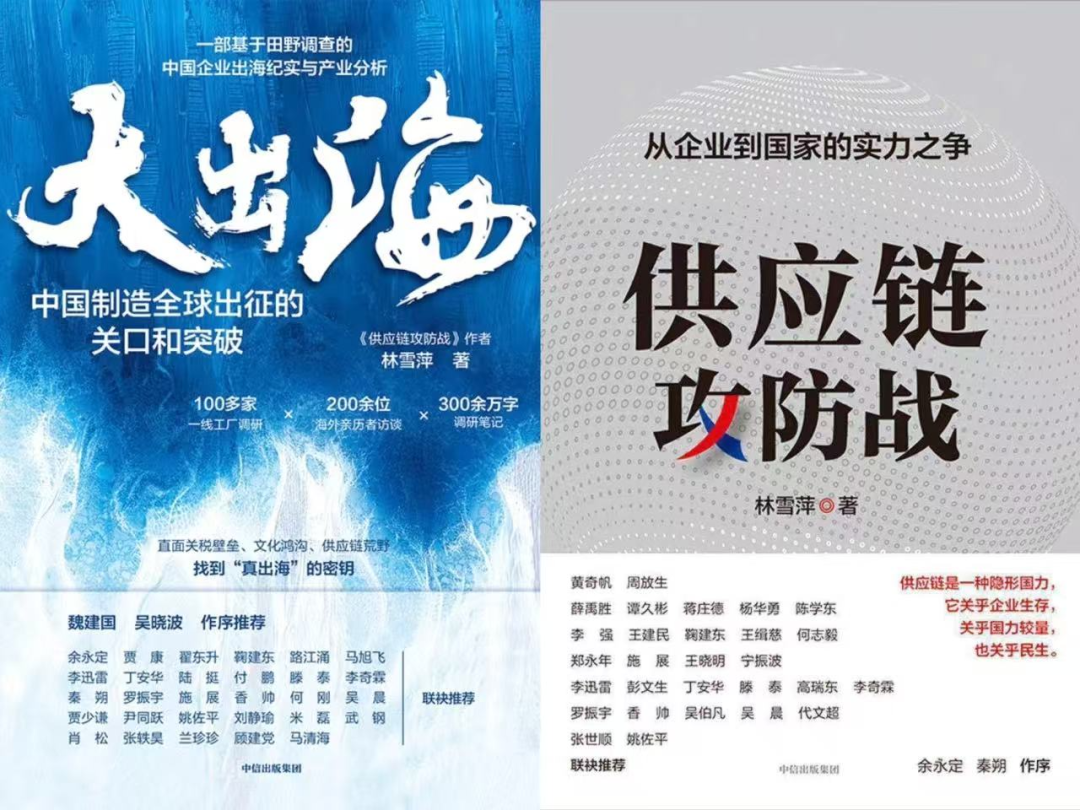
As he sees it, the competitive nature of supply chains is now being overlaid with national attributes, and "supply chain security" has replaced the traditional pursuit of cost and efficiency as the top priority for supply chain enterprises and the nations behind them.
At a moment when developed countries are pushing for industrial reshoring, industries are relocating to Southeast Asia, China's supply chains face transformation, and corporate globalization has entered a new era — what is happening to Chinese supply chains? And where are they headed?
To find answers, Waves sat down with Lin Xueping. He believes that "the Chinese government should help domestic enterprises maximize their autonomy and controllability within supply chains, stay in the chain as long as possible, and buy time for 'backup options.'"
He also outlined what various parties need to do to build a more ideal global supply chain: adapting to different national supply chain networks is basic competence for enterprises; we need to demystify "China speed" in supply chains and avoid excessive technology diffusion; we should value the healthy role of foreign investment in cultivating supply chains; and lead firms need to treat every link in the supply chain with fairness.
"This is a war of offense and defense," Lin said. "And it will be a protracted one."
The following conversation, partially drawn from Lin's two books and edited by Waves —
Part 01
Supply Chain Migration Cannot Be Stopped
Waves: Supply chain migration has become one of the most frequently discussed topics in Chinese manufacturing over the past two months. What attitude should we take toward it?
Lin Xueping: The large-scale migration of Chinese supply chains is, overall, a forced condition created by external geopolitics. Chinese companies going global is a rushed process. The century-defining tariff waves unleashed by the US have especially accelerated this.
We can't judge companies too much from a moral standpoint. There are many reasons for supply chain migration — for instance, coercion from downstream brand manufacturers: if you don't relocate, you lose the order. But think about it another way — these were Chinese companies' orders to begin with. If they don't go to Mexico, those orders might go to local Mexican or Korean firms instead. This trade-off requires a dynamic, global perspective.
For regulators, there needs to be top-level design. We need to clarify which capabilities can go abroad and how to protect companies that do.
Waves: Objectively speaking, on supply chains, is competitive tension between China and other countries unavoidable?
Lin Xueping: Given China's current production capacity, it's more like a global super-supply chain. But the problem is, other countries see supply chain security as more important than cost and efficiency.
Right now, Chinese supply chains face competition from nearshoring and friend-shoring. This will lead to parallel supply chains forming in Southeast Asia and India. In a sense, parallel supply chains will inevitably replace Chinese supply chains in certain areas. The speed at which Chinese supply chains erode is essentially a race against the growth rate of these Asian alternatives.
Waves: In your book you introduce the concept of "protecting chain and soil" — essentially calling for the preservation of supply chain ecosystems. But doesn't this contradict the reality of supply chain migration?
Lin Xueping: The core is how we view foreign investment.
For example, the shift in Foxconn-related supply chains is quite pronounced. By 2024, production capacity in India was approaching 20%, with further growth expected in 2025.
We emphasize that core technologies must be autonomous and controllable, which is absolutely correct. But this could lead to three consequences:
First, it may deprive Chinese workers of opportunities to participate in globalization right at their doorstep. Because many foreign companies' products sell globally, individuals can easily become part of the global value chain while remaining in China.
Second, it creates higher barriers when trying to enter other countries' markets. The other side can say, "I have zero presence in your market." For instance, when Chinese wind turbines enter the European market, they face fierce pushback from Siemens Gamesa and Danish Vestas — because these foreign companies' market share in China has already become negligible.
Third, it degrades the supply chain environment. When foreign companies deal with suppliers, they distribute profits reasonably so that upstream and downstream players all benefit. This awareness is something Chinese companies urgently need to improve.
The survival of foreign enterprises in China seems to be a neglected topic right now. Their room to operate has taken a massive hit. If we think of foreign companies as living organisms, they now need nutrients and treatment too. This is a crucial issue for how Chinese companies can better embed themselves in the global value chain.
Waves: But Apple supply chain migration seems unstoppable?
Lin Xueping: This is an inevitable result of geopolitical pressure squeezing supply chains, creating a global redistribution of production capacity. Apple's products have always been produced in massive volumes — 240 million iPhones a year, over 100 million AirPods. This requires centralized production at super-factories to achieve economies of scale.
So iPhones are migrating to India at scale, while headphones are concentrating in Vietnam. Of course, the future remains hard to predict. Trump is continuing to pressure Apple, maintaining high tariffs on India-made phones entering the US.
This shows that global supply chains remain in an unstable state. Apple supply chain migration is a kind of imbalance. And this imbalance may also contain new possibilities.
My core emphasis is that we need to properly recognize the contributions that foreign companies like IBM, GE Healthcare, and Apple have made to China: the upstream feedback they've generated, the managers and workers they've trained, and the rich, diverse supply chains they've built — all represent enormous wealth. As a manufacturing powerhouse, we will increasingly come to appreciate this.
Waves: There was previously a widespread view that due to capacity constraints and other factors, Southeast Asia and Mexico cannot replace Chinese supply chains. What do you think of this?
Lin Xueping: This comparison isn't very meaningful. Take Vietnam — its GDP is about the same as Guangxi's, with double the population. Don't see it as a giant; it can't become a rival on China's scale. But the key question is: to what extent can Vietnam erode China's capabilities?
At the supply chain level, the "corrosion" of China's position by different countries is something that requires vigilance and defense. At Foxconn's factory in Chennai, India, female workers complete phone assembly wiring at speeds no slower than workers in Shenzhen, Dongguan, or Kunshan. As these factories' capacity grows, it reduces domestic capacity and job opportunities.
Multinationals may not withdraw from China on a large scale, but dispersing production bases has already become a key strategy.
Yet there's another important fact: even when shifting overseas, most of the capacity is still being taken on by Chinese companies themselves. Shenzhou International, the world's largest knitwear OEM based in Ningbo, Zhejiang, is a major supplier to Nike, Adidas, Uniqlo, and Puma, with 2022 revenue of nearly 27.8 billion yuan. It established factories in Cambodia in 2005, began Southeast Asia expansion, invested in Vietnam in 2014, and gradually set up fabric mills and garment factories.
The Nike hoodie in shopping malls changes from "Made in China" to "Made in Vietnam," but most of these products are still manufactured by Shenzhou International, with much of the fabric and accessories coming from China.
In many fields, it's like a thrown boomerang — it spins around and returns to the original manufacturer, only the geographic attribution has changed.
Waves: In your book you mention that the existence of supply chains, in a sense, also limits how aggressively countries can launch unilateral trade conflicts. Today's supply chains are far more tightly intertwined than before, so why is the world moving toward de-globalization?
Lin Xueping: Supply chains bind relationships between companies in different countries in a relatively invisible but tightly wound way, with economic interests interlocked. If an American company is one node in the supply chain, it may depend on its downstream Chinese company to ultimately sell the product.
Even though chips are a key battleground in US restrictions on China, in 2024 Intel's chip sales in China still ranked first by market share — higher than in the US itself. This means when the US imposes trade tariffs on Chinese-made computers, it could "harm" Intel.
This is the protective effect of supply chain interconnection.
As for what looks like "de-globalization" now, that's actually a China-centric perspective. If you "stand on the moon and look at Earth," supply chains are actually migrating, massive new factories are emerging, and we're seeing characteristics of "accelerated globalization in local pockets." The connection nodes of supply chains have simply relocated to new geographic spaces, while the interweaving remains as before.
The US now disregards economic rationality and efficiency, forcibly dismantling existing supply chain divisions, attempting to use tariffs to reduce trade deficits and bring manufacturing back. Setting aside whether this approach can work, global supply chains are in this painful period of "distortion." Global efficiency is being sacrificed in pursuit of a broad "supply chain security."
Part 02
The Truly Important Connection in Supply Chains Is Knowledge Flow
Waves: Before this year's The Great Going Global, you published Supply Chain Offense and Defense in 2023. For US-China trade disputes, why did you choose to approach them through the lens of supply chains?
Lin Xueping: I started writing Supply Chain Offense and Defense because of the 2018 ZTE incident — at the time people still thought it was part of trade friction. Then came the 2019 Huawei incident, and people realized the US was sniping at China's high-tech industries point by point.
"Big but not strong" was a common description of Chinese manufacturing. It sounded like something that could be knocked down with one blow. But the impact of the US-China trade war on China didn't turn out to be the quick victory the US envisioned.
China did get stuck in certain areas, but also showed resilience in facing massive external shocks. So I wanted to find out: what exactly is the vitality of Chinese manufacturing?
The supply chain perspective is the best way to observe this question.
Take new energy vehicles — it's not just about the cars themselves, but how they transform the upstream supply chain landscape. Previously, air suspension was only available in Audis priced above 500,000–600,000 yuan, with patents concentrated in the hands of a few German suppliers like ZF — Chinese suppliers never had a shot. But when new energy vehicles took off, companies like Zhejiang's Konghui Technology and Henan Zhongchuang Zhiling were also able to manufacture air suspension.
It's true that certain products can't be made in China — this can be called supply chain "control power." But there's also "connection power" between enterprises: building close upstream-downstream relationships to form combined force.
In a sense, control power is composed of infinite slices of connection power. If you can solve each slice individually, the collection of connection power can also offset control power.
Waves: Supply chain is an extremely complex concept. How do you understand it today?
Lin Xueping: "Supply chain" sounds like a technical term. For example, how factories schedule raw materials, arrange shipping, even getting mixed up with logistics.
But when I emphasize "supply chain," I'm not talking about technical applications — I'm emphasizing the "supply chain perspective." That is, how to view the relationship between upstream and downstream enterprises. This relationship far exceeds simple commercial ties.
The truly important "connection" is knowledge flow.
Take the most obvious example: China's airbags used to be a chokepoint. The core of an airbag is the igniter chip and control system. Knowledge about airbags was typically held separately by the OEM, the controller manufacturer, and the chip maker — split among three parties, none could break through alone.
In fact, SAIC-GM-Wuling went looking for upstream controller companies and pushed for three-party collaboration to finally crack this problem.
From a supply chain perspective, it's one lock with three keys, each held by a different person. It represents a "combinatorial efficiency," a 1+1>2 relationship. The supply chain perspective provides a systematic way of thinking that looks upward and gains holistic understanding.
Waves: China speed once made Chinese supply chains successful. Why do you say we need to forget China speed today?
Lin Xueping: We sometimes think Mexico's supply chain is weak — that's a China-centric perspective. Locally, it's actually a stable equilibrium. If you speed things up, new problems emerge.
Don't sweep the world with China's speed; release capacity at global average speed in an orderly way. This will be more beneficial for China as a whole.
Waves: So what is the core problem with Chinese supply chains right now?
Lin Xueping: Domestically, we're still in a race to the bottom. While low cost is a wonderful thing, not everyone should head in that direction. Going global offers a new alternative — not everyone needs to stay domestic and compete in the same arena; some companies can proactively seek new opportunities overseas.
You don't go global because there's profit margin; you find new profit margins after going global.
Additionally, achieving upstream-downstream integrated innovation is very meaningful: innovation-driven development isn't the affair of a single enterprise — it's about using the supply chain to bind everyone together more effectively.
Part 03
M&A Is an Effective Path to Globalization for Chinese Companies
Waves: You've said that Chinese supply chain companies going global largely lack protection from lead firms. Can you elaborate on your observations?
Lin Xueping: We still have too few international brands. Haier may already perform well in Vietnam, but it's hard for it to provide enough protection for upstream Chinese enterprises. Korean companies invest enormously locally — Samsung has put in $22 billion, LG Energy Solution $10 billion. So when there's insufficient power, Samsung's industrial park often maintains electricity while the Chinese park next door gets cut first.
Moreover, our lead firms calculate upstream suppliers' costs too precisely domestically, leaving pitiful profits and little room for development.
If you try this approach overseas, it won't work. Lead firms overseas must treat their supply chains well, because in unfamiliar territory, you need to huddle together for warmth. This "huddle" is about profit distribution, where the lead firm has enormous dominance.
Waves: How do you view some companies achieving globalization through M&A?
Lin Xueping: For brands, you can't directly copy Chinese playbooks, and rebuilding markets and channels is difficult. So overall, M&A is an efficient path to globalization.
The core of M&A isn't the transaction itself — it's the integration that follows, meaning how you digest what you've acquired.
Take Shanggong Shenbei sewing machines — as early as 2004, it acquired the German DA brand to enter Germany and the global automotive industry, becoming a key player in industrial sewing machines. Today in the German automotive world, no one thinks about what country DA belongs to. The most successful way for a Chinese company to acquire is to quietly blend into the country.
Waves: Won't foreign acquisitions face opposition from local residents or governments?
Lin Xueping: Difficulties are short-term. In 2018, Hisense acquired Gorenje, a Slovenian home appliance manufacturer. By law, Gorenje could only reduce staff by a few dozen people per month, but Hisense determined it needed to cut at least 2,000. Remember, the town where Gorenje is located has only about 30,000 people — nearly 5,000 worked there, some for generations.
Hisense headquarters sent multiple leaders for layered communication with local government and relevant institutions, presenting its "slimming plan" and using "soft landing" methods including early retirement, assistance finding second careers, and dedicated support funds. Over roughly two years, it achieved the reduction target.
What truly moved the local government was that while optimizing structure and cutting staff, Hisense also strengthened certain departments.
Later, when Slovenia experienced a once-in-a-century flood, Hisense was among the earliest to provide aid. The Slovenian prime minister later said he never felt Hisense was a foreign brand.
Waves: Against the backdrop of the tariff war, what mindset should entrepreneurs have toward going global and supply chain migration?
Lin Xueping: Trump's century-defining tariffs and the ninety-day negotiation period have created a "tariff fog."
But entrepreneurs' choices now are about long-cycle strategy for the next 5 to 10 years — they can't be distracted by various news points.
Going global is also a supply chain reshuffling and restructuring, and this essentially determines who will be in the new value chain system. Going global never distinguishes between large and small enterprises — small enterprises have opportunities too. A second-tier domestic company may go global before a first-tier one and achieve remarkable new opportunities overseas. Maybe stretch forward a bit, and a small carp becomes a dragon in two years.
In the coming 15 years of transnationalization, adapting to different countries will be basic competence. Some companies may find local workers lazy. But existence has its rationality. This is also the price of becoming a multinational corporation — like acne appearing during puberty. It brings pain, but it's not fatal.
Facing great transformation, for a company to grow bones and tissues it never had before, it must develop capabilities it never previously mastered.
References
[1] Lin Xueping, 2023, CITIC Press Group: Supply Chain Offense and Defense
[2] Lin Xueping, 2025, CITIC Press Group: The Great Going Global
Image sources | IC photo

Recommended Reading

Where Money Flows, People Rise and Fall