Will the World Get Better? An Interview on the Inner World of Entrepreneurs
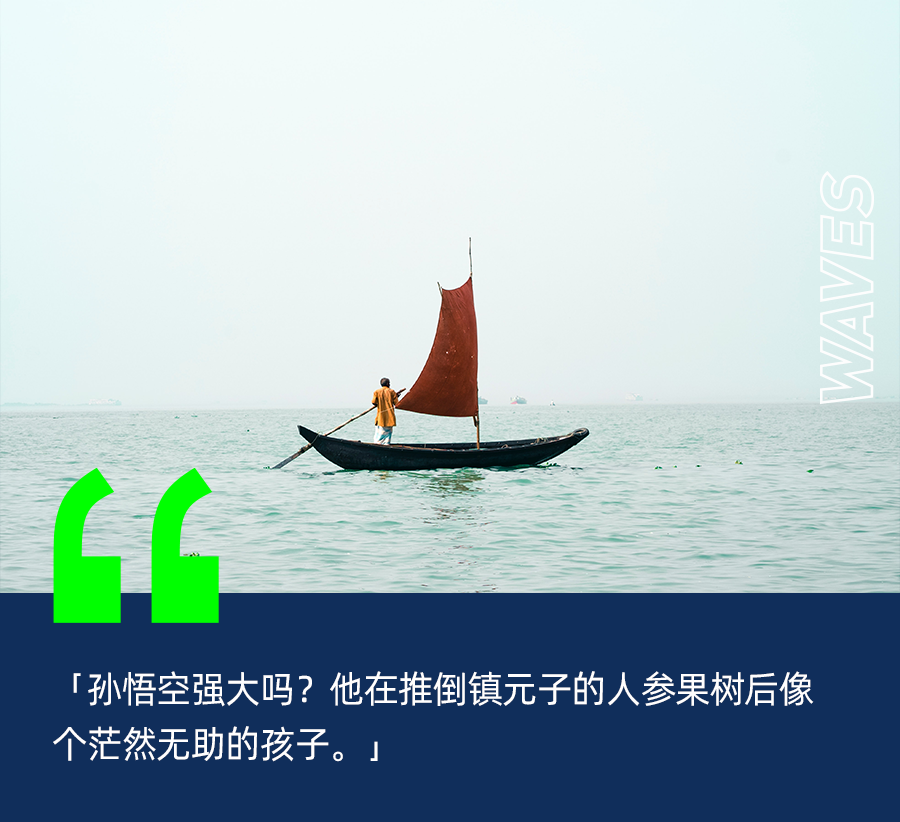
"Is the Monkey King powerful? After knocking over Zhenyuanzi's ginseng fruit tree, he was like a lost, helpless child."
By Lili Yu
Edited by Jing Liu

Someone once compared successful entrepreneurship to "riding a lion." While the crowd gasps at the spectacle, the person on the lion's back is quietly panicking: How did I get here? And how do I avoid getting eaten?
Yet these are people who are reluctant to cry out for help, more inclined to conceal their predicament. Because by conventional standards, they are the strong ones.
This is precisely why entrepreneurs have always been a high-risk group for psychological crises. A UC Berkeley survey on lifetime prevalence of mental illness found that entrepreneurs experience depression, bipolar disorder, addiction, and ADHD at rates 1.8, 2.5, 1.4, and 6.5 times higher than the general population, respectively.
When market downturns become a prolonged theme, when demographic dividends vanish, pandemics drag on, and risks like war compound, failure will arrive at entrepreneurs' doorsteps on a much larger scale. This is already happening, and hardly difficult to foresee. In the view of psychotherapist Cui Qinglong, when entrepreneurs encounter setbacks, vulnerability, even helplessness, these emotions are not only not shameful or dangerous — they are "precious." "If you understand them well, they can also become a source of your passion and vitality."
Cui Qinglong is a curious figure who has recently emerged in psychology circles. As an independently practicing psychotherapist, he began posting irregular reflections from his work on Weibo last year, written with precision and care. Intended merely as private memos, he never expected his most frequent topics — burnout recovery, embracing negative emotions, and optimizing interpersonal relationships — to trigger a tidal wave of resonance. One media professional included him in their best outputs of 2021; some readers joked they wanted to "carve Cui Qinglong's words into their DNA and memorize them verbatim."
In the two areas that have drawn the most attention — "burnout" and "relationships" — Cui has identified two common misconceptions:
First, too many people pursuing vitality emphasize positive emotions while suppressing negative ones. "Not responding to negative emotions with kindness, not embracing the shadow in one's personality — this only fills your psychological background with processes that cannot be closed, depleting you more and more."
Second, many people's experiential understanding of relationships stops at the "superficial" without becoming "mentalized." This means "many people rarely understand another person from the inside, only looking at outcomes without recognizing that seeds were planted long ago, signs appeared early."
What's interesting is that these two "diagnoses" aimed at everyday life for the general public apply equally to the venture capital and entrepreneurship crowd — people who must confront heavy workloads and complex relationships, who especially crave abundant vitality and frictionless human connection.
An Yong Waves recently spoke with Cui Qinglong about how people locked in commercial battles should embrace their negative emotions, avoid narcissistic conflicts in relationships, and where the ultimate meaning of entrepreneurship comes from.
This may also partly answer some more universal questions in current public discourse: Why does this era produce so many narcissistic personalities? And why can human sorrows and joys not connect?
Last November, we launched the "X·36 Under 36" nomination program, aimed at discovering China's new generation of entrepreneurs earlier and more broadly. To date, we have received applications from over 900 entrepreneurs. The application period is nearing its close, and initial screening has already begun. We once again thank you for your trust.
This article is the 11th expert interview in the "X·36 Under 36" series, and also a special feature.
The conversation follows:

Accepting Failure
A person's transformation often comes from something inside them collapsing, forcing them to face life with a new self.
An Yong: When markets enter a downturn cycle, what psychological adjustments do most people, including entrepreneurs, need to make first?
Cui Qinglong: First, understand this world. For many years we lived in a stable era. In up cycles, opportunities were everywhere, and people's expectations of the world and the future were very positive. Most people haven't experienced downturns, can't empathize with them, don't know that the world actually has another mode of change.
When a downturn arrives, the first mental adjustment is to recognize that this is an inescapable pattern. This is how the world operates. People too — birth, aging, sickness, death, full of impermanence.
An Yong: Entrepreneurs are seen as people who step outside their comfort zones, willingly taking on high-stakes, high-pressure endeavors. Especially at startups, failure rates are extremely high. This is the底色 of their fate, yet why is accepting failure still so difficult for most people?
Cui Qinglong: Defeat negates a person's narcissism. Broadly speaking, narcissism represents one's sense of self-worth based on competent experience. People need to experience themselves as "someone capable of doing certain things well." If you give your all and fail, the negative feedback is completely thorough.
Choosing to start a business in the current environment is a display of courage and boldness. But when someone pours everything into something and fails, they may doubt themselves — turns out I can't do this. Some may feel guilt — sorry to family, for instance. This is especially severe for those who take on debt to start a business, or first-time founders.
An Yong: Business leaders usually prefer to project strength rather than expose vulnerability. When they encounter setbacks, how should they process them?
Cui Qinglong: Influenced by China's culture of endurance, there's excessive praise for emotional restraint. Many people's understanding of strength refers to those who remain unflappable under any challenge. In reality, most people experience inner turbulence when facing setbacks, and this turbulence needs channels for resolution. Without such outlets, it's easy for problems to accumulate into psychological issues.
Beyond individual emotional regulation methods, what's more important is establishing reliable support networks at the interpersonal level — giving your emotions somewhere to go in sufficiently safe relationships, rather than suppressing them yourself.
An Yong: Some business leaders seek spiritual support, such as meditation or Zen practice.
Cui Qinglong: This is also useful. People need ways to attain psychological tranquility. The philosophy and practice of Zen can balance one's attitude toward fame and gain, allowing a person to approach their most authentic self internally. Many people at the top of their fields actually receive the most limited emotional support. They often receive the most respect and admiration, yet lack the care and attention that only equal relationships can provide.
An Yong: Do truly strong people exist in this world?
Cui Qinglong: It depends how we define strength. Whether a person is strong or not isn't about whether they experience pain, but whether they have the capacity to regulate pain. From a psychological perspective, anyone can experience emotional vulnerability at some moment; some people also use denial of vulnerability to prove their strength.
Is Sun Wukong strong? After knocking over the Ginseng Fruit Tree at Zhenyuanzi's place, he was like a lost, helpless child, calling for his master Puti to back him up. In fact, deep down everyone has a childlike part that wants to share, wants to be understood, wants to appropriately depend on others at the right moments, and deploy their strength in a supportive environment.
An Yong: From a psychological perspective, do down cycles and the collapse of one's psychological edifice hold unique value for a person?
Cui Qinglong: Sometimes real transformation comes precisely from something inside collapsing, from no longer being able to rely on what's comfortable, forcing the reconstruction of new order. For example, after some people fail in entrepreneurship, relationships, or work — some with no retreat at all, no choice — they must rally, they must survive.
Like Sucaharcan in King of Beggars, his comeback from adversity came precisely because he lost everything that gave him security and protection.
Some may find the blow too great, never find the force to recover, and never get back up. But many people — myself included — have had similar experiences: in such moments, finding a new state, a phoenix rebirth from the ashes. This may be what Taleb calls antifragility.
An Yong: But people in low states more easily fall into a trap: self-judgment or self-PUA.
Cui Qinglong: People often struggle with themselves, leading to internal depletion. Whether it's inner conflict or harsh self-evaluation, people get caught up in their own emotions or beliefs, with judgment attached. This is why some psychological schools emphasize awareness, also called metacognitive monitoring — maintaining distance from our own experience while still observing it. For example, when immersed in rage, you can mentally describe: "I notice that I am feeling angry."
An Yong: "I notice that I am feeling angry," rather than "I am angry."
Cui Qinglong: The difference is that it fully employs our observing self: one "I" watches the feeling of "I am angry." You have already created distance from your state; in this moment, there's less engulfment.
Because emotion doesn't represent you. Emotion is like a leaf in a river — once it flows past, it's gone, and you can be the person standing on the bank. This is a practiceable way of relating to your emotions. Similar concepts exist in Buddhist mindfulness practice.
An Yong: So often we actually overlook the positive meaning of negative emotions?
Cui Qinglong: Negative emotion is actually a signal. Like when you run too hard, your body aches and breathing becomes difficult — it may be reminding you to adjust your pace and control your exertion. When a person has negative emotions, it definitely means something is wrong somewhere that needs your attention.
Negative emotions mean there are things in our inner world that need to be recognized, need to be cared for, need us to stop and see what's happening.
An Yong: What happens if negative emotions aren't processed?
Cui Qinglong: They evolve into something else, called secondary emotions. For example, someone who inexplicably always feels anxious and angry, always impatient with others. Modern burnout and lying flat are both results of direct emotional needs failing to receive response. When this happens, it means something is overloaded, over capacity. If unaddressed, people become increasingly listless, uninterested in the future or relationships, feeling that marriage and children are meaningless, and so on.
An Yong: So identifying the "culprit" behind emotions is important.
Cui Qinglong: Of course. I often encounter people in therapy who appear depressed and withdrawn, but at some point in our conversation, they tap into deeply buried anger — toward a partner, or toward their parents. In that moment, they find the root of their emotions. For some, once they've expressed that anger, the depression simply lifts. In psychology, when primary emotions can't be expressed, secondary emotions persist indefinitely — just like Xianglin's Wife.

The Neurotic Personality of Our Times
Narcissistic personalities are highly adapted to the age of competition. They are fiercely self-interested, self-absorbed, and display a Darwinian capacity for survival in radical isolation.
"Dark Flow": In real-world entrepreneurship or company management, beyond obvious conflicts of interest, there's often a more fundamental clash: narcissistic conflict, or the battle of egos. Why do people invest 100% emotional intensity into things with no tangible stake?
Cui Qinglong: We often fail to recognize that working relationships are still relationships — they require cultivation, optimization, and shaping. Managers need to treat the work environment and interpersonal atmosphere as genuinely important.
This isn't simply about organizing team-building activities or entertainment. It's about whether people can actually form real connections, whether the environment allows and protects their authentic selves, whether it can cohere into a collective with belonging and mutual support.
"Dark Flow": So some conflicts arise precisely because working relationships haven't been optimized?
Cui Qinglong: If everyone exists in an atomized state — "I just need to do my own job well, I don't care about you" — people will unconsciously treat each other as enemies, rivals, competitors, and respond accordingly as if in a bad relationship.
"Dark Flow": Some business leaders with frequent narcissistic rage are often seen as having forceful presence.
Cui Qinglong: This reminds me of Steve Jobs. I read his biography — he would fly into rage over colleagues' disagreements, insulting and demeaning them. He believed his judgment, understanding, and aesthetic sense surpassed most people's. Others were merely extensions of his will, there only to respond. He was genuinely brilliant, genuinely exceptional, but those who worked with him suffered terribly.
"Dark Flow": Don't such people sometimes create efficiency miracles in business?
Cui Qinglong: Yes. If they're sufficiently visionary, they can indeed drive rapid company growth. But those around them suffer. Others' submission may not stem from genuine agreement, but from helpless capitulation. A healthy company shouldn't rely on a single superhuman — the risk is too great. It should possess structural resilience.
Companies like Google and 3M place high value on employees' suggestions and ideas. This way, everyone feels they belong in that environment, and willingly contribute value from the heart.
"Dark Flow": The term PUA now frequently appears in company management culture. Why does emotionally manipulative culture exist within corporate systems?
Cui Qinglong: Confucian culture contains an identification with the hierarchy of ruler-subject, father-son. Our cultural DNA includes a natural reverence for authority. Combined with the fact that company leaders materially determine employees' performance, evaluations, and assessments, employees will suppress certain things after multiple considerations — and this suppression in turn tends to reinforce leaders' self-identification with their own authority.
"Dark Flow": Are people with desires more susceptible to PUA?
Cui Qinglong: If you simply hope to maintain good relations with your leader, that's fine. But if you hope to gain benefits from them, and reveal such intentions, when the leader recognizes this, they may implicitly fold their own demands into this exchange, gradually facilitating the formation of PUA.
"Dark Flow": How can someone escape such potential manipulation?
Cui Qinglong: It's like how people who are good at slacking off sometimes end up with fewer heavy or exhausting tasks assigned to them (laughs). Of course I'm not encouraging slacking off — I'm saying that when a leader PUA's a subordinate, the subordinate can signal refusal or feed back certain postures. There's a saying in psychology: firmness without hostility. You need to demonstrate your refusal posture and boundaries in emotional attitude, without expressing it as hostility. When you make excessive demands of me, I'll straightforwardly inform you that I'm not comfortable doing so, but I'll complete what genuinely needs my attention even better.
"Dark Flow": What kind of temperament makes commercial success more likely?
Cui Qinglong: In a sense, sufficiently narcissistic people often stand out. But this narcissism should be healthy narcissism — the kind that can still rally collective strength, that can maximize the integration and deployment of resources around them. Narcissistic personality is a type highly adapted to our era. Psychologist Karen Horney said every age has its characteristic personality types, reflecting a special convergence between a person's mental model and the era's environment. Narcissistic personalities are highly adapted to the age of competition. They are fiercely self-interested, self-absorbed, cold, with diminished empathy, displaying a Darwinian capacity for survival in radical isolation.
"Dark Flow": What negative effects come from the proliferation of narcissistic personalities?
Cui Qinglong: People become increasingly lonely, increasingly unable to trust each other. Even among similar people, ideological opposition becomes more likely. People become more self-protective, more hostile and aggressive, more caught in involution and competition. An era of alienation produces refined egoists. I'm self-sufficient, I don't need emotions. Individually they appear strong, but fundamentally they're more fragile. To use psychologists' metaphor: if human relationships are oxygen, people are now generally in a state of psychological hypoxia.
"Dark Flow": In an era where narcissistic personalities are more likely to win out, are those who actively lie flat or give up a kind of counterbalance?
Cui Qinglong: If society can only provide quality lives for a small minority, while others have no pathway to achieve this, they'll simply give up. After giving up, they gain another benefit: thoroughly discarding external standards, living entirely according to their own wishes, no longer striving, no longer planning, even no longer working. This is actually a disguised form of self-liberation — a way of peace with self-mockery, with satisfaction, with helplessness.
"Dark Flow": You've compared involution to a war of all against all. As more people lose, can reconstructing success standards dissolve this?
Cui Qinglong: If success is narrowly defined as power, money, fame — in an era of stagnant growth, there will inevitably be more and more losers. I think in a place where everyone crowds forward, you can actually step back to find your position. Stepping back is itself a kind of wisdom. For instance, some young people now choose smaller cities. Rather than being a standard-definition middle-class person in a first- or second-tier city, I believe there's another kind of success that belongs to personal definition. If a person's lifestyle can match their internal values and beliefs, if they can obtain wealth through what they're skilled at or enjoy, that's absolutely high-quality success. Most people are actually quite blind, pursuing standards shaped by others that may not correspond to their inner selves at all.

The Loss of Empathy
Understanding between people is not given — it requires effort.
"Dark Flow": Whether war, pandemic, or other sudden social events, everything seems to be tearing apart public discourse. Even in the venture capital community, "who am I, who are you" has suddenly become a sensitive point.
Cui Qinglong: This precisely reflects that there are no real relationships between people. Online tribalism means we don't need any relationship, any emotional medium, to rapidly unite under a position. We urgently need some form of identification, yet simultaneously we can't offer relationships, can't offer emotions — so we use this quick, crude method to patch together a group. Those who don't align with us are hostile. We distinguish good relationships from bad in the most superficial way.
"Dark Flow": The phrase "human joys and sorrows do not connect" is now being repeatedly invoked. What is changing behind this?
Cui Qinglong: For the individual, we simply cannot imagine another person's inner pain unless we encounter something similar ourselves. Take aviation disaster victims — their families must be in a state of utter despair, utter anguish. But for most people, this passes in two days, a week. This extends to many things.
"Dark Flow": On one hand, modern tools make information access more convenient; on the other, we seem to have fallen into another kind of isolation.
Cui Qinglong: Yes, our era is becoming increasingly atomized, isolated. Many people immediately seal themselves off from the outside world after work. They may interact with some people online, but these interactions are very shallow. Many people seal their inner selves extremely tightly. This is a bidirectional paradox. On one hand, people are increasingly unwilling to understand others; on the other, people are increasingly unwilling to share what's inside themselves — intensifying the emotional barrier between people.
"Dark Flow": Does the popularity of social software indicate people's genuine desire for connection?
Cui Qinglong: But various social apps are now creating fast-food relationships, many aimed at physiological needs, without curiosity or desire to understand a person's inner world. In reality, many people genuinely need emotional companionship, but the cost of seeking emotions is too high, so it becomes this immediate, functional satisfaction instead.
"Dark Flow": You've mentioned a book called The World of Experience. The author spent his life seeking the experience of being understood by others. What was his ultimate finding?
Cui Qinglong: His research finding was that understanding between people is not given — it requires effort. He had a close friend with whom he spent over 40 years, both lifelong explorers of the mysteries of human consciousness. They had resonant insights in academia, and could reflect each other emotionally. This relationship came from decades of continuously and sincerely sharing their inner selves and listening to each other. They had misunderstandings and conflicts too, but what never changed was their willingness to communicate. They believed that mutual understanding between people is not based on ready-made similarities, but on creating sameness within difference.
"Dark Tides": To better understand "what understanding is," you broke it down on Weibo into two types: mentalized understanding and superficial understanding. In everyday life, what's the difference between them?
Cui Qinglong: Take a couple fighting. One person suddenly says, "I want to break up." With superficial understanding, you'd take it at face value — fine, it's over. In that moment, the two people are having a superficial interaction. But with mentalized understanding, you might recall that your relationship has always been good, that nothing truly ruptured has happened. Then this moment is probably a stress response triggered by the situation — maybe they simply have no other way to express themselves. If you see this layer, you won't think they're actually saying "let's separate," but rather expressing something else. Mentalized understanding means recognizing a person's intention before their words and actions.
"Dark Tides": So the difficulty of understanding often stems from a lack of listening?
Cui Qinglong: Many people genuinely lack the experience of being listened to. In my view, many clients wouldn't need therapy if they had good interpersonal listening and companionship in their real lives. It shows that in their lives, there's no one they can talk to about what's inside them. Too often when someone says they're in a bad mood, that they feel defeated, someone immediately jumps in to say you're wrong, you should do this or that. Very few people empathize by putting themselves in the other's shoes, saying something like, "If I were you, I'd probably feel just as bad." That kind of response is rare.
"Dark Tides": What counts as meaningful listening?
Cui Qinglong: I once heard a story: a child wanted a pair of pants that cost 20 yuan. His mother didn't buy them; instead she bought him a pair for 160 yuan that he really disliked. At that moment, he desperately wanted his mother to understand what he wanted, rather than giving him what she thought was good. Good listening means being able to leave your own position to experience the other's. There's a famous saying in psychology: "Walk in the other person's shoes and feel."
"Dark Tides": These are completely different experiences.
Cui Qinglong: Completely different. This involves emotional investment and genuine attention to a person — that's what matters most.

Nothingness and Fulfillment
People are always saving themselves. Like the natural phototropism of plants, they seek hope of living even in darkness.
"Dark Tides": Back to the topic of business life. Sudden viral fame or sudden wealth is something some entrepreneurs face. But you mentioned on Weibo that going viral or getting rich is actually quite terrifying. Why do wealth and fame require psychological space to match?
Cui Qinglong: If a person hasn't gone through the process where their abilities grow alongside their wealth, where their resources grow, their network grows, their vision grows — if they haven't developed their mind in sync with their money — then they can't properly handle that wealth. A person cannot possess wealth that exceeds their psychological value. Even if they do, they'll squander it, or save it without knowing what to do with it. Because they have no concept of money at that level; the way they plan for it is still the thinking of poverty.
"Dark Tides": So many entrepreneurs, after succeeding, don't fall into the ordinary person's fantasy of financial freedom. Many instead become serial entrepreneurs.
Cui Qinglong: Many people imagine financial freedom while still financially unfree, thinking having 100 million would be amazing. But actually reaching that situation, many lack the psychological capacity to wield that freedom. It's like someone playing a game who uses a cheat to max out all attributes — the game quickly becomes boring. Because human happiness requires continuous incremental space to sustain it. Wealth only becomes truly satisfying when it's converted into the degree to which a person is needed and recognized through their own capabilities. The absolute stock value doesn't mean much.
"Dark Tides": So the thrill of entrepreneurship comes more from continuous, challenging feedback?
Cui Qinglong: A truly interesting or meaningful life must come from overcoming things every day, accepting challenges — and these challenges happen to be ones they can overcome through their own abilities. Some people who achieve financial freedom enjoy outdoor exploration and adventure because they need to use their pure physical capabilities to overcome the most basic difficulties, to enjoy that satisfaction.
"Dark Tides": From this perspective, "winning without trying" isn't a spiritual reward at all?
Cui Qinglong: Schopenhauer also said that when a person is satisfied in all respects, they fall into a state of boredom — which is itself a new form of suffering. The best life system is one where you always face new difficulties, but these are difficulties you can overcome through your own growth and effort. When you continually anchor yourself in this tension zone, you won't drift toward nothingness. A person's deepest sense of existence and meaning needs to be reflected back through their impact on the world or those around them.
"Dark Tides": Has being a psychotherapist strengthened or weakened your faith in people?
Cui Qinglong: I think it's strengthened. One psychological school I particularly like is self psychology. Unlike other schools, it views all human behavior — even symptoms and deficits — as a person's active means of saving themselves. Like a tree that keeps growing upward; even when it encounters obstacles, it will send its shoots around and continue extending in other directions. Like human life: people get sick, go astray, but all their efforts are trying as much as possible to make themselves feel better. As I once analogized: no one wants to self-destruct, unless the pleasure of self-destruction can override that most fundamental pain. Many people are simply using the only thing they know how to do, the only thing they can do, to evoke their own sense of being alive.
"Dark Tides": Life finds a way.
Cui Qinglong: People are always saving themselves. Like the natural phototropism of plants, they seek hope of living even in darkness — this is something I've seen in everyone.
Image source | Visual China
Layout | Guo Yunxiao