Year-end good news: CDH Investments has raised 5 billion yuan for logistics investments.
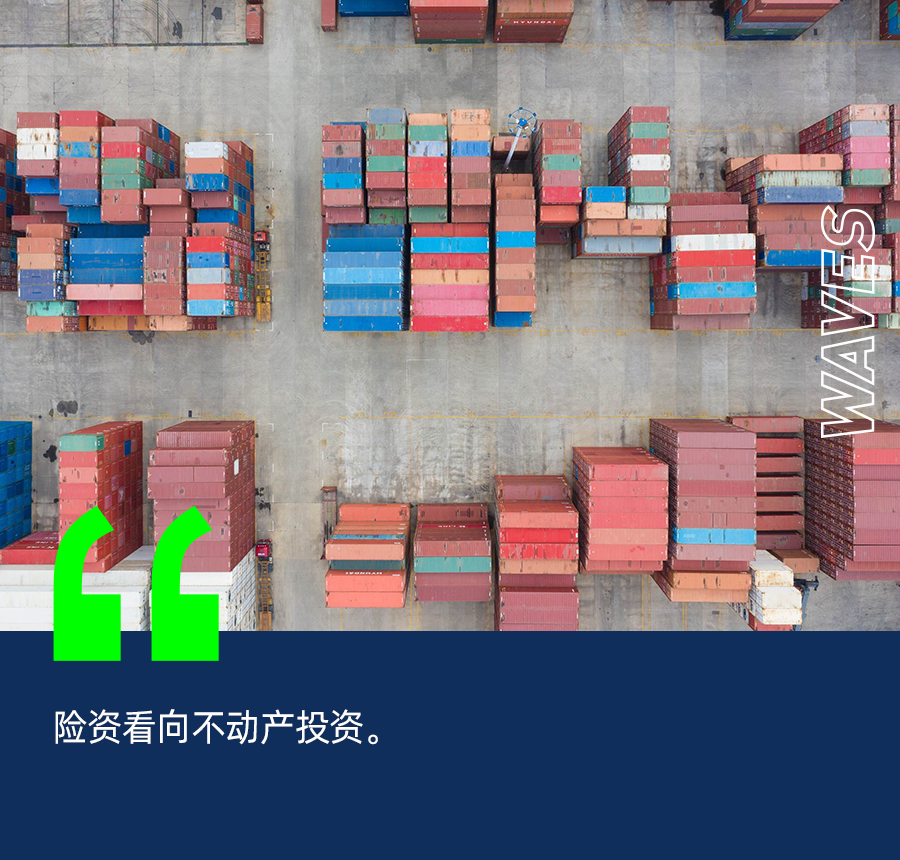
Insurance capital is turning its attention to real estate investments.
By Muxin Xu
Edited by Zhiyan Chen

CDH Investments has announced a 5 billion yuan logistics investment. The fund, raised by the firm's real estate investment management arm, is its latest logistics infrastructure fund. Its underlying assets are high-standard modern logistics parks concentrated in strategic hub locations such as the Greater Bay Area and the Yangtze River Delta, with a total investment scale of approximately 5 billion yuan.
Anyong Waves has learned that the fund is co-managed by CDH and JD Property in a Co-GP structure, with insurance capital as the primary LP base, including well-known insurers such as China Post Life Insurance and Generali China Life. In November 2022, the CSRC issued five measures to optimize and adjust equity financing for real estate enterprises, allowing qualified private equity fund managers to establish real estate private investment funds. In February 2023, the AMAC released the Pilot Filing Guidelines for Real Estate Private Investment Funds (Trial). The policy addressed at least two industry pain points: first, it permitted investment in commodity residential properties; second, it relaxed debt-to-equity ratio restrictions for hold-type properties.
Under this guidance, nearly ten institutions have reportedly obtained the first batch of pilot qualifications, including CDH Investments, Shenzhen Capital Group, Gaohao Capital, Zhonglian Qianyuan, Dingxin Great Wall, CCB (Beijing), China Merchants Bank International, and China Life Capital.
Among the succession of real estate private investment funds being established, CDH's logistics infrastructure fund can be differentiated by three characteristics: deep experience, strong track record, and global perspective.
CDH Real Estate Investment, established in 2009, is one of China's earliest real estate equity investment funds. Over 15 years, it has cumulatively managed approximately 20 real estate funds across China, the US, and Japan, with assets under management nearing 10 billion yuan.
In the more focused area of logistics warehousing, in March 2024, CDH Warehouse Logistics Fund I announced the completion of its closing. This fund was also the first established by CDH Investments after obtaining its qualification as one of the first batch of real estate private investment fund managers. Its investments are in modern high-standard warehouse parks with long-term leases from leading express delivery companies, located in multiple major logistics node cities across the country, with a total gross floor area exceeding 400,000 square meters.
Its stable income foundation rests mainly on two factors. First, because the e-commerce industry has transformed consumer habits, logistics parks — as essential supporting infrastructure — have a certain guarantee of future valuation. Second, the high-standard warehouses selected by CDH Real Estate are more fully developed in terms of site selection and construction, capable of supporting higher order volumes and turnover rates.
In the view of Mei Wang, managing partner of CDH Real Estate Investment, "Projects that combine solid market fundamentals with quality tenants possess long-term investment value. The successful fundraising of this new logistics infrastructure fund reflects the continued attention of leading insurance investors to quality warehousing and logistics projects, as well as their confidence in China's long-term economic development." The fundraising of this new fund will also continue CDH Real Estate's investment strategy in the logistics infrastructure sector of "balancing underlying quality projects with high-credit tenants."
According to Anyong Waves, CDH Real Estate is covered by a single team simultaneously managing business across major global real estate markets including China, the US, and Japan. In 2017, this team made a large-scale industrial logistics asset portfolio investment in the US, and delivered returns to investors upon exit in 2022.
How to avoid the risks of structural adjustment after years of development in the warehousing and logistics market? Sun Dan, managing director of CDH Investments, told Anyong Waves, "Insurance institutional investors are very sophisticated and professional, focusing on core investment logic. When making investment decisions, they conduct comprehensive assessments of project fundamentals, fund managers, and asset managers." Insurance capital has substantial capital and investment needs that must match liability duration, so it focuses on asset classes capable of generating long-term stable returns. Income-generating real estate requires large capital outlays and can produce stable returns over the long term. This characteristic of "mutual attraction" has long fueled insurance capital's enthusiasm for income-generating real estate investments.
According to CRIC Research Center statistics, around 2006, insurance institutions with stronger capital strength began testing the waters in real estate. Insurance capital's investment in real estate now has nearly a 20-year history. Generally speaking, European and American insurance companies allocate approximately 20% of their portfolios to real estate assets. Domestically, the industry generally considers a 10% allocation to real estate in the asset mix to be healthy, while leading domestic insurance capital currently holds only 4% to 4.5% in this category.
Beyond the above funds with pilot qualifications, some investment institutions have also begun ramping up real estate investments, with insurance capital frequently appearing among them. In December 2023, Hillhouse Capital's new infrastructure fund and its fund management platform Gaolu Group announced the completion of fundraising for an industrial logistics RMB fund, with multiple insurance institutions among its investors. In January 2024, New China Life Insurance contributed 9.999 billion yuan to subscribe to a new fund from CICC Capital, mainly targeting enterprises holding income-generating real estate project assets.
Real estate investment involves large capital commitments, long cycles, and close ties to real industry — making it a rather distinctive investment category within the primary market. What exactly is the special investment logic? Have structural opportunities already emerged? Anyong Waves spoke with Sun Dan, managing director of CDH Investments, about the changes, opportunities, and methodology.
The following is the conversation —
Anyong: A 5 billion yuan investment scale is a very large figure this year. Why has it received such substantial support from insurance capital?
Sun Dan: Our total investment scale this time is 5 billion yuan, which is truly not easy in today's market environment. Insurance capital is currently the backbone of China's real estate investment, because insurance capital pursues long-term stable returns and has the attributes of rational decision-making and patient capital. The warehousing and logistics industry that our fund invests in matches insurance capital's needs very well.
Anyong: What is the logic behind insurance capital's investment in warehousing and logistics?
Sun Dan: First, logistics is fundamentally infrastructure serving the real economy, and it receives policy support and encouragement. Second, this fund's projects are primarily located in the Greater Bay Area and Yangtze River Delta, and the tenants served are all industry-leading enterprises with a foundation of long-term stable operations, matching insurance capital's requirements.
Anyong: Then why CDH?
Sun Dan: Our real estate team was established in 2009, with business coverage across major global real estate markets including China, the US, and Japan. We have completed the investment management and exit of multiple funds in each market, and our track record has gained recognition. CDH has also continuously worked to respond to industry development initiatives, and is one of the first batch of institutions to obtain real estate private investment fund pilot qualifications. The first fund launched after obtaining pilot qualification acquired multiple high-standard warehouse parks located in multiple domestic logistics hub cities, serving industry-leading tenants, and the response was very positive. Based on these factors, the successful fundraising of this new logistics infrastructure fund will continue our stable return investment strategy in the logistics infrastructure sector of "balancing underlying quality projects with high-credit tenants."
Anyong: How does the Co-GP model with JD Property specifically operate?
Sun Dan: The basic premise for a Co-GP arrangement is that both parties share aligned understanding of the industry and consistent cooperation philosophy, with the ultimate goal being to deliver good investment returns and create ideal returns for investors. The cooperation model between CDH Real Estate and JD Property is one of transparency and mutual trust, with clear division of responsibilities, establishing market-oriented management mechanisms, and maximizing investor interests.
Anyong: You've been in real estate investment for 16 years. What are the core challenges?
Sun Dan: My feeling is that in real estate investment, first, asset pricing must match value, and costs must be well controlled. Second, capital attributes must match asset attributes, to avoid cash flow challenges that could put projects in difficulty. Equally important is that transaction arrangements must match the needs of all parties, maximizing asset value under reasonable mechanisms. Different projects have different challenges at different stages of economic development. We need to respond flexibly according to actual circumstances.
Anyong: Pricing assets is a very important step. What is CDH's methodology?
Sun Dan: CDH's real estate team has conducted different types of property investments in various forms across China, the US, and Japan. The opportunity to compare and validate markets through first-hand information is our distinctive feature and advantage. Taking stable income-generating assets as an example, on one hand we need to have as accurate a grasp as possible of project cash flows, including whether they are sustainable and whether there is room for improvement. On the other hand, we need to employ reasonable valuation logic — different types of assets and different economic cycles require different valuation logic. Referencing the performance of our logistics asset investments in the US, we can see that in a low interest rate environment, stable income-generating assets benefit in valuation. This is also one reason we are increasing allocation to stable income-generating infrastructure.
Anyong: Will insurance capital's willingness to invest in real estate change with market conditions?
Sun Dan: I believe insurance capital will continue to be an important participant in the real estate market. We see that the domestic real estate market is becoming increasingly mature and rational, which is inseparable from the active participation of institutional investors represented by insurance capital. There may be some short-term fluctuations, but in the long term overall, insurance capital still has substantial room for allocation in real estate and infrastructure.
Anyong: Previously, Forza Capital CEO Wei Fu said that "M&A is blue-collar work." If we say M&A restructuring is blue-collar work and equity investment is white-collar work, then what is real estate investment?
Sun Dan: We are both "blue-collar" and "white-collar." The characteristic of real estate investment is that each project is a complete small ecosystem — project engineering construction, tenant recruitment and operations, property management, financing arrangements, and more all need to be considered, with no blind spots. At the same time, there are physical demands. I remember one business trip last year where our team visited 8 cities in 5 days. Individual real estate investments are relatively large in scale. As real estate investment practitioners, each investment made makes us feel the weight of greater responsibility. We also hope that through continuous effort, we can deliver good returns to investors.
Image source | IC Photo
Layout | Hongyu Liu