Will AI Hardware Get Its Own iPhone? | Mono X

All unprofitable hardware innovation is, at its core, a false proposition.


The hardware industry has never lacked for grand narratives.
When we talk about AI hardware, we're all talking about the next super-terminal beyond the smartphone. But has this wave of technology actually permeated everyday life, or is it still trapped in a bubble of concepts? How many demo-level functions are currently masquerading as mass-production hopes, spawning a froth of pseudo-demand?
Recently, Monolith and D-Robotics, together with partners including FHF Compound Fertilizer Commune and Baidu AI Cloud, invited a group of seasoned hardware practitioners to an offline event in Beijing — the "D-Robotics Craft Brewery" series — to discuss the outlook and predicaments of AI hardware innovation.

We've systematically organized and anonymized the speakers' insights from the event. While we can't fully recreate the intense intellectual collisions of the live session, we hope these distilled industry observations will provide valuable reference for fellow entrepreneurs (Note: The following content is compiled from on-site discussions and does not represent Monolith's views).
Table of Contents:
-
Will embodied intelligence get its own iPhone?
-
What makes a good embodied intelligence business?
-
How should entrepreneurs work with suppliers?

1. Will Embodied Intelligence Get Its Own iPhone?
Will Drones Be the First Form Factor to Scale?
On which form of embodied intelligence will achieve commercial scale first, one particularly insightful view holds that drones (UAVs) may achieve large-scale deployment sooner than humanoid or quadruped robots.
Over the past few years, the industry has experimented with wheeled, legged, and even humanoid ground-based forms. Yet in actual deployed scenarios like industrial inspection, ground robots face enormous challenges: the environments are extremely non-standard. Navigating stairs, crossing obstacles, and adjusting viewing angles (high-low patrols) force ground robots to continuously add complex structures like robotic arms and elevating gimbals. The more complex the system, the worse the stability and the higher the cost — making it difficult to close the business loop.
By contrast, drones have a natural advantage in 3D space standardization. Once localization, perception, and obstacle avoidance are solved, the aerial environment is essentially standardized for machines.
Just as the spillover from the last wave of autonomous driving technology gave rise to the prosperity of "2D chassis" products like robot vacuums and robotic lawn mowers; the core of this wave lies in perception and understanding of 3D space. The future technology dividend will be captured by devices that migrate from planar motion to three-dimensional spatial movement. This is not only a demand from industrial scenarios, but also the core value proposition of spatial intelligence infrastructure companies.
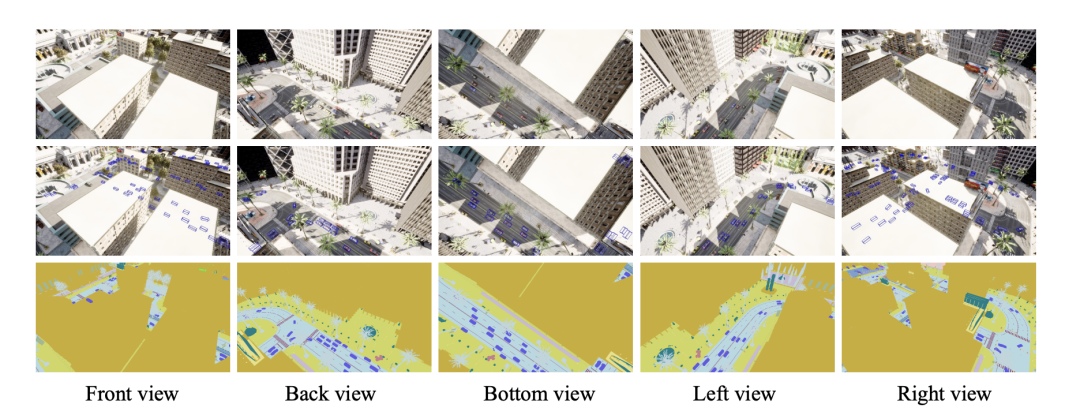
Drone 3D perception image data
What Will the iPhone of the AI Era Look Like?
Today, most practitioners are trying to find or create a super "big single product" — something with the transformative impact of the iPhone on mobile phones and the entire mobile communications market.
Looking back, the PC era gave us personal computers; the mobile internet era gave us smartphones. In the AIGC era, constrained by the extreme demands of large model Scaling Law on compute, bandwidth, and power consumption, hardware form factors are being pulled violently toward two extremes:
• One extreme goes ultralight: Smart glasses, rings, pendants, and other wearables. They strip away heavy computation tasks, retaining only perception and interaction — more portable and more seamless than phones.
• The other extreme goes ultra-heavy: Future core compute nodes may become "heavier," fixed in homes or offices as plug-in "compute centers."
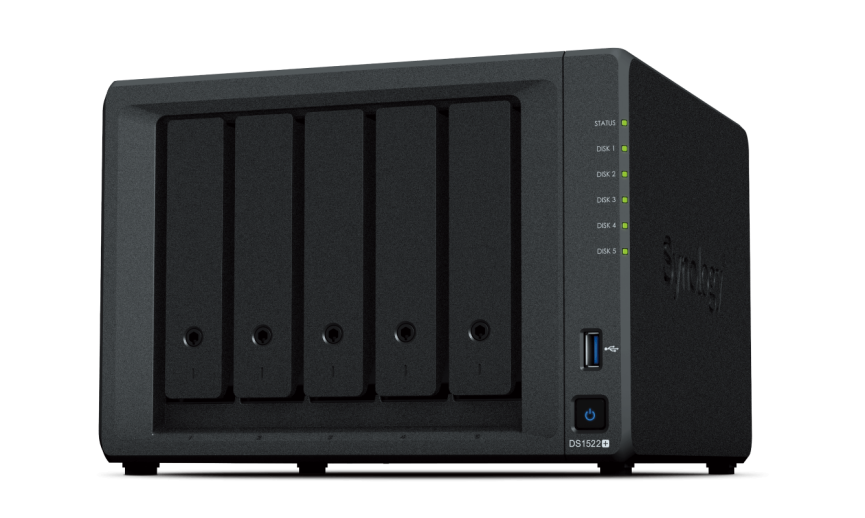
Such hardware might take forms like home NAS devices
Hardware development typically lags behind software. Current trends suggest AI capabilities will concentrate in the cloud or home compute centers, empowering lightweight edge devices through wireless networks. Therefore, the next so-called "big single product" will most likely emerge in the two scenarios where humans spend the most time — home and office — serving as the hub connecting cloud and lightweight endpoints.
But probing deeper into the very proposition of the big single product, one entrepreneur offered a contrarian take in the face of the industry's collective anxiety about finding "the next iPhone": the big single product itself may be a false proposition.
Historically, all successful hardware became "big single products" by generically solving a complete human need.
Phones solved "communication." PCs solved "productivity." Cars solved "mobility"...
And these big single products continue trending toward greater generality, aggregating more and more functions in an attempt to maintain their dominant position.
This has largely worked — the Kindle couldn't displace the iPad; MP3 players couldn't compete with phones.
But the question is: does "generality" work for hardware products in the AI era?
It appears unlikely.
Unless humanoid robots can truly achieve all-purpose "generality," it's difficult to envision a single-form-factor super-terminal emerging in the future.
The future hardware landscape is more likely to be one of "fragmented" prosperity.
Rather than obsessing over single blockbuster products with tens of millions in sales, we'll see the rise of countless vertical categories — robot vacuums, pool-cleaning robots, smart lawn mowers, medical terminals, industrial wristbands. Each niche category may only sell hundreds of thousands or a million units, but if it establishes a moat in its specific scenario with a healthy profit model, it's a good business.
Just as science fiction futures are typically depicted not as one device ruling everything, but as countless specialized intelligent machines serving humanity together.
Entrepreneurs should return to the essential demands of human nature — for instance, cameras were born from the rigid need for "memory and storage"; for better documentation, drones and action cameras emerged. By defining products along these underlying human needs, even "small categories" can find their ecological niche in this technology wave.
2. What Makes a Good Hardware Business?
Continuing to think about AI hardware development from a commercial perspective.
Among many intelligent hardware practitioners, the industry's current bubble essentially uses "novelty" to mask insufficient "usability," allowing numerous demo-level functions to masquerade as mass-production-ready products. The crucial question is: is your product actually solving pain points, or is it creating garbage?
Is Generalization Capability a Trap?
In real markets, technology itself is not a moat — solving real, painful needs is.
From the earliest industrial manufacturing through the electrification wave, the essence of hardware entrepreneurship has never changed: build things to solve problems.
The industry's biggest current delusion lies in excessive pursuit of generality.
"Do we really need a robot that can do any task in any scenario?" one entrepreneur asked.
In human society's division of labor, vocational education produces specialists — chefs cook, bricklayers build walls. We don't demand that a single human worker both flip woks and haul bricks.
So why, in industrial and commercial scenarios, are we fixated on building an all-capable robot?
This blind pursuit of generalization capability will likely result in products whose stability falls short in any single scenario. Rather than building a jack-of-all-trades, master-of-none generalist robot, it's better to use specialized equipment to solve specific problems in defined scenarios.
Unprofitable Hardware Innovation Is a False Proposition
So what is the standard for measuring whether an AI hardware business is truly sound?
From some entrepreneurs' perspective, all unprofitable hardware innovation is essentially a false proposition.
What constitutes a top-tier business? Take the cost structure of a phenomenally successful consumer electronics product — e-cigarettes — as an example:
-
Hardware cost (BOM): The pump, battery, structural components, and core MCU in the device body total roughly 46 RMB.
-
Consumables cost: Core consumables cost extremely little, even single-digit RMB.
-
Retail price: While the device itself isn't expensive, the consumables (pods) sell for 98 RMB per pair.
This constitutes an ideal hardware entrepreneurship model: the hardware itself enjoys healthy gross margins (nearly 50%), with high-frequency repurchase of consumables continuously harvesting profits. This low-cost, high-premium, high-repurchase closed loop may represent the best possible hardware business model.
In contrast, certain current intelligent hardware "innovation" projects more closely resemble self-indulgence — crowdfunding on Kickstarter or Indiegogo, claiming millions in backing, when in reality they're packaging generic white-label products costing a few dozen RMB domestically as hundreds-of-dollars "high tech" to fleece overseas markets. Without technological moats, once the hype dies, only rubble remains.
How to Break Through Industry Involution?
What pains entrepreneurs is that this false prosperity is now encountering the dimensional reduction strike of supply chain overflow.
Take security cameras: when the security boom receded, numerous manufacturers squeezed out by giants were forced to pivot, flooding into niche tracks like bird observation and pet monitoring. The results were disastrous — premium night-vision products originally selling for $1,000 were rapidly driven down to $99 or even $88 by these desperate overflow manufacturers. Everyone trampled each other in the low-end market, with no profit, no innovation, ultimately producing piles of "electronic garbage."
More realistically, this kind of involution may be the norm for the next five to ten years, even regarded as a "necessary evil" — as if only through intense competition driving prices to the bottom can technology proliferate and volume scale.
For example, a commercial 3D laser scanner averaged two to three hundred thousand RMB in 2022, fell to 120,000 in 2023, and by 2024 had been forced down to 39,800. More terrifyingly, products priced as low as 9,800 RMB appeared on the market. Consider that BOM costs alone exceed 6,000 RMB, with channel margins still needed.
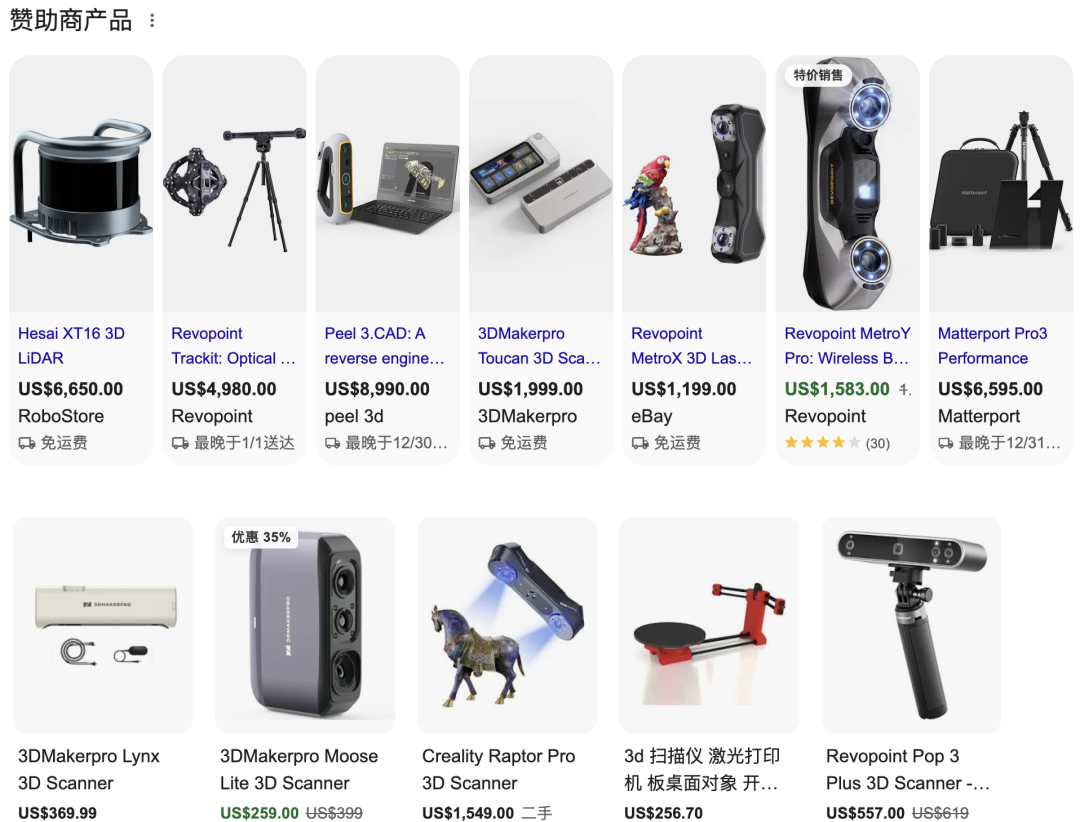
3D laser scanner prices on Google
Though some still insist on "fighting to the end, staying at the table is winning," from a long-term business logic perspective, many believe this low-dimensional mud-wrestling creates limited value.
Traditional electronics, algorithms, and mechanical engineering domains, suffering from severe talent oversupply, have had profit margins compressed to their limits. If you don't want to eat dirt in the red ocean, the real way out lies in changing tracks and dimensional reduction strikes.
-
Physical dimension upgrade: The hardware track is littered with money, but most people are fighting for scraps in crowded low-end lanes. Real opportunity lies in heavier investment in higher-order, more fundamental physical dimensions — such as optics and mechanics. Domains requiring deep accumulated expertise to access are where high premiums originate.
-
Organizational dimension reverse play: True anti-involution is fundamentally about organizational capability as a dimensional reduction strike. While most bosses are still thinking about how to save money and suppress labor costs, winners' logic is "reverse spending." If the company still has funds, they shouldn't be consumed in bottomless price wars, but all-in on talent.
One entrepreneur noted that the true use of capital is building extremely high talent density, poaching the most top-tier team members from universities. When you possess irreplaceable technology and organizational moats, you naturally don't need to engage in bottomless price competition with companies making "commodity goods."
If elevating talent density is building internal strength, then in resource allocation, one needs external expansion to combat involution. Involution is fighting for scraps in the existing pie; external expansion is cultivating new land in unknown territories.
One crucial principle: the "30% failure budget" principle — whether you're a small team or large company, do you dare allocate 20% to 30% of resources to things you've never done before, that will likely lose money?
Long-lasting hardware companies survive cycles because they maintain extensive redundant exploration. Whether you dare direct resources toward uncharted territory — trying products no one's made, partnering with suppliers no one's worked with — is a key determinant of whether you can find your own new continent.
3. How Should Entrepreneurs Work with Suppliers?
As the old saying goes, "the devil is in the details" — and entrepreneurship especially so. Beyond macro issues, operational specifics deserve attention, and how hardware entrepreneurs deal with suppliers is itself a craft.
At major companies, core suppliers revolve around you; you don't worry about resource allocation. But when you become an entrepreneur, even as a former executive, the situation completely changes.
In the chip industry, original manufacturer field application engineers (FAEs) are extremely limited in number, typically prioritized for massive-volume customers. The vast majority of SME needs are covered by distributors/solution providers.
However, startups' pain points often lie in developing differentiated new features, which typically exceed distributors' capabilities and require original manufacturer involvement. But here's the problem: why should an original manufacturer allocate scarce R&D resources to support a three-to-five-person startup?
In business logic, this doesn't hold. Therefore, when an original manufacturer chooses to support a startup, this is no longer routine commercial service, but resource allocation based on trust verging on venture investment. Entrepreneurs must recognize this as a privileged form of being looked after.
So how does one earn this privilege?
China, especially Shenzhen as the core hardware heartland, is a typical relationship-based society with dense personal networks. Information travels extremely fast here, with very low information asymmetry.
When an entrepreneur appears in Shenzhen, their whereabouts and background may circulate through core circles within half a day. When approaching a core supplier, the other party typically won't decide immediately, but will conduct informal background checks. They'll call peers asking: "Is this person reliable? How did their previous projects go?"
In this high-density information network, an entrepreneur's personal reputation constitutes their core credit asset. For micro-enterprises lacking collateral and cash flow, suppliers' cooperation decisions largely depend on judgments of the founder's character.
Regarding the importance of reputation, Duan Yongping once made a classic observation: business failure from poor operations is acceptable, because business always carries risk; but the manner of closing must be honorable — you must never mistreat suppliers, never maliciously delay payments.
The logic: projects can fail, but credit records cannot go bankrupt.
In hardware, serial entrepreneurship is the norm. If a founder demonstrated responsible conduct in a previous project, even if it failed, suppliers will still be willing to support their next venture. This support isn't based on chasing hot sectors, but on trust in the "person." Conversely, a single malicious default can sever all future supply chain financing possibilities.
Returning to the original question: for "grassroots" entrepreneurs who are neither spin-offs from major companies nor backed by massive funding, how do you move suppliers whose capacity is fully booked and whose engineers are monopolized by major clients like DJI?
The core likely lies in demonstrating above-and-beyond sincerity and certainty.
When evaluating small customers, suppliers look at "can this person actually get things done." Entrepreneurs need to prove project priority and team execution through concrete actions. For example, even without specific negotiation items, founders can fly specifically to a supplier's location simply to express importance and synchronize project progress.
For micro-entrepreneurs, every supplier willing to allocate resources to support you early on is not merely a business partner, but a "benefactor" on the entrepreneurial journey. Maintaining this relationship requires not contractual bargaining, but long-term, genuine personal interaction.
Yet not all supply chain relationships are cold interest calculations. Beyond general-purpose components (memory, hard drives), a more advanced "symbiotic relationship" exists, particularly evident in certain extreme niche products.
For example, when building a product initially regarded as obscure and niche, entrepreneurs aren't merely procuring components — they're co-defining the product with suppliers.
For highly customized, non-standard-spec core components (like high-end image sensors), terminal manufacturers lack chip-making capability, while original chip manufacturers also need an exceptionally expressive terminal vehicle to unleash their performance. Both parties are essentially jointly polishing a sensor.
This deep binding based on technical complementarity transcends simple buyer-seller relationships, becoming technical co-creation that benefits both sides and accomplishes what neither could achieve alone.
This offers hardware entrepreneurs an important insight: if you can't win on scale, try excelling in product extremity — by defining high-spec products that excite upstream partners, turning suppliers into your technical co-founders.