Andrew Carnegie | The Distance from $1.20 to Steel King

Those who cannot think are ignorant; those who dare not think are servile.


How did a poor boy from an immigrant family build America's largest steel company on nothing but his own abilities, step by step out of the neighborhood? When he worked as a child laborer in a textile mill, earning $1.20 a week, no one imagined this Scottish boy would become the steel king who dominated America and built the world's largest steel plant on the banks of the Mississippi. Though Andrew Carnegie's story is more than a century old, the ambition, diligence, and insight of this business titan — and the complexity he embodied — deserve fresh examination by entrepreneurs today.
This is the first installment of our "Titan Tales" series, drawn from the History Channel's The Men Who Built America documentary series about the great business figures who constructed modern America. Here, we retell their stories in our own words.
Carnegie's success is well-known; biographies abound. Looking back at his life now, we want to tell the lesser-known, overlooked moments and turning points — especially what particular experiences he had before his enormous wealth, experiences that let him break through the constraints of birth and circumstance to make brilliant judgment call after judgment call and build his empire.

1
An elephant stepped onto a bridge. Everyone watched the beast's demeanor; it crossed calmly, and the crowd erupted in cheers.

This seems utterly ordinary now, but in America a hundred years ago, when that elephant crossed, a popular saying circulated: "An elephant will never step onto an unstable structure." It was America's first steel bridge to span both banks of the Mississippi. Before this, no bridge had crossed the river — it was a symbol that propelled American transportation and transformed the American steel industry.
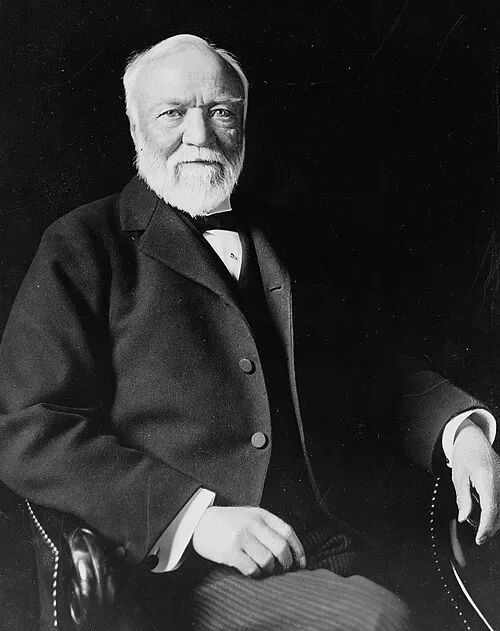
The bridge's builder, Andrew Carnegie, had been among the most unremarkable of America's young men.
Born in Scotland, he immigrated to America with his parents. At thirteen, he began his first job — winding bobbins in a cotton mill for $1.20 a week. The work confirmed his sense of self-worth. In old age, recalling this period, he would often reflect: "For it meant that I was already a useful member of a family, one who could earn his bread, no longer a burden to his parents."
This wasn't the life Carnegie wanted. He too longed to grow up and study like other children, but family poverty constrained his early path; he had to taste work too soon.
Before long, new work came: operating a steam engine and tending boilers at a spool factory, later delivering telegrams. In these seemingly trivial jobs, he demonstrated his cleverness.
One small incident proves it. Many boys worked as messengers; delivering long-distance orders earned an extra ten cents. But for that ten cents, the boys often scrambled and fought. The teenage Carnegie proactively devised a system to combine orders and split the pay equally, becoming the group's treasurer. Later, in his autobiography, Carnegie recalled the significance of this small matter: "This was real cooperation. It was also my first attempt at financial management."
A good entrepreneur doesn't only need mastery of their field and financial knowledge; broad vision and an aesthetic sensibility are also necessary — capabilities that would later help him make crucial decisions.
During his time as a messenger, Carnegie borrowed extensively from the community library, reading constantly during work breaks. He read Macaulay's essays and historical works, Charles Lamb's plays, and many history books. Later, he attended Shakespeare performances at the theater, delaying telegrams there until evening so he could catch a show after delivery — through which he also encountered classical music.

The world of literature and beauty opened to him at just the right moment. It's hard to imagine that when discussing a steel king and billionaire, we would first speak of his love of literature — yet Carnegie himself had to admit the enormous influence of these words. He even said that if someone offered a million dollars for his literary taste and discernment, he would refuse: "What would life be without literature? Keep me and my companions from vulgarity and vice."
More than a year into his messenger work, payday came once and his boss skipped him, paying the other boys first. Carnegie was disappointed and puzzled. He had always been first to receive wages, and his boss had been most satisfied with his work. Had he done something wrong? After everyone else left with their money, the boss told him: yours should be more than the others'. He received a higher wage.
Carnegie remembered running all the way home, leaping over rivers and bridges. That night, he and his nine-year-old brother began fantasizing about the future — they wanted to found a "Carnegie Brothers Company," to acquire more wealth. This was also the first time Carnegie began constructing a business empire in his mind.
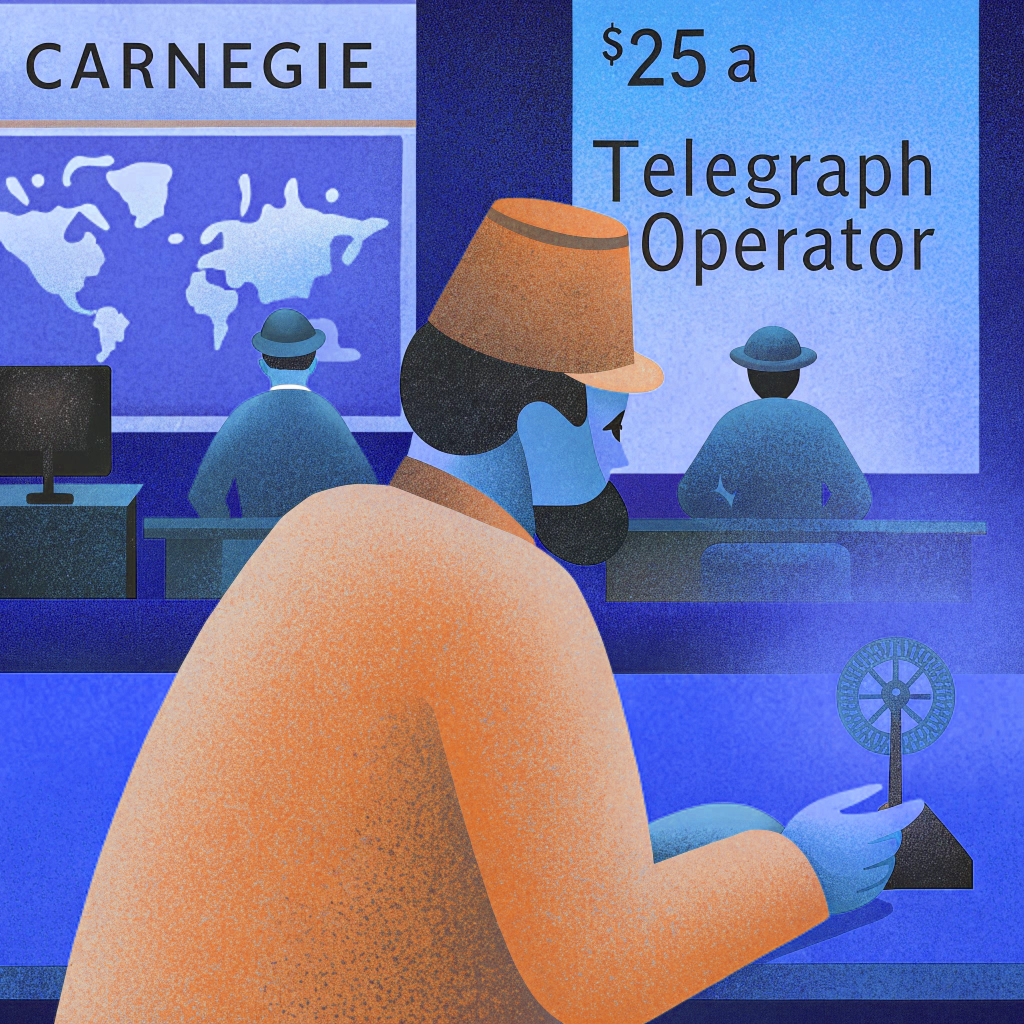
Later, through his boss's recognition, Carnegie advanced from messenger to telegraph operator, earning what he called a "magnificent salary" of $25 a month. The telegraph company's operating room was an excellent school, he said — you could hear news and messages from around the world, and his earlier reading of European history became an asset. He thus landed the most sought-after job of the time: receiving continuous "steamship news," that is, foreign dispatches.
Another matter from this period profoundly shaped his life. He and five close friends organized a small debating club. They were only about seventeen, yet already discussing public issues like "whether the judiciary should be elected by the people." They passionately followed social developments, constantly strengthening their logical thinking.
These choices, however small, helped Carnegie exercise his reasoning abilities — and later, no matter what happened, he could remain calm before the public and express his positions with clarity.
When we speak of Andrew Carnegie, we always start with his success, or merely analyze his business strategy and decisions, rarely tracing his growth process. Even when mentioned, it's treated as a poor boy's against-the-odds story. But few know how he taught himself and cultivated his own growth.
What he first encountered wasn't business knowledge — that came more as innate talent. His capacities for beauty, intellectual frameworks, and logical judgment were all acquired through long, uninterrupted learning. Re-examining Carnegie's story, you find he constantly emphasized learning, learning, learning. He even set himself a rule: "Learn and gain something from every conversation." And this he practiced.
2
When a person learns and accumulates enough, fate's turning points always arrive unexpectedly.
As a telegraph operator, Carnegie met an extraordinary figure whom he regarded as his guide and mentor: Thomas A. Scott. Scott came from the Pennsylvania Railroad Company and later became its vice president; Carnegie called him a genius. Because Carnegie's work was outstanding, Scott recruited him to his staff for clerical and telegraph duties. Carnegie was just eighteen. He had entered a broader world.
Here, he learned true investment and management, and accumulated his own capital. One incident demonstrates Carnegie's daring. His father had died early; his mother mended shoes to save money; his younger brother was still in school. As the eldest son, he began shouldering more. One day, Scott asked Carnegie if he had $500 — if so, he would help him make an investment. At the time, Carnegie had only 500 cents.
But Carnegie refused to miss this opportunity. He made a decision: raise the money. He even mortgaged the house he had just bought.
Carnegie would later earn far greater sums, but this investment remained unforgettable. He still remembered every detail — the dividends arriving in white envelopes.

The envelope read "Mr. Andrew Carnegie" — the "Mr." overwhelmed him with delight. He even remembered the name of the dividend check's cashier. This was Carnegie's first investment. He discovered the charm of investing — that one could earn income without physical labor, relying solely on one's mind and judgment.
Another small incident in his dealings with Mr. Scott truly reveals that this businessman was not merely obsessed with investment and finance, but possessed learning and a philosophy of conduct. At the time, Carnegie regularly contributed to the local newspaper as a writer, even penning a critical article on citizens' suggestions to his own company. "The pen became my weapon,"

Carnegie described it. After one article made the front page, he proactively told Mr. Scott — and in that conversation, they became close friends who could talk about anything.
What impressed him most during that visit to Scott was an open book on the mantelpiece, bearing these words: "He who cannot think is a fool; he who will not think is a bigot; he who dare not think is a slave." These lines became his creed.
So when the Civil War broke out in 1861, Scott summoned him to Washington to manage military railroads and telegraphs for the government — then among the most important departments. During this period, Carnegie foresaw the era of steel bridges. At the time, a crucial wooden railway bridge in Pennsylvania burned down, blocking traffic for eight days and accelerating the shift to steel bridges.
As a railroad industry pioneer, Scott was obsessed with all things related to roads. He had wanted to build a steel bridge connecting both banks of the Mississippi — the goal of every American railroad company at the time. Cross the river, and you could expand westward to vaster territories.
When Scott voiced this idea, Carnegie stood beside him. Carnegie decided to build this river-crossing bridge.
A hundred years ago, constructing a steel bridge that could carry trains across a river was difficult, almost unimaginable. The designer explicitly told Carnegie that the piers needed to withstand years of water impact — ordinary materials wouldn't suffice; only steel could endure.

Only steel, only steel. Carnegie knew he had to find a way to mass-produce it. He started from the source: visiting chemists, touring steel mills, earnestly studying how to make steel. Finally, he found the latest technology — invented by a British engineer, it could reduce steel smelting time from two weeks to 15 minutes. A massive breakthrough.
Steelmaking required not only enormous labor and materials but vast capital. Soon Carnegie fell into financial crisis, and bridge construction was forced to halt. Every entrepreneur faces fear and failure. What matters is how one faces the possibility of massive failure.
With the bridge complete, how to convince people it was strong and solid enough? The opening scene says it all — Carnegie had that elephant step onto the bridge. Even today, this was a stroke of marketing genius.
It seemed an extraordinarily risky decision (everyone assumed the elephant would collapse the bridge), but for Carnegie, this was one of his operating principles: if a businessman doesn't take risks, he cannot succeed.
An excellent entrepreneur must judge which way the winds of the era are blowing earlier and faster than most. When Carnegie foresaw that steel would replace iron as America's most important and core industrial material — railroads, bridges, and skyscrapers all depended on steel; this was the lifeblood of the age — he decided to found Carnegie Steel Company.
To build the bridge, Carnegie had also engaged with many bridge companies, participating in numerous railroad bridge bids. In his recollections, one small incident powerfully demonstrates his decisiveness at critical moments — and is worth sharing with investors today.
At one bidding session, Carnegie was not the lowest bidder. But during that meeting, he discovered that his rival didn't even know the difference between cast iron and wrought iron. They always used wrought iron for bridge cross-ties, while the competitor used cast iron. Carnegie depicted different collision scenarios: a wrought-iron cross-tie would merely bend; cast iron would snap, collapsing the bridge. One of the directors had, the day before, driven his carriage into a roadside lamppost — cast iron, which shattered on impact.

Carnegie saw this as heaven-sent opportunity. He told the bidders: for just a little more money, they could have a bridge built with wrought iron that no ship could knock down. "We have never built, and never will build, a cheap bridge — but our bridges never fall." In the end, Carnegie's company won a lucrative contract.
This taught Carnegie another lesson: to win a contract, you must engage with the bidders as much as possible, stay on site, seize every small possibility. Because you never know which "lamppost will be hit."
To become one who seizes the era's lifeblood requires sufficient attention to detail, patience, and persuasiveness. These didn't come entirely from business itself. Carnegie still emphasized the help of literature, art, and social activities — they more firmly established who he was, his character, and his lifelong creed.
3
Finally, we want to discuss what could be called a textbook financial operation by Carnegie — one that also nearly became a massive failure.
At the time, the Allegheny Valley Railroad Company (a well-known Pittsburgh railroad) urgently needed a loan. Its president approached Carnegie hoping for help. $5 million in bonds sat unsold; even with Pennsylvania Railroad Company guarantees, all banks had tacitly agreed to buy only at 80 cents on the dollar.
Carnegie proposed exchanging Pennsylvania Railroad bonds yielding 6% payable in gold for Allegheny bonds bearing 7% annual interest — using the obtained bonds as collateral to raise $250,000. Scott approved the trade.
Carnegie swiftly took the bonds to sell in London. His first stop was a bank; everything proceeded smoothly — terms were agreed, profits could reach $500,000. At the moment of signing, the other party noted that Mr. Baring of Baring Brothers would arrive in London the next day; out of courtesy, he would need to be informed of the transaction details. The deal was postponed until the following afternoon.
The moment he left the bank, Carnegie felt intense unease — strong enough to make him abandon his plan to report the good news to Thomas that evening. Sure enough, back at his hotel, an urgent letter awaited: a German financial storm had swept Europe, markets were in turmoil, and Baring Brothers had decided to halt the transaction. The $500,000 within his grasp evaporated. "It brought one of the heaviest blows of my financial career," Carnegie said.
In the end, Carnegie sold the bonds at a low price to the Morgan firm. He hesitated at first — after all, this company had rejected the Allegheny Valley Railroad Company in America. But J.S. Morgan & Co. in London had always trusted Carnegie; if they wouldn't buy, they would recommend a suitable buyer.
This experience taught Carnegie that financial markets are like sailing in a storm — one cannot rely solely on inspiration and intuition, but needs calm and patience.
After this, Carnegie continued assisting the Pennsylvania Railroad Company with bond issuance, facilitating Morgan bank's participation. When markets improved, Allegheny bonds sold out completely and the Pennsylvania Company's urgent need was resolved. Just as Carnegie thought the storm had passed, the Panic of 1873 struck suddenly.

At this point, Morgan proactively offered to repurchase the bonds from Carnegie. Carnegie quoted $60,000; Morgan gave him $70,000. "You're ten thousand short," he said. Carnegie pushed the extra ten thousand back; Morgan declined.
"This was not merely legal obligation, but a strong sense of honor and integrity. And this was not common in early business dealings. So from then on, I resolved that as far as lay in my power, I would never let the Morgan firm or its bank suffer loss through me. From that time, we became each other's most reliable friends."
Carnegie always believed that what truly makes an enterprise endure is honesty, not cleverness; when market storms hit, what protects a business is reputation, not capital.
Everyone knows that the trust between Carnegie and Morgan began here, and eventually led to one of the largest transactions in American history — Carnegie sold his steel company to a syndicate organized by Morgan for $480 million. Morgan immediately congratulated Carnegie on becoming the world's richest man.
For a long time, Carnegie judged his direction with great precision, clear goals, no hesitation — a true long-termist. "In any industry, if you want to excel, you must become the leader in that industry. I don't approve of scattering efforts; in my experience, I know few people who have made great fortunes through diversified operations — at least not one in steel manufacturing. Those who succeed are those who choose a particular industry and stick to it." This was Carnegie's enduring belief, his business principle: find your own gold mine.
Stories are circles, eventually returning to their beginning. After selling his steel company, Carnegie turned to philanthropy. Among his charitable projects, one deserves special mention: he spent $5.25 million to build 68 small libraries for New York, later adding 20 more for Brooklyn. Literature, books, and libraries had once provided Carnegie enormous nourishment; having succeeded, he wished to offer young children the same sustenance.

Carnegie's business story has been told countless times. Most people know his origins and poverty, but few see that in his youth, he early on grew into a complete person through his own efforts — his foundation was built by himself. The era has changed; much business logic has shifted. But what remains constant is the establishment of a person — and this is the most memorable part of Carnegie's story.
Engage with Monolith
After reading this "Titan Tales" piece on Carnegie, what are your thoughts? What aspects of the steel king's growth path moved you? Share your observations and reflections in the comments. We'll select the three most thoughtful and most-liked commenters to receive special commemorative gifts from MONOLITH. The event runs until 24:00 on April 19.