Immortality: Starting with Dogs

Death is not an inevitable law of nature — just an engineering problem.



In July 2024, Nature published a paper with a restrained title: "Inhibition of IL-11 Signalling Extends Mammalian Healthspan and Lifespan." The results were anything but restrained — researchers had injected elderly mice with an antibody, extending their median lifespan by roughly 25%. Cancer incidence dropped, metabolic function improved, and fibrosis reversed across multiple organs.
What does 25% mean? Scaled proportionally to humans, it would translate to nearly two extra decades of average life.
The paper triggered a minor earthquake in aging research. The suppressed target was a pro-inflammatory, pro-fibrotic signaling molecule that rises with age, and inhibiting it produced effects across multiple organ systems — not treating one disease, but systematically slowing aging itself. Academically, it was an exceptionally clean result.
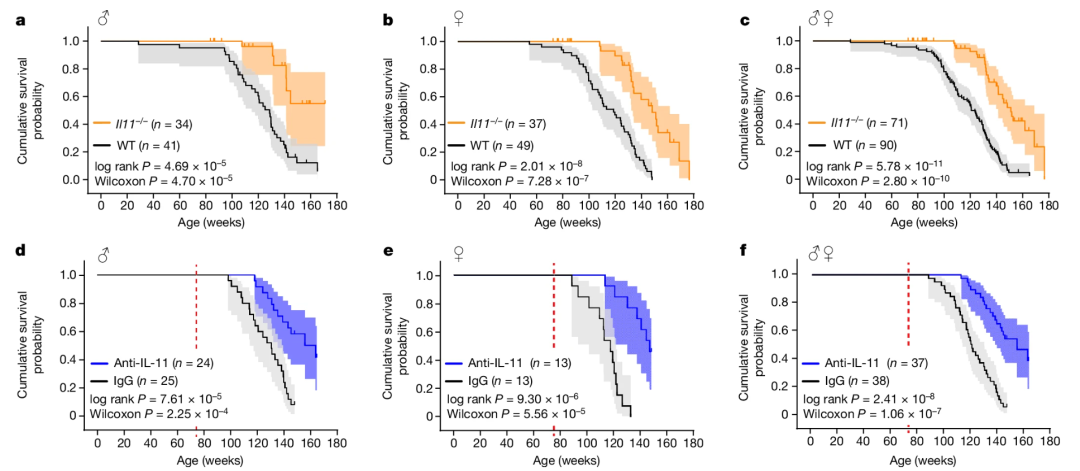
Mice receiving anti-IL-11 treatment starting at 75 weeks of age
Survival curves shifted rightward, median lifespan significantly extended
But academic cleanliness and commercial feasibility are separated by an enormous distance.

Several months before this paper's publication, a 27-year-old Oxford PhD student had already begun designing drugs around aging-related pathways. His name was Simiao Zhao — "Simiao" taken from Sun Simiao, the Tang Dynasty "King of Medicine," bestowed by his grandfather.
In 2026, he founded Ark of Infinity Technologies, a company attempting to use AI and cross-species data to bypass the bottlenecks of human longevity drug development. Monolith was its first institutional investor.
An Idea
Zhao is from Chongqing, born in 1998. He went abroad for high school, studied artificial intelligence at the University of Edinburgh for undergrad, then completed his master's and PhD at Oxford. His path into aging research didn't begin in a lab, but with a thought so simple it bordered on naive: Why do people have to die?
He says the idea came to him around age seven or eight. "The last thing my grandfather said to me was that he didn't want to die." The name was grandfather's, and so was the wish — health, longevity, freedom from disease. His family had always wanted him to study medicine, but he was equally drawn to AI, and ultimately chose an interdisciplinary path. His WeChat signature still carries a line from Su Shi's Red Cliff Rhapsody: "I mourn the brevity of my life, and envy the endless flow of the Yangtze River."
During undergrad, he attended a summer program led by Manolis Kellis, head of MIT's computational biology department. Kellis asked students about their dreams. Zhao said immortality. "He immediately introduced me to the research progress in aging, and explained a concept called longevity escape velocity."
Longevity Escape Velocity is one of the boldest hypotheses in aging research: If medical technology can extend lifespan faster than the body ages, then death is no longer theoretically inevitable — every year you live, you "earn" more than a year of additional life. Proposed by Cambridge researcher Aubrey de Grey, it's treated by mainstream medicine as an intriguing but overly optimistic thought experiment. But to a college freshman, it offered something crucial: death isn't an immutable natural law, just an engineering problem.
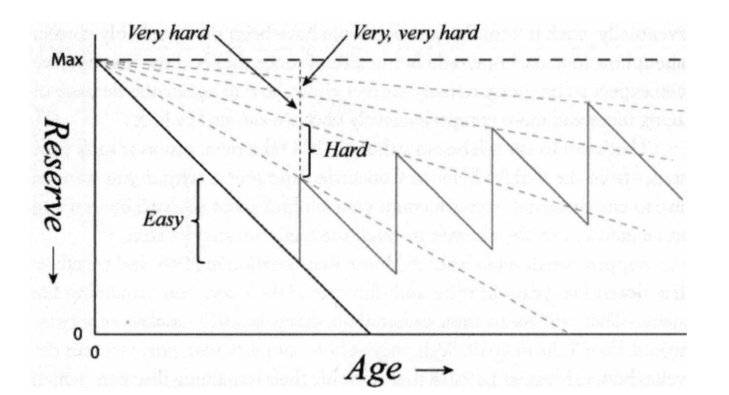
Aubrey de Grey's schematic of "longevity escape velocity"
"A department head at MIT told me this was scientifically feasible. From that point on, I always believed it could be done."
Zhao began systematically building toward this direction. During his master's, he helped found and develop the Oxford Aging and Longevity Society, serving as a board member and gaining exposure to more frontier technologies — partial reprogramming, Yamanaka factors, epigenetic clocks. Later he joined the Longevity Biotech Fellowship (LBF), a research organization gathering global longevity extremists, becoming its only Chinese member.
"Before that, I was alone with this idea. Everyone around me thought it was crazy. After joining LBF, it was like finding my home."
In London, he met Jingkun Zeng — a postdoc at UC Berkeley who had trained under CRISPR co-inventor and Nobel laureate Jennifer Doudna. Sharing aligned interests in aging research, they began discussing a core question: If you wanted to make longevity drugs, where would you start?
A Lock
The entry point was dogs.
This choice wasn't surprising. Aging research faces a fundamental dilemma: you can't run lifespan extension trials on humans. Human lives are too long — a clinical trial would need decades to observe mortality endpoints. No pharmaceutical company wants to wait, and no regulator knows how to approve a drug that "makes people live longer." The FDA still doesn't recognize aging as a disease; you can't file a new drug application with "lifespan extension" as your primary endpoint.
The animal side is completely different. Dogs live 10-15 years. You can run a statistically meaningful controlled trial in five. More importantly, pet drug regulation is far looser than human drugs — no need for the FDA's lengthy process, approval cycles compress from over a decade to two or three years.
But Zhao's ambitions extend beyond pet medicine. His logic is a "detour" strategy: first run the full drug development pipeline on pets, accumulating real-world data, while simultaneously advancing human drug pipelines in parallel. Pets are the engine, not the destination.
"We're not saying pets first, humans later. We're doing both directly. Pet drugs can reach market in three years; human drugs take ten years from development to clinical trials. When you push both simultaneously, the dog side finishes experiments and goes to market while the human side enters clinical trials — the whole process accelerates."
This strategy rests on a technical assumption: sufficient conservation of aging mechanisms between humans and dogs — meaning the core genes driving aging are shared across species. If this holds, targets validated in dogs will likely work in humans; conversely, validated human aging targets can be translated to dogs.
Validating this assumption is Ark of Infinity's core technology. They developed H2P (Human-to-Pet), a cross-species transfer learning model that uses domain-adaptive neural networks to capture conserved aging features from single-cell transcriptomic data. Simply put, it aligns gene expression data between humans and animals — roughly 16,000 genes — then uses AI to filter out genes with excessive interspecies variation, retaining those that are cross-species conserved and significantly associated with aging.
Zhao offered an analogy: "Drug development requires targets. Targets are keyholes, drugs are keys. But people don't realize that species differences cause keyhole drift. What we do is first confirm that the locks on both doors are the same lock, so the key can be shared."
This direction has almost no precedent in academia. Traditional drug development discovers targets in mice, validates drugs in mice, then attempts direct replication in humans — with interspecies differences assumed to be "roughly similar" enough. But aging is a systemic process, and species differences are massively amplified across the lifespan dimension: the same growth factor pathway inhibition can extend lifespan 200% in nematodes, yield only a modest percentage in mice, and potentially trigger metabolic disease in humans.
"These differences need to be smoothed out at the data level before we can pursue targeted therapeutics."
Two Paths
In 2026, Ark of Infinity officially launched in Shenzhen.
The core team hails from top academic institutions including Oxford, Berkeley, Cambridge, and Imperial College London, covering computational biology, gene editing, structural biology, and medicinal chemistry. CTO Jingkun Zeng completed postdoctoral training in Nobel laureate Jennifer Doudna's lab. Chief Scientist Ying Zhang is a doctoral supervisor at Sun Yat-sen University whose previously founded biotech company has raised over 100 million RMB.
The seed round was led by Monolith. Zhao was struck by how streamlined the process was — from first meeting to investment commitment, there was virtually no extraneous procedure. Afterward, he and his team studied Monolith co-founder Xi Cao's public statements and investment track record, concluding it was "an institution willing to do big things, that makes fast decisions when it sees something clearly."
Currently, Ark of Infinity is organized around two core teams: the drug group and the AI group.
The drug group is advancing multiple pipelines. ARK-001 establishes pharmacodynamic models around age-related fibrosis, metabolic, and inflammatory phenotypes in dogs and cats, while preserving human drug translation potential. ARK-002 targets another classic aging-related pathway and has received Chinese invention patent protection. On drug modalities, the team isn't betting on a single approach, but simultaneously exploring antibodies, peptides, and small molecules — antibodies offer specificity but difficult delivery, small molecules enable systemic delivery with higher toxicity risk, peptides sit in between.
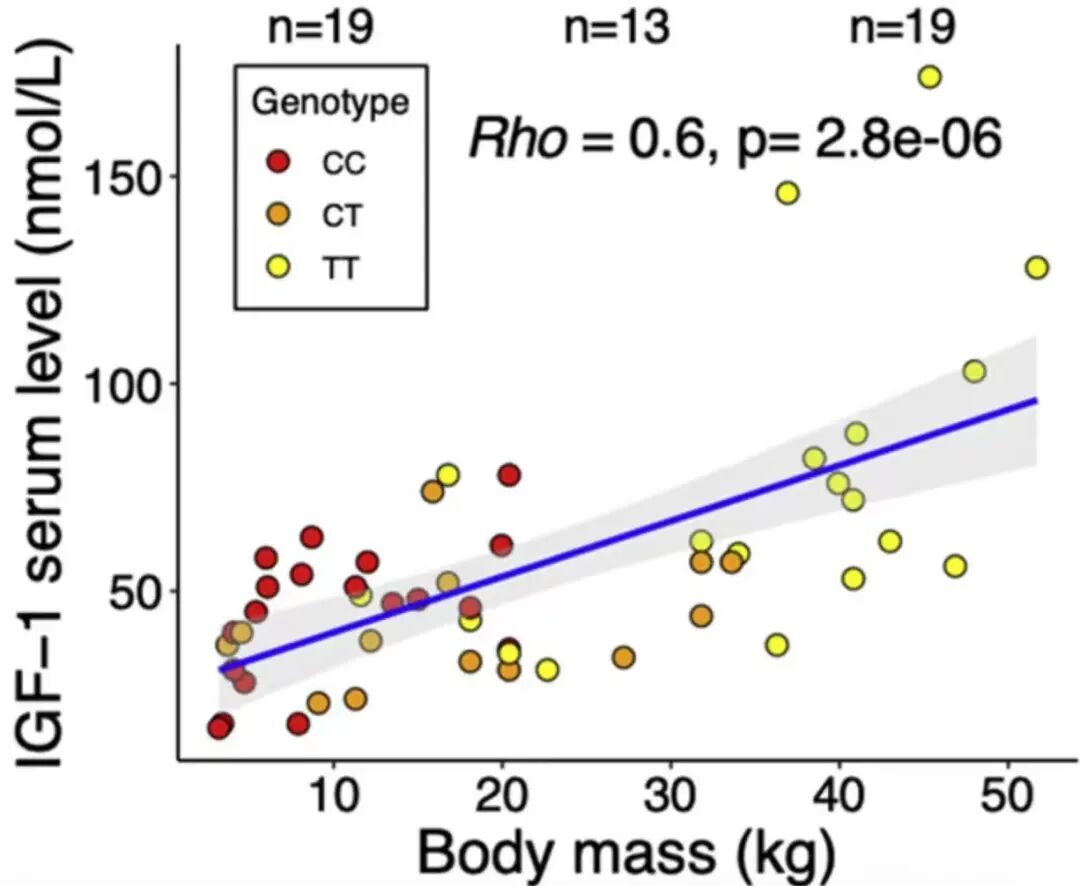
IGF-1 is significantly associated with dog body size and changes with age
The AI group is pursuing something more radical: using interpretable machine learning to find multi-gene combinations. Single-target drugs can slow aging, but genuine "rejuvenation" may require simultaneous intervention across multiple genetic pathways. The problem: if you rely on traditional wet-lab experiments to randomly test combinations for anti-aging effects, the combinatorial space of even a few targets would require thousands of years to explore. Ark of Infinity is using AI to compress this search space to hundreds of combinations verifiable by wet-lab experiments within a single generation.
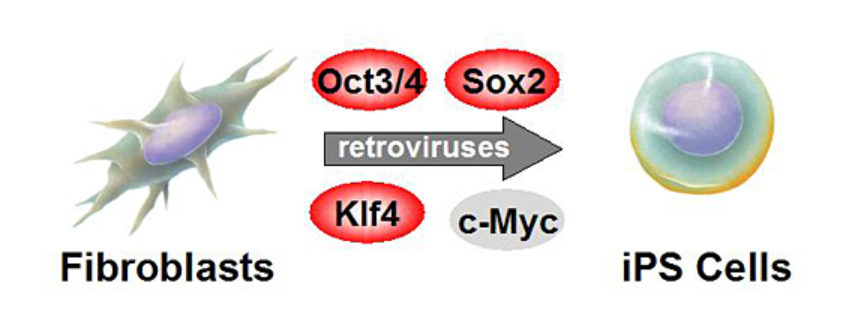
In 2006, Shinya Yamanaka discovered four key transcription factors (OSKM) capable of reprogramming mature somatic cells into induced pluripotent stem cells (iPSCs)
Zhao wants to find an optimal gene combination — analogous to Yamanaka's four transcription factors OSKM, but potentially safer and more controllable.
"We're not making a better Yamanaka factor combination. We're searching the entire space, using AI to discover nonlinear relationships between genes, then designing these genes into small nucleic acids or AAV delivery to specific tissues, observing short-term reversal effects on organ aging."
This is a high-risk, high-reward research direction. If successful, it wouldn't be "lifespan extension" — it would be organic reversal of aging. "Our goal has shifted from purely extending lifespan to functional reversal. First, it's easier to measure — you don't need decades to observe mortality endpoints, you can look at organ function improvement. Second, it's genuinely useful — if vascular endothelial cells are healthier, cardiovascular mortality drops. That's visible on imaging."
Four Walls
The challenges of aging research, beyond technology, are four words Zhao returns to repeatedly: technology, capital, ethics, policy.
"Why do I say this? Because aging can already be extended or reversed technologically — the public just hasn't accepted it yet. Ethics represents the public; policy represents government. How to advance policy and ethics? That's harder than making drugs."
This is another layer of his pet drug logic — not just technical validation, but market education. If pet longevity drugs actually reach market and work, the public will begin accepting that "aging can be reversed." Once perceptions shift, policy can follow, and capital will flood in.
"Like OpenAI. They took long-term AI research to a commercially viable stage, then triggered policy transformation and public acceptance. I want to do the same thing in aging."
The analogy sounds grandiose, but Zhao's actual wish is quite simple. His parents are in their sixties, he says, "I just want them to have access to this drug." And academic work is too constraining, "approvals go up layer by layer, collecting a mouse sample requires endless paperwork — I can't stand that kind of tedium."
So he chose entrepreneurship. Age 27, PhD unfinished. In fact, his parents preferred he accumulate a few years of experience at a major pharmaceutical company first. "But I convinced them otherwise."
Escape Velocity
The global landscape of aging research is changing rapidly.
Altos Labs raised $5.2 billion for cellular reprogramming. Retro Biosciences secured $1.18 billion from Sam Altman. Loyal has raised $150 million, targeting FDA conditional approval for a pet drug by 2026 — if successful, it would be the first regulatory-approved longevity drug in human history, even if for dogs.
Zhao sees Ark of Infinity's differentiation in two areas: broader target and mechanism coverage — spanning multiple core aging-related signaling pathways rather than betting on a single target; and the cross-species AI platform — most competitors are either pure pet companies or pure human drug companies, with few attempting to bridge species-level aging mechanisms at the data layer. Commercially, he doesn't intend to take everything to completion himself. "Early single-target pipelines get sold off one by one to accumulate capital. When we eventually find that optimal multi-gene combination — one injection to make you 20 years younger — that one we keep for ourselves."
When asked "How long do you think people should live?" Zhao didn't hesitate: "People shouldn't die. Freedom of life is the most fundamental freedom. With it, all other freedoms can be gradually obtained. Without it, nothing matters."
Coming from a 27-year-old PhD student still in school, this would be dismissed as a joke in most contexts. But Zhao genuinely works toward this goal every day. His work is concrete: getting antibodies to mass-producible cost, running clinical trials on dogs, while simultaneously using AI to search for that optimal combination among 16,000 genes.
"As the most perfect organism created by God, humans should decide life and death for themselves."

We welcome your thoughts in the comments — your reactions to this piece, or any observations and reflections. By 24:00 on May 21, we'll select five outstanding comments based on quality and engagement, and award special MONOLITH commemorative gifts.