As investors, we took Moonshot AI's K2.5 for a spin.

More Than "All-Powerful"
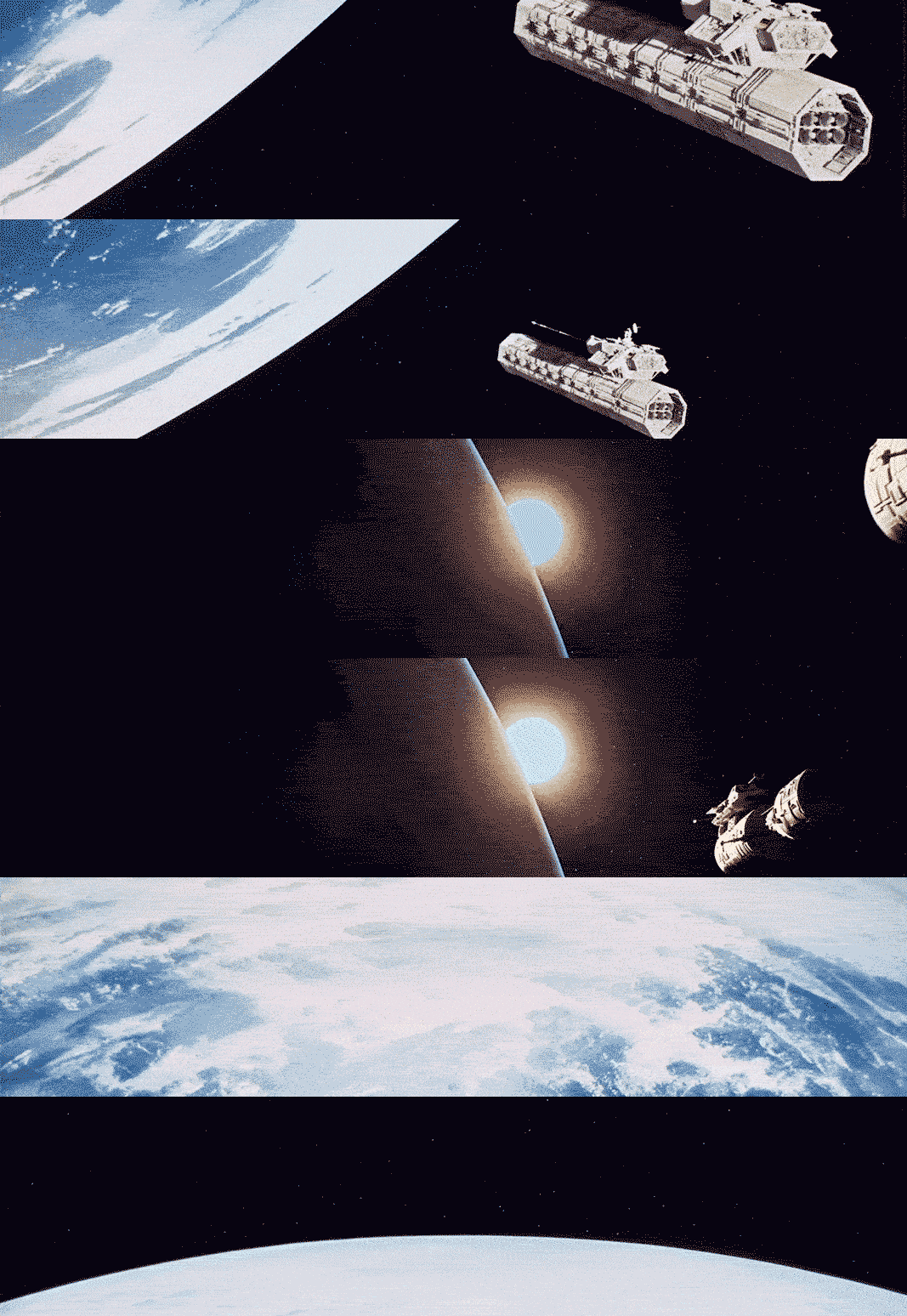

On January 27, Moonshot AI officially released and open-sourced Kimi K2.5. Kimi K2.5 breaks the zero-sum game between vision and reasoning through native multimodality, achieving Coding with Vision, and redefines AI's parallel productivity with an Agent Swarm architecture.
Monolith, as one of Moonshot AI's earliest investors, we pay attention not only to the leap in parameters but also to its performance in real engineering environments. To validate K2.5's Coding with Vision capabilities, we tested it on our own website yesterday, and synthesized the latest interpretations from leading overseas tech media. From hands-on experience, international reception, cost structure to implementation recommendations, we hope to present as objective a picture of Kimi K2.5 as possible.

1. Coding with Vision
In Venture Beat's reporting context, Kimi K2.5 is redefined as an "All-in-one Model." It is no longer a language model with a vision encoder attached, but a native multimodal model trained on 1.5T mixed tokens.
This means vision is no longer auxiliary, but a first principle on equal footing with code.
The most intuitive breakthrough lies in Coding with Vision. Previous models required us to painstakingly describe in text "a bit more whitespace on the left, rounded corners for the button," while K2.5 can directly read the pixels, layout, and even aesthetic style of design mockups.
In official demos, it can reconstruct an entire website from a video clip. In our hands-on testing, this capability proved even more aggressive — it is blurring the boundary between designer and frontend engineer.
2. Core Hands-on Testing
To validate K2.5's engineering deployment capabilities, we didn't use standard benchmark questions. Instead, we directly "fed" Kimi K2.5 a screenshot of Monolith's homepage. The prompt was extremely simple: "Replicate this webpage, maintaining consistent visual style."
Kimi's replication of the Monolith homepage
Not bad.
First, the aesthetic alignment. K2.5 didn't generate a structurally correct but ugly HTML skeleton. It precisely captured Monolith's artistic style: generous whitespace, ultra-thin grid lines, mixed serif and sans-serif typography — all perfectly reproduced through Tailwind CSS.
At the same time, interaction restoration. Based solely on a video, it even inferred the hover interactions for images and proactively filled in CSS animation code.
It's evident that K2.5, in webpage replication tasks through video, has moved beyond mere OCR to demonstrate multimodal understanding of UI and design language.
Although some details still fell short, achieving this level of fidelity from just a 5-second video and a single prompt is more than satisfactory.
Beyond vision, Agent Swarm is another major highlight of this release. Kimi's official blog explains that K2.5, trained through Parallel Agent Reinforcement Learning (PARL), can autonomously manage swarms of up to 100 sub-agents, executing parallel workflows of up to 1,500 coordinated steps without predefined roles or hand-designed workflows.
When we simulated a VC research scenario, requesting "research the global AI Agent Infra landscape," we provided the following prompt:
We need to map out the latest developments in the global AI Agent Infra space. Please focus on leading startups in North America and China that have raised Series A or later.
Map out the latest product developments and funding status of at least 10 representative companies.
Find recent analytical articles on this space from leading tech media or notable VCs.
Swarm mode rapidly deconstructed the underlying needs of the prompt, breaking the task into four components: China / US / tech media / VC research. It then created four dedicated agents responsible for each corresponding module. Each sub-agent had its own task progress, processing in parallel.
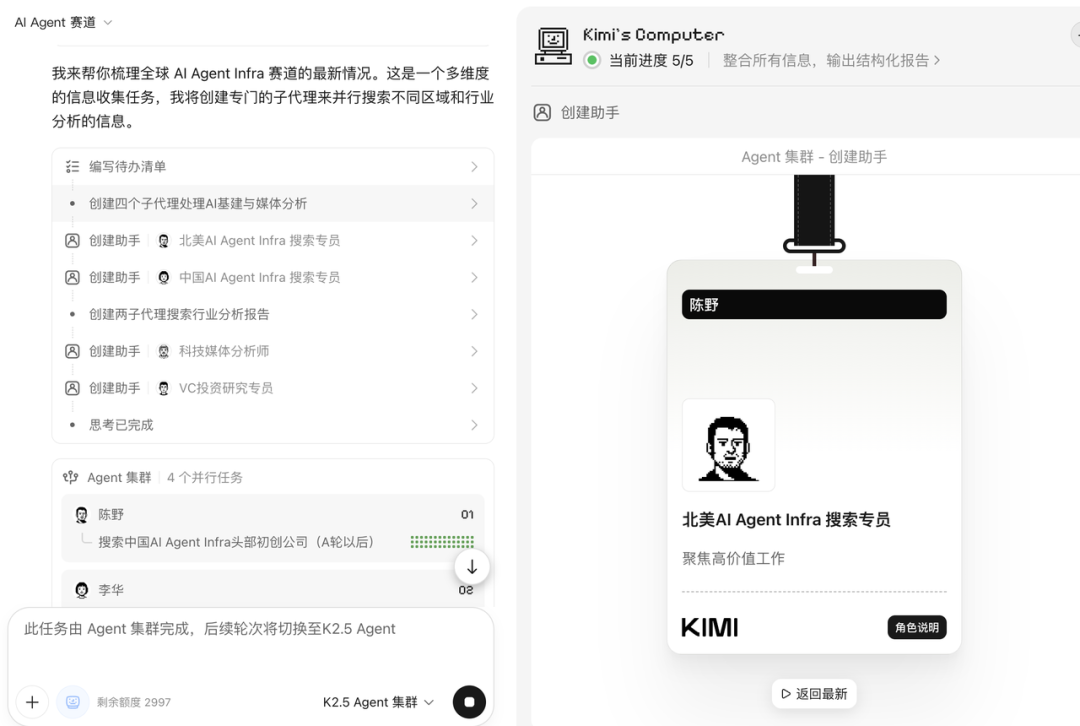
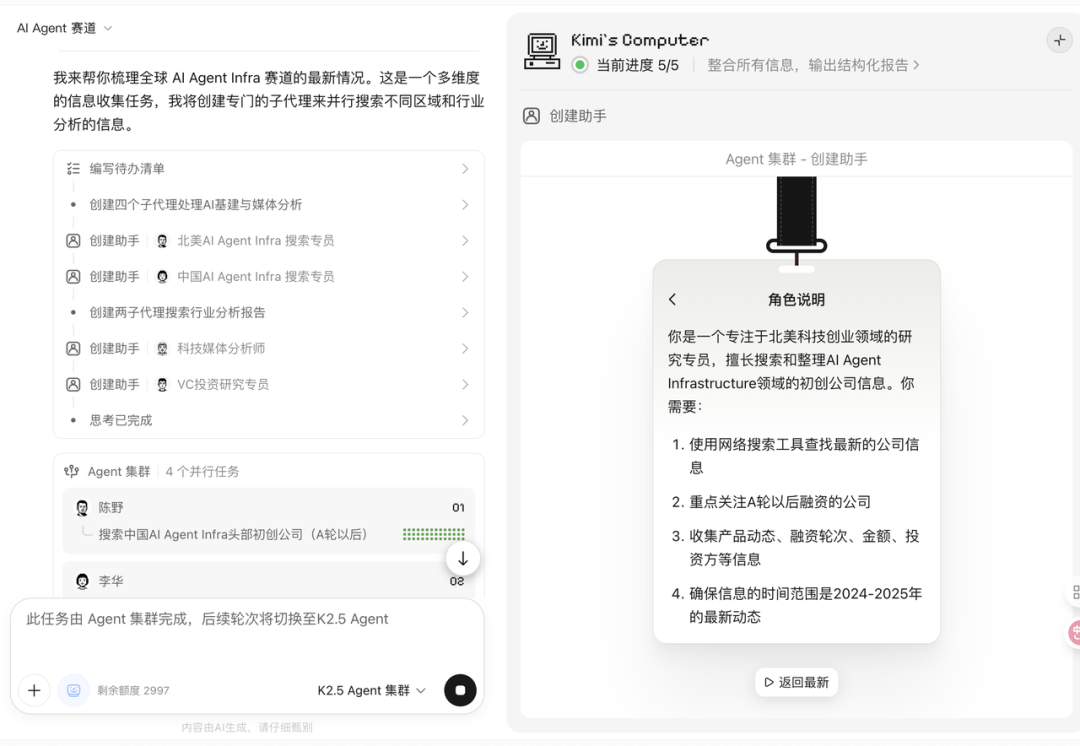
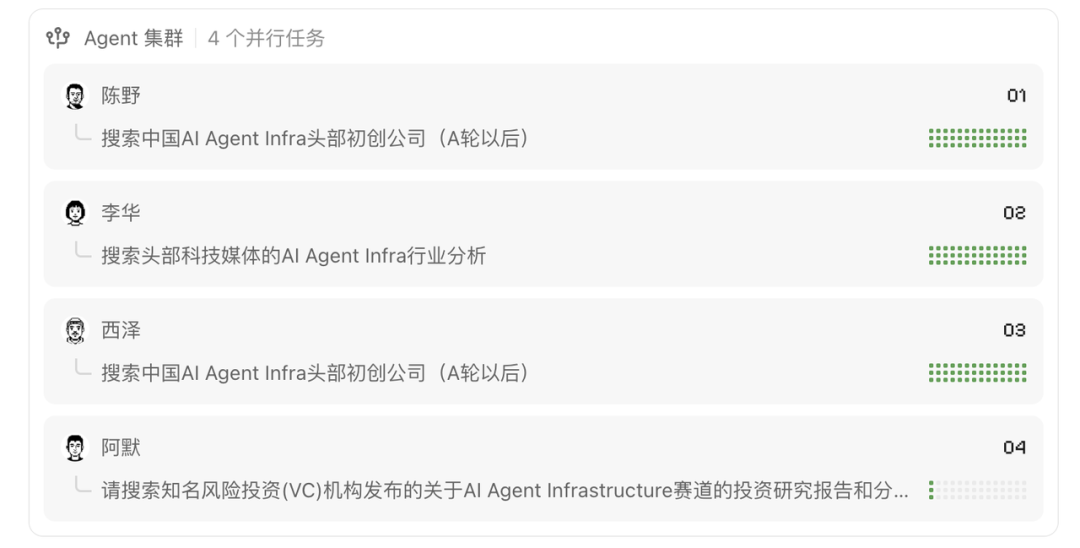
↔ Scroll left/right to view the Agent Swarm workflow
After all sub-agents complete their tasks, the primary agent aggregates all results and generates the final report for the user.
Through our verification, the facts underlying the report are substantially accurate, and the conclusions offer meaningful reference value.
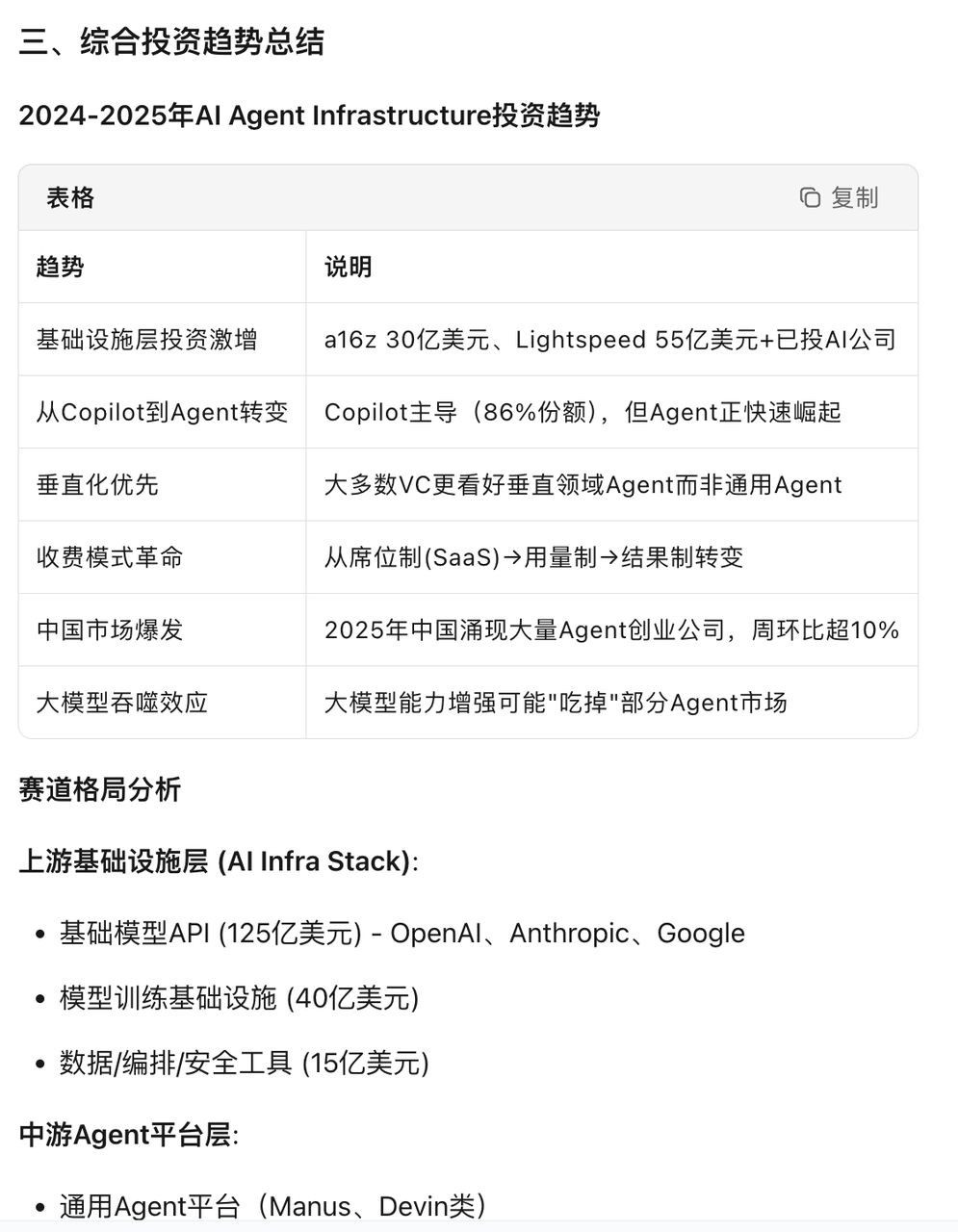
Partial report generated by Agent Swarm mode
Notably, due to the Agent Swarm design, the time spent on this research task in our testing was faster than comparable products (including Kimi's other product "Deep Research"). This effectively improves efficiency for similar work.
Another killer feature of K2.5 is its extremely aggressive pricing strategy.
On the HLE (Humanity's Last Exam) benchmark, K2.5 scored 50.2%, surpassing GPT-5.2 (xhigh) and Claude Opus 4.5, at a cost an order of magnitude lower.
While the current Swarm mode is only available directly through Kimi's product interface, the API pricing of the K2.5 model itself demonstrates Moonshot's considerable ambition. Its cached input price is just $0.10 per million tokens. This means that for developers, the cost of replicating Swarm-like high-context, multi-turn interactive workflows via API will gradually cease to be a barrier.
We note that platforms including OpenRouter, Ollama, and TraeCN have already rapidly launched the Kimi K2.5 model.
3. The Main Thread of Overseas Reception
K2.5's release triggered stronger tremors in Silicon Valley than the K2 era. VentureBeat, Constellation, and other media generally agree that K2.5 marks the evolution of open-source models from tools to Synthetic Workforce.
VentureBeat acutely points out that the only metric enterprises care about is "how much time AI gives back to you." They comment:
"K2.5 suggests a future where the primary constraint on an engineering team is no longer the number of hands on keyboards, but the ability of its leaders to choreograph a swarm."
Constellation Insights views K2.5 as further evidence that open-source models are steadily closing in on closed-source alternatives:
"The lead between frontier models is quickly collapsing... Enterprises need to pay attention to what's happening as LLMs commoditize quickly."
Medium tech blogger Mehul Gupta lavishly praised its native multimodal architecture:
"At this scale, the usual trade-off disappears... K2.5 changes how AI sees, reasons, codes, and executes tasks in real-world settings."
Overall, overseas discourse around K2.5 has clearly moved beyond discussions of model parameters or benchmark scores, gradually forming a relatively clear through-line: open-source large models are shifting from assistive tools to "synthetic labor" that can be organized and orchestrated.
4. Three Things Worth Viewing Soberly
As investors, there are also aspects we want to view with calm.
First, hardware barriers still exist.
Although K2.5 is open-source, its 1T parameter (32B activated) MoE architecture demands extremely high VRAM for local deployment. For individual developers and startups, before a quantized version becomes available, cloud API may be the only option.
Second, while swarms are powerful, unpredictability increases.
"100 sub-agents making autonomous decisions" sounds beautiful, but in actual engineering, this means exponentially increased debugging difficulty. One sub-agent's hallucination may be amplified throughout the swarm. In practical use, attention must be paid to information credibility in multi-turn, multi-agent information exchange.
Third, a slight gap in pure logical reasoning.
While K2.5 performs excellently on Agentic Workflows, in pure mathematical derivation and extremely abstract logic problems, GPT-5.2 and its xhigh mode still maintain a slight edge. K2.5's strength lies in "getting work done" (Coding & Execution), not simply "solving problems."
5. Operational Recommendations for Implementation Teams
1. Use Vision to reconstruct frontend workflows.
Stop describing UI through prompts. Feed design mockups, Figma screenshots, even hand-drawn sketches directly to K2.5. In our testing, its code generation quality in the Tailwind/React ecosystem has reached a solid level, especially suitable for rapidly building MVPs. Notably, if production-grade code is the goal, human intervention and multiple rounds of refinement are still required.
2. Enable Swarm for "broad search" scenarios.
For tasks requiring breadth of scanning (competitive research, sentiment analysis, multi-source data comparison), Agent Swarm's parallel capabilities are exceptionally strong. But for tasks requiring deep linear reasoning (mathematical proofs, long-form novel writing), a single agent may be more robust.
References and Further Reading:
- VentureBeat: "Moonshot's Kimi K2.5 introduces agent swarm..."
- Constellation Insights: "Why enterprise AI leaders need to bank on open-source LLMs"
- Mehul Gupta (Medium): "Kimi K2.5: Best open-sourced coding AI is here"