"Undercover" at Moonshot AI: 100 Hours

Taste is all you need


Moonshot AI is not as mysterious as it seems to Monolith. As one of the company's earliest investors, we allocated 20% of our first fund to this team — the maximum single-position exposure allowed — participated in nearly every funding round, stood with them through multiple storms, and witnessed each step forward.
To us, this team has always been a group of AGI evangelists who are product- and results-oriented, pragmatic, and grounded in long-termism. So we would not attribute their current attention to "the favor of spring."
In 2024, on our podcast First Mover, we summarized our conversation with Zhilin Yang using the words "innovation, long-term, first principles." In this article, those keywords have evolved into "generalization, resilience, AI Native."
The second half is here.

Contents:
- "DeepSeek Saved Us"
- Taste Is All You Need
- Generalize, Then Evolve
- "No Musk Vibes Here"
- "I Don't Know How She Survived It"
- Genius Swarm
- The Necessary "Two-Dimensional Foil"

Spring 2026 favored Kimi. From record-breaking revenue, funding, and valuation, to a paper with a 17-year-old high school intern as first author earning high praise from Silicon Valley figures like Elon Musk, to being "wrapped" by Cursor — a $50 billion American company — Kimi nearly simultaneously completed a beautiful triple play of capital, technology, and commerce. This three-year-old startup, valued at over 120 billion RMB, is gradually emerging on the global AI narrative map.
Yet Moonshot AI remains shrouded in mystery.
I was granted 100 hours of deep observation at company headquarters. As an independent writer, I could interview any employee willing to speak, sit in on any meeting not involving commercial secrets, create without interference, and receive no payment — this is indeed the company's style.
Standing inside the company feels like being at the eye of a storm. Within the wind's dead center, everything is still. Workstations are quiet, keyboard clicks sparse, occasional laughter drifting through. The outside noise — rumors, debates, adulation and imitation — finds no echo here.
Over 300 people, average age under 30, each shouldering nearly 400 million RMB in valuation. Eighty percent are introverts — people sit side by side yet prefer typing to talking. Here, introversion is not a flaw but an organizational protocol.
I recall my first visit to this company in 2024, on that night when the storm began brewing. My first impression of Moonshot AI was not particularly favorable.
"DeepSeek Saved Us"
The evening of December 24, 2024, was an unremarkable Christmas Eve for most Chinese people, but the darkest moment of Julian's life. At 26, just two years out of Peking University with no industry experience, she was already among Kimi's earliest employees. This young yet senior girl sat at the long table in the Radiohead conference room, facing more than thirty colleagues, tears streaming down her face.
She had been unable to deliver a holiday marketing plan that met co-founder standards. With a month until Spring Festival, continuing to iterate or even completely overturning the latest version — already revised six times — while ensuring product and R&D team coordination was itself a low-probability event. But the company's growth expectations for Spring Festival 2025 were enormous: it was last Spring Festival when Kimi broke through with "2-million-character long context," surging in C-end users and even spawning "Kimi concept stocks" in capital markets.
That weekly meeting was long and despairing: twenty young colleagues as inexperienced as Julian took turns presenting, from social media placement to user operations, from domestic PR to overseas marketing, every detail discussed collectively, decisions made by co-founders. Kimi was like an adolescent, bewildered teenager — even with monthly marketing budgets in the tens of millions, facing aggressive competitors, it was flustered and overwhelmed.
The meeting ended promptly before 4 a.m.
No one knows whether Julian's plan ultimately succeeded. Because a month later, when the world first learned the name DeepSeek, everything ceased to matter.
Hayley from the growth team returned to her hometown in Wenzhou; relatives and friends all asked: Do you know DeepSeek? As if Kimi were a name from the last century. Hayley endured the most difficult New Year of her life. She said the company's silence was deafening.
The annual meeting, typically held in March after Spring Festival, allows all employees to challenge leadership. That year's questions almost all revolved around DeepSeek. The sharpest came from HR, who with absolute sincerity pierced through the taboo: How should we answer candidates' question —
"DeepSeek also gave me an offer, why should I come to Kimi?"
But not everyone thought this way. Alex from the algorithms team recalls that if he felt any strong emotion during the DeepSeek moment, it was only one: excitement.
This excitement represented not just him but the entire algorithms team's mindset. They saw another possibility: lower-cost strategies, open-source approaches, and a fact no one had previously believed — that with sufficiently leading technology and solid models, an obscure Chinese startup could earn global respect.
The product team was not anxious either. Kevin, among the earliest product hires, had clear and firm confidence: DeepSeek broke through on model capabilities, but once Kimi's model capabilities caught up, the embellishments they could add on the product end would be far greater.
No one knows what discussions the co-founders went through. But the company completed strategic adjustment and refocusing with remarkable speed, achieving genuine company-wide consensus. If you asked any colleague what the company's most important priority was, they would unhesitatingly tell you: the model.
From then on, you could sense the respect for DeepSeek spreading through the company — partly professional camaraderie from a peer perspective, and partly, as Alex put it: "Actually, DeepSeek saved us."
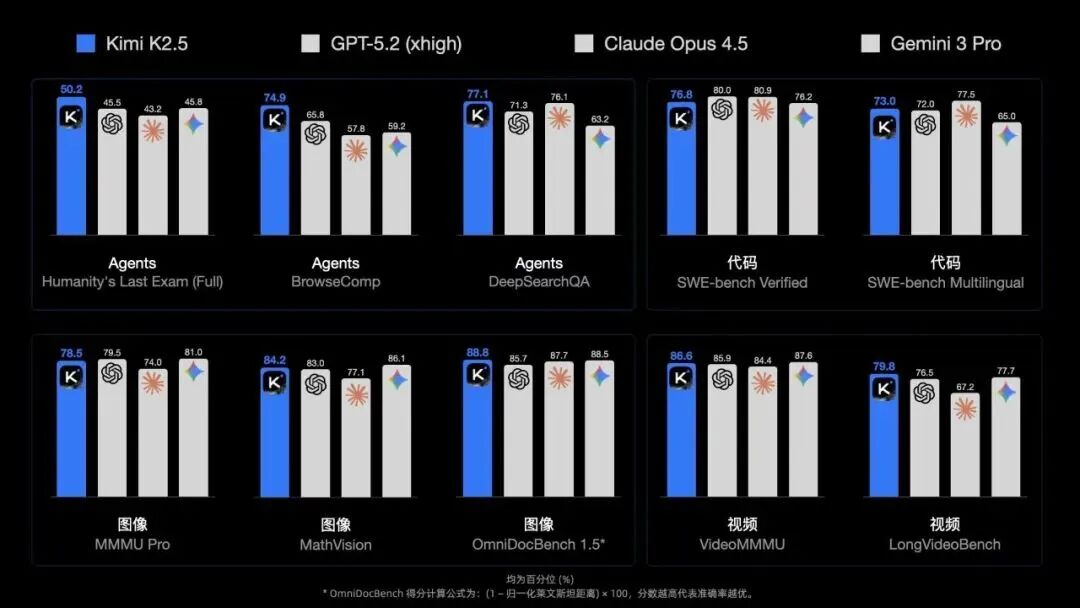
Kimi K2.5 Model Performance
Taste Is All You Need
"Why are you wearing shoes like that?"
After Ezra asked this with surprise, I was more surprised than her. On her office floor, nearly everyone keeps a pair of slippers under their desk, because comfortable clothing makes people more relaxed, more focused, and more creative.
This is the dress code of smart people.
I've met many top students, but the "good students" here are remarkably different. Ezra tried to hack her family's computer in elementary school simply because her parents wouldn't tell her the password; in middle school she developed interest in Bitcoin, then priced at just 300 RMB per coin, and urged her mother for pocket money to invest — her mother told her it was a scam; on her first taxi ride in high school, she sketched a ride-hailing product model, though without AI tools at the time she couldn't launch it early; in college she finally had her own spending money and entered the stock market, losing 90% in A-shares.
This investment Waterloo led her to deeply reflect on human limitations, unlocking her interest in AI.
Her understanding of AGI is simple: create N Einsteins to solve all humanity's hard problems. From then on, she resolved to find a company exploring AGI's limits — though she had already earned back her A-share losses.
With her solid academic background, she received offers from major companies. She chose Kimi simply because during the interview, founder Zhilin Yang's deep technical understanding and meticulous attention to detail moved her. She believed Yang was someone who truly cared about models. He lacked the restlessness of smart people and the utilitarianism of businesspeople; until the interview ended, she didn't know he was the company founder.
Karen was rebellious from childhood, arguing with teachers and never obeying parents, insisting on studying abroad despite opposition, then insisting on starting a company after graduation, finding stable and comfortable big-company life despairing. He wanted no life whose end was visible from the start.
I asked him: If you had to choose between 100% certainty of 60 points, or 1% chance of 100 points, which would you pick?
He chose the latter without hesitation. Not that he couldn't stand 60 points — he just hated that 100%.
Such entrepreneurial DNA forms a certain collective undertone. According to incomplete statistics, at least 50 people at Moonshot AI have founded or joined startups.
Clearly, Kimi likes hiring CEOs.
More precisely, this place shelters wave after wave of wandering geniuses. Genius need not mean top student or good student — what matters is possessing eyes that penetrate time in some dimension.
In this company where 80% of employees hold degrees from "985" and "211" universities, Yannis's credentials are unremarkable. Yet as early as 2023, he foresaw the rise of DeepSeek and Kimi in engineer communities — an era when model companies had no products. This foresight was discovered by another Gen-Z colleague who referred him to the company.
Karen says too many smart people are trapped in systemic shackles. From family to school to workplace, they unconsciously submit to the collective, unable to see their true inner needs. Only a small fraction attempt escape, and are often unseen by the world. One of Kimi's missions, he says, is to see them.
Without this seeing, there would be no 17-year-old high school intern collaborating with Kimi's team to publish a paper praised by Musk. The person who put him as first author was precisely the "talent scout" Bob who had discovered him.
There's a fine line between genius and madman. When an uncomprehended madman arrives at Moonshot AI, he may suddenly become a genius who changes the world; or those geniuses not yet revealed to the world can only bloom wildly here. Bob told me that, in a sense, a big ego isn't a problem — it might even be a good thing. Treating ego as internal drive, convinced that one must participate in some great cause: that's the truly mad genius, and also the kind of person they would never want to miss.
Genius is obsessive.
On this team, training top-tier AI models is called "alchemy," and alchemy is essentially endless bug-fixing. After launching a Flagship Run, Bob and his colleagues developed an unshakable habit: the first thing they do upon waking is refresh over a hundred thousand internal monitoring metrics. Any abnormal spike on the screen triggers alarm — is there an optimization problem? A flaw in the architecture? Or misaligned numerical precision?
They're as sharp as trained animals. Some even filter out tokens with extreme gradient values from the training corpus, print them one by one, and interrogate each word: why do you fluctuate so violently?
Everyone who has truly participated in this "delivery" has endured days of such tension they couldn't sleep at night. They're not anxious — curiosity drives them. Obsessive vigilance pushes this model to industry-leading levels.
Geniuses cluster.
Over the past year, more than 100 of Kimi's hires came from internal referrals — friends, or friends of friends. This recruitment model is internally called "human-to-human transmission." Based on these deeply connected networks, trust becomes a natural organizational asset.
Essentially, Kimi shifts the difficulty of organizational management onto talent acquisition. People attracted through referrals "share the same scent," echoing the keyword almost everyone emphasizes: TASTE.
One evening in September 2025, several engineers casually launched an internal side project named "Ensoul" — meaning "to give a soul." The name itself reads like poetry: they wanted sleeping code files to "come alive," becoming conversational agents in the command line.
This sensitivity to naming is no accident. They once had a framework called "YAMAHA," actually an acronym for "Yet Another Moonshot Agent"; and the core underlying layer was named "Kosong" — "emptiness" in Malay, drawn from the Zen concept of "form is emptiness," signifying a blank sheet that presupposes no function yet contains all possibilities.
Such taste determines what the product looks like.
While others crammed chat windows into command lines, they found it ugly: real programmers open terminals to input commands, not to chat. So Kimi CLI was designed more like a "smart shell" — it understands the commands you type, without forcibly becoming a chat window.
This minimalism extends to the code itself. The entire core logic is just 400 lines of Python, like a short poem with all unnecessary ornamentation deleted. Modules are decoupled so cleanly that users can not only customize functionality but also disassemble Kimi into parts and assemble their own applications.
Even Kimi Agent early on identified with "OK Computer" — though the name was eventually changed due to its high barrier to dissemination. But the namer seemed indifferent to internet rules of traffic maximization, obeying only private musical taste and linguistic fastidiousness.
Someone half-jokingly said that if measured by the proportion of employees who play musical instruments, Kimi might rank first among AI companies.
Taste becomes the highest, and hardest to achieve, hiring standard. It cannot be quantified, yet it is everywhere.
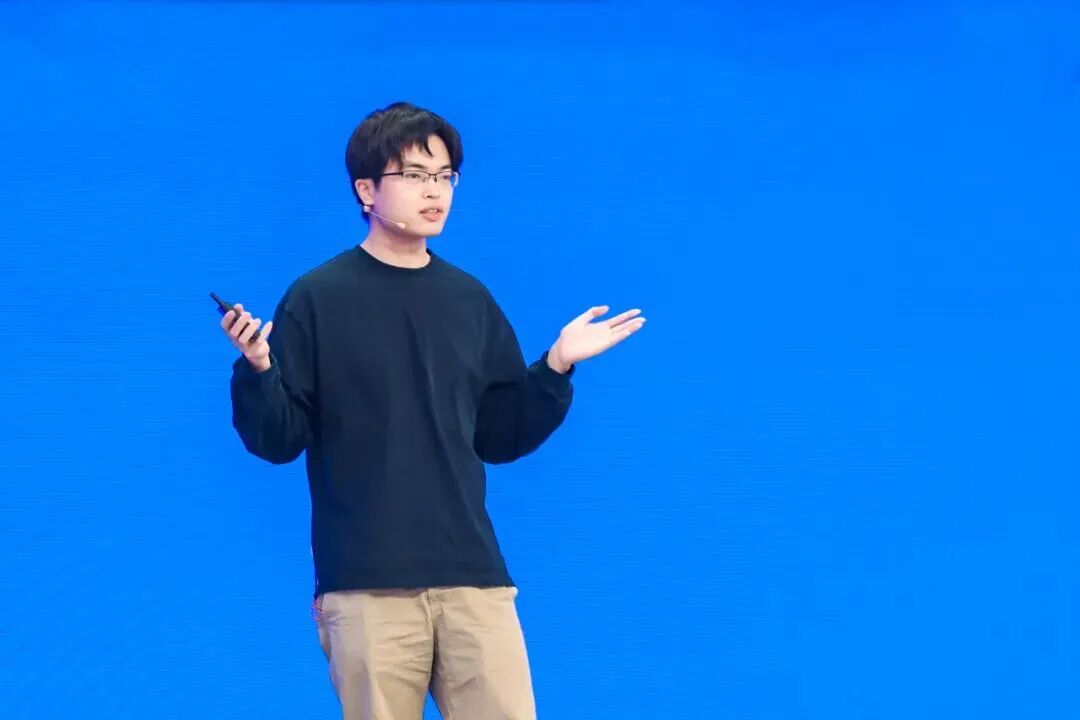
Kimi founder Zhilin Yang
Generalize, Then Evolve
You may never figure out what exactly each person at Kimi is doing.
The company prefers the word "team" to describe division of labor. Broadly, directions like algorithms, product R&D, growth, strategy, and operations are roughly clear — but once you drill down to so-called "departments" or even specific roles, no one can say for certain —
Because you're facing an organization with no departments, no ranks, no titles, no OKRs or KPIs, and reporting lines so simple they seem unreal.
For Brandon — who graduated from Tsinghua University for both bachelor's and master's, had held management positions at Silicon Valley giants and Chinese "big tech," and built a billion-dollar startup — this was simply incomprehensible. Deep in the industry for years, technically management-oriented, having led teams of nearly a thousand, he had wanted to extend his experience in AI to make his mark. But he was told by co-founder Yutong Zhang that the company didn't work that way, because the team size she could offer him was — around 2 people.
Driven by some intuition about the future, he wanted to talk further.
So in January 2025, on a long night of spreading doubt and restless minds, Brandon met his Tsinghua junior, founder Zhilin Yang. The former couldn't have known then that the latter's name would today be so frequently mentioned alongside Elon Musk and Jensen Huang in the media. All he remembered was what this junior said after the pleasantries:
"Brother, RL is the future."
After that, the conversation resembled more of Zhilin Yang's murmuring to himself — so deep in his own thoughts that Brandon couldn't understand most of the Chinese. But he couldn't deny that for the first time, he realized the knowledge structure and思维模式 he had built over two decades was collapsing on the eve of a revolution, along with all his ego. As for why he ultimately decided to join, he told me somewhat mysteriously: Zhilin Yang might become a great prophet, because he is sufficiently visionary, and sufficiently pure.
Later, when this company that doesn't use titles hesitated because they truly didn't know what role to give him, his firm response didn't sound like a joke: "Even if you have me clean toilets, I'll come. And I'll clean them the best."
Not all big tech managers and experts thrive here. Phoebe is a post-2000s girl who transferred from the growth team to product R&D, calling herself "a clueless yellow-haired girl." She told me seriously that at this company, rich experience and deep credentials can become baggage — the AI industry is too new, changing too fast; a seasoned expert might not learn and grow as fast as a "yellow-haired girl" like her.
She has seen at least three mid-to-senior-level big tech executives fail to land here. One eventually decided to spend his remaining years in another industry, because he found the people around him extremely young, extremely smart, and after being crushed again and again, he completely broke down — this wasn't his era or industry, better to accept fate and lie flat.
After the DeepSeek moment, Phoebe also developed deep crisis anxiety, determined to completely abandon research on user acquisition, wanting instead to help the company on product and R&D. She began relentless knowledge cramming, even live-streaming her studies on Bilibili for hundreds of hours. But what surprised her was that the company gave her the transfer opportunity without any hesitation from the start.
In fact, among just the thirty colleagues interviewed, over half had changed job responsibilities multiple times. Compared to their previous jobs, this proportion likely reaches 80% — meaning almost everyone at Kimi is doing something completely different from before.
Kimi likes people with generalization ability.
In AI terminology, generalization ability refers to a model's effectiveness in new scenarios beyond its training data — not rote memorization of answers, but capturing underlying structural patterns. Those big tech mid-to-senior levels, trained too long in giants' specific KPI systems, reporting jargon, and resource博弈 rules, have algorithms overfitted to local optima. When environmental variables fundamentally change, their abilities may fail during adaptation to new distributions.
If traditional big tech employees are like specialized models, then the individuals Moonshot AI pursues are like foundation models: mastering basic rules through SFT, then using RL to self-play across diverse tasks, ultimately gaining cross-domain transfer ability.
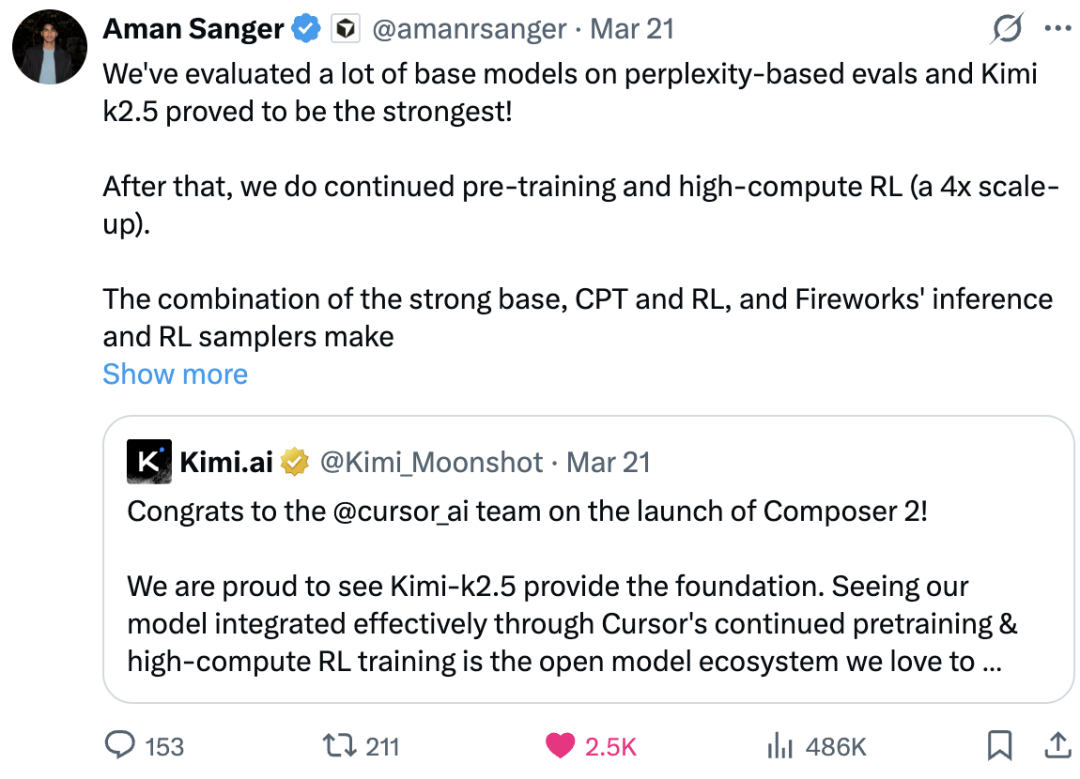
Cursor's founder publicly apologized and acknowledged that Kimi K2.5 is the "Strongest base model" in its evaluations, the soul of its core product.
James is a returnee from Silicon Valley, 26 years old, whose dream is "to give money to young people." A devout and fanatical AI believer, he considers his physical body merely a sensor for his Agent to gather information. When playing League of Legends with friends, he simultaneously records audio and collects his own heart rate, pulse, and other physiological data to analyze which teammate's words affected his emotional state and operational performance. His views are sharp to the point of near extremism:
Anyone over 14 learning a completely new language can never achieve native-level mastery. AI is the same.
Dan, who joined right after graduating, experienced "knowledge anxiety" for the first time. In school he had at most tinkered with "toy-grade" models — 7B parameter small models, finished in days on 32 GPUs; now he must harness a Mixture-of-Experts architecture beast with hundreds of billions of parameters, facing an ocean of trillions of tokens — equivalent to jumping from a small pond directly into the Pacific. To conquer this, he entered self-abusive learning mode, his schedule completely scrambled: working on Beijing daytime following Silicon Valley's late night rhythm, then switching to Beijing's late night when it's daytime in Silicon Valley, staring at training monitoring screens for hundreds of hours without daring to blink, like a stock trader watching the board.
The real challenge isn't workload — he must wear three hats: algorithm architect, designing optimal solutions in the labyrinthine model maze; systems engineer, troubleshooting in the quagmire of distributed computing like repairing a pipeline system spanning the globe; and data curator, "alchemizing" in massive data, performing hardcore on benchmarks while keeping the conversational experience soft enough.
Mid-training, "internal surgery" suddenly occurs: key parameters have been stored in half-precision (bf16), numerical anomalies spike wildly, about to go out of control. The team decisively switches to full precision (fp32) halfway through training to stabilize the situation — like changing running shoes mid-marathon. Dan says someone who only knows algorithms, only systems, or only data cleaning — a single-point expert — cannot build a top-tier model.
There's no "I only handle this part" excuse. Here you're required to融会贯通 algorithm, engineering, and data — three completely different worlds — equivalent to working several jobs simultaneously. This cross-dimensional tempering allows people to evolve in extremely short time what others take years to achieve.
So for anyone trying to join Kimi, the test is brutal.
There are no OKRs or KPIs here, no office politics or leadership gaslighting, not even clock-ins or attendance tracking — but if you aren't "AI Native," if you can't generalize, if you can't do RL, then you won't find meaning in your own existence.
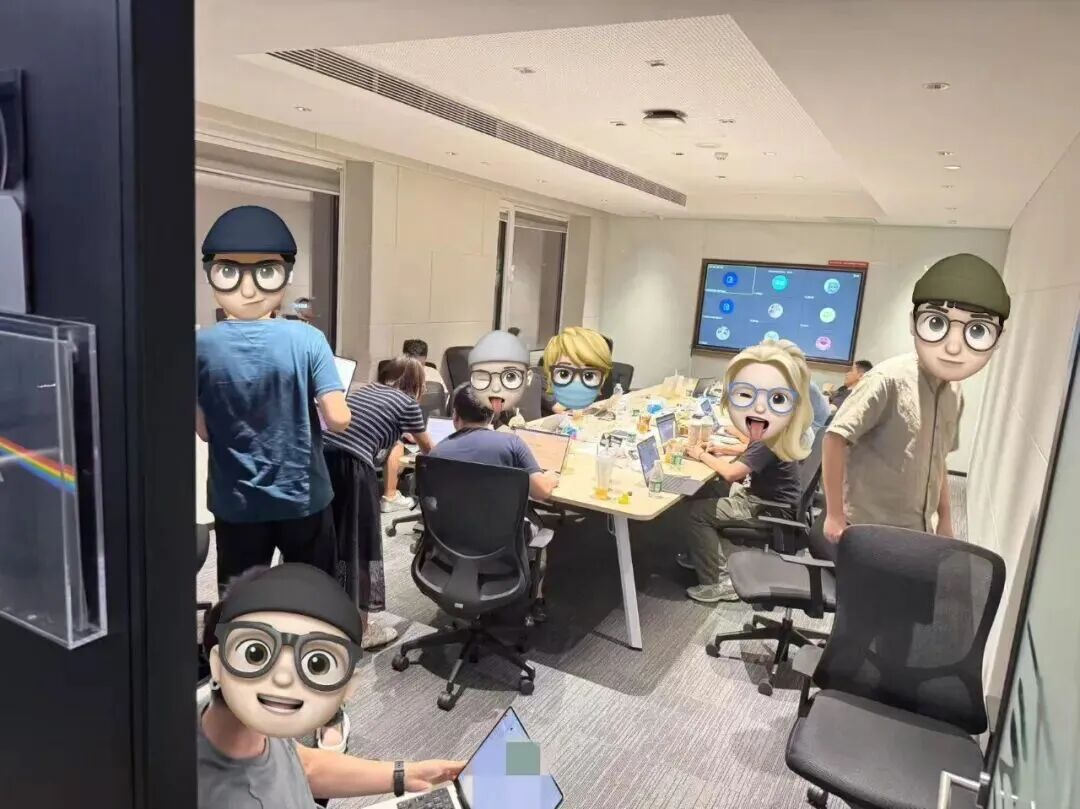
The night before the Kimi K2 model release
"No Corporate Vibe Here"
Most brands want a story. But every Kimi colleague has kindly warned me:
Don't write about Pink Floyd, or the piano sitting at the company entrance.
They figure those who get it already get it; those who don't needn't bother. From Moonshot AI to Kimi, neither name's origin has anything to do with technology or AI. But when a company overemphasizes its bond with rock and art, it comes off as affected. People prefer beauty without self-consciousness.
Win is a post-00s who escaped Big Tech. He told me this place is bizarre — you can actually get work done without meetings.
At his previous company, days were for meetings; nights were for actual work. He arrived at a simple insight: If your main energy goes into coordinating production relations, there's little room left to improve productive forces.
This is characteristic of an AI Native organization. More than ten employees explicitly said they increasingly prefer interacting and collaborating with AI over real people — AI is more reliable, simpler. This also reflects the company's overall introverted personality. Someone used a cuter word: shy. Everyone can be a social butterfly in group chats, yet remain silent in person. Kimi doesn't have many cultural activities; besides the annual party, the most recent was organizing office massages.
Introversion doesn't mean rejecting communication or lacking vitality. Though no interview was anyone's task or obligation, I never received a single "no." In group chats, massive amounts of information flow rapidly every day, alongside abstract emojis of every kind. No one's comments are met with silence.
If you need to accomplish anything requiring others' assistance, it's simple: just ask. No need to go through leadership, no approvals, no coordination meetings, no breaking down "department walls." Kimi has no department walls — it doesn't even have departments.
Zhilin Yang's personal signature is just four characters: communicate directly.
But everyone admits the company has been changing since day one. Some changes are proactive, some reactive, some even feel like getting slapped in the face. From massive user acquisition to focusing on models; from insisting on closed-source to rapidly going open-source; from chatbot to Kimi Agent, Kimi Code, Kimi Claw; from B2C to B2B and back to B2C... Not every change holds up to scrutiny.
In Ezra's mind, one thread remains constant: respect for facts. She knows all changes have one cause and one purpose — to make the company's development align more closely with objective laws.
The company allows everyone to have ego, but dislikes hiring people who place themselves above facts. From co-founders to every colleague, people are persuadable. As long as facts are clear enough, people are willing to acknowledge their limitations — and so is the entire organization.
Ezra says it's this extreme pursuit of reality, truth, and the true nature of things that lets people speak honestly. Because truly smart people don't have their pride wounded by honest words.
Another necessary condition for radical candor: there is no horse-race mechanism here, no zero-sum games, no conflicts of interest. Every member willingly shares their research findings and technical details for free. Just as the company had its own community early on, it now advocates community culture. The sharing of information and knowledge accelerates collective learning and collective progress — and ultimately, everyone benefits.
Win says toxic culture is contagious. Good culture is too.
Someone used "solidarity" — an archaic word long unused to describe a company — to capture this state. In reality, Kimi has always faced a harsh survival environment: giant competitors outside, Big Tech squeezing from within, constrained compute resources. But these adverse factors are intensifying the company's cohesion. At the end of the day, people are the only asset that matters to an organization.
Recently, Florence was poached by a peer company at double her salary. She refused without hesitation. Her reason for staying was simple: "There's no corporate vibe here."

The company's new location (JD Technology Building)
"I Don't Know How She Got Through It"
Early in my interviews, facing some of the smartest, most AI-literate people in the world, I was incredibly nervous: as a humanities major, I'd never worked in tech, and my understanding of AI was shallow at best.
But when I actually started talking with the young experts on the algorithm and product-research teams, I discovered they were even more nervous: they were terrified I'd feel embarrassed for not understanding the jargon they used.
So everyone carefully translated English into Chinese first, then translated that Chinese into Chinese I could understand.
This protectiveness was deeply moving. I thought back to the company's only request before interviews began: protect everyone.
So I avoided overly sensitive questions or ones that might touch a nerve. Even so, Ty revealed a barely perceptible emotional tremor during our call. When he first joined and was getting settled, he encountered such difficulty that he once felt he couldn't continue and considered quitting. Then at a weekly meeting, he saw Annie — a girl just two years out of school — who, after who knows how many rounds of setbacks and internal doubt, had finally pushed a project to substantial heights. He felt he couldn't give up either. After all, he was much older, with far more life experience, yet his mental resilience paled next to hers. He marveled: "I don't know how she got through it."
It wasn't just him who'd thought about leaving. Annie had considered quitting too. For a long stretch, she needed to build something from zero to one in an overseas segment, without breakthroughs. To make matters worse, colleagues from other teams, meaning well, directly advised her to "give up on this meaningless effort." She said she'd cried more for Kimi than for anything in her life — never for another company, never for any ex-boyfriend.
She wasn't short on opportunities; she even had a better-paying offer. But she couldn't convince herself to sell her soul to someone else. She wanted one more conversation with Yutong Zhang.
After they talked, she decided to stay. She didn't tell me what was said, only: Yutong is the most resilient, fastest-evolving, highest-ceiling boss I've ever seen; following her, I can reach a higher ceiling. Then she added: "I don't know how she got through it."
When you've gathered enough information, you notice how often certain phrases repeat. And the most repeated words tend to sketch the shared character of this team.
Bob was pulled back to China by Zhilin Yang to start this company, giving up his PhD opportunity in the US. He joined on day one, representative of those who know the company best. When asked the question everyone gets asked — what do you think is the team's most important quality? — he thought for about two minutes and answered with two words: resilience.
For a company only three years old, any emphasis on resilience is extravagant, but no less sincere. He believes smart and brave can be antonyms — the smarter you are, the easier you see risks, the easier you are to quit. And stupid persistence can't succeed either — so only those who see the truth, calculate the probability of failure, and still keep going deserve to be called resilient.
A story once circulated internally about "three entries into the Repentance Cliff."
In May 2023, Freddie and colleagues received a seemingly impossible task: make AI capable of reading 128K-length text in one go (equivalent to hundreds of pages), while the industry standard was roughly 4K. He quickly designed MoBA v0.5, but because it required rewriting the underlying training framework and the main model was already halfway trained, the cost was too high — the plan was shelved. This was his first entry into the "Repentance Cliff."
Half a year later he returned with v1, revised to allow continued training from the existing model. Small-model validation succeeded, but the large model hit loss spikes (sudden training loss surges) that couldn't be fixed despite all debugging. The project retreated to the Repentance Cliff a second time, for half a year, even missing the company's 200,000-character release milestone. But the team didn't disband; the company launched "saturation rescue" — mobilizing technical leads across the company to collectively attack the problem, rewriting the underlying logic, finally letting v2 stably pass the "needle in a haystack" test.
Just as it was about to launch, the third blow came: during SFT, long-text summarization tasks performed poorly due to overly sparse training signals. By now the project had incurred massive costs, but engineers retreated once more to the Repentance Cliff to find solutions, finally resolving it by adjusting the attention mechanisms in the final layers.
Three retreats, three returns. At the interview's end, I posed Freddie the ultimate question: how should this company be described?
He too answered with just two words: moonshot.
Why moonshot? He quoted that famous speech:
"We choose to go to the moon in this decade and do the other things, not because they are easy, but because they are hard."
"We choose to go to the moon in this decade and do the other things, not because they are easy, but because they are hard."
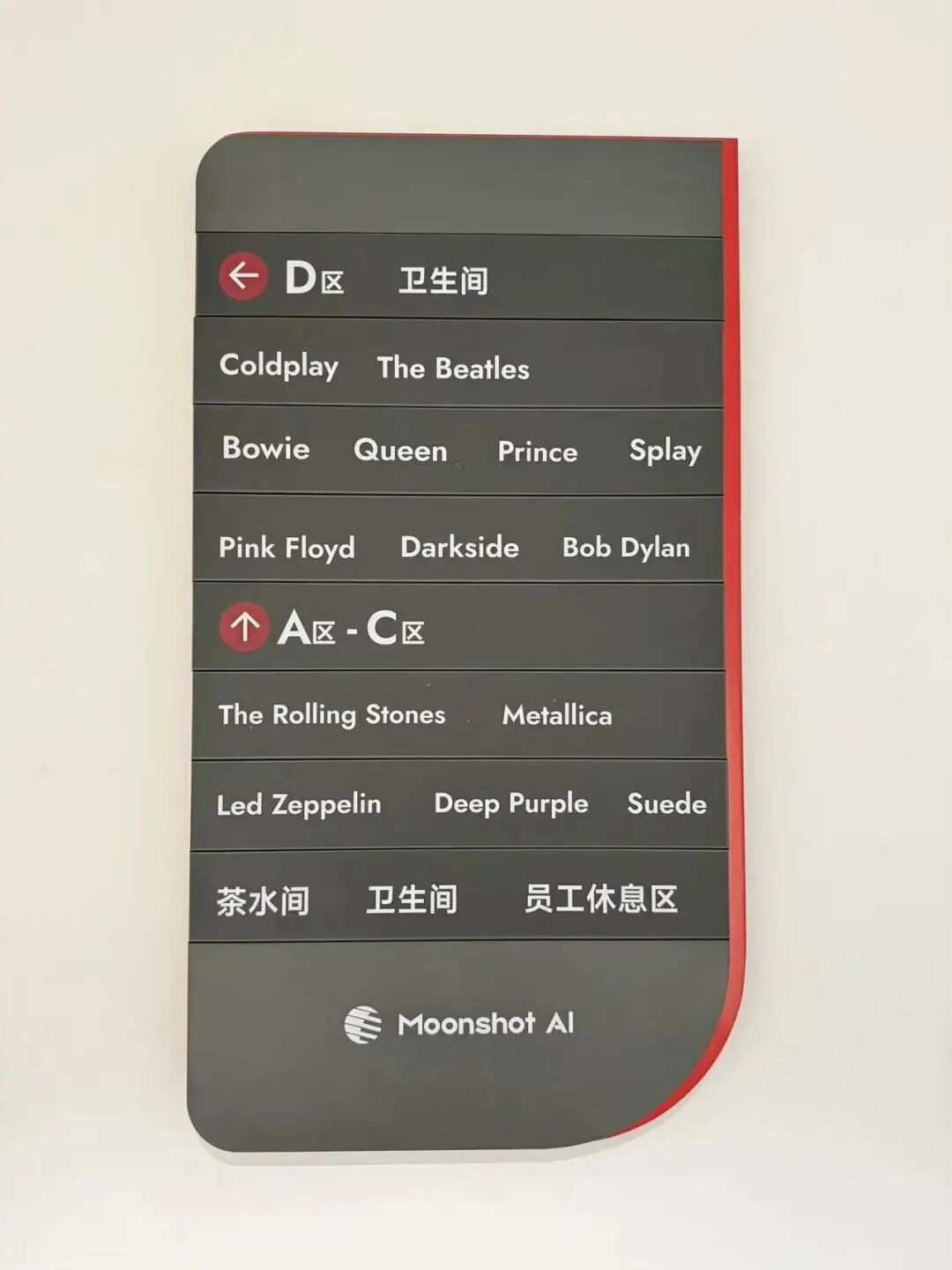
The company's meeting rooms are all named after bands
Genius Swarm
I ultimately didn't disturb or attempt to pry into any of the co-founders. Externally, they remain invisible — they dislike interviews, have no desire for fame. But internally, they are almost everywhere.
Under an extremely flat structure, superbrains must serve as the foundation; otherwise vitality devolves into chaos. With no middle management layer, each co-founder connects with 40 to 50 colleagues, embedded deeply in technology and business frontlines, ensuring the company's decision-making and execution stay highly aligned.
Though all five co-founders are from Tsinghua University, carbon-based lifeforms have finite bandwidth and management radius. When the company reached a 120 billion valuation and expanded to 300-plus people, even the superbrains began operating overloaded.
The overload isn't limited to co-founders. This is an infinite game driven by self-motivation: each team member must carry roughly 400 million in per-capita valuation, meaning they must create value far exceeding what many companies achieve per person.
The revolutionary variable is tooling. Kimi's working hours aren't extreme. Employees are allowed to sleep until they naturally wake, with no expectation of grinding past midnight. Leo, on the product team, says he commands an army of thousands. Picture this:
At 10 a.m., Leo strolls into the office. His task: synthesize user feedback from five global markets over the past 24 hours and set this week's iteration priorities — work that previously required three people and two days. Leo launches three agents. A strategy agent filters 3,000 feedback entries to surface high-priority needs related to "long-context interruption." A translation agent parses Japanese dialects and Korean honorifics in real time, flagging genuine emotional intensity. A competitor agent simultaneously captures Cursor and ChatGPT's updates for the day, generating technical comparisons. Leo does only three things: vetoes one sarcastic comment that was misclassified, flags a screenshot containing unreleased UI, and confirms the top-three needs his agents recommended. By 11:30 a.m., the PRD is done. Meanwhile, his code agent has automatically generated 70% of the foundational framework based on those requirements, waiting for afternoon discussion with human engineers on creative solutions.
Humans set the rules; silicon executes them. The organization becomes a container for algorithms. The ability to fluently deploy agents and deeply integrate them into workflows is the defining competence of an AI Native company.
Models are not merely the end goal; they are the means. Whether directly empowering productivity on the technical front or fundamentally reshaping management models organizationally, AI's genes are already etched into this company's bones — like it or not. Just as with its Agent Swarm, the team itself is essentially a Genius Swarm: each Genius operating in parallel independence, seamlessly coordinating with the rest.
Yet such flat structures carry structural fragility. When asked whether this model is sustainable as the company scales from 300 to 3,000 people, interviewers mostly gave cautious responses. After all, historically similar experiments in radical flatness — Holacracy, Haier's chain-group contracts — tend to hit decision bottlenecks once scale exceeds 500 people. When information nodes proliferate, "direct communication" devolves into information overload.
A more immediate pain point is the sense of weightlessness at the individual level. The absence of hierarchical buffers means directional chaos transmits directly to everyone. One former employee who ultimately returned to a major tech company put it bluntly: there are no top-down OKRs or KPIs here. Sometimes you walk into the office in the morning not knowing what you should be doing, with no one proactively telling you how you're performing — this insecurity of going without feedback led some to actually miss the clear reporting lines, defined review milestones, and quantifiable deliverables of Big Tech.
After all, those seemingly cumbersome rituals provide individuals with a baseline of certainty: where the goal is, what counts as completion, how performance is evaluated — everything visible and clear. This isn't Stockholm syndrome; it's basic organizational mechanics.
If Alibaba resembles a precisely calibrated promotion assembly line, ByteDance a goal-obsessed military corps, and Tencent a more fault-tolerant professional academy, then Moonshot AI is a primeval forest: geniuses may find their hunting paths, but ordinary people risk wandering lost in the fog.
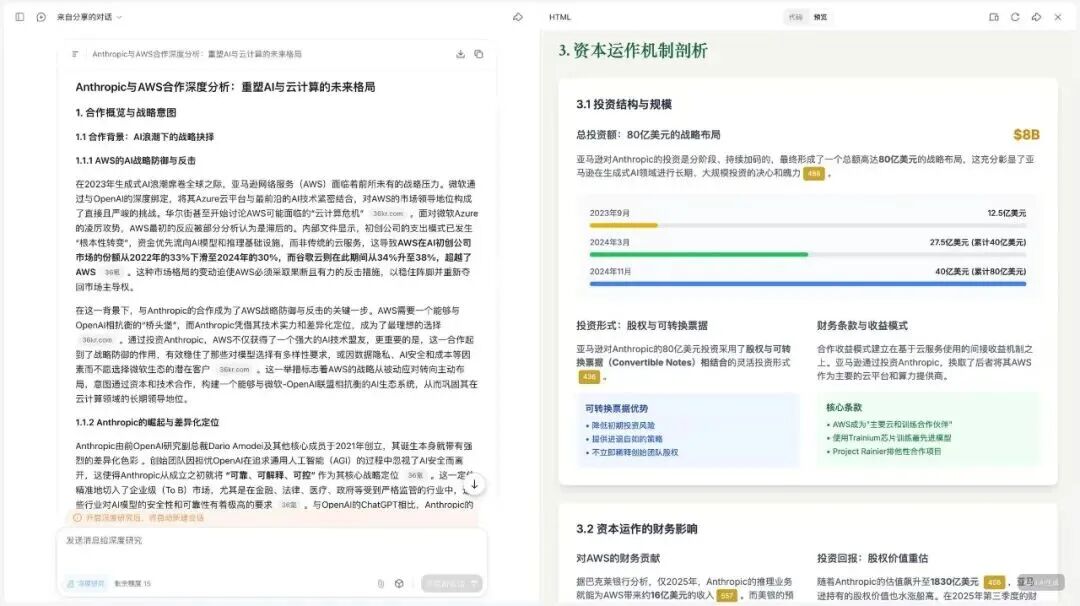
Kimi Agent conducting in-depth industry research
The Necessary "Dual-Vector Foil"
No departments, no ranks, no performance reviews — the AI Native organizational paradigm is anti-establishment, unstructured. Major tech companies can no longer pivot to this; smaller companies have missed their window for self-aggrandizement. This is asymmetric warfare.
In The Three-Body Problem, the Singer civilization casually tosses the high-dimensional weapon "dual-vector foil," flattening the solar system from three dimensions to two. Planets, stars, humanity — all collapse into a picture without thickness. Earth is destroyed.
Moonshot AI is actively deploying this same foil against its own organization. Not to annihilate rivals, but to push organizational efficiency to its extreme: no vertical depth of ranks, no horizontal walls between departments, no three-dimensional entanglement of office politics — only "models" and "intelligence" intersecting in the crudest, most direct way.
In the AI era's field of forced transformation, every startup is compelled to throw the dual-vector foil at itself. The surge of one-person companies is essentially the generational explosion of AI Native talent: when technological empowerment collapses organizational capability to the singularity of the individual, all intermediate management buffers evaporate instantly. The organization is flattened; no depth remains for maneuvering. Everyone is forced to confront the problem itself.
This is the iron law of organizational paradigm evolution across the entire business world: everyone will be folded.
When people are exposed on the same plane, one person's super-radiation over fifty ceases to be a management spectacle and becomes an organizational norm. The distance from center to periphery is redefined. Elites dependent on hierarchies and OKR coordinate systems suffocate immediately, while geniuses violently dismantle intelligence on this exposed plane, and guardians sweep away all entropic noise — not without humility styling themselves as pioneers expanding the boundaries of human civilization.
Yet from three dimensions to two, this process cannot stop, cannot reverse.
From here, the Kimis cannot turn back. Every strategic adjustment is a high-risk chaotic iteration. Rivals may still turn slowly in the labyrinth; if Moonshot AI attempts to accelerate organizational expansion, it will only trigger internal structural tearing. And all this self-dimension-reduction serves but one purpose: to complete an even more insane dimensional leap.
The endpoint of organizational dimension-reduction is intelligence dimension-elevation.
Only by breaking models past the inflection point of intelligence, ascending to sufficient height to escape the gravity well of all carbon-based organization, can Moonshot AI flatten all competitors' organizational advantages in one stroke — granting ultimate legitimacy to this irreversible adventure in dimension-reduction.
By then, discussions of management radius or architectural form will lose all meaning — just as the Singer civilization cares not what dimension it occupies, for the very advancement of dimensional weaponry defines new rules of war.
Then, "Moonshot AI" will transform from metaphor to reality: they become the high-dimensional light source illuminating the dark side of the intelligence universe, and all past organizational pain merely the ablative heat shield burning away as the lunar module punches through the atmosphere.
Either ascend to godhood through dimension-elevation, or be sealed away in collapse.
There is no third path.
(All English names in this article are pseudonyms.)