MONOLITH in Everyone's Eyes — Striving to Be a Honey Badger

Transparent, sincere, truth-seeking


As the year wound down, we did something that made us a little nervous — sent out an anonymous survey to 50 people asking what MONOLITH looks like through their eyes.
Eighty percent of respondents were founders; the rest were newsletter readers, journalists, and industry peers. We wanted to know how this four-year-old fund appeared to different people.
We expected a pile of standard answers like "professional" and "sharp." When the responses came back, well... emmm...
Operating on the principle that honest feedback beats flattery, we wanted to share some of the more interesting findings — and hopefully get even more real talk in return.

I. A Honey Badger
If you had to abstract MONOLITH into a fictional character, who comes to mind?
The answers were all over the map.
Some said "Sonic the Hedgehog," because "fundraising and investing both happen fast." Others compared us to Sasuke Uchiha from Naruto — born into privilege but burning with ambition. Another named Bayern Munich's Jamal Musiala, "doing the incredible from traditional positions with entirely new methods." Someone else said Zima Blue from Love, Death & Robots, "after traversing the universe, returning to the purest form of expression."
Then there was this one:
"A horse. Similar to Xi Cao."
Hmm, Year of the Horse — timely answer, that. Though we're not entirely sure what they meant.
The one that stuck with us most:
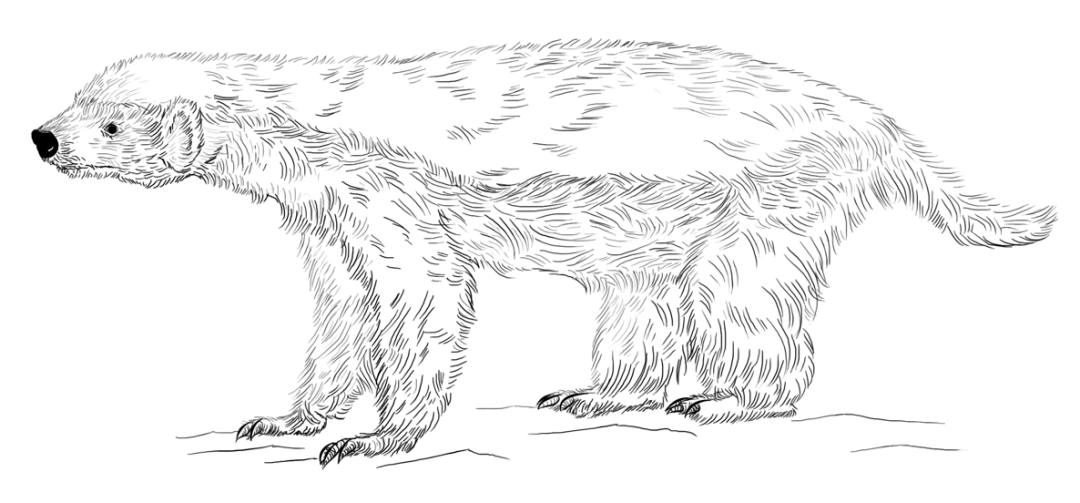
"A honey badger. Small but fearless. Doesn't talk much, just goes and does the most badass things."
They even wrote out the reasoning — four years, three funds, a team far smaller than traditional VCs. But invested in Kimi, putting 15% of one fund's allocation into Moonshot AI.
When we read that, the team went quiet for a few seconds. Someone said, "Yeah, didn't expect us to be most like a honey badger 🦨."
II. On "Endorsement" and "Having Their Back"
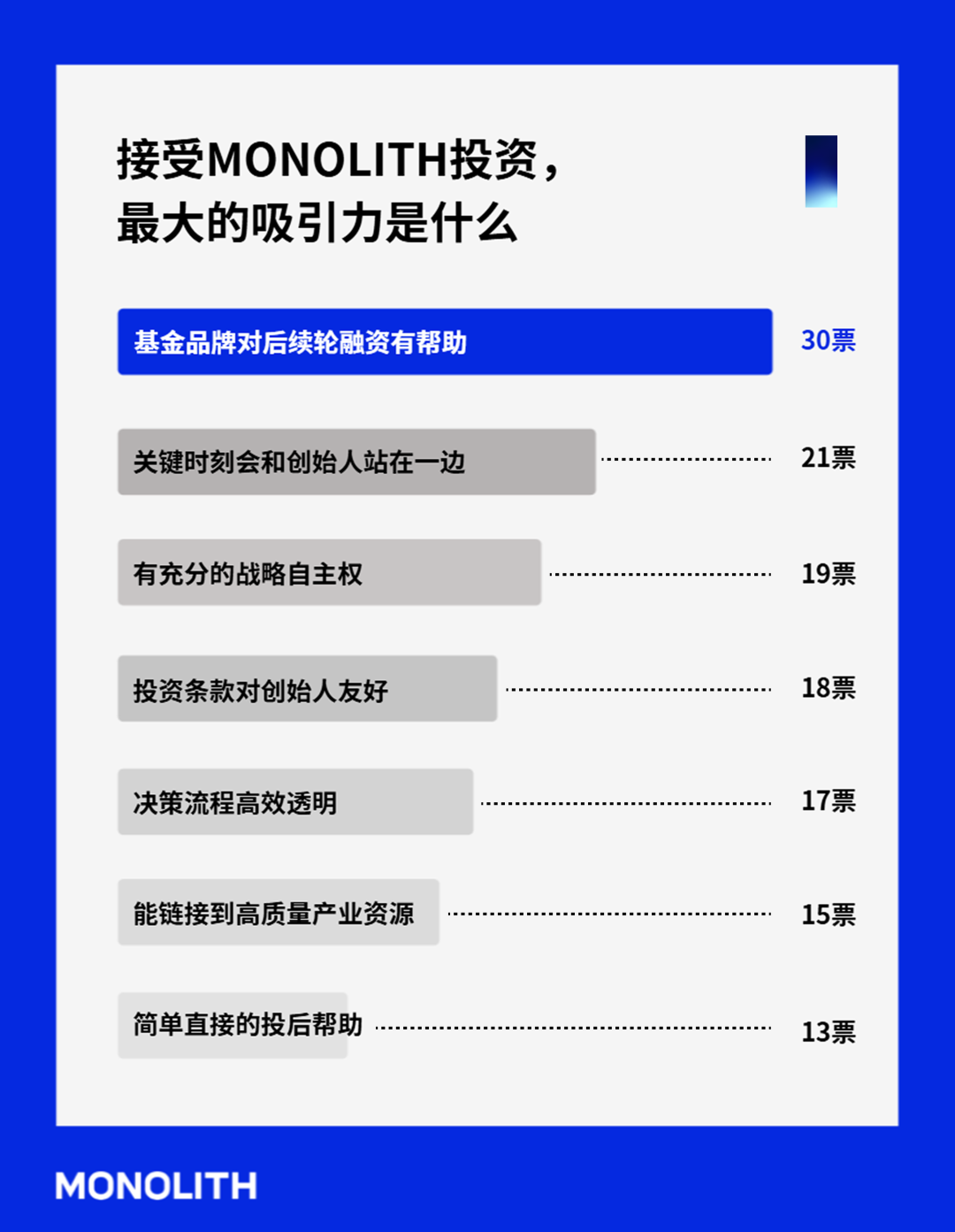
We asked founders: what's the biggest draw, and the biggest concern, about taking MONOLITH's money?
Behind this, we wanted to know: beyond cash, what should a firm actually bring to founders?
First place, with 30 votes: "brand halo that helps with follow-on fundraising" — far ahead of everything else.
We'd always assumed founders cared more about resource and network enablement. We didn't expect "brand" itself to be the top answer.
One respondent put it bluntly:
"Having MONOLITH on the cap table makes the next round easier. When people see MONOLITH invested, they figure the project must be high quality."
This reinforced our conviction: brand building is a long-term project worth sustained investment.
Second place, 21 votes: "showing up in critical moments" — meaning reliability when things get rough. Someone wrote this specifically:
"When Kimi hit a PR crisis, MONOLITH stood up and faced it together with the company. I remember that very clearly."
It brought us back to April 2024, when Kimi faced multiple waves of concentrated scrutiny. MONOLITH did two things then: first, internally, we directed every resource we could mobilize toward the team; second, at the company's darkest moment, we spoke out publicly and made our support explicit.
Standing shoulder-to-shoulder with the company through the crisis, we kept telling the team, "When a company does well, problems are inevitable. When a company does well enough, none of those problems matter. So just focus on building the business — nothing else is important."
After that, MONOLITH continued investing in Kimi across multiple consecutive rounds, backing the company's growth with real money and concrete post-investment action.
This isn't heroism. It's a simple conviction: when you back founders, you show up when they need you most.
Recently, Kimi has been performing well overseas, topping the OpenRouter charts for days now — and not just one ranking. Overall #1, coding #1, Python within coding #1, ToolCall #1, even English #1.
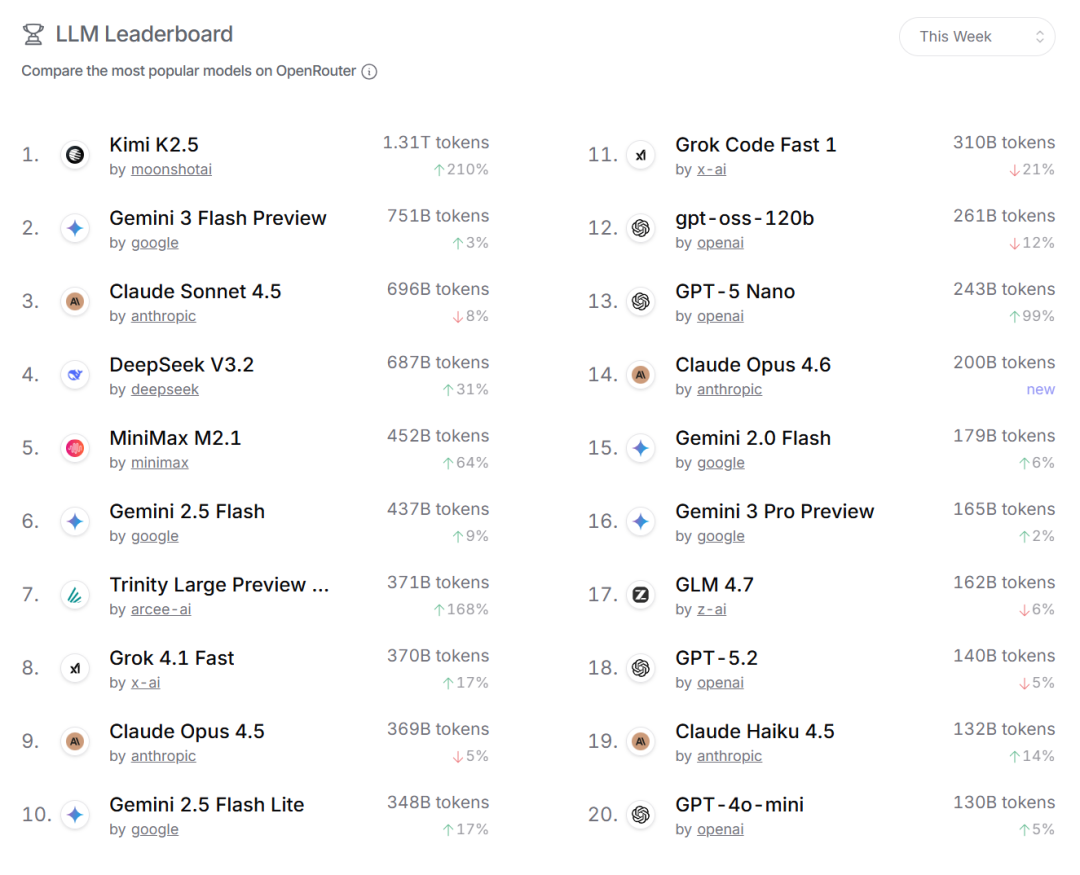
Kimi topping OpenRouter
So, "focus on building the business — nothing else is important."
III. "Young," "Unpretentious," and "Taste"
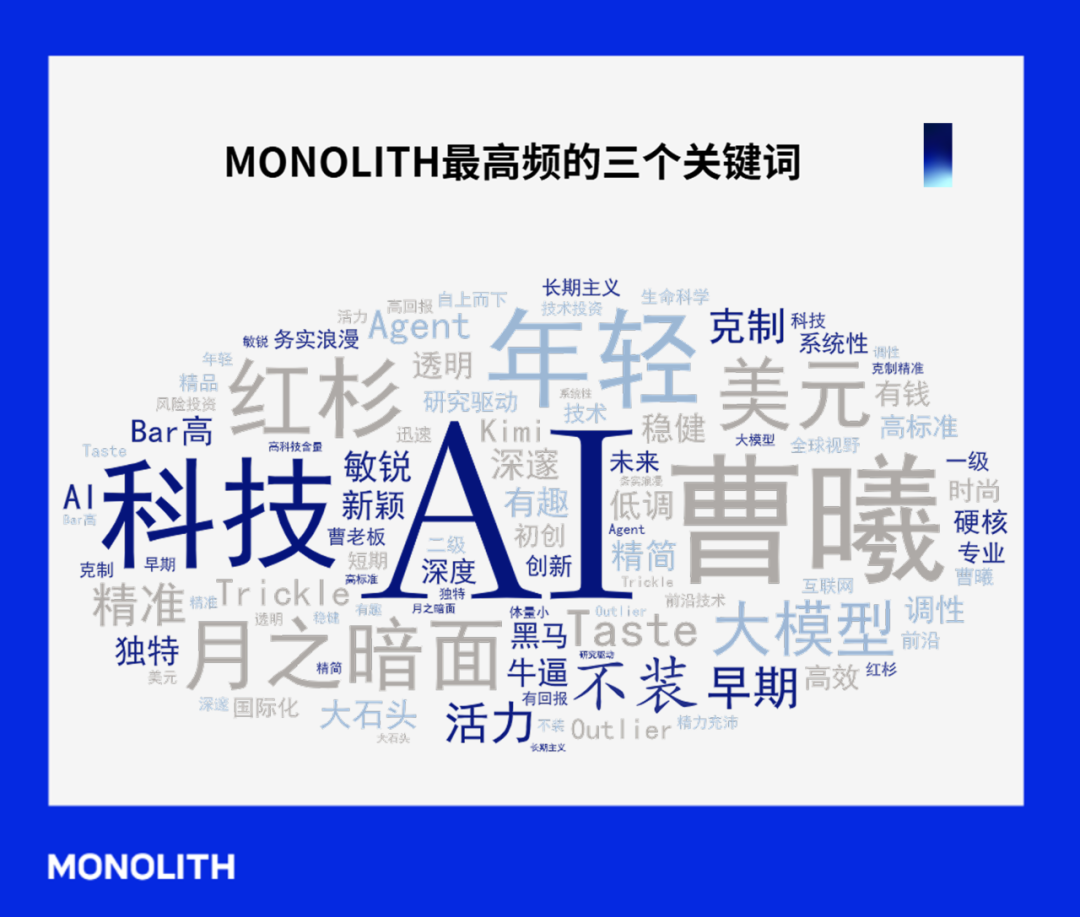
When people think of MONOLITH, what are the three most common keywords? "AI," "tech," "young," "Kimi," "taste," and "restraint" showed up most frequently.
IV. Why the "High Bar"
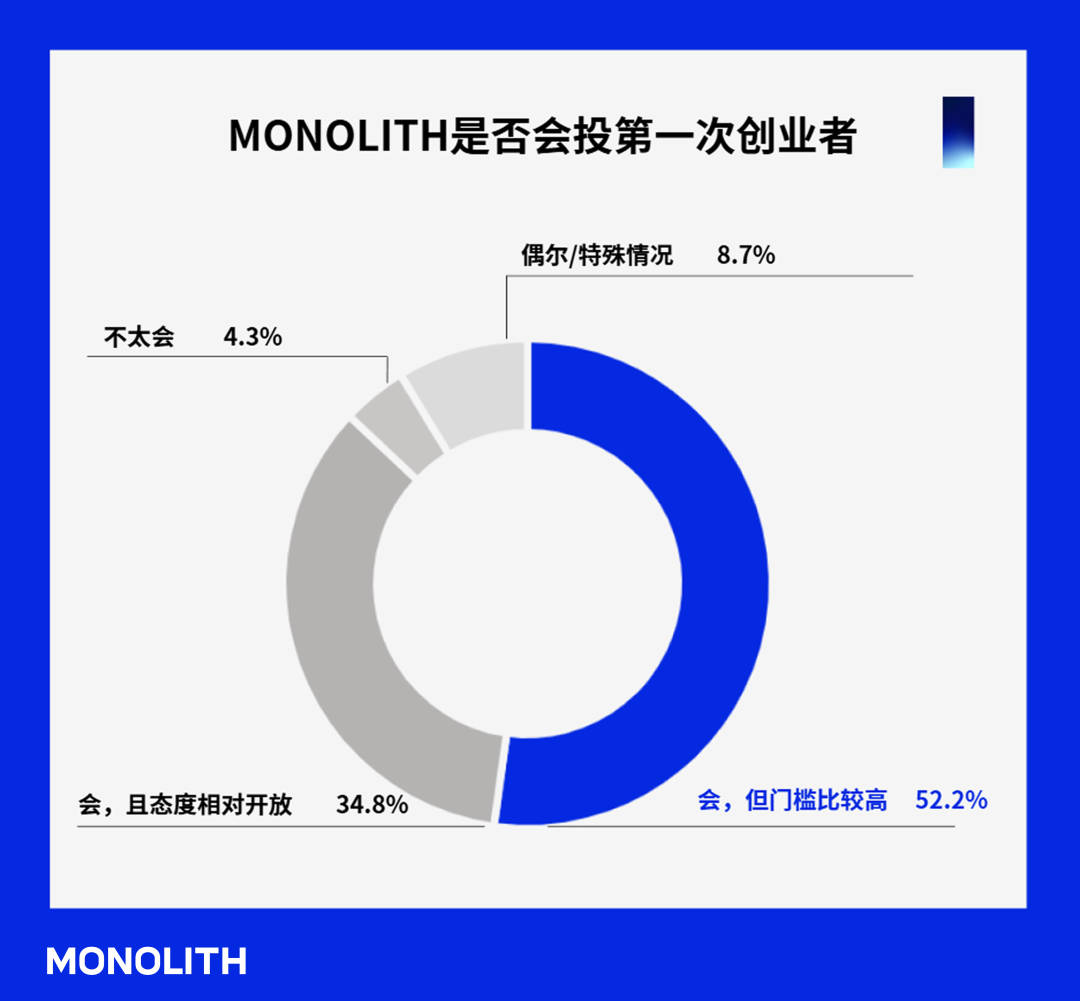
When asked whether "MONOLITH invests in first-time founders," over 52% said "yes, but the bar is high."
Someone put it this way:
"They will invest, but it's about the person, not just the resume."
Overall, people see us as "young," "open," and "willing to back first-time founders" — but also as having "a high threshold" and "strict standards," with a certain cool distance.
These two impressions seem contradictory.
In reality, we're absolutely willing to support early-stage founders. But we've never believed that "investing early" means lowering standards.
If anything, the earlier the stage, the more it comes down to the quality of the person — because apart from the person, you have almost nothing else to judge.
We've met plenty of founders in their early twenties. Some, within thirty minutes of the first meeting, you just know they're different — the depth of their problem understanding, the clarity of their thinking, their speed of learning and iteration, all several notches above their peers.
Whether it's their first or their Nth venture, these are the people we will always chase.
Early-stage investing is an extreme game. Each new business cycle, only a tiny handful make it. We're not looking for "capable people doing decent things." We're looking for outliers doing potentially huge things.
So the bar has to be high.
Not to make life hard for founders. It's that entrepreneurship, this nine-lives game, makes life hard for everyone.
We can't give each other the illusion that "this is easy" before even stepping onto the battlefield.
Being accountable to LPs is also about respecting founders' time.
V. Hopes for the New Year
When asked which three MONOLITH portfolio companies left the deepest impression, the results were heavily concentrated: Moonshot AI / Kimi appeared 30 times.
MetaX came up 12 times. Others like Xinmai, Jike, Even, Lexiang, Digua, and so on were in the single digits.
The truth is, many of our portfolio companies are doing very well.
In the coming year, we'll tell more of their stories.
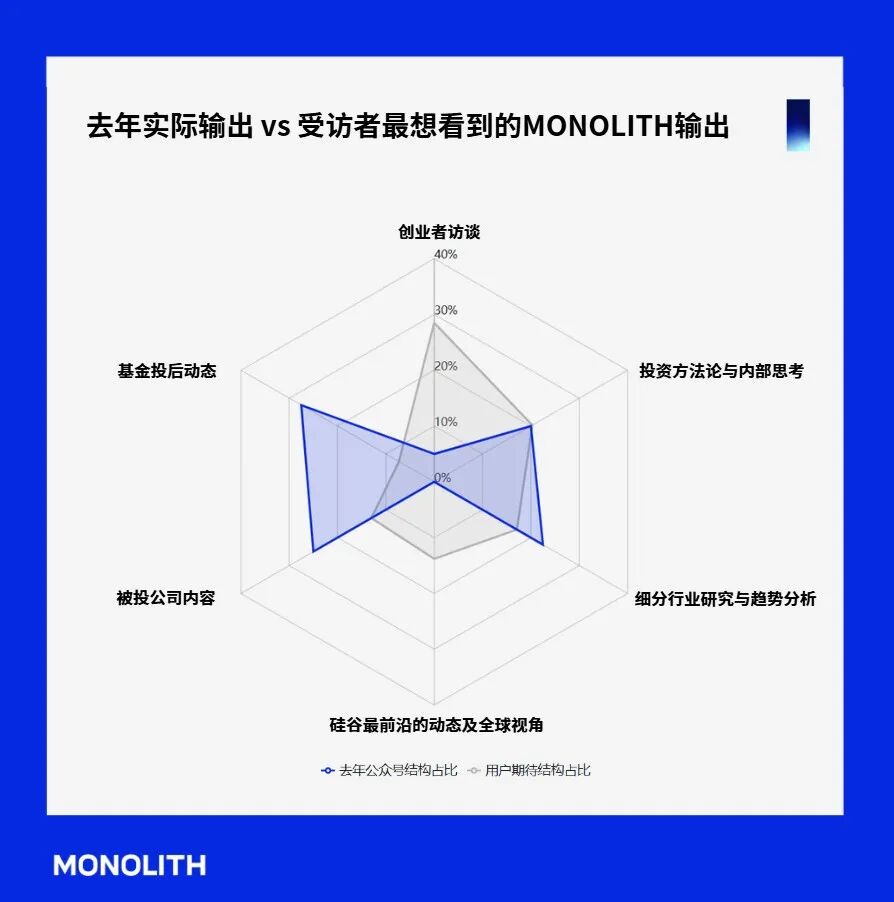
Also, 28.5% of respondents said they most wanted to see "founder interviews" — yet that content category was only 2.9% of our output last year.
Someone asked:
"Why did the podcast Prime Mover stop updating?"
Allow us to bow deeply here 🙇🙇🙇 On one hand, last year was genuinely too busy.
On the other, for many early-stage founders, there isn't always the willingness or necessity to step into the spotlight. Some want to fly under the radar longer. And excess attention can be an additional test of temperament.
The law of the dark forest — we completely understand.
In the year ahead, we'll keep holding the mic out at the right moments, making content that's substantial and engaging.
VI. Finally
This survey wasn't huge — just 50 people, hardly representative. But we did see some real, interesting feedback, and we'll act on it.
If anything in this piece sparks thoughts, suggestions, or gripes about MONOLITH, drop them in the comments.
We'll read every single one, and pick a few of you to receive New Year gifts.
Happy Year of the Horse!