Metis Pharmaceuticals lists today, marking Monolith's first HKEX IPO

The scientist who pitched in a KFC just went public today.


On May 13, 2026, METiS Pharmaceuticals (07666.HK) debuted on the Hong Kong Stock Exchange, surging over 180% at the open and briefly surpassing HK$34 billion in market cap.
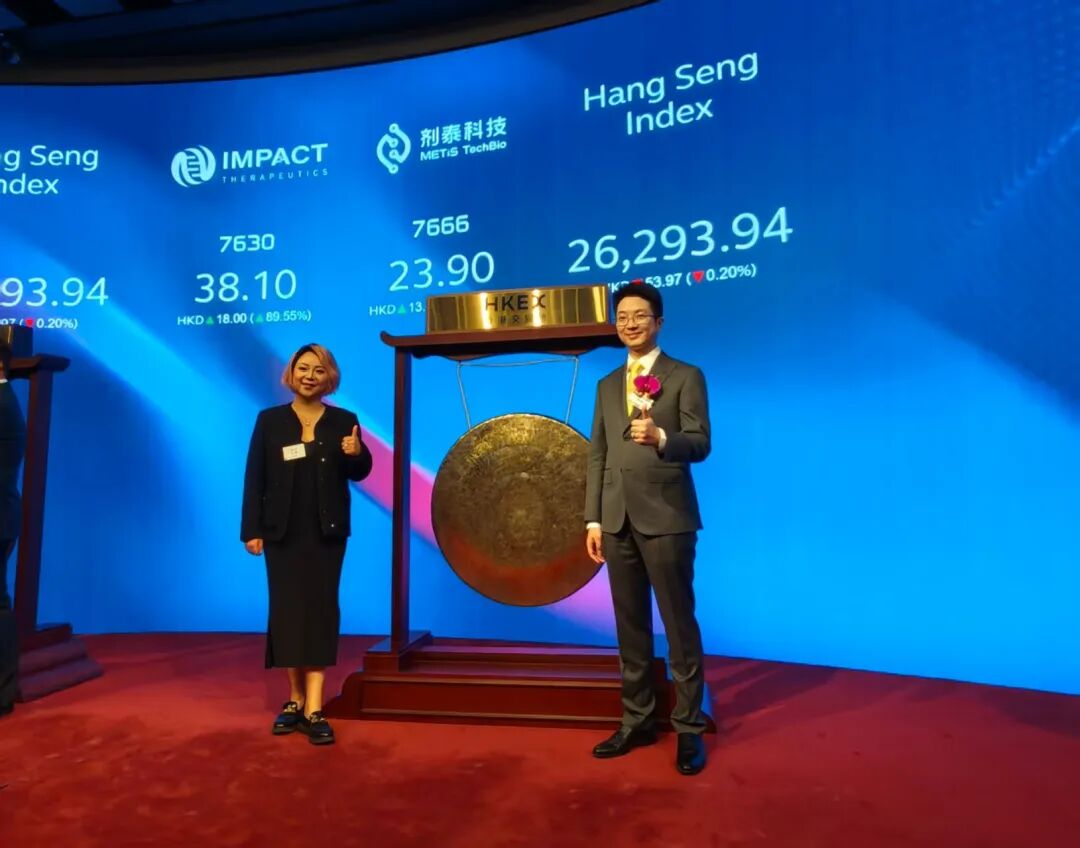
The bell-ringing ceremony at METiS's IPO (founder Chris Lai is at far right)
Xi Cao, founding partner at Monolith, has known METiS since the very beginning. At the end of 2019, while still at HSG, he led the company's angel round at a post-money valuation of roughly RMB 160 million. After founding Monolith in 2021, he continued to invest in subsequent rounds — all told, he's been along for the ride for more than six years.
So on listing day, we want to share some stories that only come into view when you've spent enough time with a company. Looking back, many things seem like correct choices. But at the time, none of them were easy.
🎙️ September 2025: Monolith's First Mover conversation with Chris Lai.
Eight months before the Hong Kong listing.

Corn Juice
Before Chris Lai came to the mainland, what his parents worried about most was drinking.
The impression left by the previous generation of Taiwanese businessmen ran deep. Doing business on the mainland, baijiu culture was unavoidable. His parents feared he'd ruin his liver. When he arrived in Hangzhou, he found that at group dinners, people were drinking corn juice.
Yellowish. At first he didn't know what it was.
"I didn't know you could juice corn."
This is one of Chris Lai's earliest memories of starting a company on the mainland.
It was late 2019. He was in his early thirties, born and raised in Taiwan, with a PhD in chemical engineering from MIT. He'd been a consultant at McKinsey and spent time at XtalPi. Some investors used him as a case study, telling Chinese scientists in America: "A Taiwanese guy is starting a company on the mainland — what are you still doing over there?"
Some of them did come back. Their first stop was to crash at METiS's Hangzhou lab.
Today, everyone knows he grew up in Taiwan, studied in America, built a company on the mainland, and listed in Hong Kong — something like a "cross-strait, three-region closed loop."
But back then, everything was still early.
The company had just been registered. The pitch deck was just finished. The lab wasn't even built yet. By Chris Lai's recollection, his first formal pitch as a founder was at a KFC in Hangzhou. A thirty-something scientist, sitting at a plastic table in a fast-food restaurant, presenting a direction that was still early and that many people didn't understand: using AI to transform pharmaceutical development.
Xi Cao first met him around that same period.
Chris Lai recalls that in that conversation, Xi Cao didn't keep pressing for platform details or pipeline data. Instead, he asked about his upbringing, the key inflection points in his life, the choices he'd made — why from MIT to McKinsey, to XtalPi, and finally to starting his own company.
"He wanted to understand me as a whole person, then judge whether I was worth betting on."
That round, Xi Cao led METiS's angel round during his time at HSG, at a post-money valuation of roughly RMB 160 million.
A few months later, COVID hit.
HSG held a virtual Demo Day to help early-stage companies raise funding. Twelve companies presented. METiS went first — and got the top response. Many of those early companies from that Demo Day didn't make it far. METiS is one of the few still standing today.
The Venetian Republic
2021 was when the primary market was at its hottest.
Back then, nearly everyone was encouraging startups to expand. One of the questions investors asked most was when the team would grow from 20 to 40 to 80 people. The industry had even developed an absurd consensus: headcount equals growth, the more pipelines you spread out, the more imaginative your company.
METiS got swept up in this too.
That year, METiS simultaneously launched more than thirty projects. Formulations, materials, pipelines — everything at once. Chris Lai later admitted that during that period, they spread themselves too thin.
"Even with AI empowerment, you can't fight on this many fronts and fight well. Doing verticals requires going very deep. It needs very deep accumulation."
But what mattered was that METiS pulled back much faster than many peers.
METiS has an internal mechanism for subtraction. The company periodically lists all R&D projects on a large poster. Each project lead presents why their project still deserves to continue. After the team debates, everyone gets red and green stickers. Red means stop. Green means continue.
Everyone votes. Then they step back and look at the poster.
Which projects truly matter, which ones you're just reluctant to let go of — this makes it visible.
Chris Lai calls this mechanism "the Venetian Republic" — roundtable discussion, collective decision-making.
He also recalled that founders need to clearly distinguish their company's "battles" from its "omissions." Battles are the fights that decide everything. At each stage, a company can only have one most important thing. Omissions are what you choose not to do. Sometimes what you don't do matters more than what you do.
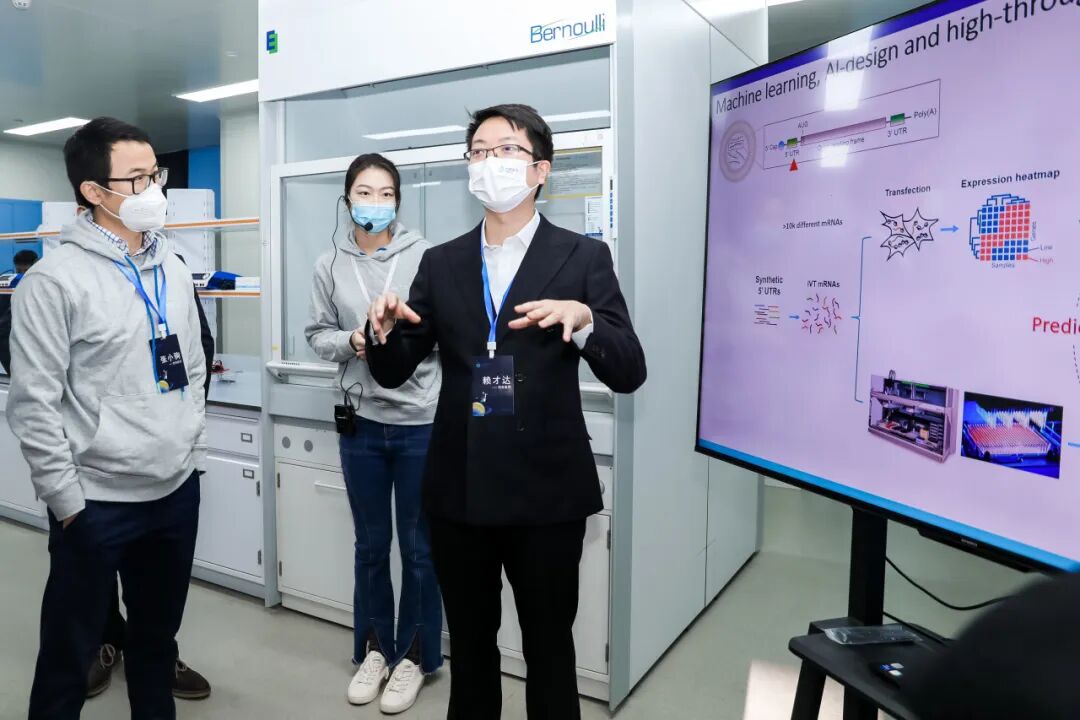
Chris Lai presenting at an early startup event
It doesn't sound like any profound insight. But truly doing it is rare.
At the time, after this process, the thirty-plus projects were quickly cut down to the core direction: all in on AI-enabled nano-delivery. The computing power, data, and people previously scattered across dozens of directions were refocused on building out the LNP platform's lipid library and achieving breakthroughs in extrahepatic targeting.
That same year, almost everyone was looking at COVID vaccines. Investors repeatedly asked METiS whether they'd do it. METiS said no.
Chris Lai's reasoning was specific: the virus mutated too fast for products to keep up; the main customer for vaccines was government, making it essentially more of a government-relations business; and if you removed COVID as a special variable, there weren't many biotech companies in history that had truly succeeded through vaccines. "This isn't our area of strength," he said.
At the time, no one thought this judgment was necessarily correct. When the market is hot, people who don't chase trends are easily seen as conservative, even as missing the era. Later, everyone saw what happened — Moderna's market cap fell more than three-quarters from its peak near $140 billion. Hordes of跟风中小biotech companies that had raised money and expanded their teams found vaccines weren't selling, pipelines couldn't pivot, and many have since shut down or are surviving through layoffs.
Because of this restraint, METiS still had over RMB 700 million in cash on its books at the time. R&D spending stayed stable. Pipeline progress and BD developments kept moving forward. Chris Lai described this efficiency gap as "dollars for RMB": producing dollar-level output at RMB-level cost.
In 2021, Xi Cao founded Monolith and continued to participate in METiS's subsequent rounds. From HSG to Monolith, the relationship spanned more than six years — at HSG, he followed continuously from angel through Pre-A to Series A; by the time Monolith joined later rounds, METiS had more data, output, and validation.
Chris Lai later recalled that initially, Xi Cao was betting on the big direction and the person. Later, the investment logic shifted: the company had output, had validation — it was no longer just a bet on one person.
Xi Cao's assessment of Chris Lai is also brief: steady, comprehensive. In his view, Chris Lai is one of the rare scientist-founders who is truly well-rounded — he understands technology, business, and markets, and can work with all kinds of people. Among scientist entrepreneurs, such people are extremely rare.
The Crayfish Restaurant
In the company's development, an even more painful subtraction for the founder was the team.
METiS once had an early architecture: America thinks, China executes. The US team handled more upstream strategic direction; the China team handled execution. This design sounded reasonable. In practice, it was very difficult.
Chris Lai later realized that no one wants to be just the hands. The bigger problem was that once brain and hands were separated, a massive gap emerged in actual R&D. The brain didn't know what was happening in the hands; the hands struggled to understand the strategic assumptions in the brain.
In the end, he decided to move R&D重心 back to China. The cost was that roughly two-thirds of the early employees left.
What Chris Lai remembers most is a scientist who joined on Day One. When the company had twenty people, this person was there. Together they did experiments in a small lab without air conditioning, drinking together to celebrate holidays.

Chris Lai with the MIT entrepreneurs' band
He still thinks this person is a brilliant scientist with exceptional problem-solving ability. But the company's technical direction changed; the person's passion remained in the original direction and couldn't shift. Chris Lai offered other roles as a transition. In the end, they couldn't keep him.
The two had their last meal at a crayfish restaurant in Hangzhou's Kangkang Valley. It was where the company had its earliest gatherings. Their first important milestone was celebrated there. In the end, they also said goodbye there.
These decisions, viewed individually, don't seem unusual. Not expanding, not chasing trends, cutting projects, adjusting teams — every entrepreneur has more or less been through these. Looking back, there don't seem to be any brilliant moves either. It reminds us of a saying — "Those who are good at war have no glorious achievements."
Chris Lai later described entrepreneurship as "fixing the car while racing." The car keeps running; problems keep appearing. You can't wait for all conditions to be ready before adjusting, nor can you wait for the car to actually break down before changing parts.
The Starting Village
From founding to listing, METiS took six years.
Recently, during these months of IPO preparation, the external environment swung dramatically. The October 2025 rally surged, then pulled back by year-end. After 2026, with US-Iran tensions heating up, markets cooled again.
Chris Lai said something internally: their pricing should make investors feel that "even if the US Army lands in Iran tomorrow, this price is still a bargain."
In short, don't chase the highest price. Leave enough room for everyone.
Two days before listing, we asked him how he felt. He said, actually more calm. He cited his role model, Alnylam — this small nucleic acid company listed and then spent another ten years before its first major breakthrough.
"A bit like the feeling of just leaving the starting village. After you get out, the challenges are bigger, the pace faster."
For METiS, this is also the more real state.
From a financial perspective, METiS is far from a company that has already "harvested." Full-year 2025 revenue was RMB 105 million, mainly from the upfront payment for MTS-004 licensing; adjusted net loss was RMB 180 million. The money raised from the listing will continue to go into pipelines and clinical work.
In other words, listing doesn't make the scientific risk disappear. It just puts the company into a more public, more rigorous validation phase.
Whether extrahepatic delivery capability can be validated by more clinical data. Whether BD partnerships can continue converting to cash flow. Whether platform capabilities can extend from "delivery" toward therapeutics themselves. None of these are easy. But each points toward METiS's true long-term value.
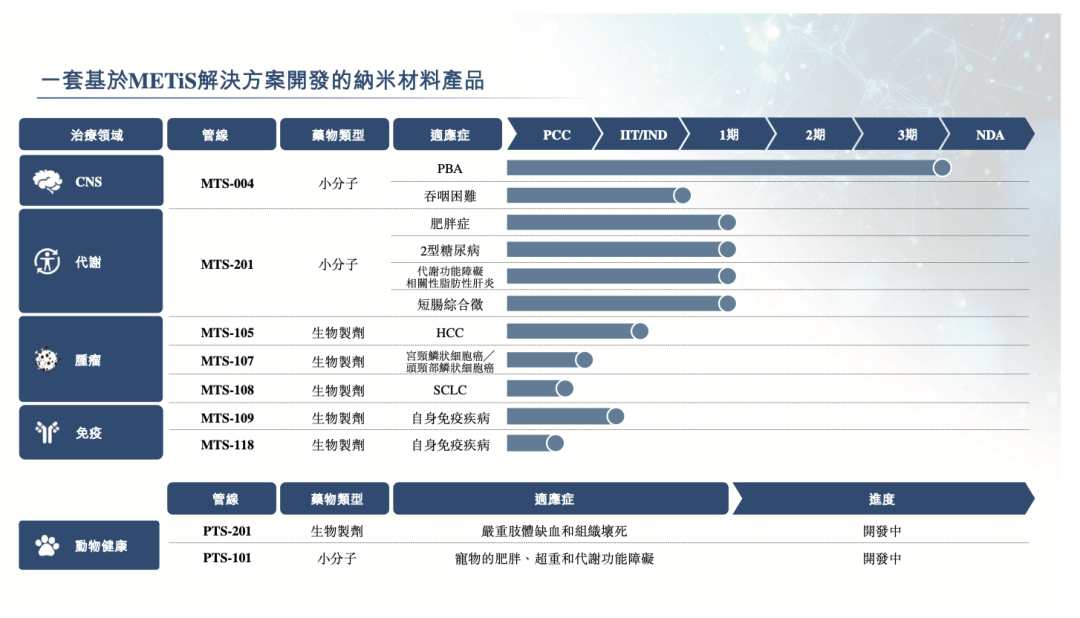
METiS Nano-Materials Product Pipeline Overview
We asked which of his own company's products he'd want to use. He smiled and said not the big oncology immunotherapy programs, but the one for fatty liver reduction. "I personally have this need. Hopefully someday I won't have to watch what I eat and can still lose weight."
Looking back at the last page of that 2019 pitch deck: Chris Lai, CEO. An email address. A WeChat ID.
Back then, METiS's entire assets were a few people, several small-molecule pipelines, and an idea that hadn't yet been fully validated.
Today, METiS lists on the Hong Kong Stock Exchange.
He says this is just Day One. Just out of the starting village.
Further reading: