A tech revolution isn't accomplished only by those standing at the very top | MonoX

Someone has to be the first to step up and test the new rung.


We are in, or at least being repeatedly told we are in, an AI wave on par with the Industrial Revolution and the internet revolution.
Everyone is talking about "disruption," "reconstruction," and "a new era." But one反常 fact is hard to ignore: the wave being called a revolution has, in its current phase, benefited most the very names that have dominated the world for ten or twenty years — Microsoft, Google, Apple, Amazon, Meta...
If a truly great technological revolution is supposed to rewrite the rules of the game and create a new generation of winners, then the obvious question is: why this time do the old titans still sit firmly on their thrones?
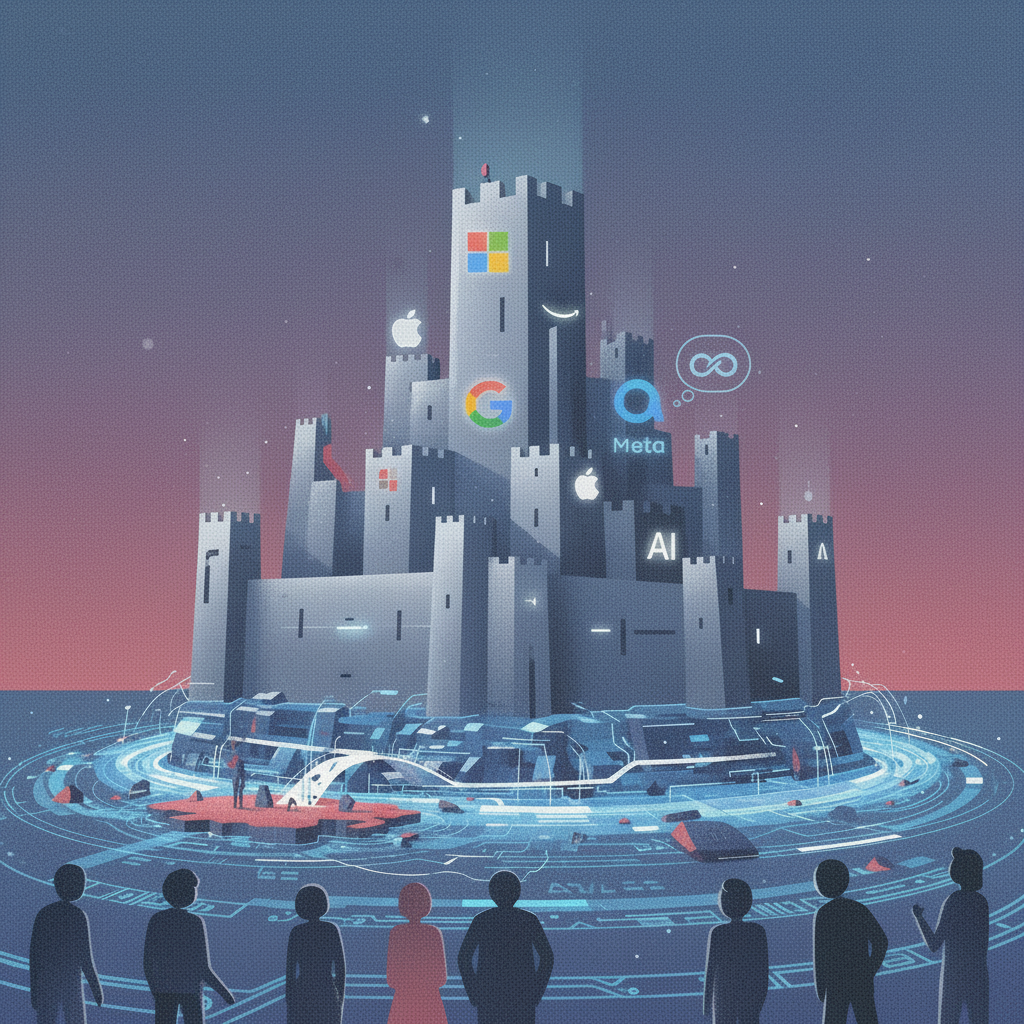
If what we're seeing today is simply trillion-dollar giants using AI to further fortify their moats, then are we experiencing a counter-revolution that consolidates the old order, or merely a brief, suffocating calm before the storm truly hits?
To understand this, we try to stretch our view a little wider, looking to history to see how each round of technological revolution step by step reconstructed the logic of wealth distribution,淘汰 old protagonists, and elevated new players to the stage.

I. From Manor to Factory
On the eve of the Industrial Revolution, Europe's wealth logic was brutally simple: land was everything.
The dignity of dukes and earls rested on absolute possession of land. They relied on hereditary feudal systems and their monopoly on violence to forcibly extract rent from peasants and tenants. Traditional merchant guilds functioned as closed associations, strictly limiting handicraft output, prices, and apprentice numbers.
This was the classic era of zero-sum competition. During this period, GDP growth was almost tightly coupled with photosynthetic efficiency — annual crop yields in the agricultural economy determined virtually all economic change for the year, with a hard ceiling on growth. To become richer, you couldn't rely on creation, only on marriage, inheritance, or war and plunder.
Then, obviously, the Industrial Revolution destroyed everything that came before — the same labor and time could now produce tenfold or even hundredfold output. Starting with tools of production efficiency, the appearance of textile machines replaced home workshops with the factory system.
This caused wealth logic to migrate fundamentally for the first time — owning the means of production (machines and factories) became more profitable than owning land. The center of wealth began shifting from old manors to emerging industrial cities like Manchester.
More importantly, the form of production organization also transformed dramatically. When railways extended markets thousands of kilometers away, allowing a single company to serve hundreds of thousands of customers across regions at scale, traditional bloodline-based family management became completely ineffective, and the modern joint-stock company was born.
In this process, a group of titans emerged — Vanderbilt, Rockefeller, Carnegie. Their businesses would have been terrible ideas in the old era, because monopoly was nearly impossible in agricultural times — production was dispersed and transportation expensive; the larger the scale, the higher the management costs, and the lower the returns.
But in the industrial age, everything flipped: intensive production made scale pricing possible, railways dramatically reduced logistics costs, and advances in communication technology allowed internal order in vast organizations to be maintained. Monopoly became economically feasible for the first time.
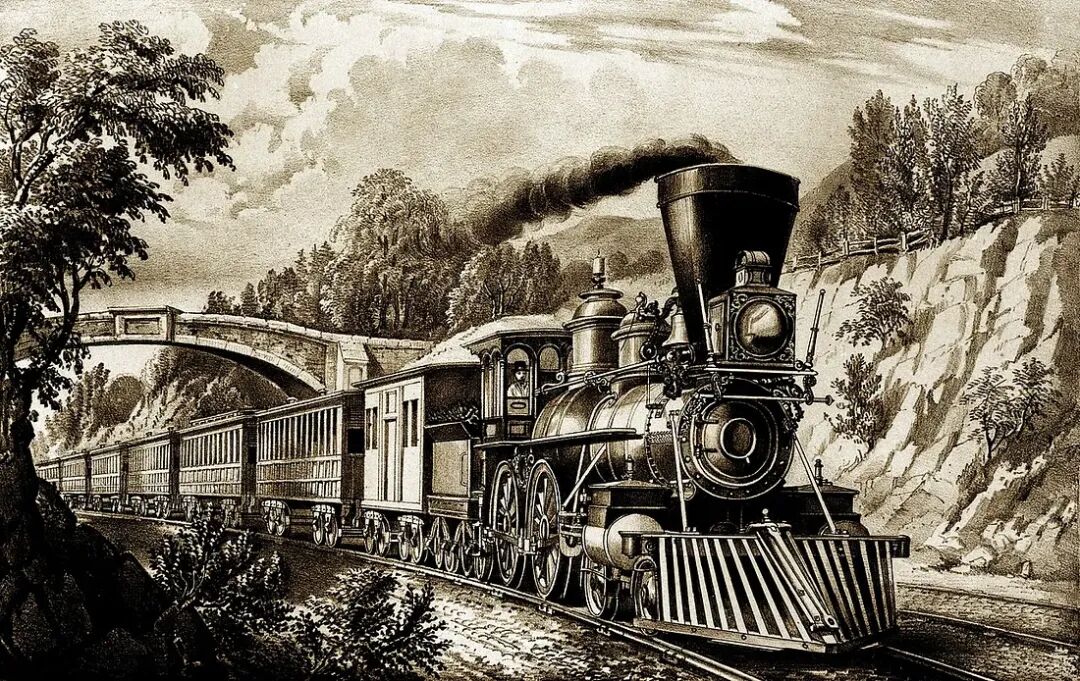
Wealth was now decoupled from bloodlines and land.
Surveying the great companies that rose during the industrial period — from Standard Oil to General Electric, from Coca-Cola to Nestlé — one industrial giant after another achieved near-crushing market positions in their respective eras. Meanwhile, the old economic structures — aristocratic estates, guild systems, feudal rents — quietly exited the stage, eventually sinking to the bottom of history.
II. From Machine Tools to Code
At the end of the twentieth century, the internet revolution once again rewrote the underlying formula of value creation.
We know that in the industrial age, marginal costs could not be eliminated: to build one more car, you still needed steel, rubber, and labor.
But in the internet age, the more important drivers of economic growth were information and connection. Bits replaced atoms; the cost of copying and distributing information approached zero.
At this stage, the greatest force driving GDP growth was no longer the stacking of production capacity, but faster information flow speed, lower transaction costs, and scaled network effects.
Thus, wealth logic was rewritten once more: whoever controlled the information gateway (Google) held the discourse power; whoever connected the most people (Facebook) possessed network effects; whoever most reduced information asymmetry (Amazon) mastered pricing power.
Each round of洗牌 was brutal and merciless. Industrial-age behemoths appeared sluggish and clumsy before the wave of informatization. This generation's winners were no longer a Siemens with its vast factories and machine tools, but young entrepreneurs who started in garages and made their fortunes writing code.
In the early days of the internet revolution, there even emerged a "false king" like America Online (AOL). In the late 1990s, AOL briefly became one of the world's most valuable companies. People believed it controlled the internet's traffic gateway and possessed unmatched user stickiness. Yet within just ten years, the company was nearly淘汰 by the times, its market value largely evaporated, eventually becoming an object of acquisition and breakup, its name gradually disappearing from public memory.

In this revolution, we clearly saw "the innovator's dilemma" — the more skilled you are at extracting profit from the old world's order, the less courage you have to embrace the new world that might zero out your existing assets. Old-era success became their shackle in moving toward the new era.
III. From Information to Compute
So, turning our gaze to the present, what exactly is the wealth logic of this AI age we inhabit?
Everything is still evolving rapidly, and any definitive answer would be irresponsible. But so far, we can see a clear阶段性 answer: compute, data, and engineering capability are highly concentrated in the hands of a few giants, and AI dividends are being voraciously consumed by them.
Unlike the early internet era's spectacle of "mass entrepreneurship where two college students in a dorm could start a company," the entry ticket to the large model era is staggeringly expensive. Massive quantities of H100 GPUs, enormous energy consumption, high-quality vertical training data, the organizational capacity of large-scale top engineering teams... every single factor is dissuading young people from entering this wave.
Under such a格局, today's game rules are equally残酷: whoever can generate tokens at lower cost, whoever can provide stronger model capabilities, stands at the top of the food chain. A single Gemini 3 model update seems sufficient to put many AI frontend companies out of business.
What's残酷 is that giants are skillfully converting their resource advantages accumulated in the internet era into entry tickets for the AI era. They use capital and compute to deeply bind with startups, offer AI talent one eye-popping salary after another, or simply acquire an entire star company's core team wholesale.
All this seems somewhat different from the past. Many people once believed that in cycles of technological transformation, old-era giants were destined to appear sluggish and rigid in the new paradigm, eventually replaced by new players. But this time, the giants' response has been swift, their bets enormous, their execution fierce — they don't seem like a party destined for淘汰 at all.
Perhaps, we need to acknowledge a reality here: "giants can't innovate" is no iron law.
Apple completed a textbook-level self-reinvention after Jobs's return. Microsoft's transformation from a PC licensing software company to a cloud computing and productivity platform giant similarly proved that large enterprises, under the right pressure and leadership, are not doomed to conservatism. In this AI round, the strategic decisiveness and speed of action that giants have demonstrated objectively show they don't intend to easily let the next platform-level opportunity slip away.
But at the same time, we must also see the other side: this doesn't mean new companies have no chance.
IV. New Possibilities
How are new-generation companies like Anthropic and Cursor doing?
At least for now, new-generation companies are using their growth curves to show that the market is far from sealed off by giants. Their ARR figures may seem insignificant next to the giants' earnings numbers, but those steep slopes represent precisely the speed of new demand emergence and the possibility of user migration.
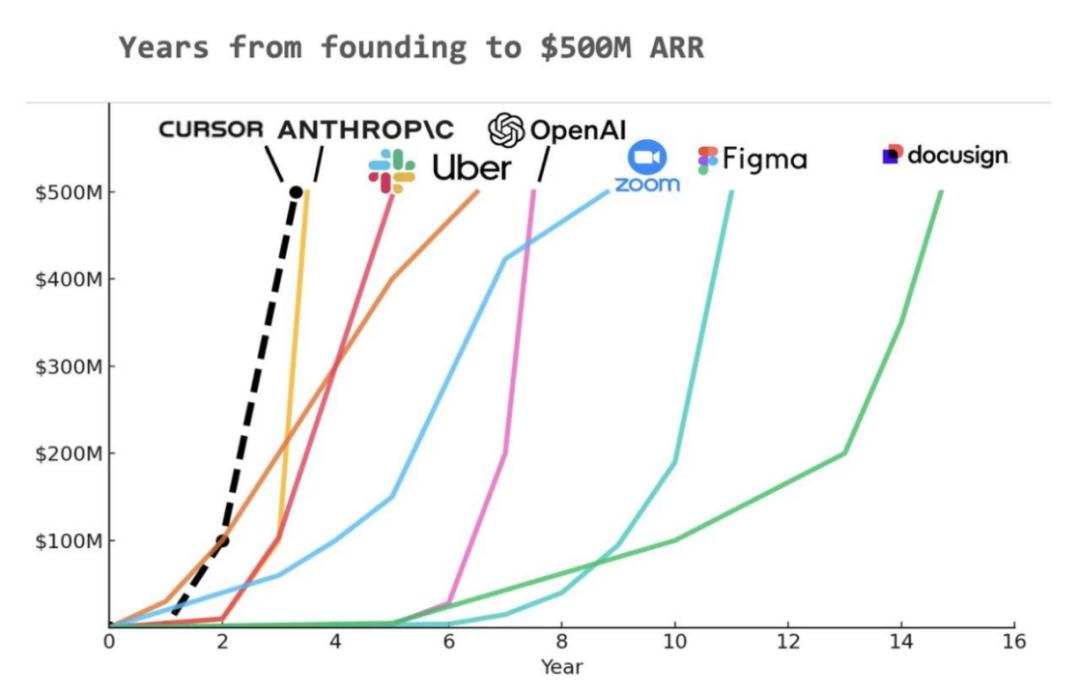
To understand this, we must abandon the traditional business logic that "big companies have low agility, small companies react fast," and instead adopt a colder way of viewing the current competitive格局.
The technology paradigm is redrawing capability boundaries. In the past, the productivity gap between an excellent engineering team and an average one mostly manifested as efficiency differences; but in the large model era, an entirely new "technology interface" has emerged. Those who master and deeply leverage Claude, vibe coding, and Agent to directly build products already possess a completely different production chain from traditional engineering collaboration. They use an entirely new production mode — and the gap created by this mode is not acceleration, but stratification.
One entrepreneur shared that his two traditional frontend engineers, using old-style collaboration workflows to polish an editor, took six months, progress stalled, with endless communication friction; while he himself, as a non-frontend engineer, spent just one afternoon rewriting and getting core functions running from scratch through iterative debugging with AI.
Large models are magnifying capability gaps between people to a degree that can no longer be aligned. What does this mean for traditional giants? It means their massive organizational structures may transform from assets into burdens.
Giants are still composed of large numbers of people dependent on traditional processes. For founders or core teams who have already switched to the new technology interface, the cost of downward alignment to traditional employees' cognitive systems has grown so large as to be completely unprofitable. Hiring someone who cannot use AI for production is almost negative value in this era. Therefore, an extremely残酷 human resource competition is likely imminent, where those middle layers dependent on hierarchical information transmission will completely lose their meaning.
And new companies have no historical baggage. They can be efficient combat units composed of dozens to hundreds of super-individuals, continuously冲击 traditional giants' traditional production systems on the battlefield. Faster, stronger, more ruthless.
There's also a more profound, more latent possibility: the very subject of commerce is undergoing displacement. Today's giants, whether Microsoft or Apple, are still essentially in the business of serving humans; the business of serving AI and machines themselves remains a blue ocean yet to take shape. In this commercial arena where no one has historical accumulation, those who have already switched to AI-native workflows and can directly use AI to build systems may be more likely to get the first tickets to the new world.
V. The Metabolism of Carbon-Based Life
Of course, from a冷静 angle, we must also admit: the barrier to entry for this technological revolution is indeed higher than the early internet era; the long-term importance of compute and data may also far exceed that round; the evolution direction of the open-source ecosystem still holds much uncertainty, and we cannot simply copy the linear analogy of "the internet went this way, so AI will definitely go this way." All we can do is abstract structural patterns from history, not mechanically replicate outcomes.
But one pattern spans nearly all eras and technological paths: as long as human society remains dominated by carbon-based life, it must rely on metabolism to maintain vitality.
If a system's resources and discourse power remain forever concentrated in the same batch of "old people," that system will gradually lose elasticity, increasingly tending toward rigidity and conservatism, ultimately slowly heading toward thermal death in seeming stable equilibrium.
Young people matter not simply because they understand new technology better, but because they are not fully bound by the old order, don't have much vested interest to protect, are less sensitive to failure, and are willing to try things that appear irrational under traditional logic.
Someone has to be the first to step onto the new ladder, and that person is usually not someone already standing firm on the highest rung of the old ladder.
Perhaps one day, silicon-based life will truly achieve meaningful immortality, and an era's leaders will be able to extend their lives indefinitely, no longer needing generational turnover.
But fortunately, that moment is not now.
So, we remain willing to bet capital, time, and patience on Davids who dare to challenge Goliath. The giants may occupy the sky, but it's on the ground that the new world sprouts.