Looking for the Next Gen Roblox

In gaming, we should always maintain a sense of reverence for what makes something genuinely fun.


Type "Give me a Tetris with Trump elements" into a chat box, and within seconds, an interactive program with basic art, sound effects, and core gameplay appears on screen.
This is now the baseline functionality for many AI game creation apps.
These generated games still look a bit rough — more like prototypes than polished products. But they reveal a clear trend: the de-codification of game development has crossed its tipping point.
With the arrival of powerful multimodal models like Gemini 3, the integration of sound, visuals, and interactivity no longer requires a full development team. The entire AI game generation space is at a critical juncture: supply-side productivity has been completely unleashed by AI, yet demand-side use cases remain hazy.
This article draws on Monolith's interviews with and observations of frontline game industry professionals to explore the evolutionary logic and entrepreneurial opportunities of interactive entertainment platforms (Next Gen Roblox) in an AI Native context. We hope founders in this space will reach out.
Contents:
- The Supply-Side Explosion
- From Playable to Fun
- Channel Restructuring
- Who Will Win

1. The Supply-Side Explosion
The most successful representative of interactive entertainment platforms is probably Roblox.
Roblox's great achievement was building a "creation as socialization"闭环: using Lua scripting to lower the development barrier to middle-schooler levels. Yet code logic remained an invisible wall.
Roblox
AI changes the equation: language becomes the engine. When the creation barrier drops from 1,000 hours of learning to a 10-second prompt, the creator base will leap by two orders of magnitude. This isn't merely an efficiency gain — it's an evolution in content species. Games will collapse from durable consumer goods into "emotional instant consumption goods."
The leverage effect of this shift is staggering. Currently, there are roughly 2 million professional game developers worldwide; including Roblox's active creators, the number might reach the tens of millions. But when natural language becomes a programming tool, the potential creator base could expand to 200 million or more.
This has already been partially validated in traditional coding. Cursor, Claude Code, Replit — the flood of Vibe Coding products has brought in waves of new developers. Something similar is happening in games, and it will have multifaceted impacts:
First, a qualitative shift in content forms driven by scale effects.
When supply grows 100x, content forms inevitably transform. In the traditional game industry, 1% serve 99%. To ensure commercial returns, developers gravitate toward "heaviness" and "premium quality," competing on AAA graphics and numerical systems.
In an AI-pervasive context, the extreme lowering of creation barriers means content will inevitably trend lightweight and generalized. Future AI games may no longer be the immersive 40-hour epics we traditionally imagine, but rather one-off software or interactive memes.
Second, the innovator's dilemma facing incumbent giants.
Why might this opportunity not belong to Roblox itself? Roblox has massive ecosystem moats, but these have become its baggage. It must balance the interests of millions of existing creators, maintaining current tool flows and economic systems.
In fully embracing AI generation technology, Roblox inevitably faces a left-hand-fights-right-hand predicament. From our observations, these giants' transformation moves remain relatively sluggish, creating a valuable window for native AI interactive entertainment platforms.
2. From Playable to Fun
Technology has reached a certain threshold, but use cases remain uncertain. This is the dilemma currently facing the game赛道.
The reality we see: AI has solved implementation problems in art, programming, and sound effects, making games "playable"; but AI has yet to solve design in game planning, numerical balance, and core fun, meaning games aren't necessarily "fun."
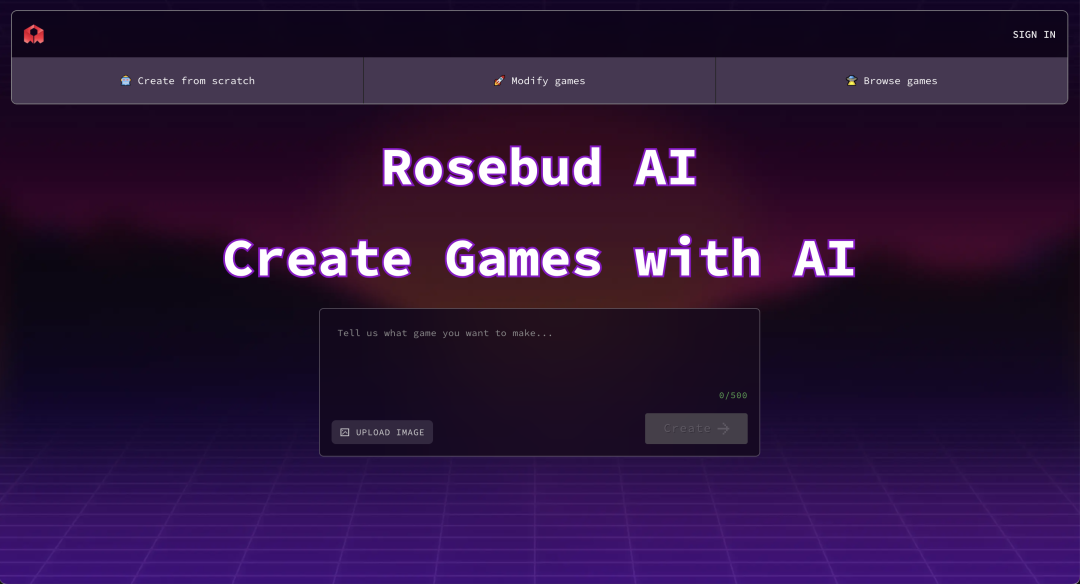
AI game creation platform Rosebud
Unlike the coding赛道, where users pay for AI-generated programs because they're "useful," in games, users won't pay simply because a game was AI-made. Users only pay for fun or interest.
Therefore, how to define product-market fit (PMF) for AI interactive content is the most worthy question for deep reflection right now.
Looking back at short video history, early short video apps didn't explode until Douyin defined short video's value — not as "low-quality micro-films," but as "recording beautiful life" or "fragmented entertainment consumption."
Similarly, what are these lightweight AI-generated interactive contents actually for? There's no clear definition yet.
Going further, if we strip away the technological surface and return to the underlying human needs for experiencing games, they roughly divide into two categories:
Fantasy fulfillment: Black Myth: Wukong satisfies the fantasy of becoming the Monkey King; PUBG satisfies the fantasy of battlefield combat. Such demands rely heavily on high-precision industrial production, which AI currently struggles to disrupt.
Socialization and interaction: On Roblox, users are essentially browsing a "virtual mall," finding conversation pieces for interacting with friends.
AI Native opportunity likely doesn't lie in the former, but in the latter — or in an entirely new dimension. We speculate on several possible scenarios:
First, the interactive upgrade of memes.
Young people today socialize by sending memes and short video links. In the future, will they communicate by sending AI instantly-generated parody mini-games? Games become a higher-dimensional information carrier.
But caution is warranted. Memes are fast and light; games require engagement. If an AI game only lasts 30 seconds, users might prefer watching a video. If interaction cost exceeds entertainment payoff, the logic doesn't work.
Second, hyper-niche one-off software.
A specific function or game needed by only 100 people — previously impossible due to high development costs. Now AI can instantly satisfy such long-tail demand. For example, a custom trivia game made for a single family gathering.
Third, dynamic social spaces.
In traditional virtual social products — whether early Second Life, current Roblox, or VRChat — scene and socialization are割裂. The scene is a pre-built static container; users enter the container, then communicate within it.
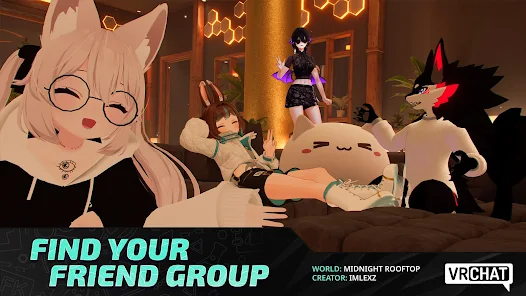
Game VRChat
AI Native social spaces can break this桎梏. Future scenes won't be static, but instantly generated following conversation content.
In an AI context, environment should be the visual extension of dialogue. The system analyzes user conversation semantics in real time, captures keywords and emotional tones, and immediately invokes generation capabilities to adjust the environment.
For example, in tabletop role-playing games (TRPG/D&D), the DM (Dungeon Master) describes scenes in words while players construct images in their minds. This is extremely high-dimensional socialization, but with extremely high barriers.
AI Native social spaces are essentially visualized AI DMs. This dynamism will change the structure of social power.
On Roblox, maps are developer-defined; users are passive experiencers. In dynamic spaces, conversation is creation. Every deep exchange between users is actually co-building a temporary, unique micro-world, becoming an irreplicable social experience.
Of course, entrepreneurs' creations will surely far exceed our imagination. We look forward to seeing more new scenarios and gameplay.
3. Channel Restructuring
If supply-side predictions hold, we'll soon face billions of discrete, lightweight apps. The current App Store distribution logic may become obsolete.
Today's App Store relies on rankings and editorial recommendations — a centralized, low-efficiency distribution method suited for存量 markets with pronounced head effects. When app quantities explode exponentially, and each app's lifecycle shortens and audience narrows, we'll need an entirely new distribution mechanism.
This may be an even bigger opportunity than the game platform itself: a new distribution platform based on algorithmic recommendation or agent intent recognition.
Algorithmic recommendation here resembles Douyin's feed, but instead of pushing videos, it pushes directly interactive mini-games or tools. The algorithm filters the most suitable content for the moment from massive AI-generated content based on user behavioral data.
Second is intent recognition. Users no longer download apps by searching keywords, but tell an AI Agent "I want something to kill time" or "Make me an expense tracker," and the Agent directly generates or invokes the corresponding service.
In this dimension, future app stores may no longer look like they do now, but be directly replaced by an intelligent operating system (OS) layer.
4. Who Will Win?
In this赛道 full of uncertainty, what kind of people are most likely to succeed?
From pattern deduction, probably founders with dual extremes in product definition capability and engineering execution capability.
Currently, technically sharp founders can earlier capture Tech to Product opportunities, gaining first-mover advantage. But we believe the ultimate competition is still product design capability. A good founder needs extreme AI Native product intuition, able to firsthand observe AI-native generations (Gen Alpha, post-2010s) usage habits. They won't carry old-era baggage, and can敏锐ly capture the subtle shifts in how new generations interact.
Additionally, people often mistakenly believe泛 entertainment platform founders must be highly entertaining or subculturally attuned. But historically, the most successful entertainment ecosystems were often built by extremely rational teams.
Just as ByteDance built the world's largest感性 content empire through极度 rational algorithmic distribution and data orientation; Roblox's founding team wasn't from traditional content production either, but experts in physics engines and tools.
Therefore, the winner may not be the person who best understands memes, but definitely the person who enables prosumers to create consumable value. This requires叠加 two layers of capability. First, product definition capability — like how Douyin defined short video not as "micro-film" but as "recording beautiful life," giving user behavior meaning. Second, engineering capability (making it possible for users to create): like how CapCut抹平 editing barriers through technology, making phone filming and one-tap成片 possible.
ByteDance's explosion was riding the wave of 4G network普及 (transmission inflection point) and mature recommendation algorithms (distribution inflection point). In the AI era, what new product forms can be derived from technology? Where are the AI Native "CapCut" and "Douyin" moments?
We don't yet know the exact inflection point, but this is precisely the answer we expect entrepreneurs to explore and define.
In games, we should always maintain敬畏 for "fun." Though AI can generate code, it cannot generate fun. AI is the lever; humans are the fulcrum, and the subject.
What's exciting is that we're in an interesting模糊 period.
On one hand,确定性 is extremely high: AI lowering creation barriers, creator scale expanding, content supply increasing — these are trends aligned with first principles.
On the other hand, uncertainty is also extremely high: what do these generated contents actually look like? What scenarios will they切入 into users' lives? There's no perfect answer yet.
The interesting part is the process of finding确定性 within uncertainty. We firmly believe that as creation barriers lower, human creativity will be massively unleashed, and the ratio of production to consumption will be restructured.
Searching for Next Gen Roblox is essentially searching for those daring to spend long periods "unable to see the coastline." At this模糊 moment, being present matters more than being right.
We're looking for those who are present — if you're thinking about new forms of interactive entertainment under AI variables, or if you're the one trying to define new scenarios, welcome to reach out anytime, and to attend the next MonoX offline event "Searching for Next Gen Roblox."