The Architect of Order | John D. Rockefeller

A beautiful rose, if it is to bloom, must sacrifice the new shoots around it.


When it comes to wealth, few figures in all of human history can rival John Davison Rockefeller. He once monopolized 90% of the American oil market, with a fortune that at its peak equaled roughly 2.4% of U.S. GDP — a record that still secures his reputation as the wealthiest American, and perhaps the wealthiest person, in history.
Rockefeller's origins were anything but privileged. Born into a fractured family, he had a libertine father who made his living through scams and a mother who struggled to hold the household together. With little formal education, he entered the business world at 16 and rose with astonishing speed. By 18, he had founded a company with a friend; a few years later, he moved into oil refining. At 38, his Standard Oil controlled 90% of America's refined oil, becoming a monopoly of staggering scale.
Yet examine his life more closely, and you'll find something unexpected: this spectacularly wealthy man maintained a life of thrift and simplicity across nearly a century, rejecting luxury and rarely indulging in entertainment, while dedicating himself to philanthropy. He accumulated wealth with ferocious intensity but handled its use with extraordinary care. In this third installment of our "Titan's Tale" series, we want to step inside Rockefeller's inner world and understand his lifelong pursuit of order.
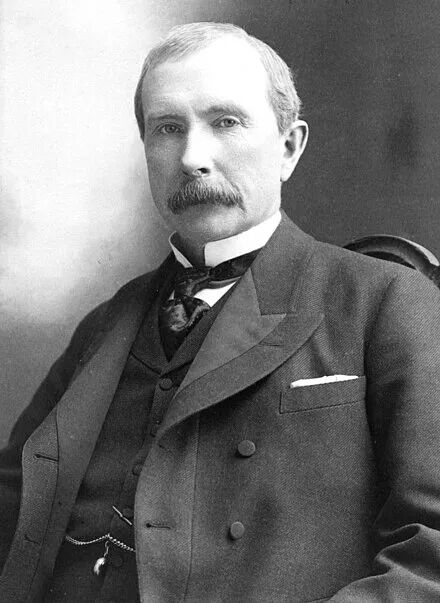
John Davison Rockefeller

I
A Poor Boy Makes Good
John Davison Rockefeller was born in 1839 in Richford, New York, into an unremarkable family. His father was an itinerant peddler of folk remedies, rootless and given to pranks. He was perpetually absent from home, and on the rare occasions he returned, he would deliberately devise tricks to deceive his own children — claiming this was to "make them sharp."
The father's cunning and disregard for rules left a complex impression on young Rockefeller. He would later recall that his father often said: "I cheat my boys every chance I get. I want to make them sharp."
In stark contrast stood his mother: a devout and restrained Baptist, industrious and frugal, running the household strictly according to biblical teachings.
The family's poverty and the father's unrestrained behavior taught Rockefeller the importance of money at an early age, forging the temperament that would serve him in business: cool-headed, steady.
In 1853, after his father became entangled in a lawsuit, the Rockefeller family relocated to Cleveland, Ohio. He enrolled in the city's only high school, then spent three months in commercial training, learning double-entry bookkeeping and other accounting skills.
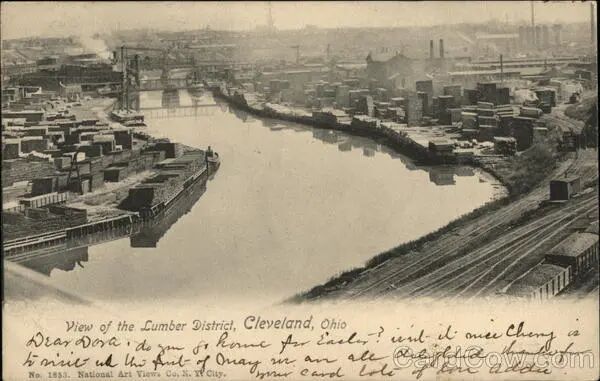
Aerial view of the Cleveland Lumber District, 1853
In 1855, at just 16, Rockefeller took to the streets to earn his living. Braving the pressures of an economic depression, he went door to door across Cleveland seeking work. After repeated rejections, his persistence paid off — he secured a position as an assistant bookkeeper at a small grain-trading firm.
He treasured this hard-won job, marking September 26, 1855, as "Job Day" and treating it as more important than his own birthday for the rest of his life.
On the job, the young Rockefeller displayed astonishing diligence and a natural gift for numbers. He meticulously recorded every transaction, quickly mastering cost calculation and negotiation techniques. His income was meager, yet he insisted on donating a tenth to charity — a principle his mother had taught him, and the starting point for how he would later navigate the relationship between wealth and responsibility.
Within a few short years, Rockefeller distinguished himself at the firm, earning recognition and promotion. But when his request for a raise was denied, he realized it was time to seek a bigger stage.
In 1858, not yet 19, Rockefeller decided to strike out on his own. He and his partner Maurice B. Clark each raised $2,000 to establish a grain and hay trading company.
To meet his share, Rockefeller borrowed $1,000 from that same prank-loving father at the steep interest rate of 10%, adding $800 of his own savings — his entire net worth, thrown into the commercial fray.
It was the great wager of his young life. They cleared their debts in the first year and turned a small profit. Here, Rockefeller's keen commercial instincts and decisive style began to show themselves.
The true turning point came during the American Civil War. The discovery of oil fields in Pennsylvania ignited a national gold rush, with countless people rushing into drilling and tales of overnight fortunes spreading everywhere. Rockefeller saw the opportunity in oil too, but he didn't follow the crowds to the fields. He focused instead on refining — technically demanding, relatively accessible, and overlooked.
He judged coolly: drillers would inevitably glut the market, while stable, clean, salable kerosene was what the market truly needed. In 1863, he wound down his grain business and founded a refinery with his former partner Clark and a chemist named Andrews.
That year, he was 24.
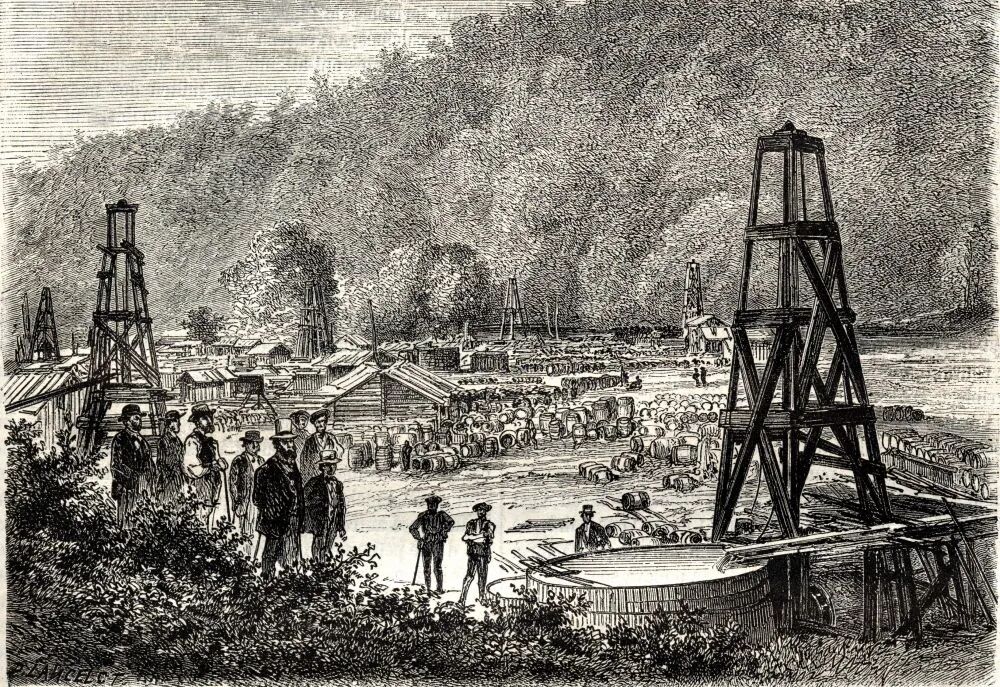
Early oil field exploitation at Tarr Farm, Oil Creek, Venango County, Pennsylvania, around 1862
Once the refinery was operational, he displayed a remarkable cost consciousness and drive for improvement. At the time, a barrel of crude yielded roughly 60% kerosene; the rest was mostly discarded as waste. But Rockefeller insisted not a drop should be wasted. Those byproducts — gasoline, paraffin, petroleum jelly, lubricating oil, tar — were one by one developed into marketable goods. In the end, they nearly extracted every possible value from each barrel. Where others might earn a dollar, Rockefeller earned two. The surplus was continuously reinvested into expanding equipment, improving processes, and acquiring rival refineries to grow market share.
Through this virtuous cycle, within five short years he owned the largest refining operation in America. Rockefeller had risen with breathtaking speed from an obscure merchant to a rising star in oil — and he was still under 30.
In 1865, Rockefeller and Clark reached an irreconcilable impasse over business strategy, and agreed to separate through auction. At that famous auction, the 26-year-old Rockefeller boldly borrowed $72,500 to buy out Clark's entire stake. To secure that fate-changing hammer fall, he risked virtually everything, even taking on crushing debt — but the gamble ultimately won the future. Legend has it that as the gavel came down, Rockefeller let out a long breath and told those beside him: "This is the day that decides my life."
After this acquisition, he renamed the firm "Rockefeller & Andrews," bringing in his brother William Rockefeller and the shrewd partner Henry Flagler. From this point, he held full control of the enterprise.
The boldness and nerve Rockefeller displayed were astonishing. He seemed to possess an almost superhuman conviction: "If you took all my money away, stripped me naked, and left me in the desert, I'd rebuild my empire if just a caravan of merchant camels passed by."
From borrowing to start a company, to choosing a different direction while others stampeded, to staking his entire fortune for control — Rockefeller's path was never flashy, but it advanced methodically. He didn't speculate or chase short-term windfalls. He was always seeking a more controllable, more accumulable, more orderly space in which to operate.
His lifelong pursuit of order began with this small refinery.
II
The Rise of Standard Oil
In 1870, at 31, Rockefeller formally established Standard Oil in Cleveland — the culmination of years of careful planning, executed at the right moment.
The American oil industry at the time was chaotic. Speculators had flooded in, refineries proliferated, supply outstripped demand, and kerosene prices collapsed; yet when refineries went under, supply quickly tightened and prices rebounded. This cycle repeated endlessly, with violent market fluctuations. Even Rockefeller, already among the largest refiners, suffered from the instability.
He began to realize that the industry's fundamental problem wasn't price — it was a structure that had spun out of control.
He believed the only solution was to break this cycle of disorderly competition. Through consolidation — the big swallowing the small — he would build a truly efficient industry.
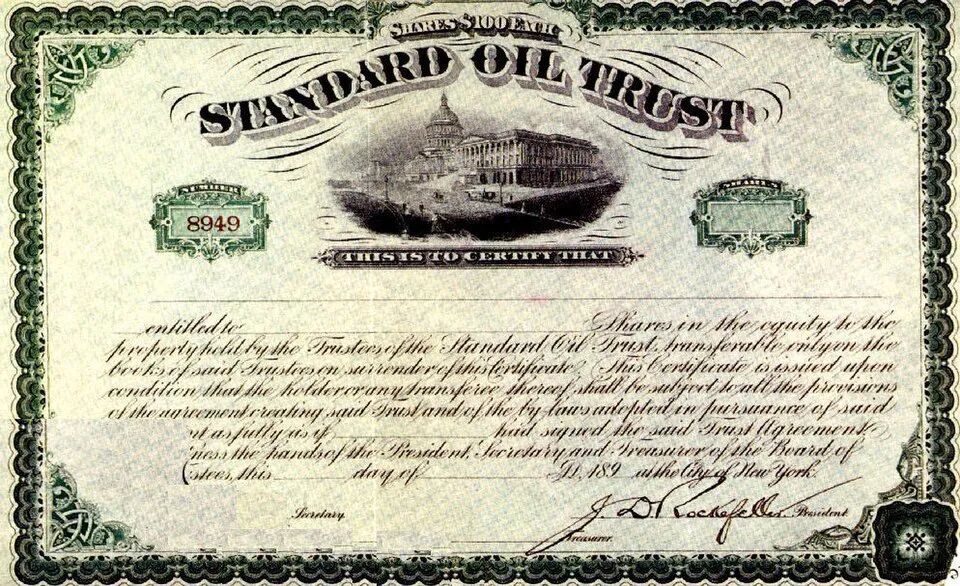
Standard Oil trust certificate
His integration campaign began in 1872. That year, as the American oil market turned downward again and refineries bled losses, Rockefeller struck. In just six weeks, he acquired 22 refineries in the Cleveland area (out of 26 total at the time) — an episode later dubbed the "Cleveland Massacre."
His methods were simple and direct. For struggling small refiners, he offered two options: take the money and exit, or swap for Standard Oil shares and become a shareholder. Most accepted; only a handful tried to hold out.
For those who refused to bend, Rockefeller squeezed them into bankruptcy through price undercutting and transportation restrictions, then acquired them cheaply at auction. Those rivals who agreed to join often became close collaborators. Henry Rogers and Charles Pratt, for instance, were absorbed in this "acquisition wave" and eventually became central figures at Standard Oil.
Defending this string of takeovers, Rockefeller employed a nearly poetic metaphor. In a speech at Brown University, he said: "The American Beauty rose can be produced in all its splendor only by sacrificing the early buds which grow up around it."
The remark carried the full flavor of social Darwinism. He saw himself not as a predator, but as a cleanser of the industry. His "mercy" was rescuing a system of misallocated resources, integrating chaos into order.
By 1879, nine years after the company's founding, Standard Oil controlled 90% of American refining capacity. Such massive market share yielded enormous economies of scale: greater output meant lower unit costs, which in turn secured cheaper crude purchases and better railroad rates, further cementing its advantages.
But Rockefeller's ambitions extended far beyond this. He began reaching into every link of the oil supply chain. Facing the dominant transportation channel of the era — the railroads.
He initially pursued cooperation. In 1871, he had participated in forming a secret alliance called the South Improvement Company, striking deals with the Pennsylvania Railroad and other major lines: Standard Oil guaranteed large, stable freight volumes to fill rail cars, and in exchange received substantial shipping rebates, plus intelligence on competitors' volumes and pricing.
Such backroom dealings were devastatingly effective at the time.
Yet the arrangement was eventually exposed, sparking fury from public opinion and rivals alike, and the alliance was forced to dissolve. But Rockefeller had already laid his next move — building his own pipeline system.
When the railroads turned around to compete against him, building their own refineries and pipelines and waging price wars, he countered with acquisitions. Soon Standard Oil regained the initiative, absorbing the Pennsylvania Railroad's refineries and transport infrastructure.
From this point, he completed the loop from oil fields to transportation to refining to sales, constructing a thoroughly vertically integrated petroleum empire.
His expansion along the supply chain knew almost no bounds. Upstream, he bought producing regions to secure crude supply. Downstream, he acquired tank cars, built vast distribution networks, opened proprietary retail outlets, and was among the first to construct a nationwide network of filling stations, offering consumers convenient one-stop service. Meanwhile, he continued developing byproducts — from gasoline and paraffin to lubricants and petroleum jelly — slicing each barrel into multiple profit streams, maximizing returns.
To rapidly capture markets, Rockefeller sometimes resorted to "predatory pricing": dumping products at prices far below cost in certain regions, absorbing short-term losses to crush local competitors, then raising prices to recoup losses once monopoly was achieved.
This strategy, though controversial, worked repeatedly. Standard Oil's territory expanded swiftly across the nation, ultimately sweeping up 80-90% of market share.
By the early 1880s, Rockefeller — now in his early forties — had amassed a personal fortune exceeding one million dollars, achieving financial freedom. In his youth, he had once set his life goals at "earn $100,000" and "live to 100" — the former was now accomplished.
But his pursuit of order and control did not stop. He publicly stated his hope that Standard Oil would "become the standard for American oil, and the standard for the world."
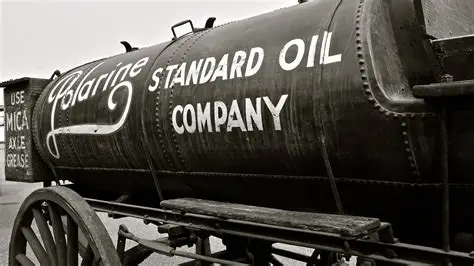
A metal tank transported on an old wood wagon carrying Standard Oil is displayed during Pioneer Days
In 1882, the Standard Oil Trust was formally established, marking the institutionalization of his business model. Under this structure, a parent company controlled refineries across the country, forming a vast yet efficient holding network. At that point, 85% of American oil extraction, transportation, and sales fell under his control. Globally, only Russia's Baku oil fields could still compete.
The outside world began calling him the "Oil King" — no exaggeration. In profit, scale, and governance architecture, Standard Oil was ahead of its entire era. He had used commercial means to establish an unprecedented industrial order — not merely a successful company, but an order.
He never concealed his position. He believed competition produced not innovation but waste; not progress but chaos. He once said: "Competition is a sin." The statement grates on modern ears, but in that age of pervasive disorder, it did resonate with some.
Under Standard Oil's dominion, kerosene quality and stability improved markedly. Kerosene lamps no longer exploded from impurities, and were no longer the exclusive preserve of the wealthy. Prices fell 80% over several decades, and ordinary families could afford clean, stable lighting for the first time. He wrote in one letter: "We refine oil so the poor can afford good oil."
Viewed from today, this is a classic paradox: he reshaped the industry while suppressing competition; he drove efficiency while triggering the antitrust movement. But whatever the verdict, for that stretch of time, one man had single-handedly reconstructed American oil.
III
Storms and Breakup
As Standard Oil grew ever more powerful, public unease quietly accumulated.
Initially, people were largely indifferent to Standard Oil. But as its products penetrated every household, its transportation dominance became absolute, and even prices fell under its control, skepticism and resentment gradually surfaced. The press struck back. Newspapers published accusations of monopoly and market manipulation, and outlandish rumors — such as "Standard Oil will flood seawater into Texas oil fields to block competitors" — circulated across multiple states.
What truly shook the Rockefeller empire was a female journalist named Ida Tarbell. Her father had been a small Pennsylvania refiner, bankrupted by Standard Oil's squeeze, and she resolved to expose what Rockefeller had done.
Beginning in 1902, Tarbell serialized The History of the Standard Oil Company in McClure's Magazine, exhaustively detailing how Standard Oil secured railroad rebates, crushed competitors, and manipulated officials and the judiciary. With meticulous documentation and vivid prose, she cast Rockefeller as a scheming, coldly greedy monopoly magnate. The public, shocked and outraged, demanded government action against Standard Oil.
President Theodore Roosevelt, reading Tarbell's exposé, was deeply shaken and resolved to wage war against this unchecked trust.
In 1901, the first famous political cartoon appeared, depicting the nearly 60-year-old Rockefeller as a crowned emperor with octopus tentacles coiled around Wall Street and the White House. Public hostility toward him was now nakedly on display. The press described him as a "queer, cunning, and pitiless" villain, an ugly octopus throttling American government and business, a greedy python drooling over all "black gold."
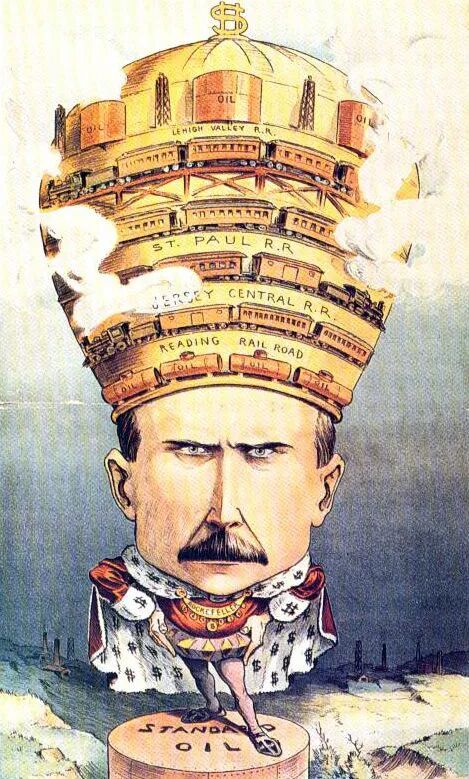
JOHN D ROCKEFELLER as an industrial Emperor in a 1901 cartoon from Puck magazine
Under this onslaught, Rockefeller endured enormous psychological pressure. He developed severe anxiety and health problems — sleepless nights, hair falling out in clumps, even alopecia areata. The torment of this period scarred him for life. Recalling it years later, he said painfully: "All the wealth I have earned cannot compensate for the anxiety of that period."
In 1897, at 58, Rockefeller formally retired from Standard Oil's management, though retaining a symbolic position. He handed daily operations to lieutenants like John D. Archbold and withdrew from the fray, moving to an estate in upstate New York to devote himself to cycling, gardening, and golf.
This was also seen as a shrewd "preservation" move — when the final great trial came in 1911, the 72-year-old Rockefeller had already been "above the fray" for over a decade.
In 1911, the Standard Oil case reached its conclusion. That May, the U.S. Supreme Court ruled that Standard Oil had violated antitrust law and must dissolve within six months, splitting into 34 independent companies.
The public cheered. Some called it "a commercial colossus finally crashing to earth"; others proclaimed "the free market returned to the people."
Rockefeller made no heated public statements about the verdict. Privately, however, his attitude was more complex. Upon hearing the ruling, he reportedly said calmly to those around him: "Antitrust will eventually be forgotten."
What makes this so intriguing is that Standard Oil's dissolution did not break Rockefeller — if anything, his wealth grew in the years that followed. As Standard Oil's largest shareholder, he held shares in many of the newly independent companies. Their stock prices — Exxon, Mobil, Chevron, and others — rose steadily over subsequent decades as automobiles spread and energy consumption surged.
The trust had fallen, but the wealth had not fled. By 1916, Rockefeller became the first "billionaire" in American history, with personal assets exceeding one billion dollars, representing over 2% of U.S. GDP.
IV
The Best Investment
What many find hard to imagine is that Rockefeller — this man who controlled nearly all American oil, whose wealth reached unprecedented historical heights — maintained thrifty habits throughout his life. He refused alcohol, never owned yachts or private rail cars or art collections, the standard accoutrements of the wealthy. At 53, he even fell seriously ill after wasting $150 on insurance for a shipment.
In daily life, his frugality sometimes bordered on miserliness. One day, warming himself before the fireplace at home, he suddenly asked his housekeeper: "How long are these logs?" Learning they were 14 inches, Rockefeller inquired in a negotiating tone: "If we cut them two inches shorter, would they burn just as well?" Receiving an affirmative answer, he established 12 inches as the household standard for firewood — saving money while achieving roughly the same heating effect.
Over his lifetime, Rockefeller donated approximately $550 million to charity and public welfare. This was an astronomical sum for the era, roughly equivalent to one-third of his total personal wealth. Many scholars believe the philanthropic practices he pioneered shaped the institutional framework of modern charitable enterprise.
Rockefeller practiced what he called "efficient philanthropy," emphasizing that charitable work demanded professionalism and results, not indiscriminate giving. Influenced by the Progressive Era's Efficiency Movement, he believed charity should operate with the same precision and effectiveness as business management.
He once put it bluntly: "To support a school that is inefficient, poorly located, and unresponsive to social need is a waste... The money squandered in the past on useless educational projects might have been sufficient to build a complete system of higher education — if it had been properly applied." This statement influenced the operations of many philanthropic foundations to come.
As early as 1884, he funded the creation of Spelman College — among the first American institutions of higher education for African American women. His most representative project, however, was the University of Chicago: from 1889 to 1910, he donated over $35 million to this once-modest Baptist college, rapidly elevating it to international research university status. He called this "the best investment I ever made," and always regarded it as among his most important philanthropic achievements.
In 1917, the Rockefeller Foundation purchased the former residence of a Qing prince in Beijing, and on this site of green-glazed tile palaces established the Peking Union Medical College, successively opening pre-medical, medical undergraduate, and nursing programs. Using Johns Hopkins University School of Medicine as their model, they built PUMC and its affiliated hospital as an integrated system combining teaching, research, and clinical practice. This became a foundational institution for modern medicine in China, producing medical masters such as Wu Jieping, Lin Qiaozhi, and Zhang Xiaqian.
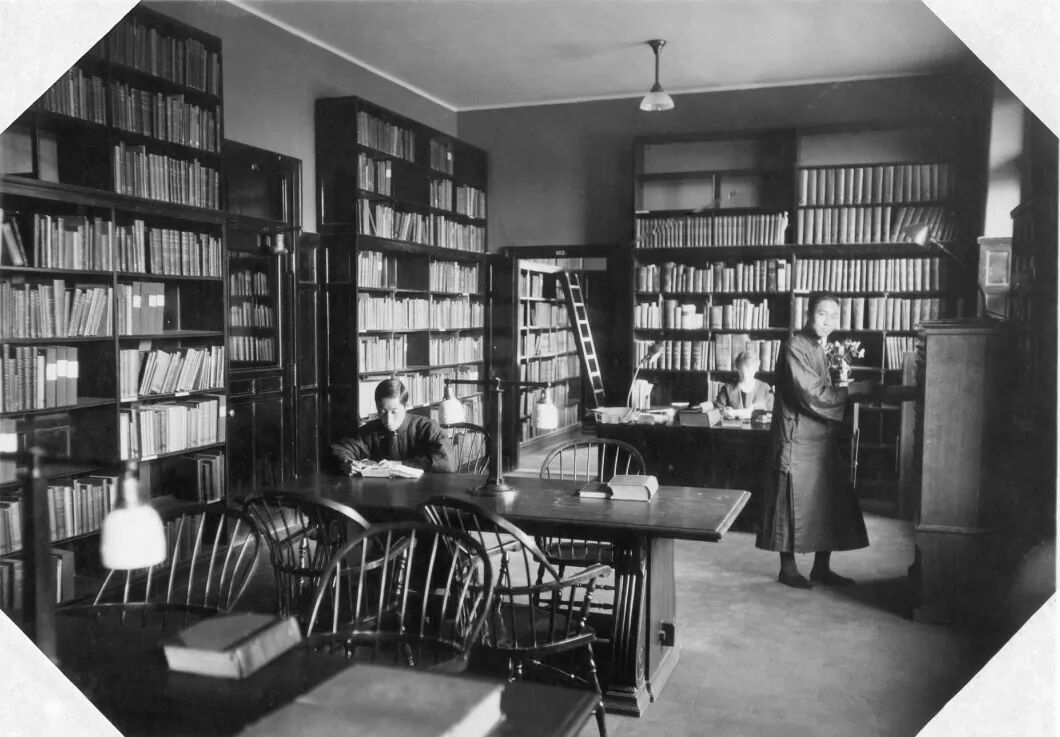
Peking Union Medical College, library and students
In his later years, Rockefeller gradually transformed in the public eye from "robber baron" to kindly philanthropist, somewhat diluting the notoriety of his early commercial battles. People began to view him through a more complex, more forgiving lens — in youth, he forged an oil kingdom with iron will; in middle age, he endured the infamy of monopoly and weathered the storm of empire's collapse; in old age, he withdrew from contention, showering fervent benevolence upon the world.
He was no saint, but his life was vast and tumultuous.
On May 23, 1937, John D. Rockefeller passed away peacefully at Ormond Beach, Florida, at the age of 97. He failed to reach his goal of 100, but his influence — magnified many times beyond his years — was permanently inscribed in the history of industry and philanthropy.
Interact with Monolith
After reading this article, what are your thoughts on Rockefeller's entrepreneurial history and life? Feel free to share your observations and reflections in the comments. We'll select three users with the most thoughtful comments and highest likes to receive special commemorative gifts prepared by MONOLITH. The event runs until 24:00 on July 25.