Two thousand years after the thunder of hooves at the Wolf Mountain victory, that same conquering echo resounds in the age of AI.

The Best Era for Young People


In Chengguan District, Lanzhou, there stands a statue of Huo Qubing.
Twenty-two centuries ago, he led his army through the eastern end of the Hexi Corridor. Legend has it that when the Western Han troops reached this place, they ran short of water and the soldiers grew weary. He halted his horse before the mountain, whip in hand, and struck the ground five times. With each crack of the whip, a spring burst forth, quenching the army's thirst — and so Wushan, the "Five Springs Mountain," got its name.
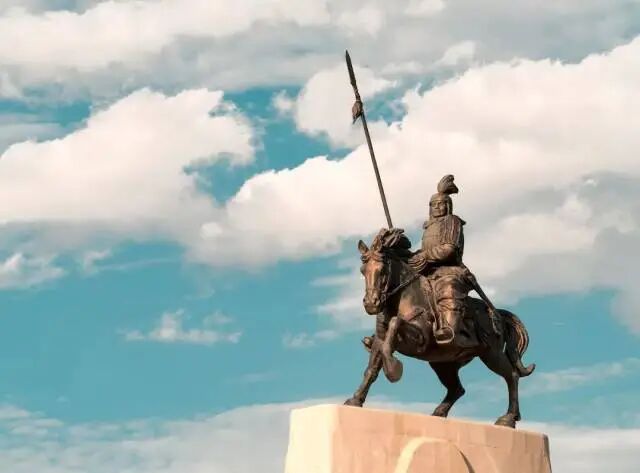
Statue of Huo Qubing in Chengguan District, Lanzhou
It's hard not to admire Huo Qubing. Survey the whole of Chinese history, and you'll find: those who could fight better than him weren't as young; those who were as young couldn't fight as well. In his most celebrated campaign, he rode hard for over two thousand li, striking the Xiongnu court and sending them fleeing south in panic. After the battle, he piled earth into an altar, watered his horses at the Hanhai Sea, and performed the Fengshan rites at Langjuxu. Emperor Wu built him a mansion, but he firmly declined, leaving behind the words: "The Xiongnu are not yet destroyed — what home is there to speak of?" Then he rode out again.
That year, he was twenty-one.
Standing before this statue, he is resplendent in his youth, brimming with confidence, spear raised toward the west. In reality he was unstoppable — wherever his warhorse trod became Han territory.
As an investment firm that consistently backs young founders, we love this image too — the youth, the speed, the decisiveness, and the courage to push forward through sandstorms and into the unknown.
More than two thousand years later, a prodigy like Huo Qubing remains a historical anomaly.
But think more carefully, and his achievements are hard to replicate not merely because of raw talent. More crucially, at twenty-one he had already gained resources that most people never attain in a lifetime — troops, military command, the emperor's full backing. It was this concentration of resources that allowed him to accomplish the greatest deeds at the youngest age.
Under the old logic, such a combination of resources was nearly impossible to replicate. Even in the internet era, if you had ideas and ambition, a founder in their early twenties could rarely secure the weapons and team that could change the game at such a young age.
In that logic, experience was often hard currency; great achievement required sufficient resources and chips to trade for it.
Now, that equation is being rewritten.
With AI, a one-person company (OPC) or a small team has, for the first time, the chance to be armed with extraordinarily powerful weapons at a very young age. A founder in their early twenties can use AI to accomplish what once required teams of dozens — like Huo Qubing in his day, wielding a sharp blade, venturing deep into uncharted territory, and achieving something great.
This is no longer a joke. It's happening right now.
Look through history and you'll find no era that offered young people such dense and formidable tools. In the past, armies belonged only to the few; today, they rest in every hand.
This time, the times are on the side of the young.
So this Lunar New Year of the Horse, we took this statue as our inspiration for posters and red envelopes, paying tribute to every founder still on the journey.
In the year ahead, MONOLITH stands with you. Don't waste your youth. Spur your horse and raise your whip.