Who's Cleaning the World's Pools?

A Predictable Trend


In recent years, when overseas consumers have gone shopping for a decent drone, 360-degree camera, or desktop 3D printer, the item they've dropped into their cart has increasingly turned out to be a Chinese brand.
They may not have realized it, but names like DJI, Insta360, and Bambu Lab from China have been showing up in their orders more and more often.
This is no accident. Chinese companies are genuinely breaking through in the global consumer electronics market:
DJI began focusing on drones in 2006. When consumer aerial photography took off in 2012, the company rapidly captured the North American and European markets by steadily improving its two core technologies — flight control and gimbal stabilization — eventually securing over 70% global market share.
Insta360 was founded in 2015, entering the niche 360-degree camera segment first. Through superior stabilization technology and AI-powered smart editing features, it not only defeated traditional Japanese manufacturers in the global 360-degree camera market, capturing over 60% share, but also became GoPro's most formidable rival in the action camera space.
The upstart Bambu Lab, whose founding team came from DJI, applied their drone product experience — at a lower dimension — to 3D printers. Launching its first product in 2022, it quickly disrupted a market that had been stagnant for years by making multi-color printing accessible to consumers and achieving print speeds several times faster than competitors. In remarkably short order, it became the global leader in desktop 3D printers.
Why are Chinese companies getting better at going global? Beyond each brand's individual technical strengths, one common answer is the responsiveness of China's supply chain.
The manufacturing ecosystem that China has built over decades — from components to complete assembly — lets Chinese enterprises move from idea to mass production faster than many rivals. What's more, the technical skills and optimization capabilities that engineers have honed in China's fiercely competitive environment allow them to match performance while keeping prices accessible.
Now, something similar is happening in a seemingly vertical, once-stagnant market: pool-cleaning robots.

A pool-cleaning robot at work

1 The Shift
In Europe and America, especially where there are single-family homes, a backyard pool is fairly common — according to the Pool & Hot Tub Alliance, there were 10.4 million residential pools in the US in 2023.
Pool maintenance is a necessity. Before automatic equipment existed, cleaning was done manually with brushes and nets. The first labor-saving devices only appeared in the 1950s to 1970s.
The first generation was like a "vacuum cleaner" — connected by hose to a suction port in the pool wall, dragged around by the suction of the pool pump to suck up debris from the bottom. The second generation had its own filter bag to collect debris, and connected to a water outlet at the pool's edge, using the jet of water to push it across the pool floor.
But these devices were limited in efficiency and required the main pump to be running.
The real revolution came in the 1980s: the birth of the electric pool-cleaning robot. With its own motor, wheels, and filter basket, it could swim and clean like a proper little submarine, completely freeing itself from dependence on the main pump. The Israeli company Maytronics, founded in 1983, was the pioneer in this field.
In the decades that followed, technology gradually matured, and two giants came to dominate the global pool robot market.
Maytronics' Dolphin product line, with better path planning and control, became the industry benchmark, long holding the leading position with market share often above 40%.
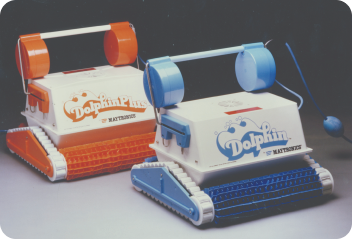
Dolphin's first pool-cleaning robot
The Spanish multinational Fluidra, through continuous acquisitions, brought established pool-cleaning brands like Polaris, Zodiac, and AstralPool under its umbrella, building a vast pool equipment empire and becoming Maytronics' main rival.
Additionally, the established American manufacturer Hayward also held steady market share (with its TigerShark series, for example) thanks to deep distribution channels and comprehensive pool solutions.
The landscape remained relatively stable before 2019, with the giants maintaining their grip on the market's main share through accumulated technology, brand reputation, and global distribution networks.
Yet technological changes were quietly opening windows for newcomers.
Early pool robots were like blind "vacuum cleaners," moving randomly across the pool bottom, relying on long hours of repetitive cleaning to cover the floor — low efficiency and poor targeting.
Moreover, the vast majority of robots still needed to be tethered to a long power cord. This not only limited their range but also led to the maddening problem of "cord tangling," requiring manual rescue. Even more annoying, users had to physically fish them out and plug them back in to charge.
Wanting to remotely check how the cleaning was going was basically impossible — no internet connectivity, no smartphone app for control or monitoring. The entire cleaning process required substantial manual intervention.
Around 2019, high-performance, long-lasting rechargeable lithium batteries solved the power cord problem. Breakthroughs and maturation in underwater navigation technology, environmental sensing sensors, and underwater image recognition also gave pool robots the ability to plan cleaning routes like robot vacuums, with the possibility to "perceive" the pool environment and "see" stains on walls and floors.
In short, "cordless" capability and "sensing and planning" ability were like giving pool robots "legs" and "eyes." Remote control was no longer difficult either — just add Wi-Fi or Bluetooth modules and develop a dedicated mobile app.
Products that aligned with technological development and demand quickly found market response. By 2021, cordless pool-cleaning robots' market share grew from 13.5% to 27.4% by 2023, a rapid increase.
And these technology-driven product innovations happened to be exactly the arena where Chinese companies excel. In 2021, Chinese brands held a staggering 81.2% share of this sub-segment. On Amazon US, searching with the keyword "robotic pool cleaners," approximately 53% of the top 100 best-selling pool-cleaning robot products came from Chinese sellers.
By today, two of the top three pool robot shippers in the US market are from China; the second-ranked Chinese player surpassed former market leader Dolphin this year — a clear signal of the trend.
Before pool robots, Chinese robot vacuums were selling several million units annually, capturing roughly half the global market. The supply chain for core components — motors, batteries, sensors — was already extremely mature. User habits were gradually formed, so companies in this vertical pool scenario didn't have to start completely from scratch and could quickly produce good products.
2 The Overtaking
Chinese households don't have pool-cleaning scenarios, but as early as 2005, companies entered this track as OEM manufacturers.
Though working as OEMs, Chinese companies continuously refined their manufacturing and technology with high sensitivity. For example, in 2018, WYBOT launched its first cordless pool-cleaning robot with built-in lithium battery power, eliminating the need to drag a cable, for a client. This OEM product quickly became the company's main revenue source, growing from 30% to 70% of revenue until it completely replaced wired products.
Long-term frontline manufacturing accumulated technical talent and supply chain capabilities, but OEM business profits were inferior to owning one's own brand. Seeing wireless products become the new trend, WYBOT decisively seized the opportunity to upgrade from "wired" to "cordless" in 2019, launching its own brand Wybot.
Also in that same year, seeing the technological inflection point and new market opportunities, YuanDing Intelligence — with sophisticated understanding of online marketing — launched the Aiper brand and quickly opened up visibility in the mass market.
According to public information, in 2024, Aiper's sales reached nearly 1.4 billion RMB ($195 million), with shipments exceeding 1 million units across its product lines, ranking second on Amazon US's sales charts. That year, the pool robot sales rankings had Israeli brand Dolphin in first place, and Chinese brand Wybot in third.
The growth speed of Chinese brands has been remarkable.
In 2023, Chinese brands' combined market share on Amazon US reached 31%, up 15.1 percentage points from 2022. At that time, YuanDing (Aiper) and WYBOT (Wybot) ranked fourth and fifth globally in market share. But by April this year, Chinese brands had surpassed Dolphin to claim the top spot.
The entry and rapid growth of Chinese players intersected with the decline of Dolphin, the industry-leading brand from Israel.
From 2022, Maytronics' financial reports showed slowing sales growth and sharply declining profits; by Q3 2023, it even posted losses. In 2024, its full-year revenue growth was only in single digits.
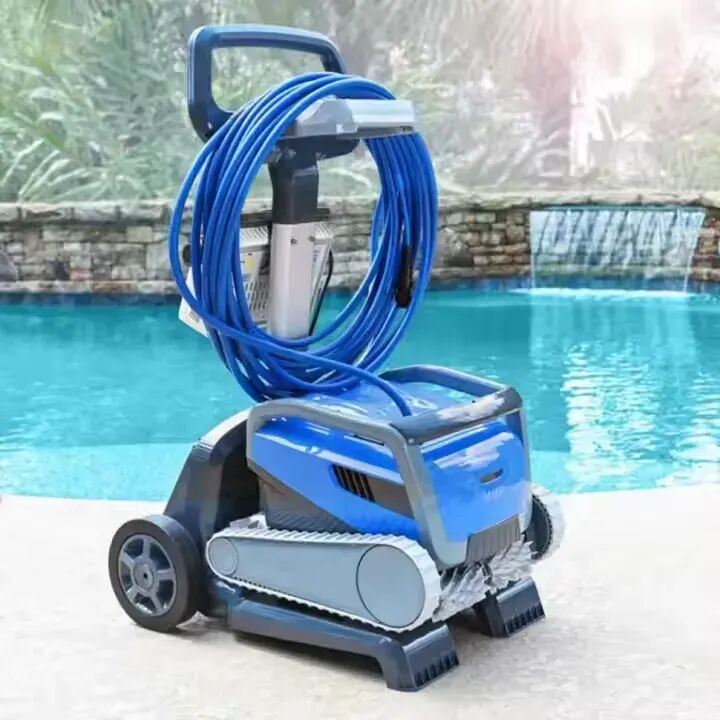
A wired pool-cleaning robot
As a 40-plus-year-old large company, Maytronics lagged far behind Chinese startups in market responsiveness, product iteration, and technology application.
On e-commerce platforms like Amazon, this contrast was especially stark. While Dolphin and other Western brands still priced above $600, Chinese brands could deliver similarly reliable performance at prices below $500.
With higher cost-performance ratios, Chinese brands have been rapidly eating into its territory. According to internal Amazon pool robot sales data, Dolphin has already fallen from the top position.
As a publicly listed company, under financial pressure, it has difficulty making bold innovation investments. Currently, to cope with this asymmetric competition, Maytronics has had to begin choosing strategic partnerships with Chinese challengers, co-launching new brands with Chinese factories responsible for R&D and production.
This overtaking is a typical Chinese playbook, deeply rooted in the common DNA of Chinese consumer electronics going global.
Compared to large foreign companies, Chinese players are more sensitive and decisive about opportunities brought by technological inflection points. Whether "veterans" with nearly two decades of OEM experience or "newcomers" skilled at online marketing, all precisely hit the 2019 technological node of pool robot "cordless" transformation and intelligence.
Second, what supports this sensitivity is China's powerful supply chain advantages and talent accumulation. The already mature domestic robot vacuum industry provided pool robots with core modules and technical talent that could be almost directly transplanted, greatly shortening R&D cycles. The ability of Chinese engineers to "efficiently engineer complex technology and optimize costs," honed in fierce competition, was also validated here.
This kind of disruption and even overtaking has been proven multiple times: Insta360 versus GoPro, Bambu Lab versus Stratasys, and DJI which has become the absolute leader... Now, this trend is spreading from major consumer electronics tracks to more vertical categories including pool robots.
A clear trend is emerging: in the new phase of globalization, with strong supply chain foundations and innovation efficiency forged in intense markets, Chinese companies are challenging global brands in nearly every niche segment.
3 A New Path
In this process, Chinese players are also expanding from the cost-performance route to the premium brand route.
Founded in 2022, Beatbot aimed at the premium pool robot market from the start. This was evident from its aggressive pricing strategy — Beatbot's first product, the AquaSense Pro, was priced at a steep $2,199, far exceeding industry leader Dolphin's main products and several times the market average.
Founder Shengle Wang, born in 1990, entered the robotics industry right after graduation, successively holding core R&D positions at two leading robot vacuum companies. He believes that for quality-seeking American users, a brand's pricing confidence itself is an important manifestation of strength and attitude: "If you're not confident in your pricing, why should consumers buy from you?"
This seemingly crazy strategy was ultimately preliminarily validated by the market — first-month sales reached several million dollars.
What supports the premium price is the high value delivered by product and service. For instance, Beatbot pioneered many industry firsts. To give the product a more premium feel, it innovatively used automotive-grade membrane technology. For safer charging, it also introduced a wireless charging dock for the first time.
Of course, more importantly, Beatbot made breakthroughs in product functionality. For example, a key differentiator it bet on early was pioneering surface cleaning and water quality management.
Mainstream products on the market (including Dolphin) focused on pool floor and wall cleaning, powerless against floating leaves, insects, and other debris on the water surface. Through pressure chamber design and bubble control systems, Beatbot enabled the robot to effectively submerge and surface, extending the cleaning range to the water surface for the first time.
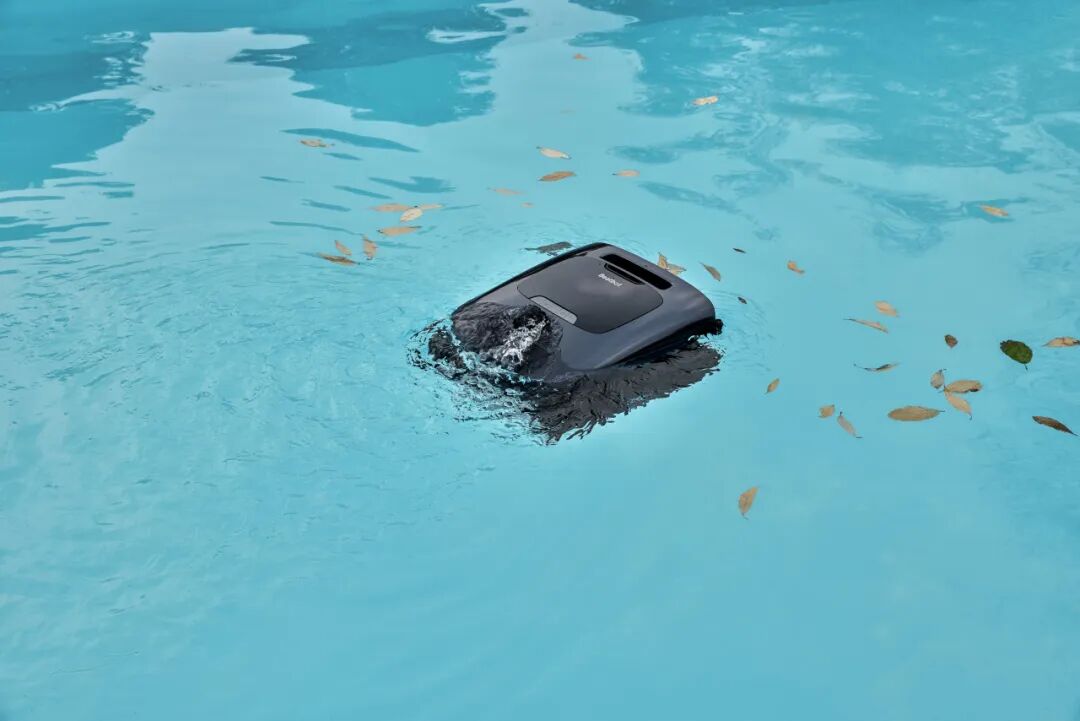
Beatbot extends cleaning range to the water surface
Meanwhile, the product also provides water clarifying functionality. Through clarifying agents made from environmentally friendly materials like discarded crab shells, it not only solves actual cleaning problems but also enhances users' psychological feeling that the water "looks crystal clear."
In February this year, Beatbot's AquaSense series upgraded to its second generation, expanding to three models. As its prices continued climbing toward $3,000, product exploration also continued.
At the same time, Beatbot's second-generation new products incorporated AI vision cameras up front, capable of identifying object types — whether stones, leaves, or other debris fragments. After identification, the robot can precisely head straight for the target and remove it.
This fundamentally changes traditional cleaning logic. In the past, relying on preset path programs, if new debris fell after the robot finished cleaning an area, it could do nothing. AI recognition transforms blind carpet-style searching into "point-to-point" precise operation, followed by global scanning to check for missed spots.
For user-concerned cleaning progress visualization, Beatbot also made technical breakthroughs. The companion mobile app can display approximate schematic diagrams of cleaned areas. Though not as refined as indoor robot vacuums, its successful mapping probability has improved from 30-40% last year to over 90%.
Control improvements are also highlights, especially when the machine floats to the surface — users can directly guide it to clean specific areas on the mobile app like playing a game, effectively overcoming problems of debris movement due to wind direction changes that traditional modes might not clean thoroughly.
In the premium market, Beatbot has carved out a path.
In the first quarter this year, Beatbot held over 65% market share for products priced above $1,000 in North America, and as high as 90% for above $1,400, nearly tripling year-over-year. In February this year, Beatbot began expanding into the European market, achieving five times its previous transaction volume in its first month on Amazon.
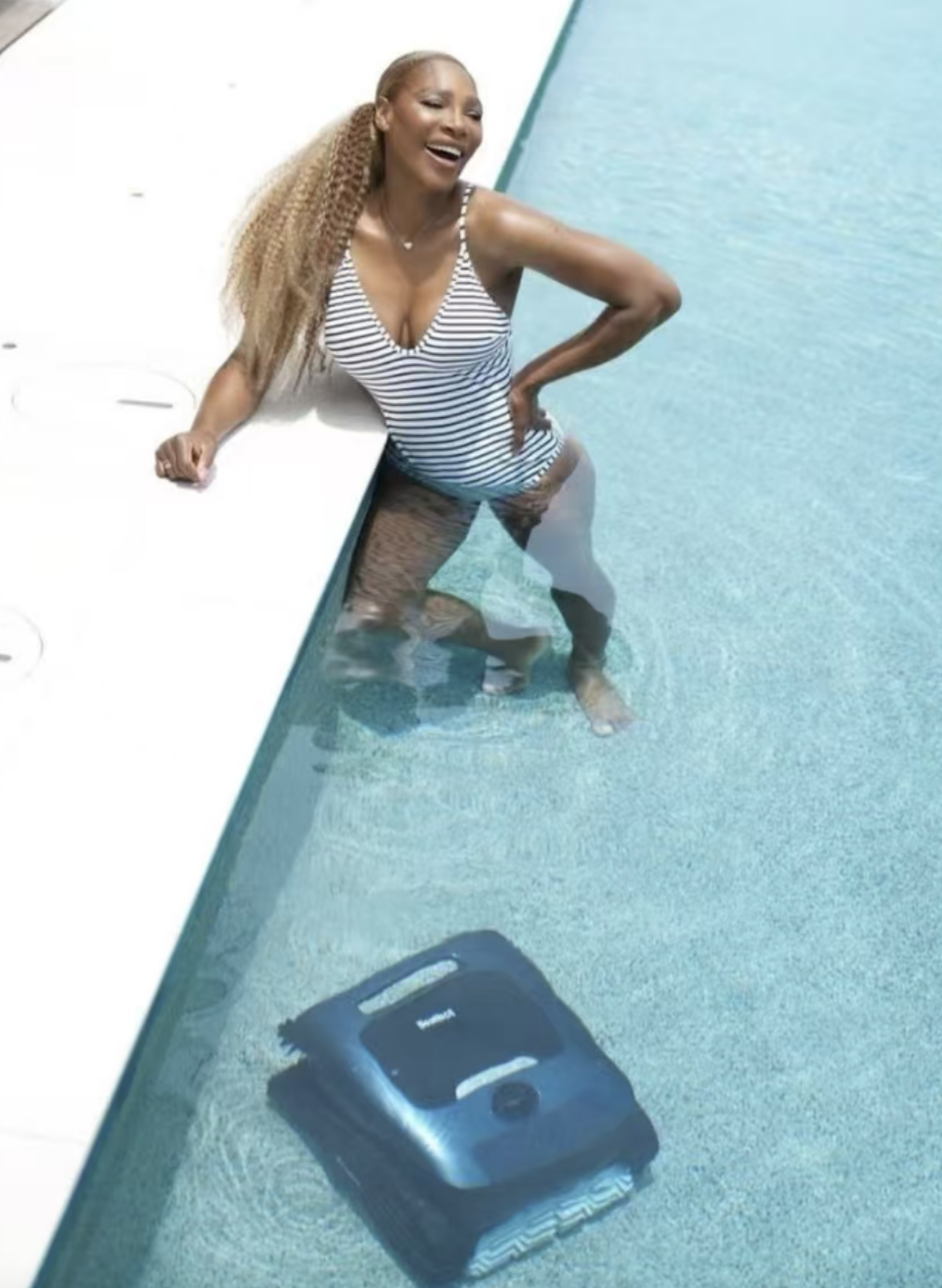
Serena Williams endorsing Beatbot
To some extent, Beatbot once again validates the successful path of Chinese startups overseas: move faster, operate at a more intense pace, make products more extreme — and you can carve out a market of your own.
At the same time, this kind of new product also demonstrates a new logic for going global: that innovation — even small innovation — and the incremental value it brings will be paid for by consumers.
Founder Shengle Wang has his own thoughts on the brand-user relationship: "Neither looking up nor looking down, nor secretly pleased." They hope that after respecting users, understanding users, and empowering users, they can lead users.
As the most expensive pool robot on the market, Beatbot's brand spirit looks to two objects for inspiration. One is Apple, using creative spirit to lead technological innovation and bring users good experiences. The other is Rolex — powerful, becoming classic.
Today, Chinese consumer electronics companies are continuously branching out and occupying high ground overseas. As technological innovation and brand power continuously improve, the highest price tiers and most premium markets now also have new players.
What can be certain is that Beatbot won't be the last company to join the fray and dare to set high prices, and pool robots won't be the last industry with opportunity — this originally seemingly small market of a few billion dollars has now been stirred with new vitality.
Interact with Monolith
After reading this article, what are your thoughts on Chinese consumer electronics going global, and on brands like Beatbot? Feel free to share your observations and reflections in the comments. We'll select five users with the most thoughtful comments and most likes to receive special commemorative gifts prepared by MONOLITH. The event deadline is 24:00, June 28.