Yunqi Capital Research | Gen Z Under the Lens: "Contradictory Symbionts" and AI Natives

The "Twisted" Generation's New Entrepreneurial Choice

In the year that's about to end, "Gen Z" has been a frequent topic in AI venture capital circles.
Some celebrate it, others push back — the former treat it as shorthand for raw talent, efficiency, and new paradigms; the latter warn that overemphasizing age risks sliding into another form of narrow bias. We share this caution. Complex and diverse entrepreneurial choices should never be flattened into generational narratives.
But at the same time, we're living with a clear shift: AI founders are getting meaningfully younger.
In October this year, Yunqi Capital launched Project Y Transformers, a program targeting a new generation of AI-native entrepreneurs. As a fund now in its eleventh year, we're also spending more time in Gen Z founders' worlds — and in ongoing conversations, we've found that the logic driving their choices is indeed undergoing structural change.
A set of seemingly contradictory traits keeps surfacing in this group: socially fearless online, socially anxious offline; ambitious "grindset" energy alongside constant talk of "lying flat"; impulsive spending on emotional value yet extreme penny-pinching elsewhere...
These traits aren't merely generational personality shifts. They look more like the rational choices of a generation born into economic prosperity, now coming of age into a contraction cycle where individual effort and real returns increasingly fail to align.
Based on these intriguing patterns, Yunqi began conducting ongoing observation of Gen Z founders. What we're sharing today extends from our internal "Gen Z" research, attempting to answer a more specific question: In an era where AI becomes default infrastructure, how is the new generation choosing their starting points?
01
The Gen Z Baseline
Consistency Behind the "Contradictions"
On the surface, Gen Z does seem to concentrate a mass of "contradictory" traits. They'll freely spend on emotional value while being heavy users of "group-buy meals" and deal-hunting; they're wildly extroverted in familiar online circles yet cautious in real-world social settings; they maintain astonishing internship density and action intensity while constantly talking about "lying flat" and "giving up."
But in frequent contact, we've become increasingly clear: these aren't conflicting personality fragments, but a highly consistent logic of choice.
Behind the "Schrödinger's" Consumption
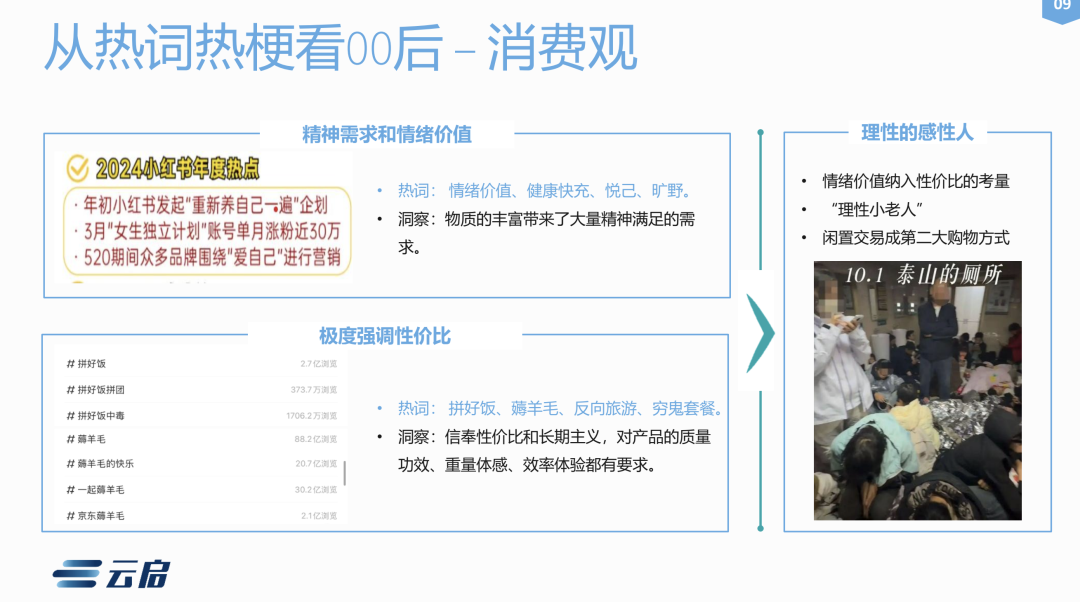
Emotional value becomes a hard need
They'll pay premium prices to ride to Mount Tai for sunrise, buying an experience — then spend the night in a packed bathroom there wrapped in a foil blanket. They'll pay for trendy toys, interests, and values alignment, yet comparison-shop every meal in daily life.
Gen Z's contradictory consumption patterns largely stem from how this group redefines "cost performance": emotional value has become a core component that must be factored into the cost-performance equation.
In an environment of high-frequency anxiety and scarce certainty, experiences that make one "feel certain" are themselves a hard need. What they're willing to pay for are "antidotes" that clearly relieve anxiety and confirm the self. What they aggressively save on are parts that bring no sense of certainty.
The Social "Paradox"
Both socially fearless and socially anxious
The same logic appears in how they socialize.
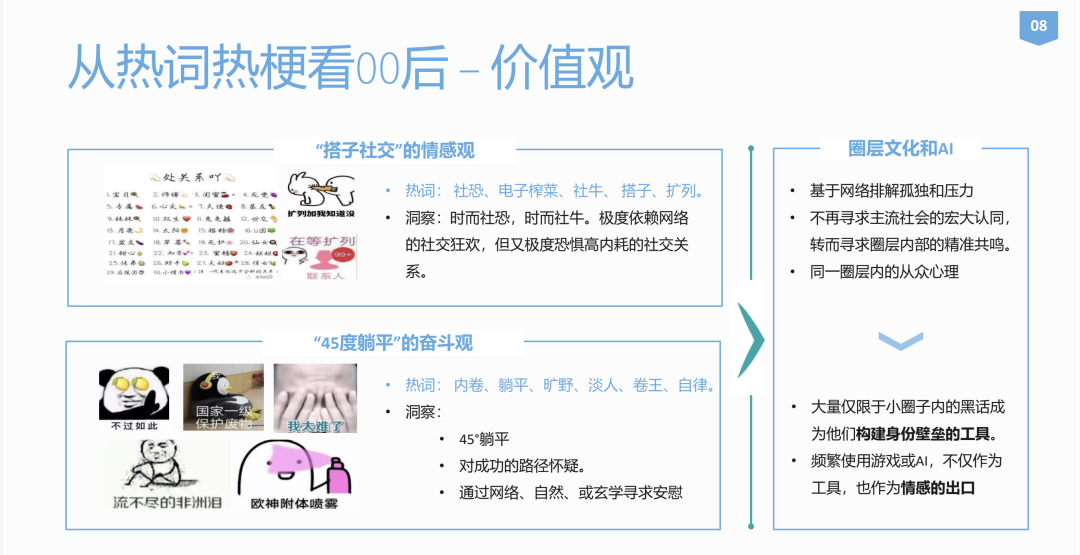
In networks and familiar circles, Gen Z can be highly extroverted: expanding contact lists, group chats, slang, abbreviations — quickly building connections, quickly confirming identity. But once entering unfamiliar real-world social settings with higher evaluation costs, they rapidly tighten boundaries.
This doesn't mean they don't need relationships; quite the opposite. In an environment where judgment is always visible and negative feedback carries extremely high costs, their aversion to "being rejected" far exceeds their aversion to loneliness. Small circles, slang, and highly atomized social methods are essentially risk control — ensuring emotional costs remain manageable and feedback stays predictable.
The "45-Degree Stance" on Hustle
The coexistence of grind and mysticism
Gen Z is often tagged with "lying flat," but looking at their actual trajectories, this judgment barely holds.
Front-loaded internships, stacked skills, early positioning become normalized. Some even forgo overseas exchange opportunities to enter competition at earlier points. Yet simultaneously, "giving up," "mysticism," and "koi fish luck" frequently appear in their discourse.
This isn't self-negation but a rewrite of the high-pressure hustle narrative. For a generation that grew up with high expectations yet faces economic decline in adulthood, effort no longer automatically leads to returns. Mysticism, jokes, and self-mockery become psychological regulators against uncertainty.
They haven't abandoned action; they've simply stopped betting all meaning on a narrative of inevitable success. To summarize, Gen Z's seemingly contradictory choices all answer the same question:
In a world where effort and reward no longer stably correspond, how do I keep uncertainty within what I can bear?
02
What Shaped This Generation?
Social Structure
More isolated, yet learning self-protection earlier
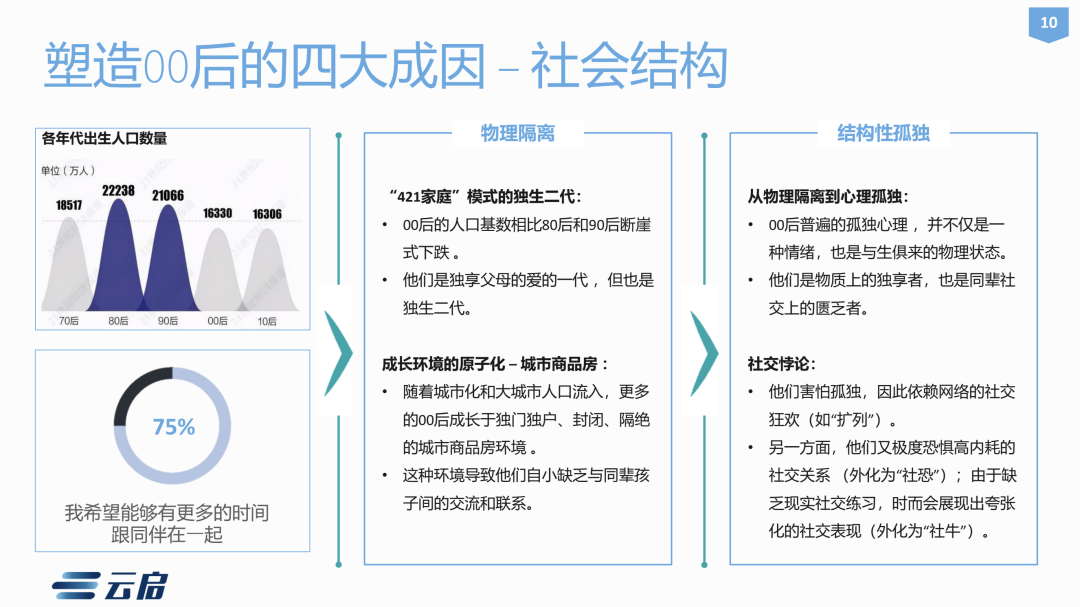
Gen Z is the first generation to grow up at scale in the "4-2-1" family structure. Only children became the norm; parents likewise lacked sibling support; highly urbanized living further weakened natural peer interaction.
Meanwhile, educational competition was significantly front-loaded. Multiple studies show Gen Z's time investment in extracurricular classes and tutoring notably exceeded 90s-generation levels at equivalent ages. High-intensity training and performance-oriented growth paths placed them in evaluation systems from early stages, yet without adequate space to practice low-cost, non-utilitarian social interaction.
This structural isolation didn't make them "need relationships less" — quite the opposite. Their desire for connection is intense, so they more frequently "expand contact lists" in online worlds, entering various circles, attempting to compensate for scarce real-world relationships.
But as shallow connections continuously amplify and negative feedback accumulates, socializing itself becomes high-consumption behavior. Thus a contradictory cycle gradually forms:
The more they crave connection, the more they fear getting hurt; the more they try expanding relationships, the more they tend to retreat to small circles for self-protection.
AI Native
Not escaping reality, but lowering social costs
Against this backdrop,叠加 rapid information technology development, AI began entering their daily systems.
Gen Z is the first generation to complete socialization in mobile internet and AI technology environments. Their acceptance of chatting, interacting, and even building emotional connections with AI is markedly higher than previous generations. Data shows over 70% of Gen Z are willing to establish "friend"-like relationships with AI, a proportion still rising.
But one easily misjudged question: Is AI replacing real socializing? The reality is opposite: in extensive real usage scenarios, AI functions more as a social "intermediary" and buffer.
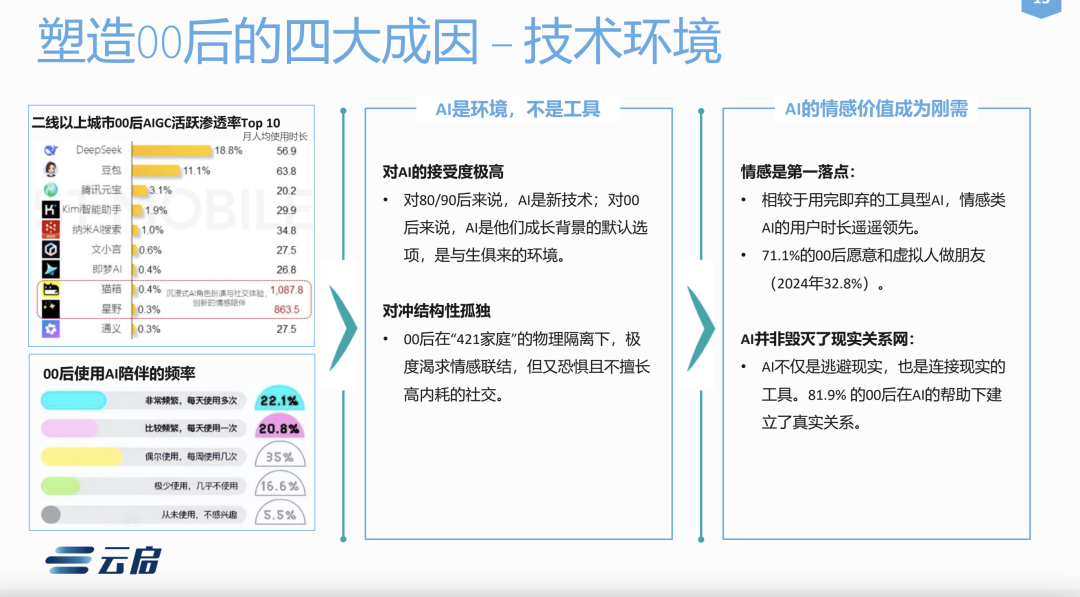
Many Gen Z users leverage AI to think through how to reply to a message, how to express emotions, how to face relationship dilemmas. Research shows over 80% of Gen Z have used AI to help establish or repair real human relationships.
This also explains why some seemingly "counterintuitive" products are emerging. Take recently funded emotional apps: their core users aren't the socially deprived, but so-called "Party Queens" — highly socially active people with many friends but predominantly shallow relationships, lacking anyone for deep confiding.
Such products actively limit usage time, encouraging users to return to real-world socializing, positioning themselves as "occasional communication tools" — precisely hitting Gen Z's real situation of both craving connection and fearing social burnout.
Here, AI isn't an escape from reality but a tool to lower the threshold of real-world socializing.
Economic Cycle
The collision of high expectations and low certainty
If social structure and technological environment shaped Gen Z's psychological baseline, then the economic cycle directly influenced how they judge risk and reward.
Most Gen Z were born during rapid economic growth; many individuals had relatively abundant family resources and material conditions. Their pocket money and spending power at equivalent ages generally exceeded the 90s generation, and they held higher expectations for the future. But when they reached adulthood and entered society, they encountered a down economic cycle with significantly rising uncertainty in employment returns. The gap between high expectations and reality became an unavoidable shared experience for this generation.
In such an environment, "effort—reward" no longer shows stable correspondence. Thus, cost-performance consciousness is greatly intensified: on one hand, they begin meticulously calculating costs, focusing on deal-hunting and efficiency maximization; on the other, they need trendy toys, experiential consumption, emotional products, and AI interaction to relieve persistent psychological pressure.
This isn't contradiction but two responses to uncertainty — compressing risk at the practical level, finding buffers at the emotional level.
03
Gen Z Founder Behavioral Patterns
No Longer a Life Choice to "Bet It All"
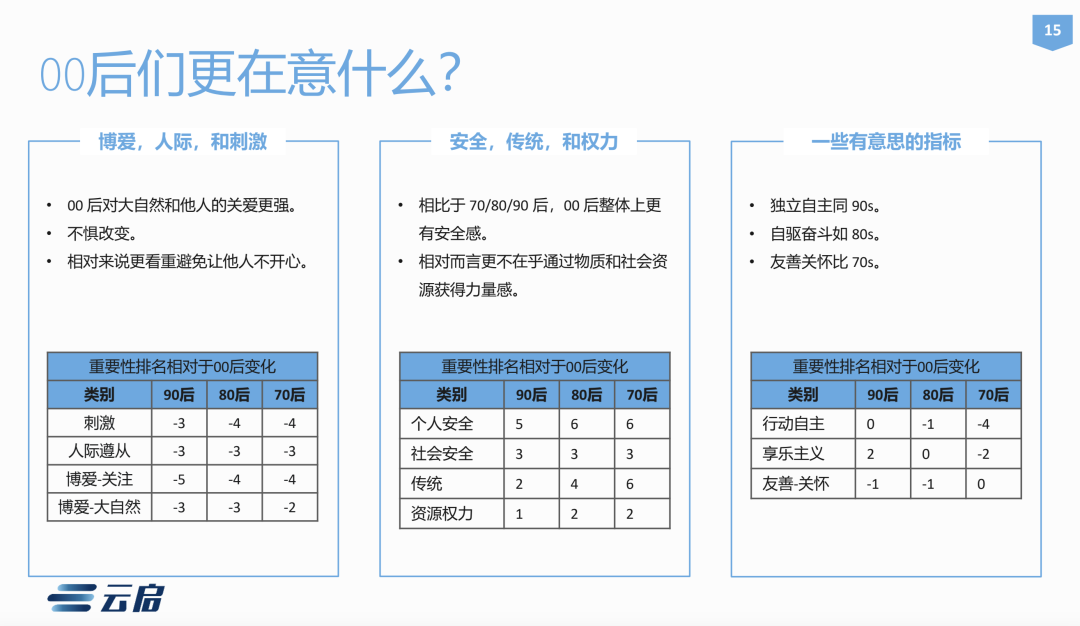
Based on different era backgrounds, Gen Z also shows certain generational shifts across two dimensions — "why start up" and "how to start up": Entrepreneurship is no longer viewed as a life leap requiring going all-in, but more like an actionable choice that can be repeatedly attempted and corrected at any time.
Against a backdrop where individual effort and real returns struggle to stably correspond, Gen Z's judgment logic on entrepreneurship is shifting from "betting on the future" to "managing uncertainty."
Shifting Entrepreneurial Motivation
From "bet it all" to "calculate clearly"
In previous entrepreneurial narratives, starting up typically meant: betting time and opportunity cost, enduring long-cycle uncertain returns, with "success or failure" as the only outcome.
But for Gen Z, this narrative itself no longer holds. They don't deny entrepreneurship's value, but more clearly recognize: pressing all life's meaning onto one highly uncertain outcome is itself high-risk behavior.
Thus entrepreneurial motivation begins shifting — from "I want to win big once" toward whether it can continuously satisfy personal interest, realize personal value. "Whether I can keep moving forward in this process." In their value model, entrepreneurship leans more toward satisfying self-interest and value.
Shifting Starting Points
From "grand narratives" to "small entry points"
Unlike the "big stories" common in previous entrepreneurial narratives, more Gen Z founders are choosing to start from very specific, even seemingly unremarkable problems. They care more about: whether this problem truly exists, whether it repeatedly troubled them, whether it can be validated with limited resources as quickly as possible.
In the very early-stage startup samples we've encountered, this tendency is particularly pronounced. Whether from campus, workplace, or personal life experience, many projects' starting points stay highly close to individual experience — not to "do a sector," but attempting to solve a specific problem they've long personally felt.
For example, some projects originate from founders' high-frequency pain points in study or research: when existing tools can't meet efficiency or experience needs in some niche scenario, they choose to use AI to rebuild one specific link, rather than building complete platform products from the start. Other projects originate from founders' personally experienced emotional or relationship troubles — they don't attempt to "solve emotional problems" as a grand proposition, but cut in from a clear, verifiable usage scenario, testing whether people would pay for lower-friction support methods.
This shift isn't due to shrinking ambition but a rational choice after technological environment change. With AI significantly lowering prototype building and trial-and-error costs, entrepreneurship no longer requires advance betting on a sufficiently big story. Rather, starting from small entry points enables faster direction confirmation, risk control, and provides clearer basis for judging whether to scale later. Under this path, "small" no longer means limitation, or more means a higher-frequency, replicable starting method.
Conclusion
From seemingly contradictory behavioral traits, to underlying social structures, technological environments, and economic cycles, to specific entrepreneurial motivations and behavioral paths — what we see isn't a generation that's more aggressive or more conservative, but one that recognized uncertainty's existence earlier and more actively attempts to manage it.
For Yunqi Capital, paying attention to Gen Z founders isn't a "generational bet" but a long-term judgment on the changing form of entrepreneurship itself. As a fund now in its eleventh year, we similarly need to continuously update our understanding of "who is the founder," "where does entrepreneurship start," and "how should risk be managed."
This report is our first systematic梳理 around this group, not a conclusive judgment. We will also continue recording how this generation of founders shapes their own entrepreneurial methods in the AI era. More research observations — to be continued.